英语中句子的种类
- 格式:docx
- 大小:19.92 KB
- 文档页数:5
三句子的种类
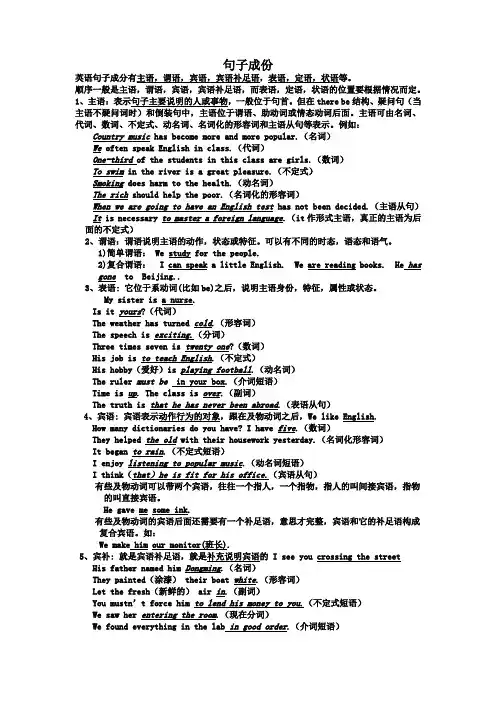
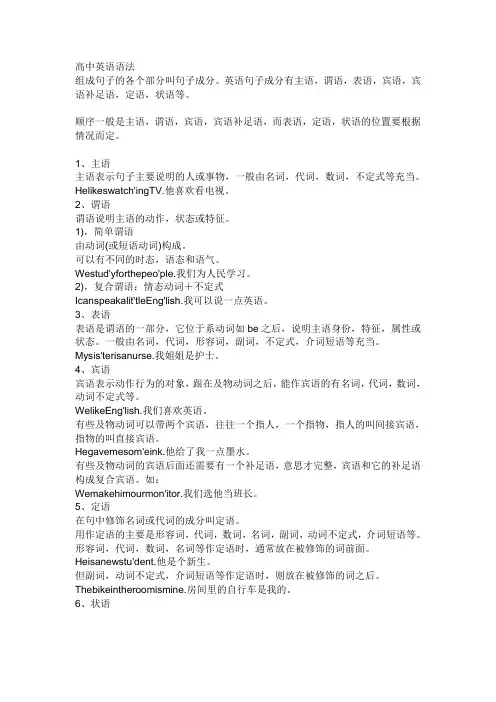
句子是一个独立的语言单位,表示一个完整的思想.
按使用目的可分为陈述句、感叹句、疑问句和祈使句;
从结构上又可分为简单句、并列句和复合句.
按使用目的分:
一、 陈述句
That boy always helps others.
Tom was not at home yesterday.
He is too late to catch the bus.
二、 疑问句一般疑问句、特殊疑问句、选择疑问句和反意疑问句
Are you a doctor
How often do you have an English party
Which would you like better, tea or coffee
She is too young to go to school, is she
三、 感叹句
(一)What +a /an+形容词+可数名词的单数形式+主语+谓语 ==二How+形容词+a/an +可数名词的单数形式+主语+谓语
What a beautiful girl she is == How beautiful a girl she is
三 What+形容词+可数名词的复数+主语+谓语
What beautiful girls they are
(四) What+形容词+不可数名词+主语+谓语
What fine weather it is (五) How+形容词或副词+主语+谓语
How interesting the dog is
(六) How+主语+谓语
How time flies
四、 祈使句祈使句主语通常被省略,谓语动词用原型.
Be quiet
Don’t be late
从结构上分:
一、 简单句句子只包含一个主谓结构.如,五种基本句型列式如下:
基本句型一:主+系+表
基本句型二:主+谓
基本句型三:主+谓+宾
基本句型四: 主+谓+间宾+直宾
基本句型五 主+谓+宾+宾补.
二、 并列句句子包含两个或多个主谓结构,通常有并列连词连结.
由并列连词把两个或两个以上的简单句连在一起的句子叫并列句.不同的并列连词表示并列分句之间的不同关系.根据并列分句之间的关系不同,并列句可以分为以下几种: 1.表示联合关系的并列句 这类并列句常用并列连词and 和,not only ... but also... 不但……而且……等来连接,这时分句之间是顺承关系或并列关系.and一般不译出来.
1. We bought her a birthday present,_____ she liked it very much. A. so B. or C. and D. but
2. — Didn’t you give roses to your father on Father’s Day
— Oh, not only my father,_____ my grandpa got red roses.
A. or B. and C. but D. until
2.表示转折关系的并列句 这类并列句常用but 但是;可是,yet可是;然而,while 而等来连接,后面分句与前面分句之间有意义上的转折关系.
1. — Would you like to go to the concert with me
— I’d love to,_____ I can’t. I have a lot of homework to do.
A. or B. but C. so D. and
2. The doctors tried their best to save the patient’s life,_____
failed
A. or B. so C. but D. because
3.表示选择关系的并列句 这类并列句常用并列连词or或者,either …
or … 要么……,要么……等连接.
1. _____ Lily _____ Lucy may go with you because one of them must
stay at home.
A. Not only; but also B. Neither; nor C. Both; and D.
Either; or
2. None of the shoes in the shops are the right size. They are _____
too big _____ too small.
A. both; and B. neither; nor C. either; or D. not
only; but also 3. “Are you going to eat here ____ take it away” asked the waiter..
A. and B. so C. or D. but.
4.表示因果关系的并列句 这类并列句常用并列连词so因此;所以,for因为等连接,后面分句与前面分句之间有因果关系.
1. Mother was ill,_____ Father cooked for us instead.
A. but B. or C. so D. and
2. There is a lot of traffic in this city,_____ look both ways
before crossing the street
A. so B. and C. but D. for
特殊的并列句
1. 祈使句+and+一般将来时的句子 这个句型表示“如果做到了祈使句表示的事情,就会有后面句子表示的结果”.
2. 例如: Study hard,_____ you are sure to have a good result
in the exam.
A. or B. and C. for D. but
3. 2. 祈使句 + or + 一般将来时的句子 这个句型表示“如果做不到祈使句表示的事情,就会有后面句子表示的结果”
4. 例如: 1. Be quick,_____ we’ll be late for class.
A. or B. so C. and D. but
2. Come a little earlier next time,_____ you’ll miss the
best part of the TV play.
A. and B. but C. or D. till 三、复合句
复合句Complex Sentence由一个主句Principal Clause和一个或一个以上的从句Subordinate Clause构成. 主句是全句的主体,通常可以独立存在;从句则是一个句子成分,不能独立存在.从句不能单独成句,但它也有主语部分和谓语部分,就像一个句子一样.所不同在于,从句须由一个关联词 引导. 我们至今学过的从句有:定语从句, 名词性从句主语从句、宾语从句、表语从句、同位语从句,和状语从句.
1. 定语从句 He is the man who wants to see you.
2. 同位语从句 She told us her hope that she would become a
pianist.
注意:定语和同位语从句的区别.
3. 表语从句 This is what we should do
4. 宾语从句注意it做形式宾语
Everybody knows that money doesn't grow on trees
We think it wrong that he told a lie to everyone. it做形式宾语
5.主语从句注意it做形式主语
What caused the accident remains unknown
It is certain that he will win the matchit做形式主语
6.状语从句
MyfriendsdislikemebecauseI’mhandsomeandsuccessful.