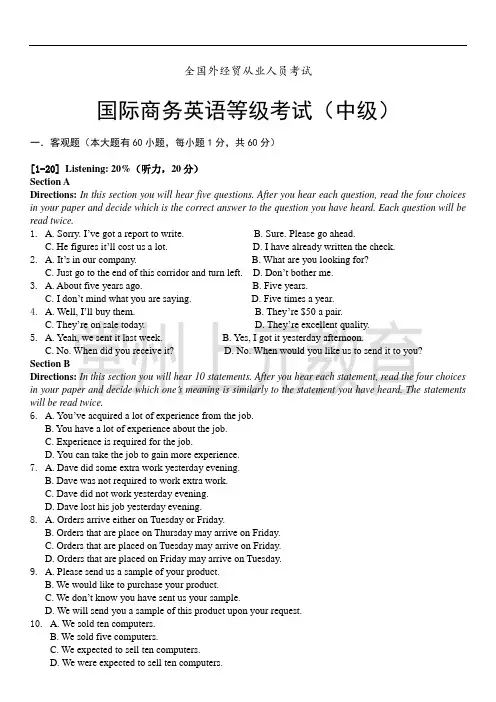
全国外经贸从业人员考试国际商务英语等级考试(中级)一.客观题(本大题有60小题,每小题1分,共60分)[1-20] Listening: 20%(听力,20分)Section ADirections: In this section you will hear five questions. After you hear each question, read the four choices in your paper and decide which is the correct answer to the question you have heard. Each question will be read twice.1. A. Sorry. I‟ve got a report to write. B. Sure. Please go ahead.C. He figures it‟ll cost us a lot.D. I have already written the check.2. A. It‟s in our company. B. What are you looking for?C. Just go to the end of this corridor and turn left.D. Don‟t bother me.3. A. About five years ago. B. Five years.C. I don‟t mind what you are saying.D. Five times a year.4. A. Well, I‟ll buy them. B. They‟re $50 a pair.C. They‟re on sale today.D. They‟re excellent quality.5. A. Yeah, we sent it last week. B. Yes, I got it yesterday afternoon.C. No. When did you receive it?D. No. When would you like us to send it to you?Section BDirections: In this section you will hear 10 statements. After you hear each statement, read the four choices in your paper and decide which one’s meaning is similarly to the statement you have heard. The statements will be read twice.6. A. You‟ve acquired a lot of experience from the job.B. You have a lot of experience about the job.C. Experience is required for the job.D. You can take the job to gain more experience.7. A. Dave did some extra work yesterday evening.B. Dave was not required to work extra work.C. Dave did not work yesterday evening.D. Dave lost his job yesterday evening.8. A. Orders arrive either on Tuesday or Friday.B. Orders that are place on Thursday may arrive on Friday.C. Orders that are placed on Tuesday may arrive on Friday.D. Orders that are placed on Friday may arrive on Tuesday.9. A. Please send us a sample of your product.B. We would like to purchase your product.C. We don‟t know you have sent us your sample.D. We will send you a sample of this product upon your request.10. A. We sold ten computers.B. We sold five computers.11. A. Even if you have experience, you won‟t get a promotion.B. You‟ll need three years of experience to get a promotion.C. You didn‟t work hard, so didn‟t get a promotion.D. You didn‟t work hard enough to get a promotion.12. A. There used to be more competing brands on the market.B. The brands on the market are not quite competitive.C. There are a lot of competing brands on the market now.D. There aren‟t many competing brands on the market now.13. A. The goods arrived in spite of the bad weather.B. The goods arrived because of the good weather.C. The goods did not arrive because of the bad weather.D. The goods arrived in good condition.14. A. We hope you can come here for an interview.B. We hope you can come here right now.C. We‟d like t invite you here.D. We can offer you a position if you can come here.15. A. We don‟t like your product.B. We don‟t want your product.C. We need to talk.D. That‟s what we want.Section CDirections:In this section you will hear 5 short conversations between two speakers. At the end of each conversation, there will be a question about what was said. After you hear a conversation and question about it, read the four choices in your paper and decide which is the correct answer to the question you have heard. Both the conversations and the questions will be read twice.16. A. Teacher and student.B. Employer and employee.C. Guest and receptionist.D. Seller and buyer.17. A. At a bus stop.B. At a rail way station.C. At home.D. At an airport.18. A. A restaurant.B. Their office.C. Their home.D. A school.19. A. Sight L/C.B. Usance L/C.C. Fifteen days L/C.D. Fifty days L/C.20. A. To go sightseeing.B. To negotiate.C. To have dinner.D. To sign a contract.[21-60] Reading Comprehension: 40%(阅读理解,40分)Section ADirections: There are ten incomplete sentences in this section. For each sentence there are four choices marked A, B, C, and D. Choose the ONE that best completes the sentence. This section totals 10 points, one point for each sentence.21. We are pleased to write to _______you in the hope of doing business with you in this line.A. contactB. get in touchC. contact withD. get contact with you22. Every laptop we sell comes with a two-year _______.A. agreementB. securityC. promiseD. guarantee23. _______both parties have agreed on all the terms and conditions can we start to prepare the contract.A. Even ifB. Only whenC. Even thoughD. Only while24. All our T-shirts you saw at the fashion show _______in four sizes.A. becomeB. putC. getD. come25. With the price of oil _______, the economy of oil-producing countries is expanding at a high rate.A. going upB. goes upC. gone upD. to go up26. Under D/P terms, the buyer may refuse to pay, in _______case the seller maintains the title to theshipment.A. thisB. thatC. theD. which27. We are sorry to let you know that neither of the relative _______has reached us yet.A. letter of creditB. letter of creditsC. letters of creditD. letters of credits28. The paper _______our cartons is strong and damp-proof.A. liningB. linesC. linedD. to line29. We will make arrangements to _______an all-risk insurance on the following consignments.A. make outB. get outC. put outD. take out30. A corporation cannot come into existence on a handshake _______a partnership can.A. the sameB. the wayC. in whichD. by way ofSection BDirections: There are ten blanks in the following letter. You are required to choose the best one from the given four choices marked A, B, C, and D. This section totals 10 points, one point for each blank.Dear SirWe have learned your name and address 31 the Commercial Counselor‟s Office of our 32 in your country, and would like to take this opportunity 33 to you in the hope of establishing business relations with you.We are a large 34 of retailers and are looking for a manufacturer who could supply us with a wide 35 of raincoats for all age groups.As we usually place substantial orders, we would like to 36 a quantity discount in addition to a 20% trade discount 37 net list prices. We usually deal 38 new suppliers on the basis of payment in our 39 by 60-day irrevocable letter of credit.If these conditions interest you, and you can 40 orders of over 20,000 raincoats at one time, please send us your latest catalogue and price-list.We are looking forward to hearing from you soon.Sincerely yoursJohnson MorganPurchase Manager31. A. on B. for C. at D. from32. A. Office B. Headquarters C. Embassy D. Company33. A. writing B. to write C. written D. writes34. A. train B. chain C. link D. bond35. A. scope B. series C. range D. change36. A. allow B. allowing C. allowed D. be allowed37. A. on B. off C. at D. from38. A. with B. on C. in D. at39. A. coin B. money C. dollar D. currency40. A. have B. run C. meet D. operateSection CDirections: There are two passages in this section. Each passage is followed by some questions or unfinished statements. For each of them there are four choices marked A, B, C, and D. You should decide on the best choice. This section totals 20 points, two points for each question.Questions 41 to 50 are based on the following passage.①China‟s entrance into the World Trade Organization (WTO) will benefit not only itself but the wholeworld, said an article in People‟s Daily (December 28).②For the last nine years negotiations have gone on concerning restoring China‟s status in the GeneralAgreement on Tariffs and Trade, which is replaced by WTO. The negotiations have drawn attention from all over the world. Only when consensus is reached on key issues, can the final decision, involving more than 100 member states, be made. It is expected that China‟s bid will eventually pass, though final details and a timetable have not been decided yet, said the People‟s Daily.③Over the past years, China has taken important steps to conform to international trade regulations basedon the Uruguay-round talks. It is clear that China has made its markets more open, both in commercial and tertiary industries. Since 1992, a series of measures has been taken in lowering tariff rates and reducing non-tariff barriers. These reforms demonstrate China‟s readiness to join the WTO. Serious disputes, however, still remain between China and some key member states over the obligations China should undertake. China should be responsible for reform compatible with its current development level, the article stressed. In future negotiations, we should insist on this point and give the member states a clearer understanding of the practical situation in China.④China has a population of 1.2 billion, which increases by 10 million each year. The government must bevery cautious in reforms to prevent dramatic economic downfalls, which may have disastrous results not only in China but around the world. China‟s per capita income remains less than $500. There are still 70 million people who do not have enough for basic food and clothing. The negotiations should bear in mind the country‟s development level when they decide the obligations China should assume. Otherwise, negotiation results will be meaningless, or worse; they could stifle the Chinese market. It is like the old Chinese saying: “Killing the hen to get the eggs.”⑤China is in transition from a planned economy to a market one. With such a big population and largeeconomic development scale, a transitional period is necessary for any new reform measure. This is also the case when adopting some international practice.41. What does the word consensus in the second paragraph probably mean in the context?A. Result.B. Contract.C. Arrangement.D. Agreement.42. According to the passage, which of the following will not help demonstrate China‟s readiness to join theWTO?A. China has a population of 1.2 billion, which increases by 10 million each year.B. China has made its markets more open, both in commercial and tertiary industries.C. China has taken important steps to conform to international trade regulations.D. China has taken measures in lowering tariff rates and reducing non-tariff barriers.43. According to the passage, disputes about China‟s entry into the WTO still remain and they mainly focuson _______.A. the rights China should enjoyB. the obligations China should bearC. the benefits China can bring to the whole worldD. the sanctions China may impose on the WTO44. The proverb “Killing the hen to get the eggs” in Paragraph 4 means _______.A. more haste, less speedB. strike while the iron is hotC. look before you leapD. never run for two hares at the same time45. Which is not true according to the passage?A. Though there are some obstacles, China will eventually join the WTO.B. China is ready for the entry into the WTO.C. In order to speed its entry, China will have to undertake reforms compatible with its currentdevelopment level.D. China will have to assume the obligations that other member states are undertaking withoutconsideration of its current development level.46. China must carry out its reforms in a cautious way in order to _______.A. prevent the dramatic rise of pricesB. prevent the dramatic financial crisisC. prevent dramatic economic downfallsD. prevent too much foreign investment into China47. Which is true according to the passage?A. Dramatic economic downfalls in China only affect China‟s entry into the WTO.B. Dramatic economic downfalls in China will cause disasters to China only.C. Dramatic economic downfalls in China affect not only China but also the world.D. Dramatic economic downfalls in China may not affect the world.48. When adopting some international practice, China must consider _______.A. the necessity of a transitional periodB. the big populationC. the large economic development scaleD. the political system49. What is the former economy mode in China before its reform?A. market economy.B. free economy.C. commercial economy.D. planned economy.50. The writer‟s attitude toward China‟s entry into the WTO is _______.A. positiveB. negativeC. not clearD. ambiguousQuestions 51 to 60 are based on the following passage.①Companies that have warned their workforces to confront the realities of job insecurity and limitedcareers are finding they have created a new type of mercenary manager prepared to move to the highest bidder, according to a new report. The survey by Ashridge Management Centre says the wave of insecurity that affected managers during the corporate downsizings of the early 1990s was an unpleasant experience for many, but it has taught them to be more self-centred and independent about their careers.②The backlash for companies, according to Laurence Handy, Ashridge‟s director of research, is that manymanagers are now more likely to look elsewhere to further their careers if their current employer is not meeting their expectations. They are saying they want something that‟s interesting, and they want paying for it. You now have a very hard-nosed group of people who have got the message,‟ he said.③Nearly three-quarters of the 553 managers who responded to the survey said they felt in control of theirjobs. …This is a marked change from previous years‟research when the message coming from managers was that they did not feel in control of anything,‟ said Mr Handy. …Life has moved on and now managers are flexing their muscles,‟ he added. The pressure is moving over to the other side with the laws of supply and demand and now companies are screaming that they are spending a fortune on headhunters.‟④Managers are keeping their options open, says the report. More turn to their partners for career advicethan to the personnel specialist or to their immediate boss. Trust in senior management also appears to have declined in some companies. Many of the managers interviewed in the survey complained that fear and threats were the prime motivators in their companies.51. Which expression in Paragraph 1 matches the meaning “the person or organization willing to pay themost for something?A. Limited careers.B. Mercenary manager.C. Highest bidder.D. Corporate downsizing.52. Which verb in Paragraph 2 is used to talk about developing your career?A. Further.B. Meet.C. Want.D. Get.53. In Paragraph 3, “a marked change” in something is _______ .A. a small changeB. a big changeC. a minimum changeD. a medium-size change54. Look at the statement in Paragraph 3 “The pressure is moving over to the other side with the laws ofsupply and demand”. What is the “other side”?A. Managers.B. Companies.C. Employees.D. Interviewees.55. In Paragraph 4, if you keep your options open, you decide to commit yourself to _______.A. something well in advanceB. something just before it happensC. nothing now and foreverD. nothing for the moment56. What can managers learn from the wave of insecurity mentioned by the survey?A. To work harder for their employers.B. To be more loyal to their employers.C. To be more self-centered and independent about their careers.D. To be more disappointed about their careers.57. According to the passage, what is the backlash for companies?A. They are more likely to loose their managers.B. They are more likely to retain their managers.C. They are more likely to motivate their managers.D. They are more likely to cultivate their managers.58. In Paragraph 3, by saying that “managers are flexing their muscles”, the writer means _______.A. managers do not show their real powerB. managers do body-building exercisesC. managers show how much power they really haveD. managers show off their muscles59. Trust in senior management also seems to have declined in some companies because _______.A. managers feel bored in their companiesB. managers feel hopeful in their companiesC. managers feel motivated in their companiesD. managers feel fear and threats in their companies60. The most suitable topic for this passage may be _______.A. The BacklashB. Corporate DownsizingC. Wave of InsecurityD. The Mercenary Manager★答题卡空间有限,以下部分请注意控制答题篇幅。