
M5 Unit 1初三上第五模块第一单元
- 格式:ppt
- 大小:1.62 MB
- 文档页数:28


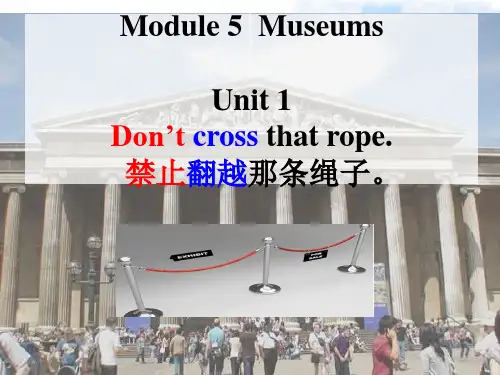

外研版九年级上册Module 5 unit1 Don't cross that rope!教案Objective:➢To enhance students' understanding of imperative sentences and cautionary language.➢To develop students’ability to discuss and interpret rules and safety measures in various contexts.➢To improve listening, speaking, and critical thinking skills through contextual activities.Materials Needed:✓Textbook: Foreign Research Series, Grade 9, Module 5, Unit 1.✓Interactive whiteboard or projector.✓Handouts with exercises and scenarios for group activities.✓Audio/visual equipment for listening exercises.Lesson Duration: 45 MinutesLesson Plan:Introduction(1)Start with a question: “What are some places where you might see asign that says, 'Don't cross that rope!'? What might happen if you do?”(2)Briefly introduce the topic of safety and rules, highlighting theimportance of imperative sentences.WarmUp Activity1)Show pictures of various warning signs and ask students to guesstheir meanings.2)Discuss the importance of following such signs and theconsequences of ignoring them.Reading and prehension(1)Have students read the main text in the textbook individually.(2)Conduct a class discussion to check understanding and to discuss thecontexts in which rules and warnings are necessary.Grammar Focus1)Present a lesson on imperative sentences, focusing on form andusage, especially in cautionary or advisory contexts.2)Provide examples from the text and have students create their ownsentences based on different scenarios.Listening Exercise(1)Play a short audio clip (from the textbook or another source) thatincludes examples of imperative sentences and cautionary language.(2)Conduct a listening prehension exercise, asking specific questionsabout the situations and advice given.RolePlay and Discussion1)Divide students into groups and give them different scenarios wherethey have to use cautionary language (e.g., acting as a lifeguard, a museum curator, or a tour guide).2)After roleplays, have a discussion about the importance of clearmunication in ensuring safety.Group Work: Creating Safety Posters(1)In groups, students create their own safety poster for the school,using imperative sentences and cautionary language learned in the lesson.(2)Allow groups to present their posters and explain the rules they'vechosen to include.Homework AssignmentAssign students to write a paragraph on a situation where they encountered a warning sign or had to give someone else a warning, explaining what happened and the language used.Closure1)Summarize the day's lessons, emphasizing the importance ofunderstanding and adhering to warnings for safety.2)Preview the next unit or topic.Assessment:(1)Participation in class and group discussions.(2)Creativity and accuracy in roleplay scenarios and poster creation.(3)Homework paragraph demonstrating understanding of imperativesentences and cautionary language.。