
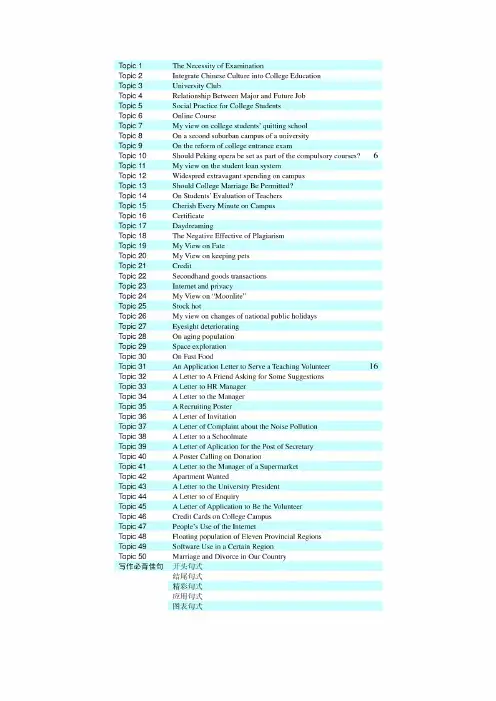
六级范文50篇
- 格式:pdf
- 大小:3.46 MB
- 文档页数:32
英语六级写作必背范文20篇范文赏析(一)1.My View on Fake Commodities (1998.1)1. 假冒伪劣商品的危害。
2. 怎样杜绝假冒伪劣商品。
My View on Fake CommoditiesNowadays fake commodities have flooded almost every inch of the market. Wherever you are, whatever you do, it seems that you can hardly have fallen prey to them. In other words, it is highly probable that you have bought some of those fake goods or products of inferior quality.Needless to say, fake commodities have already done great harm to our society. On the one hand, they will ruin the good reputation of genuine products and disturb the balance of the market. On the other hand, the prevalence of such products has hindered interpersonal relationship and resulted in the decline of public morality. As a consequence, they have w asted exhaustible resources, endangered people’s precious life and health, and in the long run eroded public trust.Then, what should be done to do away with fake commodities? To start with, the government needs to tighten its inspection program andstrengthen its enforcement policies. Secondly, honest businessmen should modify some long-accepted practices at the protection of their intellectual property right. Most important of all, we consumers will have to do a better job of learning how to distinguish between the genuine and the phoney and definitely say no to the fake ones. In one word, the coordinated effort of the whole society will put an end to fake commodities.2.Changes in the Ownership of Houses (2003.6)要求:1、根据上图描述该市住房产权的变化;2、分析产生这些变化的原因;3、说明这些变化对个人和社会产生的影响。
01 The Language of MusicA painter hangs his or her finished pictures on a wall, and everyone can see it. A composer writes a work, but no one can hear it until it is performed. Professional singers and players have great responsibilities, for the composer is utterly dependent on them. A student of music needs as long and as arduous a training to become a performer as a medical student needs to become a doctor. Most training is concerned with technique, for musicians have to have the muscular proficiency of an athlete or a ballet dancer. Singers practice breathing every day, as their vocal chords would be inadequate without controlled muscular support. String players practice moving the fingers of the left hand up and down, while drawing the bow to and fro with the right arm-two entirely different movements.Singers and instruments have to be able to get every note perfectly in tune. Pianists are spared this particular anxiety, for the notes are already there, waiting for them, and it is the piano tuner’s responsibility to tune t he instrument for them. But they have their own difficulties; the hammers that hit the string have to be coaxed not to sound like percussion, and each overlapping tone has to sound clear.This problem of getting clear texture is one that confronts student conductors: they have to learn to know every note of the music and how it should sound, and they have to aim at controlling these sound with fanatical but selfless authority.Technique is of no use unless it is combined with musical knowledge and understanding. Great artists are those who are so thoroughly at home in the language of music that they can enjoy performing works written in any century.02 Schooling and EducationIt is commonly believed in United States that school is where people go to get an education. Nevertheless, it has been said that today children interrupt their education to go to school. The distinction between schooling and education implied by this remark is important.Education is much more open-ended and all-inclusive than schooling. Education knows no bounds. It can take place anywhere, whether in the shower or in the job, whether in a kitchen or on a tractor. It includes both the formal learning that takes place in schools and the whole universe of informal learning. The agents of education can range from a revered grandparent to the people debating politics on the radio, from a child to a distinguished scientist. Whereas schooling has a certain predictability, education quite often produces surprises. A chance conversation with a stranger may lead a person to discover how little is known of other religions. People are engaged in education from infancy on. Education, then, is a very broad, inclusive term. It is a lifelong process, a process that starts long before the start of school, and one that should be an integral part of one’s entire life.Schooling, on the other hand, is a specific, formalized process, whose general pattern varies little from one setting to the next. Throughout a country, children arrive at school at approximately the same time, take assigned seats, are taught by an adult, use similar textbooks, do homework, take exams, and so on. The slices of reality that are to be learned, whether they are the alphabet or an understanding of the working of government, have usually been limited by the boundaries of the subject being taught. For example, high school students know that they’re not likely to find out in their classes the truth about political problems in their communities or what the newest filmmakers are experimenting with. There are definite conditions surrounding the formalized process of schooling.03 The Definition of “Price”Prices determine how resources are to be used. They are also the means by which products and services that are in limited supply are rationed among buyers. The price system of the United States is a complex network composed of the prices of all the products bought and sold in the economy as well as those of a myriad of services, including labor, professional, transportation, and public-utility services. The interrelationships of all these prices make up the “system” of prices. The price of any particular product or service is linked to a broad, complicated system of prices in which everything seems to depend more or less upon everything else.If one were to ask a group of randomly selected individuals to define “price”, many would reply that price is an amount of money paid by the buyer to the seller of a product or service or, in other words that price is the money values of a product or service as agreed upon in a market transaction. This definition is, of course, valid as far as it goes. For a complete understanding of a price in any particular transaction, much more than the amount of money involved must be known. Both the buyer and the seller should be familiar with not only the money amount, but with the amount and quality of the product or service to be exchanged, the time and place at which the exchange will take place and payment will be made, the form of money to be used, the credit terms and discounts that apply to the transaction, guarantees on the product or service, delivery terms, return privileges, and other factors. In other words, both buyer and seller should be fully aware of all the factors that co mprise the total “package” being exchanged for the asked-for amount of money in order that they may evaluate a given price.04 ElectricityThe modern age is an age of electricity. People are so used to electric lights, radio, televisions, and telephones that it is hard to imagine what life would be like without them. When there is a power failure, people grope about in flickering candlelight, cars hesitate in the streets because there are no traffic lights to guide them, and food spoils in silent refrigerators.Yet, people began to understand how electricity works only a little more than two centuries ago. Nature has apparently been experimenting in this field for million of years. Scientists are discovering more and more that the living world may hold many interesting secrets of electricity that could benefit humanity.All living cell send out tiny pulses of electricity. As the heart beats, it sends out pulses of record; they form an electrocardiogram, which a doctor can study to determine how well the heart is working. The brain, too, sends out brain waves of electricity, which can be recorded in an electroencephalogram. The electric currents generated by most living cells are extremely small - often so small that sensitive instruments are needed to record them. But in some animals, certain muscle cells have become so specialized as electrical generators that they do not work as muscle cells at all. When large numbers of these cell are linked together, the effects can be astonishing.The electric eel is an amazing storage battery. It can seed a jolt of as much as eight hundred volts of electricity through the water in which it live. ( An electric house current is only one hundred twenty volts.) As many as four-fifths of all the cells in the electric eel’s body are specialized for generating electricity, and the strength of the shock it can deliver corresponds roughly to length of its body.05 The Beginning of DramaThere are many theories about the beginning of drama in ancient Greece. The on most widely accepted today is based on the assumption that drama evolved from ritual. The argument for this view goes as follows. In the beginning, human beings viewed the natural forces of the world-even the seasonal changes-as unpredictable, and they sought through various means to control these unknown and feared powers. Those measures which appeared to bring the desired results were then retained and repeated until they hardened into fixed rituals. Eventually stories arose which explained or veiled the mysteries of the rites. As time passed some rituals were abandoned, but the stories, later called myths, persisted and provided material for art and drama.Those who believe that drama evolved out of ritual also argue that those rites contained the seed of theater because music, dance, masks, and costumes were almost always used, Furthermore, a suitable site had to be provided for performances and when the entire community did not participate, a clear division was usually made between the "acting area" and the "auditorium." In addition, there were performers, and, since considerable importance was attached to avoiding mistakes in the enactment of rites, religious leaders usually assumed that task. Wearing masks and costumes, they often impersonated other people, animals, or supernatural beings, and mimed the desired effect-success in hunt or battle, the coming rain, the revival of the Sun-as an actor might. Eventually such dramatic representations were separated from religious activities.Another theory traces the theater's origin from the human interest in storytelling. According to this vies tales (about the hunt, war, or other feats) are gradually elaborated, at first through the use of impersonation, action, and dialogue by a narrator and then through the assumption of each of the roles by a different person. A closely related theory traces theater to those dances that are primarily rhythmical and gymnastic or that are imitations of animal movements and sounds.06 TelevisionTelevision-----the most pervasive and persuasive of modern technologies, marked by rapid change and growth-is moving into a new era, an era of extraordinary sophistication and versatility, which promises to reshape our lives and our world. It is an electronic revolution of sorts, made possible by the marriage of television and computer technologies.The word "television", derived from its Greek (tele: distant) and Latin (visio: sight) roots, can literally be interpreted as sight from a distance. Very simply put, it works in this way: through a sophisticated system of electronics, television provides the capability of converting an image (focused on a special photoconductive plate within a camera) into electronic impulses, which can be sent through a wire or cable. These impulses, when fed into a receiver (television set), can then be electronically reconstituted into that same image.Television is more than just an electronic system, however. It is a means of expression, as well as a vehicle for communication, and as such becomes a powerful tool for reaching other human beings.The field of television can be divided into two categories determined by its means of transmission. First, there is broadcast television, which reaches the masses through broad-based airwave transmission of television signals. Second, there is nonbroadcast television, which provides for the needs of individuals or specific interest groups through controlled transmission techniques.Traditionally, television has been a medium of the masses. We are most familiar with broadcast television because it has been with us for about thirty-seven years in a form similar to what exists today. During those years, it has been controlled, for the most part, by the broadcast networks, ABC, NBC, and CBS, who have been the major purveyors of news, information, and entertainment. These giants of broadcasting have actually shaped not only television but our perception of it as well. We have come to look upon the picture tube as a source of entertainment, placing our role in this dynamic medium as the passive viewer.07 Andrew CarnegieAndrew Carnegie, known as the King of Steel, built the steel industry in the United States,and , in the process, became one of the wealthiest men in America. His success resulted in part from his ability to sell the product and in part from his policy of expanding during periods of economic decline, when most of his competitors were reducing their investments.Carnegie believed that individuals should progress through hard work, but he also felt strongly that the wealthy should use their fortunes for the benefit of society. He opposed charity, preferring instead to provide educational opportunities that would allow others to help themselves. "He who dies rich, dies disgraced," he often said.Among his more noteworthy contributions to society are those that bear his name, including the Carnegie Institute of Pittsburgh, which has a library, a museum of fine arts, and a museum of national history. He also founded a school of technology that is now part of Carnegie-Mellon University. Other philanthrophic gifts are the Carnegie Endowment for International Peace to promote understanding between nations, the Carnegie Institute of Washington to fund scientific research, and Carnegie Hall to provide a center for the arts.Few Americans have been left untouched by Andrew Carnegie's generosity. His contributions of more than five million dollars established 2,500 libraries in small communities throughout the country and formed the nucleus of the public library system that we all enjoy today.08 American RevolutionThe American Revolution was not a sudden and violent overturning of the political and social framework, such as later occurred in France and Russia, when both were already independent nations. Significant changes were ushered in, but they were not breathtaking. What happened was accelerated evolution rather than outright revolution. During the conflict itself people went on working and praying, marrying and playing. Most of them were not seriously disturbed by the actual fighting, and many of the more isolated communities scarcely knew that a war was on.America's War of Independence heralded the birth of three modern nations. One was Canada, which received its first large influx of English-speaking population from the thousands of loyalists who fled there from the United States. Another was Australia, which became a penal colony now that America was no longer available for prisoners and debtors. The third newcomer-the United States-based itself squarely on republican principles.Yet even the political overturn was not so revolutionary as one might suppose. In some states, notably Connecticut and Rhode Island, the war largely ratified a colonial self-rule already existing. British officials, everywhere ousted, were replaced by a home-grown governing class, which promptly sought a local substitute for king and Parliament.09 SuburbanizationIf by "suburb" is meant an urban margin that grows more rapidly than its already developed interior, the process of suburbanization began during the emergence of the industrial city in the second quarter of the nineteenth century. Before that period the city was a small highly compact cluster in which people moved about on foot and goods were conveyed by horse and cart. But the early factories built in the 1840's were located along waterways and near railheads at the edges of cities, and housing was needed for the thousands of people drawn by the prospect of employment. In time, the factories were surrounded by proliferating mill towns of apartments and row houses that abutted the older, main cities. As a defense against this encroachment and to enlarge their tax bases, the cities appropriated their industrial neighbors. In 1854, for example, the city of Philadelphia annexed most of Philadelphia County. Similar municipal maneuvers took place in Chicago and in New York. Indeed, most great cities of the United States achieved such status only by incorporating the communities along their borders.With the acceleration of industrial growth came acute urban crowding and accompanying social stress-conditions that began to approach disastrous proportions when, in 1888, the first commercially successful electric traction line was developed. Within a few years the horse-drawn trolleys were retired and electric streetcar networks crisscrossed and connected every major urban area, fostering a wave of suburbanization that transformed the compact industrial city into a dispersed metropolis. This first phase of mass-scale suburbanization was reinforced by the simultaneous emergence of the urban Middle Class, whose desires for homeownership in neighborhoods far from the aging inner city were satisfied by the developers of single-family housing tracts.10 Types of SpeechStandard usage includes those words and expressions understood, used, and accepted by a majority of the speakers of a language in any situation regardless of the level of formality. As such, these words and expressions are well defined and listed in standard dictionaries. Colloquialisms, on the other hand, are familiar words and idioms that are understood by almost all speakers of a language and used in informal speech or writing, but not considered appropriate for more formal situations. Almost all idiomatic expressions are colloquial language. Slang, however, refers to words and expressions understood by a large number of speakers but not accepted as good, formal usage by the majority. Colloquial expressions and even slang may be found in standard dictionaries but will be so identified. Both colloquial usage and slang are more common in speech than in writing.Colloquial speech often passes into standard speech. Some slang also passes into standard speech, but other slang expressions enjoy momentary popularity followed by obscurity. In some cases, the majority never accepts certain slang phrases but nevertheless retains them in their collective memories. Every generation seems to require its own set of words to describefamiliar objects and events. It has been pointed out by a number of linguists that three cultural conditions are necessary for the creation of a large body of slang expressions. First, the introduction and acceptance of new objects and situations in the society; second, a diverse population with a large number of subgroups; third, association among the subgroups and the majority population.Finally, it is worth noting that the terms "standard" "colloquial" and "slang" exist only as abstract labels for scholars who study language. Only a tiny number of the speakers of any language will be aware that they are using colloquial or slang expressions. Most speakers of English will, during appropriate situations, select and use all three types of expressions.11 ArchaeologyArchaeology is a source of history, not just a bumble auxiliary discipline. Archaeological data are historical documents in their own right, not mere illustrations to written texts, Just as much as any other historian, an archaeologist studies and tries to reconstitute the process that has created the human world in which we live - and us ourselves in so far as we are each creatures of our age and social environment. Archaeological data are all changes in the material world resulting from human action or, more succinctly, the fossilized results of human behavior. The sum total of these constitutes what may be called the archaeological record. This record exhibits certain peculiarities and deficiencies the consequences of which produce a rather superficial contrast between archaeological history and the more familiar kind based upon written records.Not all human behavior fossilizes. The words I utter and you hear as vibrations in the air are certainly human changes in the material world and may be of great historical significance. Yet they leave no sort of trace in the archaeological records unless they are captured by a dictaphone or written down by a clerk. The movement of troops on the battlefield may "change the course of history," but this is equally ephemeral from the archaeologist's standpoint. What is perhaps worse, most organic materials are perishable. Everything made of wood, hide, wool, linen, grass, hair, and similar materials will decay and vanish in dust in a few years or centuries, save under very exceptional conditions. In a relatively brief period the archaeological record is reduce to mere scraps of stone, bone, glass, metal, and earthenware. Still modern archaeology, by applying appropriate techniques and comparative methods, aided by a few lucky finds from peat-bogs, deserts, and frozen soils, is able to fill up a good deal of the gap.12 MuseumsFrom Boston to Los Angeles, from New York City to Chicago to Dallas, museums are either planning, building, or wrapping up wholesale expansion programs. These programs already have radically altered facades and floor plans or are expected to do so in the not-too-distantfuture.In New York City alone, six major institutions have spread up and out into the air space and neighborhoods around them or are preparing to do so.The reasons for this confluence of activity are complex, but one factor is a consideration everywhere - space. With collections expanding, with the needs and functions of museums changing, empty space has become a very precious commodity.Probably nowhere in the country is this more true than at the Philadelphia Museum of Art, which has needed additional space for decades and which received its last significant facelift ten years ago. Because of the space crunch, the Art Museum has become increasingly cautious in considering acquisitions and donations of art, in some cases passing up opportunities to strengthen its collections.Deaccessing - or selling off - works of art has taken on new importance because of the museum's space problems. And increasingly, curators have been forced to juggle gallery space, rotating one masterpiece into public view while another is sent to storage.Despite the clear need for additional gallery and storage space, however," the museum has no plan, no plan to break out of its envelope in the next fifteen years," according to Philadelphia Museum of Art's president.13 Skyscrapers and EnvironmentIn the late 1960's, many people in North America turned their attention to environmental problems, and new steel-and-glass skyscrapers were widely criticized. Ecologists pointed out that a cluster of tall buildings in a city often overburdens public transportation and parking lot capacities.Skyscrapers are also lavish consumers, and wasters, of electric power. In one recent year, the addition of 17 million square feet of skyscraper office space in New York City raised the peak daily demand for electricity by 120, 000 kilowatts-enough to supply the entire city of Albany, New York, for a day.Glass-walled skyscrapers can be especially wasteful. The heat loss (or gain)through a wall of half-inch plate glass is more than ten times that through a typical masonry wall filled with insulation board. To lessen the strain on heating and air-conditioning equipment, builders of skyscrapers have begun to use double-glazed panels of glass, and reflective glasses coated with silver or gold mirror films that reduce glare as well as heat gain. However, mirror-walled skyscrapers raise the temperature of the surrounding air and affect neighboring buildings.Skyscrapers put a severe strain on a city's sanitation facilities, too. If fully occupied, the twoWorld Trade Center towers in New York City would alone generate 2.25 million gallons of raw sewage each year-as much as a city the size of Stanford, Connecticut , which has a population of more than 109, 000.14 A Rare Fossil RecordThe preservation of embryos and juveniles is a rate occurrence in the fossil record. The tiny, delicate skeletons are usually scattered by scavengers or destroyed by weathering before they can be fossilized. Ichthyosaurs had a higher chance of being preserved than did terrestrial creatures because, as marine animals, they tended to live in environments less subject to erosion. Still, their fossilization required a suite of factors: a slow rate of decay of soft tissues, little scavenging by other animals, a lack of swift currents and waves to jumble and carry away small bones, and fairly rapid burial. Given these factors, some areas have become a treasury of well-preserved ichthyosaur fossils.The deposits at Holzmaden, Germany, present an interesting case for analysis. The ichthyosaur remains are found in black, bituminous marine shales deposited about 190 million years ago. Over the years, thousands of specimens of marine reptiles, fish and invertebrates have been recovered from these rocks. The quality of preservation is outstanding, but what is even more impressive is the number of ichthyosaur fossils containing preserved embryos. Ichthyosaurs with embryos have been reported from 6 different levels of the shale in a small area around Holzmaden, suggesting that a specific site was used by large numbers of ichthyosaurs repeatedly over time. The embryos are quite advanced in their physical development; their paddles, for example, are already well formed. One specimen is even preserved in the birth canal. In addition, the shale contains the remains of many newborns that are between 20 and 30 inches long.Why are there so many pregnant females and young at Holzmaden when they are so rare elsewhere? The quality of preservation is almost unmatched and quarry operations have been carried out carefully with an awareness of the value of the fossils. But these factors do not account for the interesting question of how there came to be such a concentration of pregnant ichthyosaurs in a particular place very close to their time of giving birth.15 The Nobel AcademyFor the last 82years, Sweden's Nobel Academy has decided who will receive the Nobel Prize in Literature, thereby determining who will be elevated from the great and the near great to the immortal. But today the Academy is coming under heavy criticism both from the without and from within. Critics contend that the selection of the winners often has less to do with true writing ability than with the peculiar internal politics of the Academy and of Sweden itself. According to Ingmar Bjorksten , the cultural editor for one of the country's two major newspapers, the prize continues to represent "what people call a very Swedish exercise:reflecting Swedish tastes."The Academy has defended itself against such charges of provincialism in its selection by asserting that its physical distance from the great literary capitals of the world actually serves to protect the Academy from outside influences. This may well be true, but critics respond that this very distance may also be responsible for the Academy's inability to perceive accurately authentic trends in the literary world.Regardless of concerns over the selection process, however, it seems that the prize will continue to survive both as an indicator of the literature that we most highly praise, and as an elusive goal that writers seek. If for no other reason, the prize will continue to be desirable for the financial rewards that accompany it; not only is the cash prize itself considerable, but it also dramatically increases sales of an author's books.16 the war between Britain and FranceIn the late eighteenth century, battles raged in almost every corner of Europe, as well as in the Middle East, south Africa ,the West Indies, and Latin America. In reality, however, there was only one major war during this time, the war between Britain and France. All other battles were ancillary to this larger conflict, and were often at least partially related to its antagonist’ goals and strategies. France sought total domination of Europe . this goal was obstructed by British independence and Britain’s efforts throughout the continent to thwart Napoleon; through treaties. Britain built coalitions (not dissimilar in concept to to day’s NATO) guaranteeing British participation in all major European conflicts. These two antagonists were poorly matched, insofar as they had very unequal strengths; France was predominant on land, Britain at sea. The French knew that, short of defeating the British navy, their only hope of victory was to close all the ports of Europe to British ships. Accordingly, France set out to overcome Britain by extending its military domination from Moscow t Lisbon, from Jutland to Calabria. All of this entailed tremendous risk, because France did not have the military resources to control this much territory and still protect itself and maintain order at home.French strategists calculated that a navy of 150 ships would provide the force necessary to defeat the British navy. Such a force would give France a three-to-two advantage over Britain. This advantage was deemed necessary because of Britain’s superior sea skills and technology because of Britain’s superior sea skills and technology, and also because Britain would be fighting a defensive war, allowing it to win with fewer forces. Napoleon never lost substantial impediment to his control of Europe. As his force neared that goal, Napoleon grew increasingly impatient and began planning an immediate attack.17 Evolution of sleepSleep is very ancient. In the electroencephalographic sense we share it with all the primates。


经典必背25 篇文章Topic 1: Is It Better to Buy or Rent?The price of housing has kept increasing in recent years, which causes a big headache for people living in cities. A lot of people cannot afford to own a real estate property, so they choose to rent instead of buying an apartment. This group of people does not want to bear burden of mortgage so that they opt for a practical solution. Renting an apartment makes them have a place to stay and thus they can focus on work as well as personal life.Some other people, however, believe that an apartment owned by themselves makes them feel safe and relieved, so they are willing to sacrifice some other aspects of life to borrow money from the bank to buy an apartment. As far as I am concerned, to buy or to rent is all about people's personal choice. But when the price of housing is standing too high, it will be better to rent first and wait for the good timing when the price is going down to buy.Topic 2: On Job Hopping(跳槽)It seems that nowadays, very few young people are willing to stay in a job position for long, let alone for the whole life. They change jobs constantly. This results from several factors. Firstly, young people like fresh things, and it is easy for them to be fed up with old routine work. So when they stay in a position for a while,the excitement will fade out. Secondly, young people are still looking for the best suitable job for themselves. They are quite realistic and not willing to waste time in a job they are not interested in. Thirdly, some young people are not satisfied with current salary, believing they deserve better pay. In my opinion, constant job hopping will not benefit young people in their career development. Every job has its own merits and young people can certainly learn something from it as long as they are patient and wise enough. Every job experience is valuable down the career path and young people shall be able to make the most of it.Topic 3: Online Social NetworkModern people will be no stranger to online social network. Facebook, Renren and Kaixin001 are probably the most populous networks among Chinese netizen. In these networks, people interact with each other, be it a stranger or a friend, and have a lot of fun in the virtual world. This phenomenon could be a result of the fast development of the Internet and people's great interest of the virtual world. I think it is a very good new platform for people to keep in touch. But it should not be overused. Firstly, some people are addicted to it, which makes them want to get online 24 hours a day. When people spend too much time on one thing, they will naturally have not enough time for study and for work. Secondly, online social network change people's behavior of interacting with others. In virtual world, you just click the mouse and type in words instead of having a face-to-face talk. This will not benefit people's long term friendship, and even harm their interpersonal relationships in real world.Topic 4: The Most Important Skills for Modern PeopleWith the development of science and technology, the skills that modern people master are also changing with it. Some old skills including cooking, sewing and gardening are no longer be deemed as necessary skills. Then what are the most important skills for modern people? Some hold that foreign language skills and computer skills are on top of the list, whereas some others believe that communication skills are the must.As far as I am concerned, communication skills are of the greatest importance for modern people. Firstly, in a globalized world, everyone is interconnected with each other. Communication is the key in personal interaction, and good communication skills can bring people sound interpersonal relationship. Secondly, most of the work done today requires teamwork. One person alone can not finish everything. Cooperation asks for communication, and effective communication will promote cooperation. That's the reason why lots of big companies emphasize communication skills first when they are recruiting new employees.Topic 5: What Is More Important: Character or Academic Achievement?What is the criterion to judge the performance of a student? Some believe that the exam marks should be the first standard concerned. A student's first priority is to study well, and academic achievement can show the result of a student's efforts and capability. But some disagree by holding that good character should be considered first when talking about the performance of a student, as character shows that whether a student has correct basic moral value and proper behavior. As far as I am concerned, sound character is more important in judging a student's performance. Firstly, good exam marks can not be everything as that won't follow a student's whole life. But sound character will be the only thing that lasts for long. Secondly, if a student has very poor character, good marks will be meaningless. When the student has grown up, his academic achievement will probably be used for wrong purpose. I, therefore, believe that we should reform the education system and care more for students' character cultivation.Topic 6: On the Importance of Being GratefulHave you ever said "thank you" when your classmates helped you? Have you ever thought about repaying a business partner who once lent you a hand? If the answer is yes, you must be a person who feels grateful. Your gratefulness makes your family more harmonious and helps you build a reliable cooperative relationship with other people, which can help you a lot in your lifetime.However, there are less and less people who feel grateful in the modern society. For one thing, people focus so much on what they can get that they never think of what to give. That is to say, they are too greedy to feel grateful. For another, some people take others' love and care for granted and know nothing about gratefulness.In my view, gratitude is important to our society and cultivating gratitude should begin from childrenwith something small. We should teach our children how important gratitude is and ask them to do small things for others to show their gratefulness. Our society can become more harmonious and beautiful because of gratitude.Topic 7: Living with Parents after GraduationWhich will you choose to deal with your accommodation problem after graduation, living with parents or renting a room on your own? Quite a number of people prefer to rent a room on their own; however, more and more people choose to live with parents.There are several reasons for that. First, because of high housing prices, most people can't afford to buy a house after graduation. What's more, with their limited incomes, the graduates feel stressed with the high housing rent and living costs. Living with parents can save them lots of money which they may spend on housing and daily expenses. Finally, many people have been accustomed to depending on their parents and they can't take care of themselves. Personally speaking, I'd rather rent a room to live my own life, though living with my parents may help save much money. I also suggest that those who are so dependent on parents should learn to be independent as early as possible.Topic 7: Living with Parents after GraduationWhich will you choose to deal with your accommodation problem after graduation, living with parents or renting a room on your own? Quite a number of people prefer to rent a room on their own; however, more and more people choose to live with parents.There are several reasons for that. First, because of high housing prices, most people can't afford to buy a house after graduation. What's more, with their limited incomes, the graduates feel stressed with the high housing rent and living costs. Living with parents can save them lots of money which they may spend on housing and daily expenses. Finally, many people have been accustomed to depending on their parents and they can't take care of themselves. Personally speaking, I'd rather rent a room to live my own life, though living with my parents may help save much money. I also suggest that those who are so dependent on parents should learn to be independent as early as possible.Topic 8: More Disasters than Before?Much attention has been paid to reports about natural disasters recently. Earthquakes, droughts and floods in the West and Southwest this year resulted in many casualties and great losses, which greatly shocked us and forced us to be on alert. We can't help raising the question: are there more disasters than before?Many people probably will say "yes" to this question. There are more and more reports about disasters on TV and on the front pages of newspapers and websites. Media often cover details of disasters for days, which easily gives viewers a false image that disasters happen every day. As far as I am concerned, the great coverage of natural disasters by the media reflects the environmental awareness of human beings. We are more concerned about environmental protection now, and this is the first step to a better future of our planet.Topic 9: How to Deal with Peer Pressures?People often feel peer pressures. For example, your roommates smoke but you don't. Your classmates wear expensive clothes but you don't. In these cases, you may feel excluded if you don't do the same things as they do. Sometimes peer pressures drive people crazy, but you can only rely on yourself to deal with it.There are two ways to deal with peer pressures. First, pay attention to your own feelings and decide what you should do. Try saying "no" to peer pressures. Don't give in to pressures and do things against your will.Second, find friends who stand on your side. It's tough to deal with peer pressures alone,but it's much easier if at least one peer supports you. Make friends with those who have similar opinions or habits to yours, so that you won't feel excluded.To conclude, peer pressures can be eased if you have the courage to say "no" to it, and combat with it together with your true friends.Topic 10: Lectures and DiscussionsLectures and discussions are two main styles of teaching in universities, and each has its own advantages and disadvantages. Some students are in favor of lectures, but others enjoy discussions very much.Lecturing is the most traditional teaching method in China, because it is considered highly efficient. Students can get used to lectures easily, for most of them have been taught in this way since primary school. Teachers play a very important role in lectures, while students seldom have chances to speak. On the contrary, discussions allow students to have chances to interact with each other. What's more, students have more freedom and initiative in class where they can express their ideas freelyTopic 11: On the Importance of Mutual UnderstandingNowadays many people are so focused on their own interests that they barely consider the feelings of others. As a result, misunderstandings, or even conflicts, arise.It is important for people to understand each other during a conversation, or in the interpersonal communication. For one thing, mutual understanding makes it easy for both parties to reach an agreement on the topic they are discussing. This may help solve the most difficult issues among different cultures, countries or communities. Furthermore, for people who are friendly to each other, this mutual understanding can definitely strengthen the love and friendship between them.Both the speaker and the listener can do much to help gain mutual understanding. On the one hand, the speaker should try his best to express himself clearly, correctly, vividly and forcefully. On the other hand, the listener should also make every effort to be very attentive. Most importantly, both parties should take a friendly attitude towards the other side.and ask any questions about the topic. However, the class can easily go out of control if there is no restriction.As for me, I prefer discussions to lectures because of the open atmosphere. However, teachers should take charge of the discussions to help students learn more.Topic 12: Book Smart or Street Smart?There is a heated debate nowadays about which is better or more useful, to be book smart or street smart. People's opinions differ greatly over this topic. Some people believe to be book smart is way better. Many important fields like science and education need a great number of book-smart people. They can apply what they learn from books to their career. Others argue that true cleverness is not about how much you have learnt, but about how you deal with what you have learnt. Street-smart people can learn much from different experiences and can solve practical problems easily. They are much useful than book-smart people to some extent. As for me, there's no clear victor in the battle between street-smart people and book-smart ones. They both have their advantages, and our society require both. As a result, it's much better if we are both book smart and street smart.Topic 13: Due Attention Should Be Given to Spoken EnglishAs we all know, spoken English plays an important part in learning English. However, more and more students pay less attention to spoken English nowadays. There are two main reasons for this phenomenon. First, students would rather pay more attention to written English than spoken English because of pressure of exams. In order to enter a better school, students take efforts to improve their grades in examinations. As for English, exams mainly focus on the written part. Therefore, written English becomes students' priority.Furthermore, many students lack courage to speak English. Being afraid of making mistakes and thus losing face, many students dare not speak English in public. In order to change this situation, the educational system should be reformed to keep a balance between written English and spoken English, and schools should pay more attention to the latter. And most importantly, students should be encouraged to make mistakes when speaking English. If they are self-confident, their spoken English is sure to improve.Topic 14: Volunteering ActivitiesWith the progress of society, the volunteer spirit has spread all over the country. More and more people are willing to be volunteers and take part in volunteering activities. Getting involved in volunteer work means a lot to our society. Firstly, you show loving care to others when you are doing volunteer work. You pass love and civilization on to others with your volunteer work, and make others feel that there are always people caring about them. This makes our society more harmonious. Secondly, people whom you help may be influenced by your good deed and follow your lead. As a result, all people may help and care about each other, which makes the world a better place to live in.Since volunteer work is so meaningful, we should call on more people to take part in volunteer activities. All young people are supposed to have the volunteer spirit and be active to do volunteer work.Topic 15: Keep Connected with ParentsMany parents feel confused that, once upon a time, their kids shared everything with them, but now they don't even look at them. With the development of modern society, it seems that more and more children aren't willing to communicate with their parents. There are several reasons for this phenomenon. For one thing, many kids think that they have nothing in common with their parents. What parents chatter about is study, which makes them bored. Thus, they prefer to communicate with friends. For another, they feel that their parents don't understand them at all. What they love to do is often against their parents' will and they can't get any support. As a result, the generation gap between parents and children become wider and wider. In order to change this situation, both parents and children should work together. Parents should learn to be a good listener and respect their children's ideas, whereas children should keep connected with their parents actively.Topic 16: My View on Knowledge EconomyKnowledge economy, which emphasizes knowledge and people of talent, is gradually replacing the industrial economy and becoming the dominant economic form. It is playing a more and more important role in our economic life in recent years. Knowledge economy has fundamentally transformed our ways of work, business and education. To start with, with the development of knowledge economy, more and more people are transformed from traditional manufacturing industries to new fields such as the Internet and the computer science area. Secondly, knowledge economy has given rise to the boom of electronic commerce and online trade, so you can do business anytime and anywhere. Besides, people have to keep learning something new to adapt to this explosive knowledge society. In my opinion, we should insist on developing knowledge economy and make efforts to educate the young generation, to contribute to the progress of knowledge economy.Topic 17: The Impact of the Internet on EducationAs Internet application is becoming wider and wider, the Internet has already permeated traditional education and has tremendous impact on education. As a result, more and more people tend to choose online education. There are some reasons for this phenomenon. First,online learning breaks the limits of time and space traditional education encounters and provides flexible learning opportunities for all people. Second, with the online learning, one can learn lessons from the best teachers of top schools which one can't have access to traditionally. Third, online learning gives freedom to students, so they can schedule their study according to their own pace of learning. Finally online learning enables them to discuss with others and ask questions freely without seeing each other, which is perfect for shy people. In order to develop online learning, there should be more schools providing all kinds of online lessons for people who have different needs, and more people should seize these learning opportunities to enrich their knowledge.Topic 18: On DialectsThere is a controversial issue about whether dialects should be prohibited in public. Opinions vary greatly on this issue.Some deem that dialects should be forbidden in public. There are so many people with various dialects in public that if everybody just speaks their own dialects, it can easily lead to chaos. In order to avoid this situation, we have to choose mandarin as the official language, for it can be understood by most Chinese. However, others argue that everybody has the right to speak dialects. Local dialects have been used for thousands of years, and they are valued as part of the traditional culture. Therefore they shouldn't be abandoned randomly. In addition, dialects still enjoy popularity in the daily communication among people from the same place. From my perspective, local dialects should be maintained and they can be used in public as long as they do not cause misunderstanding among the audience. Moreover, we should take responsibility to preserve endangered dialects.Topic 19: Interviews NowdaysThe Benefits of Job Interviews Nowdays, if you apply for a job, you usually have togo through the job interview process. A job interview is an undoubtedly vital process in the course of applying for a job. Job interviews benefit both the interviewer and the candidate. On the one hand, the interviewer is able to get more information about the candidate beyond his resume, and to know what qualifications he has by judging from the performance in the interview. After examining the ability and personality, they can decide whether he is the right person for the position. On the other hand, the candidate can decide whether he takes this job after he gets general information about it, such as the income, working conditions, etc. Moreover, he can gain precious experience by taking part in interviews, which is good for the following interviews.Therefore, the interviewer should make efforts to improve the job interview process to select the best candidate, whereas the candidate should also get well prepared for a better job.Topic 20. My View on White LiesThe question about whether we should tell white lies in daily life has aroused an intense debate over these years. Different people have different opinions.Many believe that we need white lies. There are moments in our life when we have to tell lies. In order to avoid hurting others' feelings or to make others feel better, we often tell white lies instead of conveying the truth. White lies have magic power to give people much hope and warmth. For instance, when you tell lies to a patient who gets incurable disease, he can probably enjoy the rest of his days more peacefully. Others argued that no one should tell lies, no matter what kind of lies. A white lie is essentially a lie. Some people feel betrayed and even get more hurt once they find out the truth, which can wreck a relationship easily. As for me, whether we should tell white lies really depends. You'd better take into consideration what the occasion isand what the result may be.Topic 21: Should a Formal Distance Be Kept Between Students and Teachers?A good interpersonal relationship between teachers and students is vital for successful education.And what is a perfect teacher-student relationship like? Should there be a formal distance between them?The question has aroused much interest.For some, teachers and students should be friends, and there should be little distance between them. The teacher enjoys being treated as a friend by the student, and the student likes confiding in the teacher. Such a relationship is treasured especially by teenagers who are eager to grow up.However, others hold that there should always be a formal distance between the teacher and the student. They argue that only when the teacher keeps a distance from the student can he make fair judgments about all the students and avoid prejudice. In my opinion, the distance between the teacher and the student can best be adjusted according to the specific situation. There is no need to regulate a set distance between the two.Topic 22: Need We "Never Give Up"?When Wallace watched the spider fail six times in spinning a web and succeed at the seventh time, he realized that he should lead his Scottish people to fight against the English invaders for another time, and he, too, succeeded. Whenever we face some difficulties or suffer setbacks in our projects, we can always gain strength from the popular saying: "Never give up!"But need we never give up?Apparently there are always goals we can never achieve. However hard we tried, we could not win the top prize in every contest; whatever treatment used, we may fail to lengthen the life of someone beloved. There are always frustrations, and some are just beyond us. It is thus wise to accept the reality, i.e. to give up sometimes.As college students, we need the saying "Never give up" to keep us going. But we also need to learn to come to terms with reality. When occasionally I heard news about some college students committing suicide, I said to myself, "If only they had learned to give up!"Topic 23: Work in the CountrysideMany university graduates now volunteer to work in the countryside. It is reported that once hundreds of university graduates competed with one another to work as a village leader in Beijing. Many factors have contributed to this phenomenon. First, with more and more university students graduating each year, the job market competition becomes increasingly fierce, and many graduates cannot find jobs in the cities. Working in the countryside is better than being jobless. Second, the villages that are trying to employ university graduates are generally in the rich areas of the country, which makes working there an attractive choice. Third, some university graduates, being from the countryside, are eager to go back home to contribute to the construction of their hometown. With their knowledge and enthusiasm, they will play an important role in building the new countryside.Personally, I think university graduates should go to work where they are needed most and where they can make full use of their talents. Working in the countryside can be truly an advisable choice.Topic 24: Should Old People Stay at Home or Be Placed in Nursing Homes?Should old people stay with their children or go to the nursing homes?Some hold that old people should stay at home. For one thing, the young are obliged to repay the care and love they once received from the old. For another, the old may help with some housework and gain a sense of achievement, which is important for their mental and physical health. By contrast, some argue that old people should be placed in nursing homes, where they can not only have opportunities to communicate and have fun with their peers,but also be treated by professional doctors and nurses. Furthermore, with the old staying in nursing homes, the young may have more time and energy to devote to their own careers.In my view,the decision should be made with all factors fully considered. Above all, the opinion of the old should be respected. They themselves should be the ones who make the decision, not the young.Topic 25: A Letter to Apply for a Student LoanDear Sir or Madam,I am a freshman in Peking University majoring in Civil Engineering. I am applying to your bank for a loan of 10,000 yuan.It is hard for me to make the application, but I have to. Last year both my parents were laid off, and to make matters worse, three months ago my mother was discovered to have caught a serious disease. Therefore, I could not get support for my study from my family any more. But I treasure the opportunity to go to college very much, and I have no choice but to ask for your help.If the application is approved, all the money will go to my tuition and fees for the next two years. I guarantee to repay the loan within five years, that is, one year after my graduation.Attached are documents confirming my statements. I would be greatly obliged if my application is granted. Many thanks.Yours sincerely,Li Ming。