否定句式的翻译
- 格式:doc
- 大小:33.00 KB
- 文档页数:5
英汉翻译
否定句式的翻译
l 就词汇而言,英语中表示否定的词比汉语多,按词分类,有名词、代词、动词、形容词、副词、连词等;从意义上分类,有完全否定、部分否定、含蓄否定、双重否定以及其他否定形式等。
就表达方式而言,有用单词或词组表示的,也有用特殊结构表示的。
l 例如,not 和 no 都表示否定,但在否定句中有时候意思却同:
l 1. She is not a dancer.
l 她不是个舞蹈家。
l 2. She is no dancer.
l 她算不上个舞蹈家。
(她跳舞还可以,但还达不到舞蹈家的水平)
l 3. It is not easy task.
l 这不是一件容易的事。
l 4. It is no easy task.
l 这可不是一件轻而易举的事。
(主观上的强调)
l 5. It is not a joke.
l 这不是玩笑。
l 6. It is no joke.
l 这决不是开玩笑的事情。
(着重强调这是件很正经的事)
一、完全否定
l 英语表示完全否定的词有 no, not, never, none, nobody, nothing, nowhere, neither…nor等。
含有这些词的完全否定句一般情况下意思都是一目了然,只要注意译文的表达,符合现代汉语的习惯就行了。
l None of the answers are right.
l 这些答案都不对。
l Matter can neither be created nor be destroyed.
l 物质即不能创造又无法消灭。
l He has nothing to do with the matter.
l 他和这件事毫无关系。
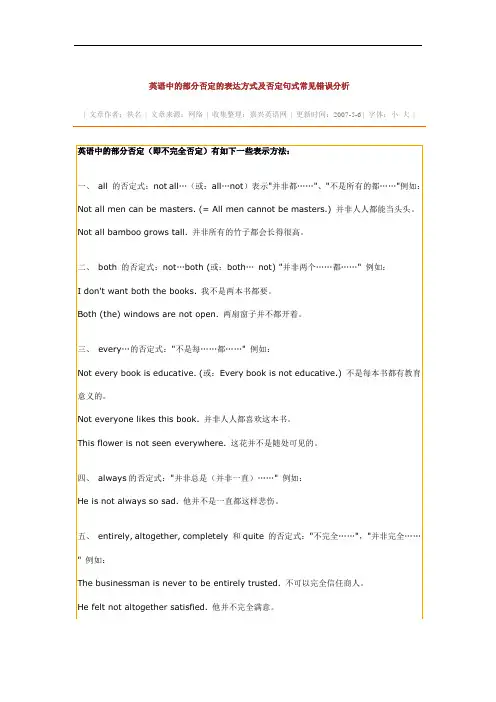
二、部分否定
l 部分否定就是指整个句子所表达的意义或概念不是全部否定,而是既含有部分否定的意思,也含有部分肯定的意思。
部分否定句式常常译为“不都……” “并非……”。
l --所有的问题在会上都没有解决。
l --All of the problems were not solved at meeting. = Not all of the problems were solved …= Some of the problems were solved, but some are not… (错译)
l --None of the problems were solved at the meeting.
l 注意区分完全否定和部分否定,才能避免翻译上的错误。
l 1.不定代词或形容词在否定句中
l 带有不定代词或形容词all, both, each, every, everybody, everyone, everything等在否定句中作主语时,这种句子不是全部否定,而表示部分否定,汉语常翻译成“不都是……”“并非都……”
l -All that glitters is not gold. (=Not all that glitters is gold.)
l -闪光的不都是金子。
l 试比较:None that glitters is gold. 闪光的都不是金子。
(完全否定)
l Each side of the street is not clean. (=Not each side of the street is clean) l 并非街道两边都干净。
(部分否定)
l 试比较:Neither side of the street is clean. 街道两边都不干净。
(完全否定)
l Both of the buildings are not big. (=Not both of the buildings are big. ) l 两栋楼并非都大。
(部分否定)
l 试比较:Neither of the buildings is big. 两栋楼都不大。
(完全否定)
l Every word is not known. (=Not every word is known.)
l 并非每个单词都认识。
(部分否定)
l 试比较:None of the words is known.每个单词都不认识。
(完全否定)
l I do not want everything. (=I want not everything.)
l 我并不是什么都想要。
(部分否定)
l 试比较: I do not want anything. 我什么都不想要。
(完全否定)
l 2. 副词在否定句中
l 在否定句中,带有副词always, wholly, entirely, completely, totally, altogether, everywhere, often, quite, enough 等表示部分否定。
l He is not always at home on Sundays.
l 他星期一不一定在家。
(部分否定)
l 试比较:he is never at home on Sundays. 他星期天从来不在家。
(完全否定)
l I do not wholly agree with you.
l 我不完全同意你的意见。
(部分否定)
l 试比较:
l I do not agree with you.
l 我不同意你的意见。
(完全否定)
l I do not agree with you at all.
l 我一点都不同意你的意思。
(完全否定)
l This kind of trees cannot be seen everywhere.
l 这种树并非到处都能见到。
(部分否定)
l 试比较:This kind of trees cannot be seen anywhere. 这种树哪儿都见不到。
(完全否定)
l The water is not hot enough. 水不够热。
(部分否定)
l 试比较:The water is not hot. 水不热。
(完全否定)
l 3. hardly/scarcely(几乎不), rarely/seldom(很少、不常), few/ little (没几个、几乎没有)等表示部分否定
l I could hardly recognize you.
l 我几乎认不出你了。
l He scarcely knew the accident.
l 他对这次事故几乎一无所知。
l Meetings are seldom held recently. l 最近很少开会。
l Few of the films are interesting.。