
General - all Master's Programmes
- 格式:ppt
- 大小:1.11 MB
- 文档页数:18
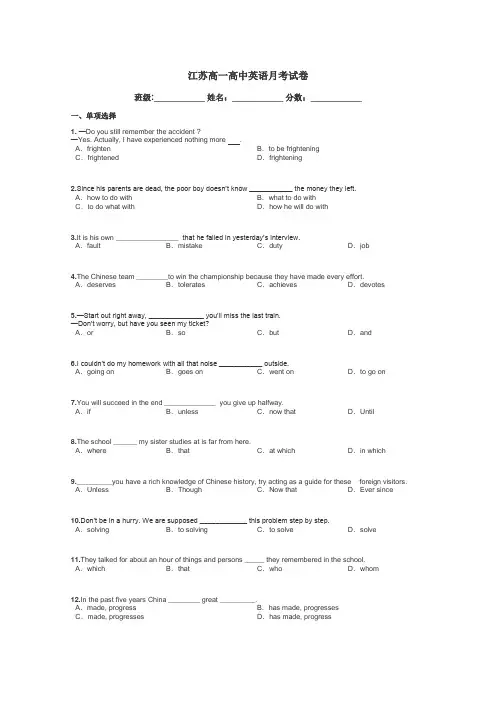
江苏高一高中英语月考试卷班级:___________ 姓名:___________ 分数:___________一、单项选择1.—Do you still remember the accident ?—Yes. Actually, I have experienced nothing more .A.frighten B.to be frighteningC.frightened D.frightening2.Since his parents are dead, the poor boy doesn’t know ___________ the money they left.A.how to do with B.what to do withC.to do what with D.how he will do with3.It is his own ________________ that he failed in yesterday’s interview.A.fault B.mistake C.duty D.job4.The Chinese team ________to win the championship because they have made every effort. A.deserves B.tolerates C.achieves D.devotes5.—Start out right away, ______________ you’ll miss the last train.—Don’t worry, but have you seen my ticket?A.or B.so C.but D.and6.I couldn’t do my homework with all that noise ___________ outside.A.going on B.goes on C.went on D.to go on7.You will succeed in the end _____________ you give up halfway.A.if B.unless C.now that D.Until8.The school ______ my sister studies at is far from here.A.where B.that C.at which D.in which9._________you have a rich knowledge of Chinese history, try acting as a guide for these foreign visitors. A.Unless B.Though C.Now that D.Ever since 10.Don’t be in a hurry. We are supposed ____________ this problem step by step.A.solving B.to solving C.to solve D.solve11.They talked for about an hour of things and persons _____ they remembered in the school.A.which B.that C.who D.whom12.In the past five years China ________ great _________.A.made, progress B.has made, progressesC.made, progresses D.has made, progress13.In our town, wood can ___________ a fire.A.be used to make B.be used to makingC.use to make D.used to making14.He missed _______ when he was in Africa.A.killing B.to be killed C.to kill D.being killed15.Joe Jones, the eldest of the eight children, had to ________ out of high school at the age of 16 to help his father on the farm.A.leave B.drop C.fall D.go16.-----How do you find the book? ------_____________.A.Great.B.With the help of my brother.C.By looking around.D.By chance.17.He has lost the key to the drawer _____ the papers are kept.A.where B.on which C.under which D.which18.The hotel _____ during our holidays stands by the seaside.A.we stayed at B.where we stayed atC.we stayed D.in that we stayed19.I found the homework was not so heavy as ________ I ________ to get in my old school.A.that; was used B.what; used C.which; used D.that; used20.Which sentence is wrong?A.The professor lives in the room whose windows face south.B.Don’t enter the house its roof has been destroyed in the hurricane.(飓风)C.We prefer the students who like challenging themselves.D.I still remember the name of the village we visited last year.二、完形填空Surfing: It’s Not Just for Boys Any MoreIf you asked high school girls to name their favorite sports, most would probably say basketball or volleyball. I am one of the few girls who would 21 : surfing(冲浪运动). But isn’t that a boy thing? Some people22 .Most certainly not.I started surfing about five years ago and 23 in love with the sport on the very first day. Riding the first 24 was the best feeling I had ever experienced.When I try to 25 surfing with other things, I find it very difficult because, in my 2—___26 , there’s nothing like it. It involves(牵涉到) body and 27 . There’s sand between my toes and cool, salt 28 all around us. The feeling I get when I’m surfing 29 that water, becoming one with the 30 , is like I’m weightless.The one thing I can 31 from surfing and not any other sport is endless challenge. You can never be the “best surfer” because the ocean 32 an too many kinds of waves that nobody can ever master. The variations of surfing styles are wonderful. Some surfers are free and flowing; others are very aggressive(活跃有力的) and 33 . All of these things attract me to surfing and make it 34 from any other sport.I’ve 35 to tell every girl I know to do something that people don’t think girls can do. It’s part of being human to advance to new 36 , so shouldn’t it be expected that girls should step up and start 37 __the limits of things boys and men used to dominate(主宰)?There’re women 38 side by side with the President of our country, so why not side by side with theboys 39 the football team or out in the water surfing? Give girls a chance to 40 , and they will.【1】A.tell B.answer C.give D.realize【2】A.wonder B.understand C.reply D.believe 【3】A.stayed B.came C.dropped D.fell【4】A.wave B.storm C.sail D.boat 【5】A.bring B.connect C.compare D.tie【6】A.work B.study C.holiday D.life【7】A.mind B.effort C.health D.time 【8】A.beach B.ocean C.water D.coast 【9】A.through B.across C.over D.above 【10】A.sky B.world C.earth D.ocean 【11】A.take B.get C.make D.keep 【12】A.catches B.includes C.offers D.collects 【13】A.sharp B.great C.hard D.calm 【14】A.known B.right C.far D.different 【15】A.chosen B.tried C.managed D.promised 【16】A.levels B.points C.steps D.parts 【17】A.reaching B.accepting C.pushing D.setting 【18】A.sitting B.walking C.fighting D.working 【19】A.of B.from C.on D.with 【20】A.think B.succeed C.perform D.feel三、阅读理解1.How to Become ClevererOnce a boy came to ask a fisherman how to become cleverer, because his mother always called him “foolish boy”.“That’s easy,” answered the fisherman. “I know one way to make you become cleverer.”“Really?”“Of course. It is said a fish head is good for brain. If you eat one, you’ll become cleverer indeed. Pay only three pounds for one fish head.” The boy paid him t hree pounds and the fisherman cut off a fish head and handed it to him.A raw fish head is not good—not even for a hungry boy to eat but the boy ate it up in two gulps.“Do you feel anything?” asked the fisherman.“Not in my head,” said the boy.The boy la y on the ground and thought. “One whole fish costs only two pounds. I had paid him three pounds for the fish head. Why couldn’t I have the whole fish for soup, a head for brain and one pound left over?” He jumped up and shouted at the fisherman. “You thief! You are fooling me!” The fisherman laughed, saying, “The fish headworks now, you see.”【1】The boy ate up the raw fish head only in two gulps, because he __________.A.enjoy itB.wanted to taste itC.took it as a good medicineD.was a foolish boy【2】The boy came to the fisherman in order to __________.A.buy a fish headB.ask the fisherman a questionC.become clevererD.A and C【3】“Not in my head” means “__________”.A.The fish head was not in the boy’s headB.The boy felt nothing came into his headC.It’s difficult to give an answer right awayD.The boy didn’t feel that he was cleverer【4】The boy paid three pounds. He should have had __________.A.a whole fishB.a fish head and one pound backC.a whole fish and one pound backD.a whole fish, a fish head and one pound back【5】__________ helped the boy become cleverer.A.A good meal B.The raw fish headC.Nothing D.What had happened2.Although there are no state controlled survival courses in Britain or the United States, there are various independent organizations offering similar activities.Students can participate ( take part ) in outdoor training courses through university clubs and societies . Anyone can register ( 登记 ) with such groups , which then organize courses ,training and trips for all members .One of the most popular outdoor training programmes in both the US and Britain , is Outward Bound ( 户外训练 ) . It was founded in 1941 in Wales and attracts hundreds of thousands of adventurous types every year .The courses are to broaden minds through experiences that build confidence , self-esteem ( 自尊 ) and character . As well as specialist courses such as canoeing , leadership skills and sailing , participants can take part in week long adventure training camps which include a host of sports and survival training education skills . Michael Williams , an American student , took part in an Outward Bound course last year . He said : “W e learned lots of first aid skills , lots of natural history , lots of environmental facts , and participated in a wildlife preservation ( protecting ) programme . Beyond that , my favorite skills learned were sailing and rock climbing .”Courses can last up to 40 days and are open to anyone over the age of 14 . Students must be in general good health , but do not need to be experienced in outdoor-sports . There is no selection process ; everyone is welcome , although new participants are advised to pick a course matching their physical power .Most of the British courses take place in the Beacons in Wales . Another similar organization is the UK Survival School , which includes courses on learning to live with the environment , sailing and winter survival . On a basic survival weekend students will learn how to get water and food , how to make fire and cook with it , to find and build a shelter , control survival life support , how to cross rivers , send off an SOS signal , and to use compassesby day and night .According to the leaders , such adventures are “an awakening , an exploration into unknown.” Outward Bound believes that participants will “use mind and body traveling some of the earth’s roughest wildness areas .”【1】The advantage of the training courses is that _________________ .A.participants can make friends with othersB.participants can visit some places of interestC.participants can experience different adventuresD.participants can learn how wonderful nature is【2】 In the Outward Bound course last year , the most exciting experience Michael Williams had was_____________________.A.learning first aid skills B.collecting facts of environmentC.preserving wildlife D.rock climbing and sailing【3】What’s the writer’s purpose to write this passage ?A.To introduce the training course to readersB.To persuade readers to take part in the training courses.C.To tell readers the danger of this training courseD.To introduce the wonders of the world to readers3.Many Chinese students who have learnt English for more than ten years are still unable to speak English very well when they meet a foreigner. They seem to have mastered the basic language structure(结构), but a conversation in English will make them feel uneasy. They are afraid that other people might find out their mistakes.It's uncommon that many students who are bad speakers of English can write English perfectly. This proves that they are unable to organize their idea in English. The center of the problem is that they lack practice and confidence ( 自信).Why should you be afraid? Do you fear those foreigners with whom you are speaking? Don't be shy, they will not laugh at you just for a little mistake you make. The best way to get rid of trouble is to learn to speak by speaking more. I am sure that constant practice will help you succeed.【1】What's the best topic for the passage?A.How to Speak to ForeignersB.How to Study English WellC.How to Organize the Idea in EnglishD.Practise Speaking English All the Time【2】 According to the passage, which of the following is NOT true?A.We can speak English fluently by doing more speaking.B.If you can write English perfectly, you are able to organize your idea in English.C.If you can write good English composition, you can speak English very well.D.Any Chinese students can't speak English fluently because they are afraid of making mistakes.4.The clothes you wear. The food you eat. The color of your bedroom walls. Where you go and how you get there. The people you hang around with. What time you go to bed. What do these things have in common? You’re asking. They’re just a few examples of many hundreds of things that your parents controlled for you when you were a child.As a kid, you didn’t have a say in everything; your parents made decisions about everything from the cereal you ate in the morning to the pajamas you wore at night. And it’s a good thing, too—kids need this kind of protection on their own.But finally, kids grow up and become teens. And part of being a teen is developing your own identity—one that is separate from your parents’. But as you change and grow into this new person who makes his own decisions,your parents have a difficult time adjusting (调整).In most families, it is this adjustment that can cause a lot of fighting between teens and parents. And issues like the type of friends you have or your attitudes to partying can cause bigger arguments, because your parents still always want to protect you and keep you safe, no matter how old you are.The good news about fighting with your parents get more comfortable with the idea that their teens have a right to certain opinions. It can take several years for parents and teens to adjust to their new roles, though. In the meantime, focus on communicating with your parents.Sometimes this can feel impossible—like they just don’t see your point of view and never will. But talking and expressing your opinions can help you gain more respect from your parents.Keep in mind, too, that your parents were teens once and that in most cases, they can relate to what you’re going through.【1】In the first two paragraphs, the writer .A.complains that parents control kids too muchB.proves that kids have no right to give their opinionsC.describes how carefully parents look after kidsD.explains that it is necessary for parents to control kids【2】A lot of fighting breaks out between teens and parents because .A.parents aren’t used to losing control of kidsB.teens like to have everything decidedC.parents blame teens for not respecting themD.teens are eager to develop their own identity【3】In the writer’s opinion, parents control teens in order to .A.prevent them from having their own ideasB.protect them from being hurtC.make them respect parents in the familyD.make sure that children have a good future【4】The underlined word “this” in paragraph 6 may refer to “”.A.arguing with friendsB.fighting with your parentsC.communicating with parentsD.adjusting to new roles【5】What might be the most suitable title for the passage?A.What do parents control their children for?B.How parents take care of children?C.How to get rid of your parents’ control?D.Why do I fight with parents so much?四、单词拼写根据首字母或中文注释拼写单词:(10空,1空1分,共10分)【1】Why is everything my fault? Can I d_____________ for myself?.【2】Bob! Shall I e______________ seats with you?【3】The huge windows of the hotel gave us a s________________ view of the beautiful park. 【4】As a good g______________ from a key university,they had no difficulty in finding jobs.【5】How amazing! The boy is f________________ in both Japanese and English【6】The students in China usually return to school for the start of the new _________ (学业的)year. 【7】The young man knows how to ______________(处理)his own problems.【8】After one year in hospital,he is back to his_______________(以前的)self again.【9】Last year he __________________(捐赠)much money to the research center.【10】My _________________ (一代) behaves differently from my father`s and grandfather`s.五、其他1.用动词的正确形式填空:(10空,1空1分,共10分)【1】To everyone`s _______________ (satisfy), he was admitted into Beijing University.【2】John had an ________________ (enjoy) time when he was in the village.【3】She is a strong and _________________ (depend) woman who needs no help from others. 【4】The job isn`t ____________ (challenge) enough for me . I want to do something more difficult. 【5】He practises playing football everyday in ____________ (prepare) for the coming examination. 【6】Mother`s ________________ (encourage) drove him to write better poems.【7】What are you going to do after _________________ (graduate)?【8】He has been teaching for twenty years.He is an ________________ (experience) teacher. 【9】Excuse me ,where is the ______________ (enter) to the exhibition hall?【10】He gave me some _________________ (explain)of what he had seen .2.句型转换:(20空,1空0.5分,共10分)【1】It took me seven hours to make such a nice kite.I ____________ seven hours ___________ such a nice kite.【2】My father finds it hard that he finishes the work on time.My father finds _______ ______________ __________ finish the work on time.【3】We got those flowers without having to pay for themWe got those flowers _____________ _______ ______________.【4】 Eight more classrooms are able to be used for different classes.Eight more classrooms _________ ______________ ___________ different classes.【5】I am in charge of the radio as the oldest student member.I am older than __________ _____________ student member and the club is ___________________________________. .【6】It wasn`t quiet enough in the classroom and I couldn`t hear what the teacher said.It was ________ noisy in the classroom ____________ I couldn`t hear what the teacher said.【7】 The office is too dirty .It requires cleaning.The office is too dirty . It requires _______ _______ __________.3.完成句子:(20空,1空1分,共20分)【1】教授走进了大厅,其身后跟着两位助手。

WORLD DECLA RATION ON HIGHER EDUCATIONFOR THE TWENTY-FIRST CENTURY:VISION AND A CTIONAND FRAMEWORK FOR PRIORITY ACTION FOR CHANGEAND DEVELOPMENT IN HIGHER EDUCATIONadopted by theWORLD CONFERENCE ON HIGHER EDUCA TIONHigher Education in the Twenty-First Century:Vision and Action9 October 1998WORLD DECLARATION ON HIGHER EDUCATIONFOR THE TWENTY-FIRST CENTURY: VISION AND ACTIONPREAMBLEOn the eve of a new century , there is an unprecedented demand for and a great diversification in higher education, as well as an increased awareness of its vital importance for sociocultural and economic development, and for building the future, for which the younger generationswillneed to be equipped with new skills, knowledge and ideals.Higher education includes ‘all types of studies, training or training for research at the post-secondary level, provided by universities or other educational establishments that are approved as institutions of higher education by the competent State authorities’. Everywhere higher education is faced with great challenges and difficulties related to financing, equity of conditions at access into and during the course of studies, improved staff development, skills-based training, enhancement and preservation of quality in teaching, research and services, relevance of programmes, employability of graduates, establishment of efficient co-operation agreements and equitable access to the benefits of international co-operation. At the same time, higher education is being challenged by new opportunities relating to technologies that are improving the ways in which knowledge can be produced, managed, disseminated, accessed and controlled. Equitable access to these technologies should be ensured at all levels of education systems.The second half of this century will go down in the history of higher education as the period of its most spectacular expansion:an over sixfold increase in student enrolments worldwide, from 13 million in 1960 to 82 million in 1995. But it is also the period which has seen the gap between industrially developed, the developing countries and in particular the least developed countries with regard to access and resources for higher learning and research, already enormous, becoming even wider. It has also been a period of increased socio-economic stratification and greater difference in educational opportunity within countries,including in some of the most developed and wealthiest nations. Without adequate higher education and research institutions providing a critical mass of skilled and educated people, no country can ensure genuine endogenous and sustainable development and, in particular, developing countries and least developed countries cannot reduce the gap separating them from the industrially developed ones. Sharing knowledge, international co-operation and new technologies can offer new opportunities to reduce this gap.Higher education has given ample proof of its viability over the centuries and of its ability to change and to induce change and progress in society. Owing to the scope and pace of change, society has become increasingly knowledge-based so that higher learning and research now act as essential components of cultural, socio-economic and environmentally sustainable development of individuals, communities and nations. Higher education itself is confronted therefore with formidable challenges and must proceed to the most radical change and renewal it has ever been required to undertake, so that our society, which is currently undergoing a profound crisis of values, can transcend mere economic considerations and incorporate deeper dimensions of morality and spirituality.It is with the aim of providing solutions to these challenges and of setting in motion a process of in-depth reform in higher education worldwide that UNESCO has convened a World Conference on Higher Education in the Twenty-First Century: Vision and Action. In preparation for the Conference, UNESCO issued, in 1995, its Policy Paper for Change and Development in Higher Education. Five regional consultations (Havana, November 1996; Dakar, April 1997; Tokyo, July 1997; Palermo, September 1997; and Beirut, March 1998) were subsequently held. The Declarations and Plans of Action adopted by them, each preserving its own specificity, are duly taken into account in the present Declaration - as is the whole process of reflection undertaken by the preparation of the World Conference - and are annexed to it.We, participants in the World Conference on Higher Education, assembled at UNESCO Headquarters in Paris, from 5 to 9 October 1998,Recalling the principles of the Charter of the United Nations, the Universal Declaration of Human Rights, the International Covenant on Economic, Social and Cultural Rights, and the International Covenant on Civil and Political Rights,Recalling also the Universal Declaration of Human Rights which states in Article 26, paragraph 1, that ‘Everyone has the right to education’ and that ‘higher education shall be equally accessible to all on the basis of merit’, and endorsing the basic principles of the Convention against Discrimination in E ducation (1960), which, by Article 4, commits the States Parties to it to ‘make higher education equally accessible to all on the basis of individual capacity’,Taking into account the recommendations concerning higher education of major commissions and conferences, inter alia, the International Commission on Education for the Twenty-First Century, the World Commission on Culture and Development, the 44th and 45th sessions of the International Conference on Education (Geneva, 1994 and 1996), the decisions taken at the 27th and 29th sessions of UNESCO’s General Conference, in particular regarding the Recommendation concerning the Status of Higher-Education Teaching Personnel, the World Conference on Education for All (Jomtien, Thailand, 1990), the United Nations Conference on Environment and Development (Rio de Janeiro, 1992), the Conference on Academic Freedom and University Autonomy (Sinaia, 1992), the World Conference on Human Rights (Vienna, 1993), the World Summit for Social Development (Copenhagen, 1995), the fourth World Conference on Women (Beijing, 1995), the International Congress on Education and Informatics (Moscow, 1996), the World Congress on Higher Education and Human Resources Development for the Twenty-First Century (Manila, 1997), the fifth International Conference on Adult Education (Hamburg, 1997) and especially the Agenda for the Future under Theme 2 (Improving the conditions and quality of learning) stating: ‘We commit ourselves to ... opening schools, colleges and universities to adult learners ... by calling upon the World Conference on Higher Education (Paris, 1998) to promote the transformation of post-secondary institutions into lifelong learning institutions and to define the role of universities accordingly’,Convinced that education is a fundamental pillar of human rights, democracy, sustainable development and peace, and shall therefore become accessible to all throughout life and that measures are required to ensure co-ordination and co-operation across and between the various sectors, particularly between general, technical and professional secondary and post-secondary education as well as between universities, colleges and technical institutions,Believing that, in this context, the solution of the problems faced on the eve of the twenty-first century will be determined by the vision of the future society and by the role that is assigned to education in general and to higher education in particular,A ware that on the threshold of a new millennium it is the duty of higher education to ensure that the values and ideals of a culture of peace prevail and that the intellectual community should bemobilized to that end,Considering that a substantial change and development of higher education, the enhancement of its quality and relevance, and the solution to the major challenges it faces, require the strong involvement not only of governments and of higher education institutions, but also of all stakeholders, including students and their families, teachers, business and industry, the public and private sectors of the economy, parliaments, the media, the community, professional associations and society as well as a greater responsibility of higher education institutions towards society and accountability in the use of public and private, national or international resources,Emphasizing that higher education systems should enhance their capacity to live with uncertainty, to change and bring about change, and to address social needs and to promote solidarity and equity; should preserve and exercise scientific rigour and originality, in a spirit of impartiality, as a basic prerequisite for attaining and sustaining an indispensable level of quality; and should place students at the centre of their concerns, within a lifelong perspective, so as to allow their full integration into the global knowledge society of the coming century,Also believing that international co-operation and exchange are major avenues for advancing higher education throughout the world,Proclaim the following:MISSIONS AND FUNCTIONS OF HIGHER EDUCATIONArticle 1 - Mission to educate, to train and to undertake researchWe affirm that the core missions and values of higher education, in particular the mission to contribute to the sustainable development and improvement of society as a whole, should be preserved, reinforced and further expanded, namely, to:(a) educate highly qualified graduates and responsible citizens able to meet the needs of all sectors of human activity, by offering relevant qualifications, including professional training, which combine high-level knowledge and skills, using courses and content continually tailored to the present and future needs of society;(b) provide opportunities (espace ouvert) for higher learning and for learning throughout life, giving to learners an optimal range of choice and a flexibility of entry and exit points within the system, as well as an opportunity for individual development and social mobility in order to educate for citizenship and for active participation in society, with a worldwide vision, for endogenous capacity-building, and for the consolidation of human rights, sustainable development, democracy and peace, in a context of justice;(c) advance, create and disseminate knowledge through research and provide, as part of its service to the community, relevant expertise to assist societies in cultural, social and economicdevelopment, promoting and developing scientific and technological research as well as research in the social sciences, the humanities and the creative arts;(d) help understand, interpret, preserve, enhance, promote and disseminate national and regional, international and historic cultures, in a context of cultural pluralism and diversity;(e) help protect and enhance societal values by training young people in the values which form the basis of democratic citizenship and by providing critical and detached perspectives to assist in the discussion of strategic options and the reinforcement of humanistic perspectives;(f) contribute to the development and improvement of education at all levels, including through the training of teachers.Article 2 - Ethical role, autonomy, responsibility and anticipatory functionIn accordance with the Recommendation concerning the Status of Higher-Education Teaching Personnel approved by the General Conference of UNESCO in November 1997, higher education institutions and their personnel and students should:(a) preserve and develop their crucial functions, through the exercise of ethics and scientific and intellectual rigour in their various activities;(b) be able to speak out on ethical, cultural and social problems completely independently and in full awareness of their responsibilities, exercising a kind of intellectual authority that society needs to help it to reflect, understand and act;(c) enhance their critical and forward-looking functions, through continuing analysis of emerging social, economic, cultural and political trends, providing a focus for forecasting, warning and prevention;(d) exercise their intellectual capacity and their moral prestige to defend and actively disseminate universally accepted values, including peace, justice, freedom, equality and solidarity, as enshrined in UNESCO’s Constitution;(e) enjoy full academic autonomy and freedom, conceived as a set of rights and duties, while being fully responsible and accountable to society;(f) play a role in helping identify and address issues that affect the well-being of communities, nations and global society.SHAPING A NEW VISION OF HIGHER EDUCATIONArticle 3 - Equity of access(a) In keeping with Article 26.1 of the Universal Declaration of Human Rights, admission to higher education should be based on the merit, capacity, efforts, perseverance and devotion, showed by those seeking access to it, and can take place in a lifelong scheme, at any time, with due recognition of previously acquired skills. As a consequence, no discrimination can be accepted in granting access to higher education on grounds of race, gender, language or religion, or economic, cultural or social distinctions, or physical disabilities.(b) Equity of access to higher education should begin with the reinforcement and, if need be, the reordering of its links with all other levels of education, particularly with secondary education. Higher education institutions must be viewed as, and must also work within themselves to be a part of and encourage, a seamless system starting with early childhood and primary education and continuing through life. Higher education institutions must work in active partnership with parents, schools, students, socio-economic groups and communities. Secondary education should not only prepare qualified candidates for access to higher education by developing the capacity to learn on a broad basis but also open the way to active life by providing training on a wide range of jobs. However, access to higher education should remain open to those successfully completing secondary school, or its equivalent, or presenting entry qualifications, as far as possible, at any age and without any discrimination.(c) As a consequence, the rapid and wide-reaching demand for higher education requires, where appropriate, all policies concerning access to higher education to give priority in the future to the approach based on the merit of the individual, as defined in Article 3(a) above.(d) Access to higher education for members of some special target groups, such as indigenous peoples, cultural and linguistic minorities, disadvantaged groups, peoples living under occupation and those who suffer from disabilities, must be actively facilitated, since these groups as collectivities and as individuals may have both experience and talent that can be of great value for the development of societies and nations. Special material help and educational solutions can help overcome the obstacles that these groups face, both in accessing and in continuing higher education.Article 4 - Enhancing participation and promoting the role of women(a) Although significant progress has been achieved to enhance the access of women to higher education, various socio-economic, cultural and political obstacles continue in many places in the world to impede their full access and effective integration. To overcome them remains an urgent priority in the renewal process for ensuring an equitable and non-discriminatory system of higher education based on the principle of merit.(b) Further efforts are required to eliminate all gender stereotyping in higher education, to consider gender aspects in different disciplines and to consolidate women’s participation at all levels and in all disciplines, in which they are under-represented and, in particular, to enhance their active involvement in decision-making.(c) Gender studies (women’s studies) should be prom oted as a field of knowledge, strategic for thetransformation of higher education and society.(d) Efforts should be made to eliminate political and social barriers whereby women are under-represented and in particular to enhance their active involvement at policy and decision-making levels within higher education and society.Article 5 - Advancing knowledge through research in science, the arts and humanities and the dissemination of its results(a) The advancement of knowledge through research is an essential function of all systems of higher education, which should promote postgraduate studies. Innovation, interdisciplinarity and transdisciplinarity should be promoted and reinforced in programmes with long-term orientations on social and cultural aims and needs. An appropriate balance should be established between basic and target-oriented research.(b) Institutions should ensure that all members of the academic community engaged in research are provided with appropriate training, resources and support. The intellectual and cultural rights on the results of research should be used to the benefit of humanity and should be protected so that they cannot be abused.(c) Research must be enhanced in all disciplines, including the social and human sciences,education (including higher education), engineering, natural sciences, mathematics, informatics and the arts within the framework of national, regional and international research and development policies. Of special importance is the enhancement of research capacities in higher education research institutions, as mutual enhancement of quality takes place when higher education and research are conducted at a high level within the same institution. These institutions should find the material and financial support required, from both public and private sources.Article 6 - Long-term orientation based on relevance(a) Relevance in higher education should be assessed in terms of the fit between what society expects of institutions and what they do. This requires ethical standards, political impartiality,critical capacities and, at the same time, a better articulation with the problems of society and the world of work, basing long-term orientations on societal aims and needs, including respect for cultures and environmental protection. The concern is to provide access to both broad general education and targeted, career-specific education, often interdisciplinary, focusing on skills and aptitudes, both of which equip individuals to live in a variety of changing settings, and to be able to change occupations.(b) Higher education should reinforce its role of service to society, especially its activities aimed at eliminating poverty, intolerance, violence, illiteracy, hunger, environmental degradation and disease, mainly through an interdisciplinary and transdisciplinary approach in the analysis of problems and issues.(c) Higher education should enhance its contribution to the development of the whole education system,notably through improved teacher education, curriculum development and educational research.(d) Ultimately, higher education should aim at the creation of a new society - non-violent and non-exploitative - consisting of highly cultivated, motivated and integrated individuals, inspired by love for humanity and guided by wisdom.Article 7 - Strengthening co-operation with the world of work and analysing and anticipating societal needs(a) In economies characterized by changes and the emergence of new production paradigms based on knowledge and its application, and on the handling of information, the links between higher education, the world of work and other parts of society should be strengthened and renewed.(b) Links with the world of work can be strengthened, through the participation of its representatives in the governance of institutions, the increased use of domestic and international apprenticeship/work-study opportunities for students and teachers, the exchange of personnel between the world of work and higher education institutions and revised curricula more closely aligned with working practices.(c) As a lifelong source of professional training, updating and recycling,institutions of higher education should systematically take into account trends in the world of work and in the scientific, technological and economic sectors. In order to respond to the work requirements, higher education systems and the world of work should jointly develop and assess learning processes, bridging programmes and prior learning assessment and recognition programmes, which integrate theory and training on the job. Within the framework of their anticipatory function, higher education institutions could contribute to the creation of new jobs, although that is not their only function.(d) Developing entrepreneurial skills and initiative should become major concerns of higher education, in order to facilitate employability of graduates who will increasingly be called upon to be not only job seekers but also and above all to become job creators. Higher education institutions should give the opportunity to students to fully develop their own abilities with a sense of social responsibility, educating them to become full participants in democratic society and promoters of changes that will foster equity and justice.Article 8 -Diversification for enhanced equity of opportunity(a) Diversifying higher education models and recruitment methods and criteria is essential both to meet increasing international demand and to provide access to various delivery modes and to extend access to an ever-wider public, in a lifelong perspective, based on flexible entry and exit points to and from the system of higher education.(b) More diversified systems of higher education are characterized by new types of tertiaryinstitutions: public, private and non-profit institutions, amongst others. Institutions should be able to offer a wide variety of education and training opportunities: traditional degrees, short courses, part-time study, flexible schedules, modularized courses, supported learning at a distance, etc.Article 9 - Innovative educational approaches: critical thinking and creativity(a) In a world undergoing rapid changes, there is a perceived need for a new vision and paradigm of higher education, which should be student-oriented, calling in most countries for in-depth reforms and an open access policy so as to cater for ever more diversified categories of people, and of its contents, methods, practices and means of delivery, based on new types of links and partnerships with the community and with the broadest sectors of society.(b) Higher education institutions should educate students to become well informed and deeply motivated citizens, who can think critically, analyse problems of society, look for solutions to the problems of society, apply them and accept social responsibilities.(c) To achieve these goals, it may be necessary to recast curricula, using new and appropriate methods, so as to go beyond cognitive mastery of disciplines. New pedagogical and didactical approaches should be accessible and promoted in order to facilitate the acquisition of skills, competences and abilities for communication, creative and critical analysis, independent thinking and team work in multicultural contexts, where creativity also involves combining traditional or local knowledge and know-how with advanced science and technology. These recast curricula should take into account the gender dimension and the specific cultural, historic and economic context of each country. The teaching of human rights standards and education on the needs of communities in all parts of the world should be reflected in the curricula of all disciplines, particularly those preparing for entrepreneurship. Academic personnel should play a significant role in determining the curriculum.(d) New methods of education will also imply new types of teaching-learning materials. These have to be coupled with new methods of testing that will promote not only powers of memory but also powers of comprehension, skills for practical work and creativity.Article 10 -Higher education personnel and students as major actors(a) A vigorous policy of staff development is an essential element for higher education institutions. Clear policies should be established concerning higher education teachers, who nowadays need to focus on teaching students how to learn and how to take initiatives rather than being exclusively founts of knowledge. Adequate provision should be made for research and for updating and improving pedagogical skills, through appropriate staff development programmes, encouraging constant innovation in curriculum, teaching and learning methods, and ensuring appropriate professional and financial status, and for excellence in research and teaching,reflecting the corresponding provisions of the Recommendation concerning the Status of Higher-Education T eaching Personnel approved by the General Conference of UNESCO in November 1997. To this end, more importance should be attached to international experience. Furthermore, in view ofthe role of higher education for lifelong learning, experience outside the institutions ought to be considered as a relevant qualification for higher educational staff.(b) Clear policies should be established by all higher education institutions preparing teachers of early childhood education and for primary and secondary schools, providing stimulus for constant innovation in curriculum, best practices in teaching methods and familiarity with diverse learning styles. It is vital to have appropriately trained administrative and technical personnel.(c) National and institutional decision-makers should place students and their needs at the centre of their concerns, and should consider them as major partners and responsible stakeholders in the renewal of higher education. This should include student involvement in issues that affect that level of education, in evaluation, the renovation of teaching methods and curricula and, in the institutional framework in force, in policy-formulation and institutional management. As students have the right to organize and represent themselves, students’ involvement in these issues should be guaranteed.(d) Guidance and counselling services should be developed, in co-operation with student organizations, in order to assist students in the transition to higher education at whatever age and to take account of the needs of ever more diversified categories of learners. Apart from those entering higher education from schools or further education colleges, they should also take account of the needs of those leaving and returning in a lifelong process. Such support is important in ensuring a good match between student and course, reducing drop-out. Students who do drop out should have suitable opportunities to return to higher education if and when appropriate.FROM VISION TO ACTIONArticle 11 - Qualitative evaluation(a) Quality in higher education is a multidimensional concept,which should embrace all its functions, and activities: teaching and academic programmes, research and scholarship, staffing, students, buildings, facilities, equipment, services to the community and the academic environment. Internal self-evaluation and external review, conducted openly by independent specialists, if possible with international expertise, are vital for enhancing quality. Independent national bodies should be established and comparative standards of quality, recognized at international level, should be defined. Due attention should be paid to specific institutional, national and regional contexts in order to take into account diversity and to avoid uniformity. Stakeholders should be an integral part of the institutional evaluation process.(b) Quality also requires that higher education should be characterized by its international dimension: exchange of knowledge, interactive networking, mobility of teachers and students, and international research projects, while taking into account the national cultural values and circumstances.(c) To attain and sustain national, regional or international quality, certain components are particularly relevant, notably careful selection of staff and continuous staff development, in。

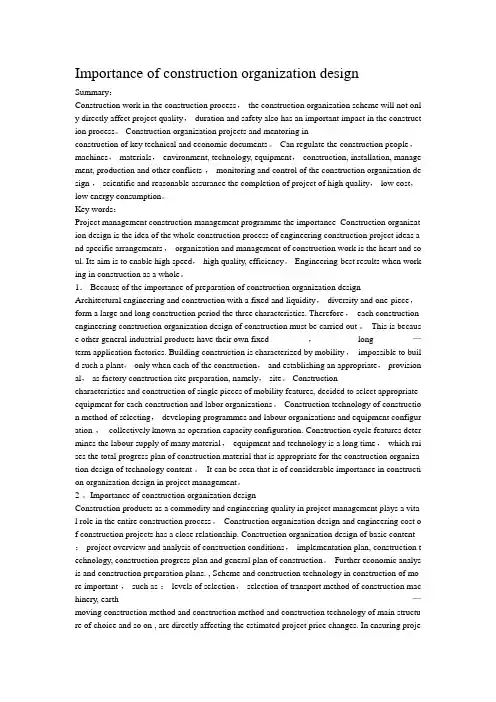
Importance of construction organization design Summary:Construction work in the construction process, the construction organization scheme will not onl y directly affect project quality, duration and safety also has an important impact in the construct ion process。
Construction organization projects and mentoring inconstruction of key technical and economic documents。
Can regulate the construction people,machines, materials, environment, technology, equipment, construction, installation, manage ment, production and other conflicts , monitoring and control of the construction organization de sign , scientific and reasonable assurance the completion of project of high quality, low cost,low energy consumption。
Key words:Project management construction management programme the importance Construction organizat ion design is the idea of the whole construction process of engineering construction project ideas a nd specific arrangements, organization and management of construction work is the heart and so ul. Its aim is to enable high speed, high quality, efficiency。