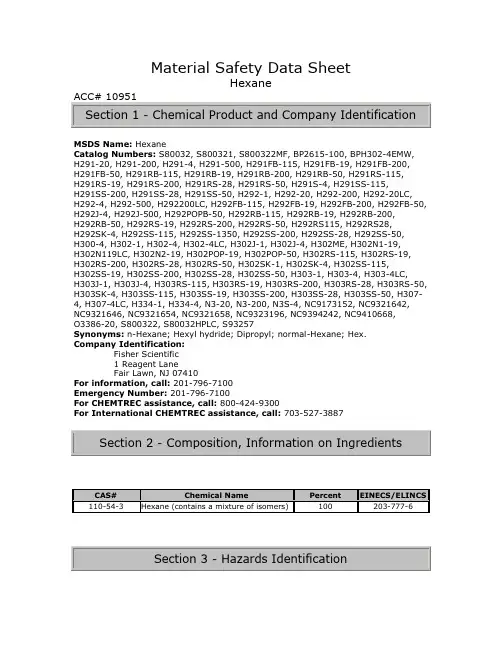
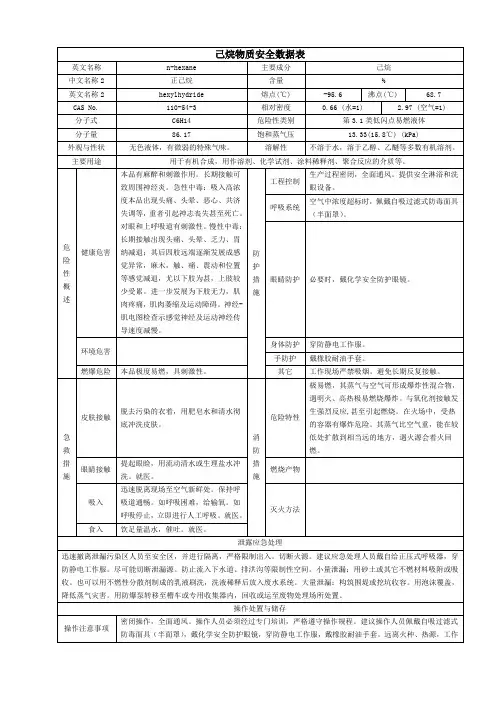
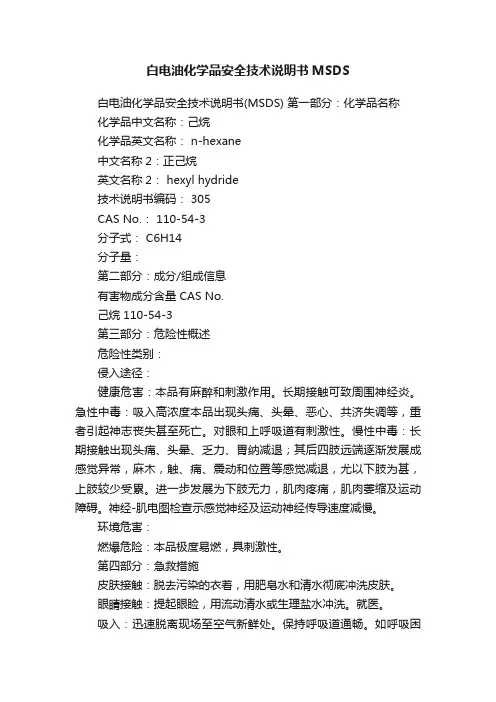
Material Safety Data SheetHexaneMSDS Name: HexaneCatalog Numbers: S80032, S800321, S800322MF, BP2615-100, BPH302-4EMW,H291-20, H291-200, H291-4, H291-500, H291FB-115, H291FB-19, H291FB-200,H291FB-50, H291RB-115, H291RB-19, H291RB-200, H291RB-50, H291RS-115,H291RS-19, H291RS-200, H291RS-28, H291RS-50, H291S-4, H291SS-115,H291SS-200, H291SS-28, H291SS-50, H292-1, H292-20, H292-200, H292-20LC,H292-4, H292-500, H292200LC, H292FB-115, H292FB-19, H292FB-200, H292FB-50, H292J-4, H292J-500, H292POPB-50, H292RB-115, H292RB-19, H292RB-200,H292RB-50, H292RS-19, H292RS-200, H292RS-50, H292RS115, H292RS28,H292SK-4, H292SS-115, H292SS-1350, H292SS-200, H292SS-28, H292SS-50,H300-4, H302-1, H302-4, H302-4LC, H302J-1, H302J-4, H302ME, H302N1-19,H302N119LC, H302N2-19, H302POP-19, H302POP-50, H302RS-115, H302RS-19,H302RS-200, H302RS-28, H302RS-50, H302SK-1, H302SK-4, H302SS-115,H302SS-19, H302SS-200, H302SS-28, H302SS-50, H303-1, H303-4, H303-4LC,H303J-1, H303J-4, H303RS-115, H303RS-19, H303RS-200, H303RS-28, H303RS-50, H303SK-4, H303SS-115, H303SS-19, H303SS-200, H303SS-28, H303SS-50, H307-4, H307-4LC, H334-1, H334-4, N3-20, N3-200, N3S-4, NC9173152, NC9321642,NC9321646, NC9321654, NC9321658, NC9323196, NC9394242, NC9410668,O3386-20, S800322, S80032HPLC, S93257Synonyms: n-Hexane; Hexyl hydride; Dipropyl; normal-Hexane; Hex.Company Identification:Fisher Scientific1 Reagent LaneFair Lawn, NJ 07410For information, call: 201-796-7100Emergency Number: 201-796-7100For CHEMTREC assistance, call: 800-424-9300For International CHEMTREC assistance, call: 703-527-3887EMERGENCY OVERVIEWAppearance: clear colorless liquid.Danger! Extremely flammable liquid and vapor. Vapor may cause flash fire. Breathing vapors may cause drowsiness and dizziness. Causes eye, skin, and respiratory tract irritation. May be harmful if absorbed through the skin. Aspiration hazard if swallowed. Can enter lungs and cause damage. Possible risk of impaired fertility. Long-term exposure may cause damage to the nervous system of the extremities (the hands, arms, legs and feet). Dangerous for the environment. Target Organs: Central nervous system, respiratory system, eyes, skin, peripheral nervous system, testes.Potential Health EffectsEye: Causes mild eye irritation.Skin: Prolonged and/or repeated contact may cause defatting of the skin and dermatitis. Causes irritation with burning pain, itching, and redness. Absorbed through the skin. There have been no reports of skin sensitization in people occupationally exposed to n-hexane. Skin sensitization was not observed in a maximization test using 25 volunteers.Ingestion: May cause gastrointestinal irritation with nausea, vomiting and diarrhea. Aspiration of material into the lungs may cause chemical pneumonitis, which may be fatal. May cause central nervous system depression.Inhalation: Causes respiratory tract irritation. Exposure produces central nervous system depression. Vapors may cause dizziness or suffocation. n-Hexane vapor concentrations can become so high that oxygen is displaced, especially in confined spaces.Chronic: Prolonged or repeated skin contact may cause defatting and dermatitis. Prolonged or repeated exposure may cause adverse reproductive effects. Chronic exposure may cause visual disturbances. Laboratory experiments have resulted in mutagenic effects. Peripheral neuropathy symptoms include: muscular weakness, paresthesia, numbing of the hands, feet, legs and arms, unsteadiness, and difficulty in walking and standing. Repeated exposure may cause nervous system abnormalities with muscle weakness and damage, motor incoordination, and sensation disturbances. Chronic exposure produces peripheral neuropathy.Eyes: In case of contact, immediately flush eyes with plenty of water for a t least 15 minutes. Get medical aid.Skin: In case of contact, flush skin with plenty of water. Remove contaminated clothing and shoes. Get medical aid if irritation develops and persists. Wash clothing before reuse.Ingestion: Potential for aspiration if swallowed. Get medical aid immediately. Do not induce vomiting unless directed to do so by medical personnel. Never give anything by mouth to an unconscious person. If vomiting occurs naturally, have victim leanforward.Inhalation: If inhaled, remove to fresh air. If not breathing, give artificial respiration. If breathing is difficult, give oxygen. Get medical aid.Notes to Physician: Treat symptomatically and supportively. For ingestion, the stomach sould be intubated, aspirated, and lavaged with a slurry of activated charcoal--protect the airway from aspiration of gastric contents. Monitor arterial blood gases in cases of severe aspiration.General Information: As in any fire, wear a self-contained breathing apparatus in pressure-demand, MSHA/NIOSH (approved or equivalent), and full protective gear. During a fire, irritating and highly toxic gases may be generated by thermal decomposition or combustion. Use water spray to keep fire-exposed containers cool. May accumulate static electrical charges, and may cause ignition of its own vapors. Extremely flammable liquid and vapor. Vapor may cause flash fire. Vapors are heavier than air and may travel to a source of ignition and flash back. Vapors can spread along the ground and collect in low or confined areas. This liquid floats on water and may travel to a source of ignition and spread fire.Extinguishing Media: Use dry chemical, carbon dioxide, or appropriate foam. Solid streams of water may be ineffective and spread material. Water may be ineffective because it will not cool material below its flash point.Flash Point: -22 to -26.1 deAutoignition Temperature: 225 deg C ( 437.00 deg F)Explosion Limits, Lower:1.2 vol %Upper: 7.7 vol %NFPA Rating: (estimated) Health: 2; Flammability: 3; Instability: 0General Information: Use proper personal protective equipment as indicated in Section 8.Spills/Leaks: Absorb spill with inert material (e.g. vermiculite, sand or earth), then place in suitable container. Avoid runoff into storm sewers and ditches which lead to waterways. Clean up spills immediately, observing precautions in the Protective Equipment section. Remove all sources of ignition. Provide ventilation. A vapor suppressing foam may be used to reduce vapors. Use only non-sparking tools and equipment.Handling: Wash thoroughly after handling. Remove contaminated clothing and wash before reuse. Ground and bond containers when transferring material. Avoid contact with eyes, skin, and clothing. Empty containers retain product residue, (liquid and/or vapor), and can be dangerous. Take precautionary measures against staticdischarges. Keep away from heat, sparks and flame. Do not pressurize, cut, weld, braze, solder, drill, grind, or expose empty containers to heat, sparks or open flames. Use only with adequate ventilation. Avoid breathing vapor or mist.Storage: Keep away from heat and flame. Keep away from sources of ignition. Store in a tightly closed container. Keep from contact with oxidizing materials. Store in a cool, dry, well-ventilated area away from incompatible substances. Flammables-area.Engineering Controls: Facilities storing or utilizing this material should be equipped with an eyewash facility and a safety shower. Use adequate general or localexplosion-proof ventilation to keep airborne levels to acceptable levels. Exposure LimitsOSHA Vacated PELs: Hexane (contains a mixture of isomers): 50 ppm TWA; 180 mg/m3 TWAPersonal Protective EquipmentEyes: Wear chemical splash goggles.Skin: Wear appropriate protective gloves to prevent skin exposure.Clothing: Wear appropriate protective clothing to prevent skin exposure.Respirators: A respiratory protection program that meets OSHA's 29 CFR 1910.134 and ANSI Z88.2 requirements or European Standard EN 149 must be followed whenever workplace conditions warrant respirator use.Physical State: LiquidAppearance: clear colorlessOdor: gasoline-likepH: Not available.Vapor Pressure: 151 mm Hg @ 25 deg CVapor Density: 2.97(Air = 1)Evaporation Rate:Not available.Viscosity: 0.31 mPas 20 deg CBoiling Point: 62 - 69 deg C @ 760 mmHgFreezing/Melting Point:-95 deg CDecomposition Temperature:Not available.Solubility: Insoluble.Specific Gravity/Density:0.678Molecular Formula:C6H14Molecular Weight:86.18Chemical Stability: Stable under normal temperatures and pressures.Conditions to Avoid: Ignition sources, excess heat, electrical sparks, confined spaces.Incompatibilities with Other Materials: Strong oxidizing agents.Hazardous Decomposition Products: Carbon monoxide, carbon dioxide. Hazardous Polymerization: Will not occur.RTECS#:CAS# 110-54-3: MN9275000LD50/LC50:CAS# 110-54-3:Draize test, rabbit, eye: 10 mg Mild;Inhalation, mouse: LC50 = 150000 mg/m3/2H;Inhalation, rat: LC50 = 48000 ppm/4H;Inhalation, rat: LC50 = 627000 mg/m3/3M;Oral, rat: LD50 = 25 gm/kg;.Carcinogenicity:CAS# 110-54-3: Not listed by ACGIH, IARC, NTP, or CA Prop 65.Epidemiology: Occupational polyneuropathy has resulted from hexane exposures as low as 500 ppm, but the minimum levels of n-hexane that are neurotoxic in humans haven't been established. Nearly continuous exposure of animals at 250 ppm has caused neurotoxic effects.Teratogenicity: No evidence of teratogenicity or embryotoxicity in anmial studies with hexane. Fetotoxicity has been observed in the presence of maternal toxicity. Reproductive Effects: Severe testicular damage has been observed in rats exposed to hexane at concentrations which have produced other significant toxicity. Although subneurotoxic doses of its principle toxic metabolite, 2,5-hexanedione, can induce progressive testiculartoxicity in rats, there have been no reports of human sterility orother reproductive toxicity associated with n-hexane exposures.Mutagenicity: Positive results (chromosomal damage in the bone marrow cells) obtained for rats exposed by inhalation to n-hexane.Neurotoxicity: n-Hexane is a mild irritant and CNS depressant in acute exposure, but its principal effects are damage to the sensory and motor peripheral nerves, particularly in chronic exposure.Other Studies:Ecotoxicity: No data available. Estimated BCF values = 2.24 and 2.89. These values suggest that hexane will show low bioconcentration in aquatic organisms. Estimated Koc value = 4.11. This product will show slight soil mobility and is expected to rapidly volatilize from moist surface soils.Environmental: Terrestrial: Volatilization and adsorption are expected to be the most important fate processes. Aquatic: Photolysis or hydrolysis are not expected to be important. Atmospheric: Expected to exist entirely in the vapor phase in ambient air, expected half life 2.8 days. Expected to biodegrade but not bioconcentrate. Physical: No information available.Other: No information available.Chemical waste generators must determine whether a discarded chemical is classified as a hazardous waste. US EPA guidelines for the classification determination are listed in 40 CFR Parts 261.3. Additionally, waste generators must consult state and local hazardous waste regulations to ensure complete and accurate classification.RCRA P-Series: None listed.RCRA U-Series: None listed.US FEDERALTSCACAS# 110-54-3 is listed on the TSCA inventory.Health & Safety Reporting ListNone of the chemicals are on the Health & Safety Reporting List.Chemical Test RulesNone of the chemicals in this product are under a Chemical Test Rule.Section 12bNone of the chemicals are listed under TSCA Section 12b.TSCA Significant New Use RuleNone of the chemicals in this material have a SNUR under TSCA.CERCLA Hazardous Substances and corresponding RQsCAS# 110-54-3: 5000 lb final RQ; 2270 kg final RQSARA Section 302 Extremely Hazardous SubstancesNone of the chemicals in this product have a TPQ.SARA CodesCAS # 110-54-3: immediate, delayed, fire.Section 313This material contains Hexane (contains a mixture of (CAS# 110-54-3, 100%),which is subject to the reporting requirements of Section 313 of SARA Title III and 40 CFRClean Air Act:CAS# 110-54-3 is listed as a hazardous air pollutant (HAP).This material does not contain any Class 1 Ozone depletors.This material does not contain any Class 2 Ozone depletors.Clean Water Act:None of the chemicals in this product are listed as Hazardous Substances under the CWA.None of the chemicals in this product are listed as Priority Pollutants under the CWA.None of the chemicals in this product are listed as Toxic Pollutants under the CWA.OSHA:None of the chemicals in this product are considered highly hazardous by OSHA. STATECAS# 110-54-3 can be found on the following state right to know lists: New Jersey, Pennsylvania, Minnesota, Massachusetts.California Prop 65California No Significant Risk Level: None of the chemicals in this product are listed. European/International RegulationsEuropean Labeling in Accordance with EC DirectivesHazard Symbols:XN F NRisk Phrases:R 11 Highly flammable.R 38 Irritating to skin.R 48/20 Harmful : danger of serious damage to health by prolongedexposure through inhalation.R 62 Possible risk of impaired fertility.R 51/53 Toxic to aquatic organisms, may cause long-term adverseeffects in the aquatic environment.R 65 Harmful: may cause lung damage if swallowed.R 67 Vapours may cause drowsiness and dizziness.Safety Phrases:S 16 Keep away from sources of ignition - No smoking.S 29 Do not empty into drains.S 33 Take precautionary measures against static discharges.S 36/37 Wear suitable protective clothing and gloves.S 9 Keep container in a well-ventilated place.S 61 Avoid release to the environment. Refer to special instructions/safety data sheets.S 62 If swallowed, do not induce vomiting: seek medical advice immediately and show this container or label.WGK (Water Danger/Protection)CAS# 110-54-3: 1Canada - DSL/NDSLCAS# 110-54-3 is listed on Canada's DSL List.Canada - WHMISThis product has a WHMIS classification of B2, D2B.This product has been classified in accordance with the hazard criteria of the Controlled Products Regulations and the MSDS contains all of the information required by those regulations.Canadian Ingredient Disclosure ListCAS# 110-54-3 is listed on the Canadian Ingredient Disclosure List.MSDS Creation Date: 6/03/1999Revision #14 Date: 10/25/2007The information above is believed to be accurate and represents the best information currently available to us. However, we make no warranty of merchantability or any other warranty, express or implied, with respect to such information, and we assume no liability resulting from its use. Users should make their own investigations to determine the suitability of the information for their particular purposes. In no event shall Fisher be liable for any claims, losses, or damages of any third party or for lost profits or any special, indirect, incidental, consequential or exemplary damages, howsoever arising, even if Fisher has been advised of the possibility of such damages.。