美国会计准则和国际会计准则对比(英文)
- 格式:doc
- 大小:118.50 KB
- 文档页数:3
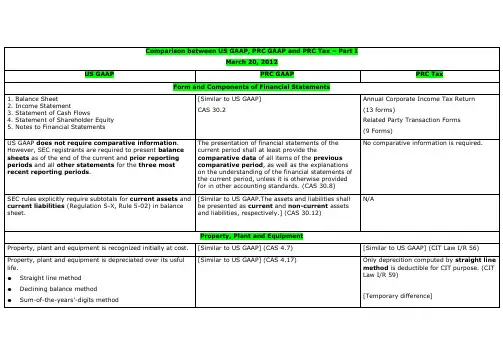
Similarities and Differences
A comparison of IFRS and US GAAP
October 2007 2 Similarities and Differences – A comparison of IFRS and US GAAP – October 2007 Summary of similarities and differences Summary of similarities and differences
Subject IFRS US GAAP
Accounting framework
Historical cost or
valuation Generally uses historical cost, but intangible
assets, property, plant and equipment (PPE)
and investment property may be revalued to
fair value. Derivatives, certain other financial
instruments and biological assets are
revalued to fair value. No revaluations except for certain types of
financial instrument.
First-time adoption of
accounting
framework Full retrospective application of all IFRSs
effective at the reporting date for an entity’s
first IFRS financial statements, with some
optional exemptions and limited mandatory
exceptions. Reconciliations of profit or loss
in respect of the last period reported under
previous GAAP, of equity at the end of that
period and of equity at the start of the
earliest period presented in comparatives
must be included in an entity’s first IFRS
financial statements. First-time adoption of US GAAP requires
retrospective application. There is no
requirement to present reconciliations of
equity or profit or loss on first-time adoption
of US GAAP.
Financial statements1
Components of
financial statements Two years’ balance sheets, income
statements, cash flow statements, changes
in equity and accounting policies and notes. Similar to IFRS, except three years required
for SEC registrants for all statements except
balance sheet. Specific accommodations in
certain circumstances for foreign private
issuers that may offer relief from the three-
year requirement.
Balance sheet Does not prescribe a particular format. A
current/non-current presentation of assets
and liabilities is used unless a liquidity
presentation provides more relevant and
reliable information. Certain minimum items
are presented on the face of the balance
sheet. Entities may present either a classified or
non-classified balance sheet. Items on the
face of the balance sheet are generally
presented in decreasing order of liquidity.
SEC registrants should follow SEC
regulations.
Income statement Does not prescribe a standard format,
although expenditure is presented in one of
two formats (function or nature). Certain
minimum items are presented on the face of
the income statement. Present as either a single-step or multiple-
step format.
Expenditures are presented by function.
SEC registrants should follow SEC
regulations.
Exceptional
(significant) items Does not use the term but requires separate
disclosure of items that are of such size,
incidence or nature that their separate
disclosure is necessary to explain the
performance of the entity. Similar to IFRS, but individually significant
items are presented on the face of the
income statement and disclosed in the
notes.
Extraordinary items Prohibited. Defined as being both infrequent and
unusual, and are rare. Negative goodwill is
presented as an extraordinary item.
Statement of
recognised income
and expense
(SoRIE)/Other
comprehensive
income and
statement of
accumulated other
comprehensive
income
comprehensive
income A SoRIE can be presented as a primary
statement, in which case a statement of
changes in shareholders’ equity is not
presented. Alternatively, it may be disclosed
separately within the primary statement of
changes in shareholders’ equity. Total comprehensive income and
accumulated other comprehensive income
are disclosed, presented either as a separate
primary statement or combined with the
income statement or with the statement of
changes in stockholders’ equity.
1 Mid-2007, the IASB voted to approve the issuance of a revised version of IAS 1, Presentation of Financial Statements. See page 13. Similarities and Differences – A comparison of IFRS and US GAAP – October 2007 3 Summary of similarities and differences
Subject IFRS US GAAP Page
Statement of
changes in share
(stock) holders’
equity Statement shows capital transactions with
owners, the movement in accumulated
profit/loss and a reconciliation of all other
components of equity. The statement is
presented as a primary statement except
when a SoRIE is presented. In this case, only
disclosure in the notes applies. Similar to IFRS except that US GAAP does
not have a SoRIE, and SEC rules permit the
statement to be presented either as a
primary statement or in the notes.
Cash flow statements
– format and method Standard headings but limited guidance on
contents. Use direct or indirect method. Similar headings to IFRS, but more specific