
硫酸法生产钛白粉工艺27页PPT
- 格式:ppt
- 大小:3.28 MB
- 文档页数:27
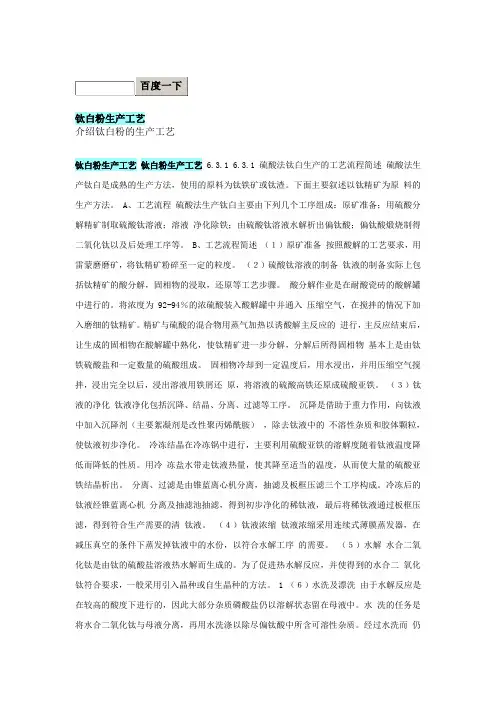
钛白粉生产工艺介绍钛白粉的生产工艺钛白粉生产工艺钛白粉生产工艺 6.3.1 6.3.1 硫酸法钛白生产的工艺流程简述硫酸法生产钛白是成熟的生产方法,使用的原料为钛铁矿或钛渣。
下面主要叙述以钛精矿为原料的生产方法。
A、工艺流程硫酸法生产钛白主要由下列几个工序组成:原矿准备;用硫酸分解精矿制取硫酸钛溶液;溶液净化除铁;由硫酸钛溶液水解析出偏钛酸;偏钛酸煅烧制得二氧化钛以及后处理工序等。
B、工艺流程简述(1)原矿准备按照酸解的工艺要求,用雷蒙磨磨矿,将钛精矿粉碎至一定的粒度。
(2)硫酸钛溶液的制备钛液的制备实际上包括钛精矿的酸分解,固相物的浸取,还原等工艺步骤。
酸分解作业是在耐酸瓷砖的酸解罐中进行的。
将浓度为 92-94%的浓硫酸装入酸解罐中并通入压缩空气,在搅拌的情况下加入磨细的钛精矿。
精矿与硫酸的混合物用蒸气加热以诱酸解主反应的进行,主反应结束后,让生成的固相物在酸解罐中熟化,使钛精矿进一步分解,分解后所得固相物基本上是由钛铁硫酸盐和一定数量的硫酸组成。
固相物冷却到一定温度后,用水浸出,并用压缩空气搅拌,浸出完全以后,浸出溶液用铁屑还原,将溶液的硫酸高铁还原成硫酸亚铁。
(3)钛液的净化钛液净化包括沉降、结晶、分离、过滤等工序。
沉降是借助于重力作用,向钛液中加入沉降剂(主要絮凝剂是改性聚丙烯酰胺),除去钛液中的不溶性杂质和胶体颗粒,使钛液初步净化。
冷冻结晶在冷冻锅中进行,主要利用硫酸亚铁的溶解度随着钛液温度降低而降低的性质。
用冷冻盐水带走钛液热量,使其降至适当的温度,从而使大量的硫酸亚铁结晶析出。
分离、过滤是由锥蓝离心机分离,抽滤及板框压滤三个工序构成。
冷冻后的钛液经锥蓝离心机分离及抽滤池抽滤,得到初步净化的稀钛液,最后将稀钛液通过板框压滤,得到符合生产需要的清钛液。
(4)钛液浓缩钛液浓缩采用连续式薄膜蒸发器,在减压真空的条件下蒸发掉钛液中的水份,以符合水解工序的需要。
(5)水解水合二氧化钛是由钛的硫酸盐溶液热水解而生成的。

联产法硫酸法钛白粉生产工艺流程The production process of titanium dioxide using the sulfate process, also known as the "联产法" (Lian Chan Fa) in Chinese, is a complex and intricate one. This method is widely used in the industry due to its efficiency and cost-effectiveness. In this process, titanium dioxide is produced from ilmenite ore, a mineral containing titanium and iron oxides. Several steps are involved in the production process, including digestion, filtration, hydrolysis, calcination, and milling.The first step in the production process is digestion, where ilmenite ore is mixed with concentrated sulfuric acid in a heated reactor. This reaction produces a solution of titanium sulfate and iron sulfate. The temperature and pressure conditions are carefully controlled to ensure optimal conversion of the ore into the desired compounds. The reaction is exothermic, meaning it releases heat, which is important for maintaining the reaction rate.After digestion, the resulting slurry is filtered to separate the solid residue from the liquid solution. The solid residue, known as "red cake," contains impurities such as iron and other metals. These impurities need to be removed to obtain high-quality titanium dioxide. The liquid solution, on the other hand, contains the desired titanium sulfate compound.The next step is hydrolysis, where the titanium sulfate solution is diluted with water and subjected to a hydrolysis reaction. This reaction converts the titanium sulfate into insoluble titanium dioxide particles. The hydrolysis reaction is usually carried out under controlled pH conditions and at elevated temperatures. The resulting suspension of titanium dioxide particles is then subjected to a series of washing and filtration steps to remove impurities and excess acid.After washing and filtration, the titanium dioxide particles are separated from the liquid phase and undergo calcination. Calcination is a high-temperature process that involves heating the particles to a specific temperature topromote the transformation of the amorphous titaniumdioxide into a crystalline form. The calcinationtemperature and duration are crucial factors that determine the final properties of the titanium dioxide pigment.Once calcination is complete, the titanium dioxide particles are milled to achieve the desired particle size distribution. Milling helps to improve the dispersibility and color properties of the pigment. The milled titanium dioxide is then subjected to additional processing steps, such as surface treatment and blending with other additives, to enhance its performance and suitability for various applications.In conclusion, the production process of titaniumdioxide using the sulfate process involves several steps, including digestion, filtration, hydrolysis, calcination, and milling. Each step is carefully controlled to ensurethe production of high-quality titanium dioxide pigment. This process is widely used in the industry due to its efficiency and cost-effectiveness, making it a crucial partof the manufacturing of various products, including paints, coatings, plastics, and paper.。

硫酸法钛白粉的生产工艺流程《硫酸法钛白粉的生产工艺流程》嘿,你知道硫酸法钛白粉是咋生产出来的不?这可老有趣了呢。
首先呢,得有原料。
这原料啊,主要就是钛铁矿啦。
我曾经有机会去看那个钛铁矿,哎呀,那看起来就是普普通通的矿石,灰不溜秋的,一块一块的,但是你可别小瞧它,这可是生产钛白粉的关键起始物呢。
然后就开始第一步啦,这一步叫酸解。
把钛铁矿和浓硫酸混合在一起,那场面,就像是在做一场激烈的化学大战。
硫酸那是相当厉害的家伙,一碰到钛铁矿,就开始发生反应了。
我当时在旁边看着那些反应设备,一个个大罐子似的,里面的东西在咕噜咕噜地翻滚着,还冒着热气呢,就像一锅煮沸了的超级浓汤。
这酸解反应会产生很多复杂的物质,什么硫酸氧钛之类的,这时候整个反应区域都弥漫着一种刺鼻的味道,有点像那种很浓的酸味加上一种说不上来的金属的味道,闻一下就感觉鼻子被狠狠刺激了一下,我当时还忍不住打了好几个喷嚏呢。
接着就是沉降啦。
酸解后的那些混合液要放在大的沉降槽里面,让那些固体杂质慢慢沉淀下去。
这就像是在一碗混着沙子的水里,等着沙子慢慢沉到碗底一样。
我看到那些沉降槽特别大,大得像好几个游泳池连在一起似的。
工人师傅们还得时不时地去检查一下沉降的情况,他们拿着各种工具,小心翼翼地测量着,就怕哪里出了岔子。
这个过程得花不少时间呢,得耐心等着那些杂质一点点地往下沉。
之后就是水解啦。
这个步骤也很神奇哦。
把之前经过沉降处理的溶液,通过一些特殊的操作,让里面的硫酸氧钛发生水解反应,变成偏钛酸。
我看着那些溶液在反应的时候,颜色都开始发生变化了,从之前那种有点浑浊的颜色慢慢变得更白一些,就像牛奶混进了水里的那种感觉。
而且这个过程中的温度控制也特别重要呢,如果温度不合适,那这偏钛酸的质量可就不好啦。
我就看到操作台上有好多仪表在显示着温度数据,工作人员就像守护宝贝一样盯着那些数据,稍微有点波动就得赶紧调整。
然后就是水洗啦。
这偏钛酸里面还有好多硫酸根离子之类的杂质呢,得用水把它们洗干净。

硫酸法钛白粉的生产工艺过程原则上岩矿(原生矿)和砂矿(次生矿)都能用于硫酸法的钛白粉生产。
但是钛铁矿的组成很复杂,它与矿石的成因、类型、共生结构有关,既使在同一矿床内的钛铁矿,也因风化、蚀变的程度不同,使用效果也不同。
因此选择好钛铁矿是生产出高质量产品的首要工作。
一般选择钛铁矿时要特别注意如下几点。
a.二氧化钛的品位高低是选择钛铁矿时首先要考虑到的因素,它直接影响工厂的收率和成本。
二氧化钛品位过低,不仅要增加矿的消耗,而且还要多消耗硫酸,由于二氧化钛含量低,矿中的非钛杂质就高,使生产中的沉淀、净化过程变得复杂困难,一般矿中的二氧化钛含量应不低子47%。
但是二氧化钛含量太高(60%以上),酸解的难度增大,通常二氧化钛含量高的钛铁矿(特别是次生矿)一般都含有少量的金红石,金红石不溶于硫酸,最后在沉淀时与废渣一道排掉,使酸解率降低。
b.二氧化钛的品位高低,主要涉及经济和消耗定额而钛铁矿中的FeO/Fe2O3的比值大小直接影响酸解的操作和安全。
因为lmol的Fe2O3与硫酸起反应要比lmolFeO与硫酸反应多生成20KJ的热量,所以Fe2O3含量高的钛铁矿反应时放热量大、反应激烈、容量发生冒锅事故,而且在浸取还原时要多消耗铁屑和硫酸。
国内某厂曾经计算过Fe2O3含量每增加1%,每吨钛铁矿仅多消耗的硫酸和铁粉的价值就达9.85元(1998年物价)。
c.控制钛铁矿中有害杂质的含量是提高产品质量(白度、消色力)的关键因素之一。
由于钛铁矿中的某些杂质通过一般的选矿方法很难除去,作为钛白粉生产者要注意控制矿中的有害杂质的含量。
这些有害杂质主要是铬、钴、锰、钒、铅、铜、铌、锡、铈、稀土元素等过渡金属元素。
上述元素在钛铁矿中通常以氧化物、砷化物、硫化物和磷酸盐的形式存在,在酸解时成为硫酸盐而溶解到钛液中,通过一般的重力沉降方法不能完全除掉,在水解时它们又沉淀、吸附到水合二氧化钛的表面,最后在煅烧时又变成氧化物而显色。