
Chapter-10
- 格式:ppt
- 大小:2.77 MB
- 文档页数:90



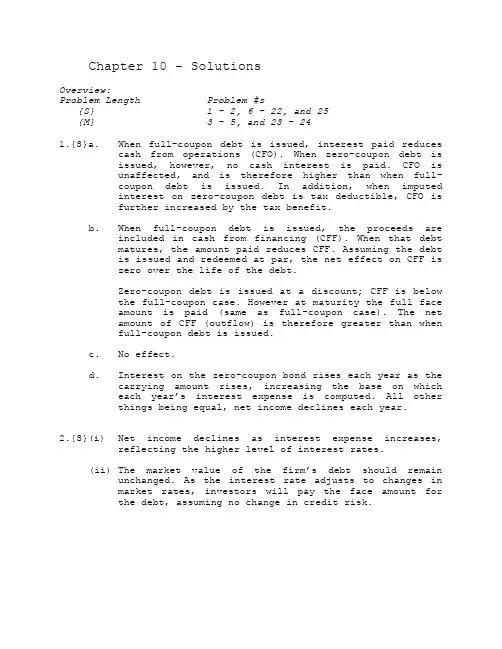
Chapter 10 - SolutionsOverview:Problem Length Problem #s{S} 1 - 2, 6 - 22, and 25{M} 3 - 5, and 23 - 241.{S}a. When full-coupon debt is issued, interest paid reducescash from operations (CFO). When zero-coupon debt isissued, however, no cash interest is paid. CFO isunaffected, and is therefore higher than when full-coupon debt is issued. In addition, when imputedinterest on zero-coupon debt is tax deductible, CFO isfurther increased by the tax benefit.b. When full-coupon debt is issued, the proceeds areincluded in cash from financing (CFF). When that debtmatures, the amount paid reduces CFF. Assuming the debtis issued and redeemed at par, the net effect on CFF iszero over the life of the debt.Zero-coupon debt is issued at a discount; CFF is belowthe full-coupon case. However at maturity the full faceamount is paid (same as full-coupon case). The netamount of CFF (outflow) is therefore greater than whenfull-coupon debt is issued.c. No effect.d. Interest on the zero-coupon bond rises each year as thecarrying amount rises, increasing the base on whicheach year’s interest expense is computed. All otherthings being equal, net income declines each year.2.{S}(i) Net income declines as interest expense increases,reflecting the higher level of interest rates.(ii) The market value of the firm’s debt should remain unchanged. As the interest rate adjusts to changes inmarket rates, investors will pay the face amount forthe debt, assuming no change in credit risk.3.{M}a. Reported datab. Unlike other payables, the air traffic liability willnot require cash outlays (other than low marginalcosts); instead this obligation is satisfied ascustomers use their tickets on flights. The air trafficliability should therefore be excluded fromcomputations of short-term liabilities.As expected, all of American Airlines' liquidity measures improve when the air traffic liability is removed from current liabilities.However the adjustments in the table above overstate the firms’ liquidity, especially for AMR. A portion of the air traffic liability relates to frequent flyer programs (37% of AMR’s 1999 liability and 13% of US Airways’ 1999 liability). AMR’s frequent flyer obligation is based on the incremental costs of fuel, food, and reservations/ticketing costs (US Airw ays’ approach is similar but includes insurance and other compensation). Thus some portion of the air traffic liability does represent near-term cash outlays.d. US Airways’ short-term liquidity position appears to bestronger than American’s at December31, 1999 as its current ratio and cash ratio are both higher and the quick ratio is that same. However, the higher current and quick ratios evaporate when the air traffic liability is eliminated. This liability is lower for US Airways (relative to total current liabilities). The adjusted data show that all three liquidity ratios are higher for AMR than for US Airways.While not part of the question, it is worth noting that two of the three 1998 ratios are higher for US Airways than for AMR. While the ratios of both companies declined in 1999, the decline in US Airways’ ratios was greater.e. The 1999 decline in US Airways’ air traffic liabilityindicates that fewer customers were willing to purchasetickets in advance, presumably due to the deteriorationin the company’s financial position. In contrast,American's air traffic liability increased, althoughthe growth should be compared to past fluctuations andto growth for the rest of the industry.US Airways filed for bankruptcy in August 2002.4.(M}a. Proceeds equal $100,000/(1.12)5 = $56,742c. For a full-coupon bond, annual interest expense paid ind. Cash flow from operations is higher when zero-couponbonds are issued because interest is never reported asan operating cash outflow. [Note the infinite cash-basis coverage ratio.] Interest coverage, however, islower after the first year, and declines as interestexpense increases over time, reflecting the steadilyincreasing principal amount. Full-coupon bonds (if soldat par) result in a constant cash outflow fromoperations and constant interest expense. Given theNull Company's "steady state," the interest coverageratio is constant on both accrual and cash flow bases.e. Given the tax deductibility of accrued but unpaidinterest on zero-coupon bonds, cash flow fromoperations will be higher for both cases. The reportedcash flow differences will remain unchanged. For thezero-coupon case, cash flow from operations is evenmore misleading as the firm must generate sufficientcash from operations to repay the debt at maturity. Theobligation must be repaid, regardless of its cash flowclassification.5.{M}a. The $US carrying amount = 1,282/1.37 = $936 million.b. Because the notes have no coupon, they were issued at adiscount. The difference between the face amount andthe amount computed in part a must be unamortizeddiscount.c. Interest expense (CHF millions) would be 7% X 1,282 =CHF 90d. Adding the 1999 interest computed in part c to thecarrying amount at December 31, 1998: 90 + 1,282 =CHF 1,372 millione. The most obvious explanation is the change in theexchange rate from 1.37 to 1.60.In $US, 1999 interest expense = 7% X $$936 = $65million, making the carrying amount at December 31,1999 equal to $1,001 million [$936 + $65]. This is muchcloser to the carrying amount computed at 1,618/1.60 =$1,011 million.A second factor is that interest expense in CHF iscomputed quarterly, based on average rates for eachperiod. The CHF carrying value at December 31, 1999equals the 1998 carrying value + 1999 interest expense+ translation loss [Swiss franc decline increases theCHF debt amount].f. (i) Cash from operations is higher each year when zerocoupon notes are issued because there is no cashinterest.(ii)Interest expense rises each year (excluding the effect of exchange rates) because it is based on a(rising) $US carrying amount.g. The rise in the value of the dollar (decline in Swissfranc) increases interest expense in CHF.6.{S}(i) Interest expense = Interest paid + change in bonddiscount$8,562= $7,200 + $1,362(ii) = Market rate x [face value - discount]= .12 x [face value - $8,652]Therefore, face value = ($8,562/.12) + $8,652 = $80,000 (iii)Coupon rate = interest paid/face value= $7,200/$80,000 = 9%7.{S}a. An interest rate rise would decrease the market valueof the fixed rate bonds but have no effect on thevariable rate bonds. The effect on the fixed rate bondswould depend on their duration.b. An interest rate rise would increase FIF’s interestexpense because more than half of its bonds havevariable rates as well as a small portion of its bankloans.c. A finance company seeks to match the interest ratesensitivity of its debt to that of its earning assets.It is likely that FIF’s fixed rate receivablesincreased over the 1996 –2000 period and the companyincreased its fixed rate debt to lock in the spreadbetween fixed rate interest income and expense.d. For a finance company, an analyst is interested inknowing how well the company has matched the interestrate sensitivity of its financial assets andliabilities. When fair value estimates of financialassets are not provided the fair value of debt has verylimited usefulness.8.{S}a. FIF has swapped variable rate interest payments forfixed rate (5.2%) payments on a notional amount of $25million.b.Interest received = $25 million X receive rateInterest paid = $25 million X 5.2% (both years)c. The swap reduced the sensitivity to changes in interestrates by converting part of the variable rateobligation to one with fixed rates.The yen amounts were obtained by multiplying the dollaramounts by the exchange rate. For example, for the2.14% bond at December 31, 1998, $55 X 113.60 = 6,248.[Note: the yen amounts are rounded.]c. It appears that both bonds were issued at a discount,creating amortization that increases the carryingamount each year. If we add the 1999 increase to thecoupon rate, it appears that the effective interestrates are 3.86% and 5.34% respectively.d. One possible motivation is to finance Japaneseoperations that are conducted in yen. A second is that,as a well-known company, BMY may be able to borrow morecheaply by borrowing in yen and swapping the yenproceeds into US dollars.10.{S}a. The advantage is that, when Takeda’s shareprice rose, the debt was converted into equity,strengthening the balance sheet. As convertible notesare issued with a conversion price that exceeds thethen market price, the company effectively sold commonshares at a premium. In addition, because of theconversion feature, the interest rate would have beenbelow the rate required by nonconvertible notes.The disadvantage is that the debt was converted intocommon shares at a time when Takeda could have sold newshares at a much higher price, obtaining the samecapital at a lower cost.b.The more than 50% debt decrease was the largest factorreducing the debt/total capital ratio.c. As the market price of Takeda shares was well above theconversion price in 1998, the convertible debt shouldbe classified as equity. After that adjustment(subtracting 22,000 from debt and adding the sameamount to equity) Takeda’s debt was virtually unchangedfrom 1998 to 1999 and the decline in the debt/totalcapital ratio was small:This analysis underscores the discussion in thechapter; the analyst must classify convertible debtbased on market considerations. Proper classificationresults in a more appropriate leverage measure.11.{S}a. There were two benefits: a lower interest rate than onnonconvertible debt of the same maturity and thepossibility of future conversion. If conversion takesplace Roche will have sold shares for 25% more thantheir then market price.b. First, you must compute the effective rate on the bondsconsidering their coupon rate and the discount fromface value at which they were sold. Interest expensefor 2000 would equal the effective rate multiplied bythe issue amount of 101.22 billion Yen (105 x 96.4%)prorated for the portion of the year for which thebonds were outstanding.The carrying amount at December 31, 2000 would equalthe issue amount (101.22) plus the excess of interestexpense over interest at the coupon rate.c. If the Yen appreciates (declines) against the Swissfranc, then both interest expense and the carryingamount of the debt will rise (fall).d. At the issue date the bonds should be considered debtbecause their conversion price is well above the marketprice. They should be considered equity only when themarket price is sufficiently above the market pricethat conversion can be considered highly likely.12.{S}a. The advantages to Network Associates compared withfull-coupon nonconvertible bonds were:(i)Lower interest rate(ii)No cash interest expense(iii)Higher cash flow from operations(iv)The likelihood that the debt would be converted to common shares before its maturity in 20 yearsb. The first year interest expense on the bonds is $16.44million [4.75% X $346 million (39.106% X $885)]. As thebonds were issued in February 1998 interest expense for1998 would have been below that amount. Assuming 1998interest expense of $15 million results in a carryingamount of $361 million ($346 + $15).Thus 1999 interest expense can be estimated as $17.15million (4.75% X $361 million), close to the amount inthe cash flow statement. This represents, therefore,the noncash interest expense for 1999.c. At a common stock price of $66.25, the conversion valueof the bonds was:$1,280 million [$885 X ($66.25/$45.80)]At this price conversion is highly likely and theconvertible bonds should be treated as equity.d. At a common stock price of $4, the conversion value ofthe bonds was $77.3 million [$885 X ($4/$45.80)]. Atthis price conversion is highly unlikely and theconvertible bonds should be treated as debt.e. Issuing bonds with an embedded put option has theadvantage of lowering the interest rate, as investorswill accept a lower rate in return for the put option.The disadvantage is that NET may be required to redeemsome or all of the bonds if bondholders exercise theput option. As option exercise is likely only if thecom pany’s financial condition has weakened and theshares are selling at a low price, option exercise maystrain the company’s financial condition further.13.{S}(i) If Munich Re had sold its shares of Allianz in June2000 it would have incurred a large capital gains tax.In addition, it would have had to sell the large blockof shares at a discount to the market price of Allianz.By selling the exchangeable notes, Munich has postponedthe effective sale date, in the expectation thatcapital gains taxes would be reduced (they were). Inaddition, assuming the bonds are exchanged for Allianzshares, it sold those shares at a premium of 28% to themarket price.The major disadvantage is that Munich Re retains therisk of ownership of Allianz shares. If Allianz sharesdo not rise by the maturity date of the notes, Munichwill still hold the shares and will be required torepay the debt. In addition, Munich will have to payinterest expense on the notes until they mature or areexchanged, although it will also receive any dividendsdeclared by Allianz. [Note: in December 2002 the marketprice of Allianz shares was €100, far below the €509price at which the bonds are exchangeable.](ii)If Munich Re had sold notes without the exchange feature it would have had to offer a higher interestrate, incurring higher interest expense. In addition,if the notes are exchanged, Munich Re will not have torepay the debt and interest expense will decline asbonds are exchanged for Allianz shares.The disadvantage is that Munich Re has given up thepossibility of a large increase in the value of Allianzshares. Munich has also lost the flexibility of beingable to choose the period in which is recognizes thegain on the sale of Allianz shares.14.{S}a. Future redemption depends on conditions in the creditmarkets at each “reset” date. Investors would chooseredemption if more attractive Swiss franc (SFR)investments were available. That would be the case, forexample, if PepsiCo’s credit rating had declined.PepsiCo would redeem bonds if alternative financingsources are available or if SFR debt is no longerdesirable. The latter depends on PepsiCo’s exposure toSFR assets at that time or, if the debt was swapped fordebt in another currency, conditions in the swap marketat that time.b. The obligations should be classified as debt. One mightargue that, because there is no stated maturity date,these bonds are “permanent” capital and should beconsidered equity. However the periodic resetprovisions suggest that, at some point, either PepsiCoor investors will choose the redemption option. Asinvestors can force redemption, the bonds should beclassified as debt.15.{S}a. An investor who is willing to accept the risk of lossof principal might find the high returns on these bondsattractive.b. In a period without insurance losses, Scor will berequired to pay the high stated interest rates on thesebonds, increasing interest expense, reducing reportedincome, and reducing the interest coverage ratio.c. In a period with insurance losses, Scor will berequired to pay little or no interest on these bonds,increasing net income and the interest coverage ratio.d. These bonds hedge Scor’s insurance risk. Interestexpense on these bonds will be high in periods withoutlosses and low in periods with losses. As a result theyreduce the variability of Scor’s reported net income. 16.{S}a. The preferred shares should be categorized as debt. Thedividend is set by periodic auctions and the companymay redeem them at any time. In effect, they are a formof short-term debt that the company can extend as longas it is willing to pay the rate demanded by themarket. Should the company find a cheaper source offinancing, it is likely to call the preferred issue.[They were called in June 2001.]b.The ratio calculation before and after adjustment is:17.{S}a. The fair value of Wal-Mart’s debt declined relative tobook value from 1-31-99 to 1-31-00. Interest rates musthave risen during that time period, as higher ratesreduce the present value of future payments.b. The fair value at 1-31-99 was above book value,implying that (on that date) interest rates were belowthe average rate of 7.2% on Wal-Mart debt. Thus thecompany could have borrowed at those lower rates,before rates increased, reducing its average rate.18.{S}a. Wal-Mart may have believed that variable rates werelikely to fall and/or remain below fixed rates over theswap period. Swapping fixed for variable rates would,under that assumption, reduce interest expense.b. One risk that variable rates would rise so that theswaps would increase interest expense. The second riskis counterparty risk – the risk that the other party tothe swap would be unwilling to pay. The second riskwould apply only when interest rate changes requirepayments to Wal-Mart.c.When interest rates rise, the value of the right toreceive the fixed rate of 5.75% declines, reducing thefair value of the swap. We know from problem 17a thatinterest rates rose from 1-31-99 to 1-31-00.19.{S}a. The market value of AMR’s fixed rate debt issues fellrelative to book value at December 31, 1999, implyingthat interest rates must have risen. Higher ratesreduce the present value of payments associated withfixed rate debt.b. The interest rate must have been below 10.2% as thepresent value exceeds book value.c. Because the interest rate on variable rate debt floats,fair value should not change except as a result ofchanges in credit quality.20.{S}a. Because the average floating rate was below the averagefixed rate, th e swaps reduced AMR’s interest expense.b. AMR’s swaps convert fixed rate to variable rate debt;AMR exchanged the right to received fixed rates for anobligation to pay variable rates. When interest ratesrise, the value of the right to receive fixed ratesdeclines, reducing the fair value of the swap. From theanswer to problem 19a, we know that interest rates fellin 1999. The rise in interest rates therefore decreasesthe fair value of the swaps.c. AMR’s debt nearly doubled in 1999, increasing itsexposure to changes in interest rates as much of itsdebt is fixed rate. Both the notional and fair value ofAMR’s swaps declined in 1999, reducing their offsettingeffect on market risk. Both of these factors increasedAMR’s exposure.21.{S}a. An argument for inclusion is that, for Fannie Mae, theissuance and retirement of debt are recurring operatingactivities whose consequences should be included in operating earnings.An argument for exclusion is that gains or losses from debt repurchase reflect economic changes during the entire period the debt was outstanding and should not be included in operating earnings for the period in which management chose to realize the gain.b. An argument for including the hedging loss is thathedging activities are part o f Fannie Mae’s normal operating activities.An argument for exclusion is that the hedging loss was unusually large and inclusion distorts the trend of operating earnings.c. We believe that gains and losses from debt retirementshould be excluded from operating earnings for most firms. These gains and losses result from management decisions and because (as discussed in the chapter) refinancing may not yield any economic gain or loss despite the accounting gain or loss. Hedging results should be included in operating earnings as hedging gains and losses should offset other economic effects that are also included.However, Fannie Mae may be an exception. As stated in part a, the company routinely issues and retires debt, suggesting that gains and losses should be included in operating earnings. Before doing so, the analyst should try to determine whether the gains or losses for the particular quarter are unusual or reflect interest rate changes over multiple periods, suggesting that the gains or losses should (analytically) be spread over several quarters.22.{S}a. The $300 million gain should be excluded from Arco’soperating earnings for 1997 because the gain resultsfrom the appreciation of Lyondell shares in prior years(possibly including years prior to the bond issuance).b.Arco may have chosen to issue the exchangeable notes to(i)maintain its controlling interest in Lyondell forstrategic reasons(ii)postpone the income tax consequences of sale(iii)obtain a higher price for the shares than the market price at that time(iv)avoid an unfavorable impact on sale proceeds due to the effect on Lyondell’s share price of sellinga large block of shares(v)retain the flexibility to report the gain in a period of management’s choicec.On Arco’s balance sheet, the investment in Lyo ndellshares is reduced by the cost basis of the sharesexchanged; debt is reduced by the carrying value of thenotes retired; equity is increased by the (after-tax)gain.The income statement reports the gain on the sale andthe related income tax expense.The transaction is noncash. However Arco’s cash flowstatement will report (as an adjustment to net incomein the cash from operations section) the amount of thegain and any deferred income tax effect.23.{M}a. Adding principal and interest payments:PV of $20 million, payable in 10 years1 = $ 9,127,800+ PV of 20 payments of $1 million each2 = 13,590,330Financing cash inflow = proceeds = $22,718,1301PV factor (n=20, r=.04) = .45639 x $20,000,000 = $ 9,127,8002PV factor (n=20; r=.04) = 13.59033 x $1,000,000 = $13,590,330On January 1, 2000, cash and debt liability are eachincreased by $22,718,130Calculations:Interest expense (income tax ignored)Year ended December 31, 2000:Interest payment of $1,000,000 (no impact on expense)Reduction of bond premium = $1,000,000 - $908,725 =$91,275Debt balance on July 1 = $22,718,130 - $91,275 =$22,626,855December 31: $22,626,855 x .04 = $905,074 interestexpense, shown as accrued interest on December 31, 1994balance sheetJanuary 1, 2001:Interest payment of $1,000,000 (no impact on expense)Reduction of bond premium = $1,000,000 - $905,074 =$94,926Debt balance on Jan. 1 = $22,626,855 - $94,926 =$22,531,929Year ended December 31, 2001:July 1: $22,531,929 x .04 = $901,277 interest expense Interest payment of $1,000,000 (no impact on expense) Reduction of bond premium = $1,000,000 - $901,277 = $98,723Debt balance on July 1 = $22,531,929 - $98,723 = $22,433,206December 31: $22,433,206 x .04 = $897,328 interest expense, shown as accrued interest on December 31, 1995 balance sheet.January 1, 2002:Interest payment of $1,000,000 (no impact on expense) Reduction of bond premium = $1,000,000 - $897,328 = $102,672Debt balance on January 1 = $22,433,206 - $102,672 = $22,330,534Operating cash outflow2000: One interest payment on July 1, 1994, $1,000,000 2001: Two interest payments of $1,000,000 each, on January 1 and July 1, $2,000,000Balance sheet impactsreduction of bond premium at July 1interest payable at December 31interest expense reduces equity2001: reduction of interest payable and bond premium at January 1reduction of bond premium at July 1interest payable at December 31interest expense reduces equityb. The purchase price must be equal to the face amountsince the market interest rate is equal to the coupon rate.3The carrying amount of the bonds on July 1, 2003 will be $21,997,050.4The gain from repurchase is the difference between the purchase price and carrying amount: $20,000,000 - $21,997,050 = $1,997,050. It is a gain because a liability has been extinguished for a lesser asset amount. Because of the change in interest rates since the bonds were issued, Derek has captured the remaining bond premium. The journal entry would be: Bonds payable 20,000,000Premium on bonds payable 1,997,050Cash 20,000,000Gain on extinguishment 1,997,0503 This can be shown, as well, by using present values: purchaseprice = present value of $20,000,000, to be repaid in 6.5 years: PV factor (n=13, r=.05) = .53032 x $20 million = $10,606,400 plus PV of 13 payments of $1,000,000 each: PV factor (n=13, r=.05) = 9.39357 x $1,000,000 = $9,393,570; total is $20,000,000.4 Present value of $20,000,000, to be repaid in 6.5 years: PVfactor (n=13, r=.04) = .60057 x $20 million = $12,011,400 plus PV of 13 payments of $1,000,000 each: PV factor (n=13, r=.04) =9.98565 x $1,000,000 = $9,985,650; total = $21,997,050. Thecarrying amount could also be determined by extending the analysis in part A (reducing the bond premium at the time of each interest payment) to July 1, 2003.c. The gain is not a component of continuing, operatingincome but should be considered nonrecurring. It is a consequence of the change in interest rates rather than the firm's operating activities, and cannot be expected to recur.d. 1. The gain provides a one-time increase in reportednet income.2. The decrease in leverage (as a lower amount ofhigher coupon debt is issued to replace the lowercoupon debt) may help the firm avert or delaytechnical default on bond covenants. Therepurchase may also allow the firm to eliminatelimiting covenants on this specific debt issue.Thus even if new debt must be issued to raise thefunds needed for repurchase, the firm may wish toretire the bond issue.24.{M}a. The data needed to calculate the ratios for each of thethree options follows ($ thousands):1 No cash interest is paid on the zero coupon bond (see note 2).2 Unpaid interest on the zero coupon bond increases the liability.The resultant ratios for each of the three options areshown above, with ratios that violate the applicablecovenant in boldface. Note that each of the optionsviolates at least one of the covenants and theconventional bond violates two.The zero-coupon bond seems to be the "best" as it results in high coverage ratios (no cash interest payment) and the debt to assets limit is barely violated. It violates this covenant because debt increases to reflect the unpaid interest.b. The best approach is to combine the zero-coupon bond,which violates only the debt/assets covenant, with another financing method that brings down that ratio without lowering either of the other ratios excessively. Preferred stock dominates conventional bonds as it has a lower debt/assets ratio and its coverage ratios are at least as high. Thus the optimal choice is a combination of preferred stock and zero coupon bonds. Because the times interest coverage ratio is identical at 1.95 for both we need only consider the last two ratios:CFO/(interest + preferred dividends) must exceed 1.80Long-term debt/gross assets must be less than 0.50 If P dollars are raised via preferred shares and Z dollars via zero coupon bonds, then P + Z = $1,000,000.For the zero coupon bonds, the amount of debt at year-end is 1.1Z because of the accrual of unpaid interest.These constraints reduce to the following equations (amounts in $thousands):I: $390/($200 + $100p) > 1.80 where p = P/$1,000,000 II: $2,000 + $1,100 (1-p) < 0.50$6,000These reduce to the following constraints:I: .167 > p II: p > .091Thus, .167 > p > .091。