
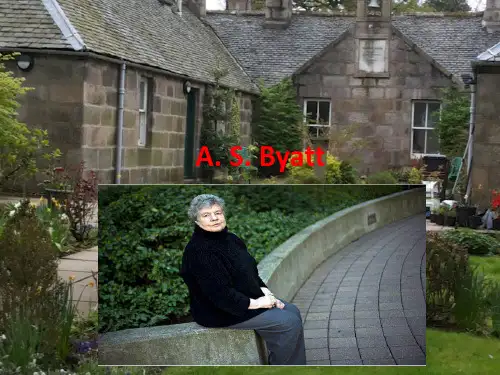
A.S.Byatt
- 格式:pptx
- 大小:1.56 MB
- 文档页数:27

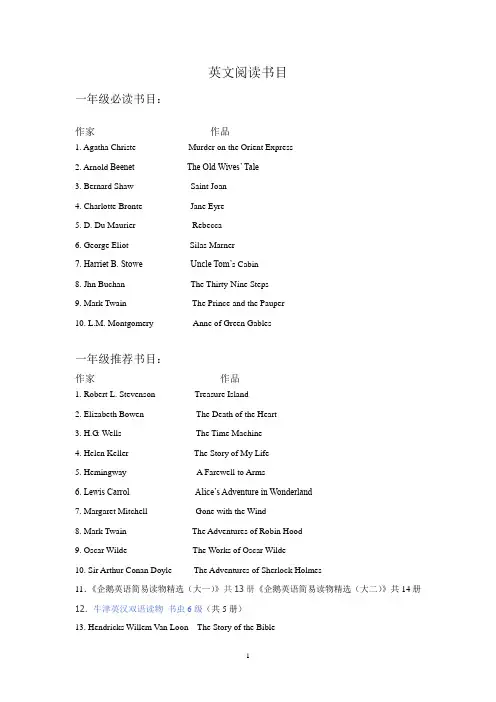
英文阅读书目一年级必读书目:作家作品1. Agatha Christe Murder on the Orient Express2. Arnold Beenet The Old Wives’ Tale3. Bernard Shaw Saint Joan4. Charlotte Bronte Jane Eyre5. D. Du Maurier Rebecca6. George Eliot Silas Marner7. Harriet B. Stowe Uncle Tom’s Cabin8. Jhn Buchan The Thirty-Nine Steps9. Mark Twain The Prince and the Pauper10. L.M. Montgomery Anne of Green Gables一年级推荐书目:作家作品1. Robert L. Stevenson Treasure Island2. Elizabeth Bowen The Death of the Heart3. H.G. Wells The Time Machine4. Helen Keller The Story of My Life5. Hemingway A Farewell to Arms6. Lewis Carrol Alice’s Adventure in Wonderland7. Margaret Mitchell Gone with the Wind8. Mark Twain The Adventures of Robin Hood9. Oscar Wilde The Works of Oscar Wilde10. Sir Arthur Conan Doyle The Adventures of Sherlock Holmes11.《企鹅英语简易读物精选(大一)》共13册《企鹅英语简易读物精选(大二)》共14册12.牛津英汉双语读物书虫6级(共5册)13. Hendricks Willem V an Loon The Story of the Bible二年级必读书目作家作品1. Charles Dickens A Tale of Two Cities2. F. Scott Fitzgerald The Great Gatsby3. George Orwell Nineteen Eighty-Four4. Jack London Martin Eden5. Jane Austen Emma6. Jane Austen Pride and Prejudice7. John Le Carre The Spy Who Came in from the Cold8. Theodore Dreiser An American Tragedy9. Theodore Dreiser Sister Carrie10. Thomas Hardy Tess of t he D’Urbervilles二年级推荐书目:作家作品1. D. H. Lawrence Women in Love2. Joseph Conrad The Secret Agent: a Simple Tale3. Joseph Conrad Lord Jim4. Mark Twain The Adventures of Huckleberry Finn5. Morley Callaghan That Summer in Paris6. Nathaniel Hawthorne The Scarlet Letter7. Northrop Frye The Great Code8. Thomas Hardy Jude the Obscure9. Thomas Wolfe Lood Homeward, Angel10. Willa Cather My Antonia/O Pioneers!11. Arthur Miller Death of a Salesman12. Mark Twain The Adventure of Huckleberry Finn13. Jane Austen Sense and Sensibility14. William Shakespeare Four Shakespeare’s Comedies15. William Shakespeare Four Shakespeare’s Tragedies16. Charles Dickens Oliver Twist17. Daniel Defoe Robinson Crusoe三年级必读书目作家作品1. Aldous Huxley Brave New World2. Alexandre Dumas The Count of Monte Cristo3. Doris Lessing The Golden Notebook4. Emily Bronte Wuthering Heights5. Francis Bacon Essays6. Henry D. Thoreau Walden7. Henry James The Ambassadors8. J.D. Sailinger The Catcher in the Rye9. James A. Michener Centennial10. William Trackery V anity Fair三年级推荐书目:作家作品1. A.S.Byatt Possession2. Alex Haley Roots3. Carson Mccullers The Heart Is a Lonely Hunter4. Ernest Hemingway The Old Man and the Sea5. Ivy Compton-Burnett A Family and a Fortune6. John Fowles The French Lieutenant’s Woman7. Maxine Hong Kingston The Woman Warrior8. Sinclair Lewis Main Street9. William Faulkner The Sound and the Fury10. William S. Burroughs The Naked Lunch11. Eugene O’Neill Desire under the Elm12. T ennessee Williams A Streetcar Named Desire13. Lin Y utang My Country and My People四年级必读书目作家作品1. Charles Dickens David Copperfield2. Ernest Hemingway The Sun Also Rises3. John Galsworthy The Man of Property4. Joseph Conrad The Heart of Darkness5. Joseph Heller Catch-226. Margaret Drable The Middle Ground7. Ralph Eillision Invisible Man8. Sherwood Anderson The Egg9. Stephen Crane The Red Badge of Courage10. Thomas Hardy A Pair of Bule Eyes11. Willa Cather The Song of Lark12. William Faulkner Go Down, Moses四年级推荐书目:作家作品1. C.P. Snow The Masters2. Erich Segal Man, Woman and Child3. Frank Norris Nineteen Eighty-Four4. Herman Wouk The Winds of War5. John Steinbeck The Grapes of Wrath6. Mark Twain Life on the Mississippi7. Norman Mailer The Naked and the Dead8. Richard Wright Native Son9. V irginia Woolf Mrs. Dalloway10. William Shakespeare The Taming of the Shrew11. Kingsley Amis Lucky Jim12. Doris Lessing The Grass Is Singing13. James Joyce Dubliners。
【一生必读的100部英文小说】 2009-07-25 22:35 | (分类:文学)下面这100本英语小说,是西方人认定的上世纪二十年代以来发表出来的最杰出的英语小说。
是绝对具有珍藏价值的小说。
学英语专业的人应该读,没学英语专业的,也应该有空的时候把相关的汉译本拿来读读。
翻阅这样的小说,可以保证你真正做到“开卷有益”,而不至于将宝贵的生命与时间浪费在茫茫的烂书堆中。
总之,这些小说的名字,对于很多中国读者来说,可能有些陌生,但那是因为是受到了前辈们的“熏陶”,他们给我们开列的书单,是那一代人视野所能及的范围。
他们也只能开列出19世纪以前的经典小说书单,从某种意义上说,它们离我们更远些。
而下面的这100本英语经典小说的书单,更反映了当代西方人的某种权威角度与视野。
诚然,这只是英语世界里的经典小说,绝对不是世界性的。
但现在不是全民一起学英语吗,这样的大环境中,好好从这100本英语经典小说中选几部出来读,恐怕都是一件十分惬意的事情。
我特意花点时间,把这100部英语经典小说的原名,作者给列在上面,并将书名全部汉译过来,主要是给没有机会读英语原版小说的人提供某种方便。
有约定俗成的就按原来的处理。
没有的,就尽量直译过来。
这是网上很多地方报道此消息时所不具备的,也是我的某种特色罢。
此外,看一下自己的书架,看一下下面这100本小说,你一共有几本,也可以从某种角度上说明了我们对现当代西方文学的认识有多深或有多浅。
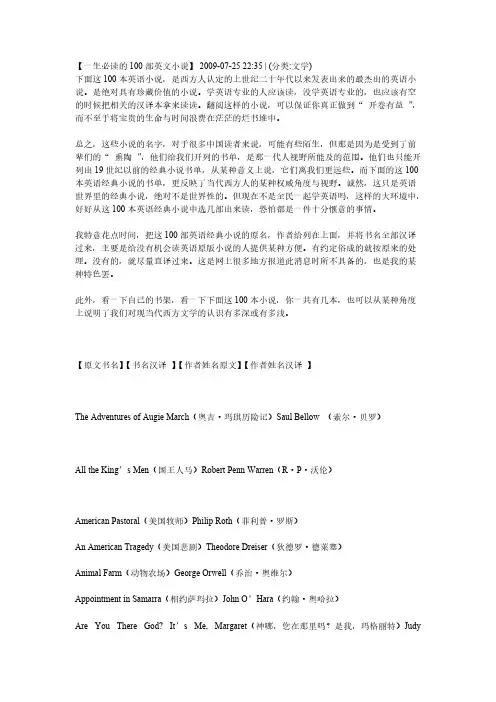
【原文书名】【书名汉译】【作者姓名原文】【作者姓名汉译】The Adventures of Augie March(奥吉·玛琪历险记)Saul Bellow (索尔·贝罗)All the King’s Men(国王人马)Robert Penn Warren(R·P·沃伦)American Pastoral(美国牧师)Philip Roth(菲利普·罗斯)An American Tragedy(美国悲剧)Theodore Dreiser(狄德罗·德莱塞)Animal Farm(动物农场)George Orwell(乔治·奥维尔)Appointment in Samarra(相约萨玛拉)John O’Hara(约翰·奥哈拉)Are You There God? It’s Me, Margaret(神哪,您在那里吗?是我,玛格丽特)JudyBlume(朱迪·布罗姆)The Assistant(助手)Bernard Malamud(伯纳德·马拉迈德)At Swim-Two-Birds(双鸟嬉戏池塘边)Flann O’Brien(弗兰·奥伯兰)Atonement(救赎)艾恩·麦克埃文Beloved(宠儿)Toni Morrison(托尼·莫里逊)The Berlin Stories(柏林故事集)Christopher Isherwood(克里斯托夫·埃舍伍德)The Big Sleep(夜长梦多)Raymond Chandler(雷蒙·珊德勒)The Blind Assassin(盲人杀手)Margaret Atwood(玛格丽特·埃特伍德)Blood Meridian(血色子午线)Cormac McCarthy(考麦克·麦卡锡)Brideshead Revisited (旧地重游)Evelyn Waugh (埃菲琳·瓦)The Bridge of San Luis Rey(圣路易雷桥)Thornton Wilder(桑顿·王尔德)Call It Sleep(睡眠)Henry Roth(亨利·罗斯)Catch-22 (第二十二条军规)Joseph Heller(约瑟·海勒)The Catcher in the Rye(麦田守望者)J.D. Salinger(J·D·塞林格)A Clockwork Orange(发条橙子)Anthony Burgess(安东尼·伯格斯)The Confessions of Nat Turner(纳特·特纳的忏悔)William Styron(威廉·斯太龙)The Corrections(纠正)Jonathan Franzen(约那逊·弗兰森)The Crying of Lot 49(拍卖第49号])Thomas Pynchon(托马斯·品钦)A Dance to the Music of Time(随时间音乐起舞)Anthony Powell(安东尼·鲍威)The Day of the Locust(蝗虫肆虐日)Nathanael West(那瑟那尔·威斯特)Death Comes for the Archbishop(大主教之死)Willa Cather(威拉·凯瑟)A Death in the Family(家族成员之死)James Agee(詹姆斯·阿吉)The Death of the Heart(心脏之死)Elizabeth Bowen(伊丽莎白·伯文)Deliverance(释放)James Dickey(詹姆斯·迪克)Dog Soldiers(亡命之徒)Robert Stone(罗伯特·斯通)Falconer(放鹰者)John Cheever(约翰·契佛)The French Lieutenant’s Woman (法国中尉的女人)John Fowles(约翰·弗勒斯)The Golden Notebook(金色笔记)Doris Lessing(D·莱辛)Go Tell it on the Mountain(山上高呼)James Baldwin(詹姆斯·鲍德温)Gone With the Wind(飘)Margaret Mitchell(玛格丽特·米切尔)The Grapes of Wrath(愤怒的葡萄)John Steinbeck(约翰·斯坦伯克)Gravity’s Rainbow(引力彩虹)Thomas Pynchon(托马斯·品钦)The Great Gatsby(了不起的盖茨比)F. Scott Fitzgerald(F·斯考特·菲茨杰拉德)A Handful of Dust(一掬尘土)Evelyn Waugh(埃菲琳·瓦)The Heart Is A Lonely Hunter(心是孤独的猎手)Carson McCullers(卡尔逊·迈勒斯)The Heart of the Matter(核心问题)Graham Greene(G·格林)Herzog(赫尔佐格)Saul Bellow(索尔·贝罗)Housekeeping(管家)Marilynne Robinson (玛琳·罗伯逊)A House for Mr. Biswas(毕斯瓦思先生之屋)V.S. Naipaul (V·S·纳保罗)I, Claudius(我,克劳迪斯)Robert Graves(罗伯特·格里夫斯)Infinite Jest(无尽的玩笑)David Foster Wallace(戴维·弗斯特·华莱士)Invisible Man(隐形人)Ralph Ellison(拉尔芙·埃利逊)Light in August(八月之光)William Faulkner(威廉·福克纳)The Lion, The Witch and the Wardrobe(狮子,女巫和魔衣橱)C.S. Lewis(C·S·Lewis)Lolita(洛丽塔)Vladimir Naboko 弗拉基米尔·那波克Lord of the Flies(蝇王)William Golding 威廉·格尔丁The Lord of the Rings(指环王)by J.R.R. Tolkein (J·R·R·托肯)Loving(爱)Henry Green(亨利·格林)Lucky Jim(幸运的吉姆)Kingsley Amis(金斯利·埃米斯)The Man Who Loved Children (那个喜欢孩子的人)Christina Stead(克里斯蒂·斯太德)Midnight's Children(午夜之子)Salman Rushdie(萨尔曼·拉什迪)Money(金钱)Martin Amis(马丁·埃米斯)The Moviegoer(电影迷)Walker Percy(沃克·泊西)Mrs. Dalloway(达罗薇夫人)Virginia Woolf(芙吉妮亚·伍尔夫)Naked Lunch(裸体午餐)William Burroughs (威廉·伯罗斯)Native Son(土著之子)Richard Wright(理查·莱特)Neuromancer(神经漫游者)William Gibson(威廉·吉普逊)Never Let Me Go(别让我走)Kazuo Ishiguro (卡佐·伊什古罗)1984(一九八四)George Orwell(乔治·奥维尔)On the Road(在路上)by Jack Kerouac(杰克·克鲁亚克)One Flew Over the Cuckoo's Nest(飞越疯人院)Ken Kesey(肯·克西)The Painted Bird(染色鸟)Jerzy Kosinski(泽西·克金斯基)Pale Fire(幽冥火)Vladimir Nabokov(弗拉基米尔·那巴克夫)A Passage to India(印度之行)E.M. Forster(E·M·弗斯特)Play It As It Lays(顺其自然)Joan Didion(琼·迪丹)Portnoy's Complaint (波特诺的抱怨)Philip Roth(菲利普·罗斯)Possession(占有)A.S. Byatt(A·S·伯亚特)The Power and the Glory(权力与荣耀)Graham Greene(G·格林)The Prime of Miss Jean Brodie(让·布罗迪小姐的巅峰时刻)Muriel Spark(莫里·斯巴克)Rabbit, Run(兔子,跑吧)John Updike(约翰·厄普代克)Ragtime(雷格泰姆音乐)E.L. Doctorow(E·L·多克特罗)The Recognitions(辨识)William Gaddis(威廉·格迪斯)Red Harvest(红色收获)Dashiell Hammett (达斯·哈迈特)Revolutionary Road(革命之路)Richard Yates(理查·叶茨)The Sheltering Sky(僻护天空)Paul Bowles(保罗·保尔斯)Slaughterhouse-Five(第五号屠场)Kurt Vonnegut(克特·冯尼格特)Snow Crash(雪崩)Neal Stephenson(尼尔·史蒂文森)The Sot-Weed Factor(因素)John Barth(约翰·伯斯)The Sound and the Fury(喧哗与骚动)William Faulkner(威廉·福克纳)The Sportswriter(体育新闻记者)Richard Ford(理查·福特)The Spy Who Came in From the Cold(柏林谍影)John LeCarre(约翰·勒克)The Sun Also Rises(太阳照样升起)Ernest Hemingway(厄内斯特·海明威)Their Eyes Were Watching God(他们仰望上帝)Zora Neale Hurston(佐拉·尼尔·赫斯顿)Things Fall Apart(瓦解)Chinua Achebe(切努瓦·阿切比)To Kill a Mockingbird(杀死一只知更鸟)Harper Lee(哈普·李)To the Lighthouse(到灯塔去)Virginia Woolf(芙吉妮亚·伍尔夫)Tropic of Cancer(北回归线)Henry Miller(亨利·米勒)Ubik(尤比克)Philip K. Dick (菲·K·迪克)Under the Net(网下)Iris Murdoch(埃尔斯·莫多克)Under the Volcano(火山下)Malcolm Lowrey(马尔孔·罗瑞)Watchmen by Alan Moore & Dave Gibbons(守夜者)White Noise(白噪音)Don DeLillo(丹·迪里罗)White Teeth(白色的牙齿)Zadie Smith(匝迪·史密斯)Wide Sargasso Sea(野海草之海)Jean Rhys(让·里斯。

The Historian has been described as a combination of genres, including the Gothic novel, the adventure novel, the detective novel, the travelogue, the postmodern historical novel, the epistolary epic, and the historical thriller.According to Kostova, Bram Stoker"created Dracula as a brilliant figure; a creature that is part monster and part genius. Dracula represents the best and worst of us.”Kostova wanted to write a serious literary novel, with scholarly heroes, that was at the same time reminiscent of 19th-century adventures. She was inspired by Victorian writers such as Wilkie Collins; his novel The Moonstone (1868), with its plot twists and bevy of narrators, was "a major model". The primary literary ancestor of The Historian, however, is Bram Stoker's Dracula (1897). For example, in The Historian and Dracula, the protagonist is both fascinated and repulsed by Dracula.[21] Both are told through a series of letters and memoirs. The Historian also includes many intertextualreferences to Stoker's work – Dracula even owns a copy of the novel. Yet, Kostova shapes Dracula into her own character. While Stoker's vampire is the focus of his novel, Kostova's is at the edges. Moreover, the blend of the fictional Dracula and the historical Vlad "adds a sinister and frightening edge" to the character, according to scholar Stine Fletcher.Despite its Gothic roots, The Historian is not suffused with violence nor is it a horror novel. Kostova aimed to write a "chilling" Victorian ghost story, and her realistic style is what creates this effect. Marlene Arpe of The Toronto Star praises Kostova's imagery in particular, quoting the following passage:A smell rose from its pages that was not merely the delicate scent of aging paper and cracked vellum. It was a reek of decay, a terrible, sickening odor, a smell of old meat or corrupted flesh. I had never noticed it before and I leaned closer, sniffing, unbelieving, then shut the book. I reopened it, after a moment, and again stomach-churning fumes arose from its pages. The little volume seemed alive in my hands, yet it smelled like death.As Peter Bebergal explains in The Boston Globe, "Instead of fetishizing blood, Kostova fetishizes documents (manuscripts, maps, letters) and the places that house them (libraries, archives and monasteries)." As one critic explains, "the real horror rests in the possibility of what Dracula truly is". For example, the narrator comments:The thing that most haunted me that day, however, as I closed my notebook and put my coat on to go home, was not my ghostly image of Dracula, or the description of impalement, but the fact that these things had – apparently – actually occurred. If I listened too closely, I thought, I would hear the screams of the boys, of the 'large family' dying together. For all his attention to my historical education, my father had neglected to tell me this: history's terrible moments were real. I understand now, decades later, that he could never have told me. Only history itself can convince you of such a truth. And once you've seen that truth really seen it – you can't look away.The novel's tone and structure place it within the serious literary tradition for which Kostova was aiming. For example, the alternating timelines are suggestive of A. S.Byatt's Possession (1990) and the intermingling of academia andthe occult suggests Arturo Perez-Reverte's The Club Dumas (1993). Although many reviewers compared The Historian to Dan Brown's historical thriller The Da VinciCode (2003), Kostova has said her book "is part of a tradition where literary craft and experiments in form are all as important as action ... the only overlap is this idea of people searching for something in history. I'm still surprised when people make this comparison, I'm very grateful my publisher has never pushed it." Moreover, the only real historical personage in her novel is Vlad Ţepeş and she changed the name of some locations "fearing some readers might confuse fantasy and reality, as they have with Brown's novels".Reviewers praised Kostova's lush descriptions of the setting and the fascinating European cities and countries which the story traverses: Amsterdam, Slovenia, Romania, Bulgaria, Turkey, France, Oxford, Switzerland and Italy.History and questions about its role in society pervade The Historian. In particular, the novel argues that knowledge of history is power, particularly as it is written in books. The title can refer to any of the major characters, including Dracula. As Nancy Baker explains in The Globe and Mail, the novel is "about the love of books" and the knowledge and comfort they offer the characters – even Dracula himself is a bibliophile. As one critic explains, the novel is specifically about the love of scholarship. At the heart of the novel is an exploration of "the power and price of scholarly obsession". As Paul explains in the novel:It is a fact that we historians are interested in what is partly a reflection of ourselves we would rather not examine except through the medium of scholarship; it is also true that as we steep ourselves in our interests, they become more and more a part of us. Visiting an American university ... I was introduced to one of the first of the great American historians of Nazi Germany. He lived in a comfortable house at the edge of the campus, where he collected not only books on his topic but also the official china of the Third Reich. His dogs, two enormous German shepherds, patrolled the front yard day and night. Over drinks with other faculty members, he told me in no uncertain terms how he despised Hitler's crimes and wanted to expose them in the greatest possible detail to the outside world. I left the party early, walking carefully past those big dogs, unable to shake my revulsion.The novel explores questions of good and evil and as Jessica Treadway states in The Chicago Tribune, it "is intriguing for its thorough examination of what constitutes evil and why it exists". For example, Dracula at one point asks Rossi:History has taught us that the nature of man is evil, sublimely so. Good is not perfectible, but evil is. Why should you not use your great mind in service of what isperfectible? ... There is no purity like the purity of the sufferings of history. You will have what every historian wants: history will be reality to you. We will wash our minds clean with blood.As Kostova explains, "Dracula is a metaphor for the evil that is so hard to undo in history." For example, he is shown influencing Eastern European tyrants and supporting national socialism in Transylvania. He is "vainglorious, vindictive, [and] vicious". As Michael Dirda explains in The Washington Post, the novel conveys the idea that "Most of history's worst nightmares result from an unthinking obedience to authority, high-minded zealotry seductively overriding our mere humanity." It is in the figure of the vampire that Kostova reveals this, since "our fear of Dracula lies in the fear of losing ourselves, of relinquishing our very identities as human beings". In fact, the narrator is never named in the novel, suggesting, as one critic explains, "that the quest for the dark side of human nature is more universal than specific to a concrete character".Religion is also a dominant theme of The Historian. Dracula is Christian and, as Bebergal explains, "Much of what is frightening in the novel is the suggestion of heretical Christian practices and conspiratorial monks." Kostova herself notes that the world is still "wracked by religious conflict", therefore historical fiction about the topic is relevant. The portions of the novel set in Istanbul, for example, highlight the extent to which the real Vlad detested the Ottomans, waging holy war upon them. More specifically, Amir Taheri in Asharq Alawsat argues that the novel highlights the relationship between the West and Turkey. The West, which is laden with the "dead" weight of this past (represented by the vampires) needs the help of Turkey (and perhaps the entire Muslim world) to recover. As Taheri points out, one of the most appealing characters in the novel is Professor Bora, a Turkish professor who is part of an ancient Ottoman society dedicated to defeatingDracula. Taheri emphasizes that the novel highlights that "Western civilisation and Islam have common enemies represented by 'vampires' such as postmodernism in Europe and obscurantism in the Muslim world".。