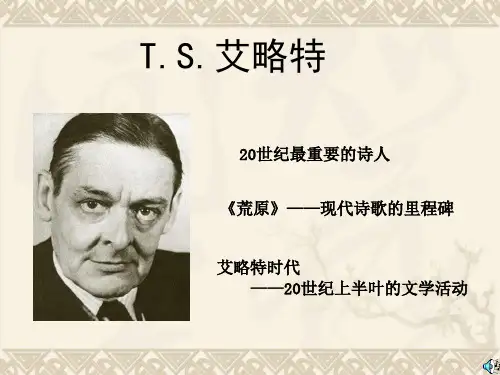
T.S.Eliot
- 格式:doc
- 大小:37.00 KB
- 文档页数:4
T. S. Eliot (1888- 1965) was born into a Unitarian family in St. Louis of America. His grandfather was a priest of Christian Association of North America, who also founded Smiths Academy and Washington University. Eliot’s father built a famous Brick Manufacturing Company in St. Louis after graduating from Washington University. His mother was a daughter of local eminent family, having a great passion for literature, especially poetry, who had a great influence on T. S. Eliot. He spent his childhood in Smith Academy and Milton Academy, and these two colleges had a close relationship with his family.At 16, he began to publish poetry, and A Lyric was one of his early several poems. In 1906, he entered Harvard University to learn philosophy, and three years later, he received his M. A. degree. At that time, he was greatly influenced by Irving Babbitt’s anti- romanticism. After graduation from Harvard University, he studied in Paris and Oxford. In 1915, he moved to England and settled down there, teaching, working as a bank clerk, writing book reviews for publishers, suffering intensely from an unhappy marriage, and all the while composed poetry. In 1948, he won the Nobel Prize for Literature. In the following time, he received a series of honors, such as Medal of Honor issued by English queen, Dante Award and Hansa Goethe Prize. In 1965, he died of emphysema in London. In accordance with his wishes, his ashes were taken to St. Michael’s Church in Easter Coker, the village from which his ancestorshad moved to America. In 1967, on his second anniversary of his death, he was commemorated by the installation of a large stone in the floor of Poets’ corner in London’s Westminster Abbey.T. S. Eliot can be regarded as a productive writer. In his early works, western world is described as a faithless and dangerous land. The Love of J. Alfred Prufrock depicts the protagonist seems to go for an appointment, but the timidity and cowardice occupying his mind, and he is dissatisfied with the increasingly indifferent industrial city. But at the same time he can’t escape from this reality. This poem is seen as a masterpiece of the Modernist Movement, and is followed by some of his best- known poems in English language, such as The Waste Land,The Hollow Man,Four Quarters, Ashes Wednesday. He is also famous for his seven plays, especially The Murder in Cathedral Church.T.S. Eliot is more than a radical reformer, but also a blimp in creation of poetry. In order to portray the spirit and emotion of modern society, he creates fresh poetry form and language style. He makes use of natural colloquial language instead of old-fashioned poetic language, vivid and concrete image instead of void and abstract image. However, on the other hand, he places great emphasis on cultural tradition because of its unique role. In Tradition and Individual Talent, T. S. Eliot makes it clear that poet can’t transcend tradition, and history is one part of the present, having a sense of history in literature creation. He also holds anopinion a poem should be an organic thing in itself, a made object. Once it is finished, the poet no longer has control of it. It should be judged, analyzed by itself without the reference of the poet’s personal influence and intentional elements and other elements. He also thinks that modern life is chaotic, fragmentary, futile, so poetry should reflect this fragmentary nature of life.T. S. Eliot is one of the most extraordinary poets, critics of the 20th century, and he makes a significant contribution to the field of literary criticism, strongly influencing the school of New Criticism.The Hollow Man is a major poem written by T. S. Eliot. It contains five sections of varying length. The poem begins with two epigraphs: one is a quotation from Joseph Conrad's Heart of Darkness and the other is an expression used by English school children who want money to buy fireworks to celebrate Guy Fawkes Day. In the first section of the poem, a bunch of Hollow Men are leaning together like scarecrows. Everything about them is dry, including their voices and their bodies. Everything they say and do is meaningless. In the second section, the hollow man is afraid to look at people who made it to “death’s dream kingdom”–either Heaven or Hell. The Hollow Men live in a world of broken symbols and images. The third section of the poem describes the setting as barren and filled with cacti and stones. When the Hollow Men feel a desire to kiss someone, they are unable to. Instead, they say prayers to broken stones.In the fourth section, the hollow continues to describe his vacant, desolate surroundings, in which are no “eyes.”The Hollow Men are afraid to look at people or to be looked at. The fifth and final section begins with a nur sery rhyme modeled on the song “Here we go 'round the mulberry bush,” except instead of a mulberry bush the kiddies are circling a prickly pear cactus. The speaker describes how a "shadow" has paralyzed all of their activities, so they are unable to act, create, respond, or even exist.The Hollow Men is essentially a poem of expressing emptiness, meaningless and hopeless, Eliot’s exploration of the state of his own soul as one of many modern souls suffering the same affliction. The emptiness is caused by the condition of modern world, in which men live only for thems elves, failing to choose between good and evil. The “hollow men” represents all humankind, and the “hollow” has several significant images: emptiness, rootless, without social, political and ethical bounds and obligations.The lack of essence in their life is what causes a meaningless ending.。