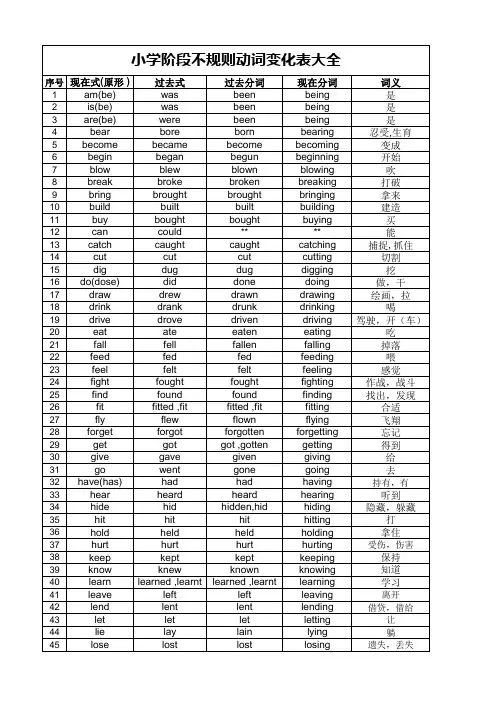
动词过去式、现在分词的不规则变化
- 格式:doc
- 大小:25.50 KB
- 文档页数:2

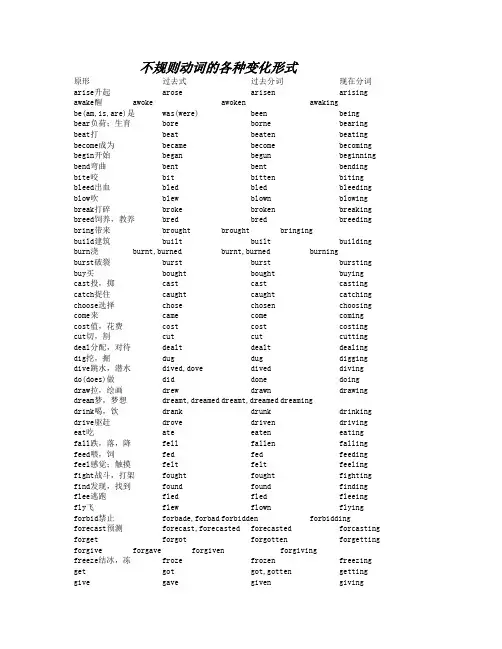
不规则动词的各种变化形式原形过去式过去分词现在分词arise升起arose arisen arising awake醒awoke awoken awakingbe(am,is,are)是was(were) been beingbear负荷;生育bore borne bearing beat打beat beaten beating become成为became become becoming begin开始began begun beginning bend弯曲bent bent bending bite咬bit bitten biting bleed出血bled bled bleeding blow吹blew blown blowing break打碎broke broken breaking breed饲养,教养bred bred breeding bring带来brought brought bringingbuild建筑built built building burn浇burnt,burned burnt,burned burningburst破裂burst burst bursting buy买bought bought buying cast投,掷cast cast casting catch捉住caught caught catching choose选择chose chosen choosing come来came come coming cost值,花费cost cost costing cut切,割cut cut cutting deal分配,对待dealt dealt dealing dig挖,掘dug dug digging dive跳水,潜水dived,dove dived divingdo(does)做did done doingdraw拉,绘画drew drawn drawing dream梦,梦想dreamt,dreamed dreamt,dreamed dreamingdrink喝,饮drank drunk drinking drive驱赶drove driven driving eat吃ate eaten eatingfall跌,落,降fell fallen falling feed喂,饲fed fed feeding feel感觉;触摸felt felt feeling fight战斗,打架fought fought fighting find发现,找到found found finding flee逃跑fled fled fleeingfly飞flew flown flying forbid禁止forbade,forbad forbidden forbidding forecast预测forecast,forecasted forecasted forcasting forget forgot forgotten forgetting forgive forgave forgiven forgivingfreeze结冰,冻froze frozen freezing get got got,gotten getting give gave given givinggo went gone going grow grew grown growing hang悬挂hung hung hanging hang绞死hanged hanged hanging have(has) had had having hear heard heard hearing hide隐藏hid hidden hiding hit hit hit hitting hold握住;举行held held holding hurt损伤,伤害hurt hurt hurting keep kept kept keeping know knew known knowing lay放置laid laid laying lead led led leading learn learnt,learned learnt,learned learningleave left left leaving lend lent lent lending let let let letting lie躺lay lain lyinglie撒谎lied lied lying light点燃,照明lighted,lit lighted,lit lighting lose lost lost losing make made made making mean meant meant meaning meet met met meeting mistake误会,弄错mistook mistaken mistakingpay paid paid paying prove proved proved,proven proving put put put putting read read read reading rid摆脱rid rid ridding ride骑,乘rode ridden riding ring鸣响rang rung ringing ring环绕ringed ringed ringing rise rose risen rising run ran run running say said said saying see saw seen seeing seek sought sought seeking sell sold sold solding send sent sent sending set set set setting sew缝合sewed sewn,sewed sewing shake shook shaken shaking shave刮(脸,胡子)shaved shaved,shaven shaving shall shouldshine发光,照射shone shone shining shine擦亮shined shined shining shoot shot shot shootingshow showed shown,showed showingshut shut shut shuttingsing sang sung singingsink下沉sank sunk sinkingsit坐sat sat sittingsleep slept slept sleepingslide滑(动)slid slid slidingsmell嗅,闻smelt,smelled smelt,smelled smellingsow撒播sowed sown,sowed sowingspeak spoke spoken speakingspeed急行;加速sped sped` speedingspeed促进;超速speeded speeded speedingspell spelt,spelled spelt,spelled spellingspend spent spent spendingspin纺spun spun spinningspit spat spat spittingsplit裂开,劈开split split splitting spread散布spread spread spreadingspring弹回sprang sprung springingstand stood sood standingsteal stole stolen stealingstick stuck stuck stickingstrike struck struck strikingstring上弦;吊起strung strung stringing sweep swept swept sweepingswim swam swum swimmingswing摇摆swung swung swingingtake took taken takingteach taught taught teachingtear扯,撕tore torn tearingtell told told tellingthink thought thought thinkingthrow threw thrown throwing understand understood understood understanding wake woke woken wakingwear穿;磨损wore worn wearingweep哭泣wept wept weepingwet使湿wet,wetted wet,wetted wettingwin获胜,赢won won winningwind绕wound wound windingwrite写wrote written writing名词的数:可数名词的复数形式一:规则变化构成:1:一般在词尾加s2:以s,x,sh,ch结尾的加es 注意:ox-oxen stomach-stomachs3:以辅音字母加y结尾时把y变成i再加es eg: factory-factories (五个元音字母a,e,i,o,u 和一个半元音 y,其它的为辅音字母)4:以f或fe结尾时,把f或fe变v再加es注意:belief,roof,fulf,safe,proof,chief,handkerchief直接在后面加s 5:大写字母及大写字母的缩写形式的复数加-s, eg:UFO-UFOs.小写字母及数字的复数形式加's:eg: three a's二:不规则变化1:foot-feet tooth-teeth goose-geese鹅mouse-micelouse-lice虱子man-men woman-women policeman-policemenEnglishman-Englishmen Frenchman-Frenchmen German-Germans ox-oxen child-children 注意:German-Germans2:单复数同形sheep deer aircraft cattle Chinese Swiss means species种类worksyuan jin crossroads series3:通常将主体名词变为复数:father-in-law fathers-in-lawcomrade-in-arms comrades-in-arms战士passer-by passers-by过路人looker-on lookers-on旁观者4:无主体名词构成的复合词,在词尾变复数:grown-up grown-ups go-between go-betweens 中间人has-been has-beens过时的人forget-me-not-forget-me-nots勿忘草hand-me-down hand-me-downs旧衣5:由man,woman,lord构成的复合名词,应将前后两个词都变成复数形式man doctor-men doctors woman driver-women driverslord mayor-lord mayors市长6:以o结尾的名词photo-photos radio-radios tobacco-tobaccos zoo-zoospiano-pianostomato-tomatoes`` potato-potatoes hero-heroes Negro-Negroes 7.外来语的复数形式:datum-data medium-media crisis-crisesphenomenon-phenomena8.下列名词的复数表示另外的含义goods,times,works,galsses,papers,greens青菜,uribs熨斗,forces军队,sands沙滩,waters水域,seas海域9.常用复数形式的名词:trousers,glasses ,thanks,clothes,remains,contents,congratulations,games,sports,prepara tions,tears,works,repairs,regards, scissors10.以s结尾但仍然是单数的词politics,maths,physics,the United States, the United Nations二:常用的不可数名词advice,chalkm,furiture,patience,paper,clothing,cloth,fun,power,work,oil,homework,house work,information,knowledge,luck, weather,progress,news,money有些不可数名词的复数形式表示不同种类 tea, fruit, steel, food, grass三:修饰词有:A:修饰不可数名词的有:a little,little,a bit of,much,a little bit of,a great/good deal of,a largesum of, a great/large/small amount ofB:修饰可数名词的有:these,those, few, a few, many, a good/great many, a good/great number of, both,severalC:修饰不可数名词的有和修饰可数名词的有:the, one's,some,any,no,all ,a, lot of ,lots of, plenty of,a large/small quantity of, quantities of, which , what, other, half,one-third, ...percentAnswers of exercises Unit 1-Unit 16Unit1-Unit2A: 1.edition, edit,editor 2. conclude, conclusion 3.describle; (n)description4.confirm, confirmation5. gradual, gradually6.decade,century7.underline 8. permission,permit9.concentrate,concentration10.energetic,energe 11.outgoing,easygoing12.evaluating,evaluation13.wander,wonder 14.royal,loyal 15.arise,arose,arisenB: 1.down 2.of 3.a 4.in 5.place 6.for 7. down 8. on 9.about/of 10. out11.sail12.in 13. of 14.from 15. out 16. tounit3-4A: 1.strait 2. criminal 3. govern,governor, government 4. immigrate,immigration 5.strength(strong) 6.differ,difference,(different)7.concept 8.classify 9. identification(identify)10.promote,promotion 11.appetite 12. calculate,calculation 13. enterprise14.settlement, settle, settler 15. distinguish, distingishedB: 1.as 2.on 3.up 4.on 5.away 6.for 7.on 8.from 9.from 10.from11.attempt 12.at 13.out 14. in 15. to 16. on 17.to 18.tounit5-6A:1.advertise;advertisement;advertising 2.conevey 3.campaign 4.profitsider;comsideration;considerate6.blame7.annoy;annoying;annoyed8.legal;illegal 9.criticize;criticism;critic 10.associat;association11.nutrition;nutritious/nutritive 12.promote;promotion 13.appeal14.perseverance 15.assessmentB:1.to 2.for 3.sense 4.to 5.in 6.into 7.in 8.to 9.behind 10.to 11.up 12.of 13.to unit7-8A:science;conscious 2.admit;admission poser;compose4.selfish;selfless5.motivation;motivated6.dictation;dictate7.acquire;acquisition8.secure;security 9.patience,patient 10.easygoing 11.broaden;broad 12.convenient;convenience 13.occupy;occupation 14.welfare;farewell 15.anxious;anxietyB:1.to 2.in 3.alone 4.for/about 5.of 6.up 7.of 8.with 9.on/upon 10.about 11.risks 12.withunit9-10A:1.penny;pence;pennies 2.bakery;baker;bake 3.baggage;luggage 4.fundamental5.consult;consultation6.furnish;furniture7.clothing8.approve;approval9.resident;non-resident 10.jewel;jewelleryB:1.take 2.so 3.on 4.living 5.series 6.to 7.in 8.off 9.worse 10.of11.ends 12.to 13.in 14.up 15.down 16.at 17.at 18.in 19.afford 20.atunit11-12A:1.summary 2.percentage 3.frequency;frequent;frequently 4.colleague5.questionaire6.temporary7.ambitious8.declinebination;combine10.absent;absence 11.expand 12.career/profession 13.obtain 14.evident;evidence 15.scheduleB:1.through 2.out 3.to 4.for 5.in 6.into 7.as 8.up 9.with 10.out 11.to 12.in 13.on 14.know 15.into 16.to 17.from 18.far pulsory 20.outunit13-14A:1.curse;swear;swore;sworn 2.considerate;consideration 3.astonish;astonishment 4.elegant;elegance 5.investigate;investigation 6.religious;religion7.guilty;guiltless/innocent 8.convince;convinced9.humorous;humour10.adaptation;adapt;adoptB:1.down 2.with 3.wrong 4.for 5.face 6.out 7.protect 8.for 9.of 10.apart 11.to 12.of 13.of 14.in 15.to 16.up 17.engaged 18.about/of 19.to do 20.choice but unit15-16A:1.starve;starvation 2.adjustment;adjust 3.mature 4.uniform 5.possess;possession 6.whereas 7.barber;cook/chef;accountant 8.adviser9.typist;type;typewriter10.receptionist;receive 11.astronaut;pilot;astronomer 12.outstanding13.assess;assessment 14.occupation;occupy 15.qualification;qualify16.applicant;application;applyB:1.for 2.in 3.to 4.hold 5.off 6.to 7.a 8.of 9.for 10.in 11.with 12.of 13.on 14.true形容词和副词的基本用法一:形容词和副词比校等级的构成:A:规则变化:1:一般在词尾加er或est eg:small-smaller-smallest2:以字母结尾的加r或st eg:large-larger-largest3:以辅音字母加y结尾的,先变y为i,再加er或est eg:dry-drier-dries4:以重读闭音节结尾的,双写最后一个字母再加er或est eg:hot-hotter-hottest5:部分双音节或多音节词在前面加more或most eg:happily-more/most happilyB:不规则变化good/well-better-best bad/badly/ill-worse-worstmany/much-more-most little-less-leastfar-farther-farthest(距离的远近) far-further-furthest(距离的远近或更进一步)old-older-oldest(较老的) old-elder-eldest(较年长的,作定语)my elder sister 我的姐姐可总结为:不管多少好坏老远与规则的不一样二:比较等级的用法:A:表A超过B A be/does + 比较级+ than eg: She speaks English better than me.B: 表A不及B He doesn't run faster than Tom.= Tom runs faster than he.=He doesn't run as fast as he.C: 表A和B一样 Robin sings as well(原级) as Leo.D: the+比较级......,the+比较级...... 越......越...... eg.The more he eats,the fatterhe will be.E: 比较级+and+比较级越来越...... eg: bigger and bigger more and more important G: the+比较级+of the two + n eg: The two of the boys is my brother.F: 倍数表达法(自己去查)H: 1. Tom is the tallest boy in my class.2. Beijing is among/one of the greatest cities in the world.三:比较等级常用的修饰语A:修饰原级: faily,quite,rather,so,very,too......B:修饰比较级: much,even,far,rather,still,any,no,a bit,a little,two metres,a great deal,a lot, by farC:修饰最高级: by far, almost 或序数词另注意:Jiujiang is the most beautiful city. 九江是一座最漂亮的城市.Jiujiang is a most beautiful city. 九江是一座非常漂亮的城市四:多个形容词修饰名词的位置关系:限定词+序数词,基数词+性质,状态+大小,长短.高低+形状+新,旧+颜色+产地,国籍+质地,材料+用途+n 可以记为:。
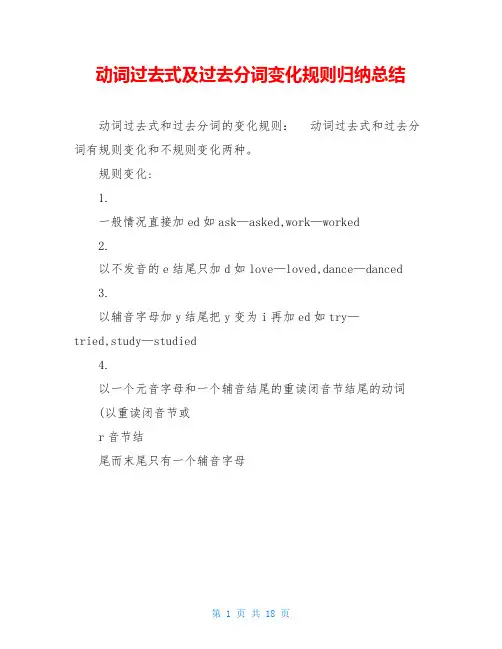
动词过去式及过去分词变化规则归纳总结动词过去式和过去分词的变化规则:动词过去式和过去分词有规则变化和不规则变化两种。
规则变化:1.一般情况直接加ed如ask—asked,work—worked2.以不发音的e结尾只加d如love—loved,dance—danced3.以辅音字母加y结尾把y变为i再加ed如try—tried,study—studied4.以一个元音字母和一个辅音结尾的重读闭音节结尾的动词(以重读闭音节或r音节结尾而末尾只有一个辅音字母),先双写末尾这个辅音字母,再加ed,如stop—stopped,permit—permitted现在分词的变化规则:1、一般在词尾加-ing(一般-ing)。
例如:goingplayingknowing2、以不发音的字母e结尾先去e再加-ing(去e)。
例如:makingarrivinging3、以重读闭音节结尾且词尾只有一个辅音字母时先双写这个辅音字母再加双写)。
例如:runningstoppingpreferring-ing(重闭单辅先4、以-ie 结尾先将-ie 改成y再加-ing。
例如:tyingdying,lying口诀:现在进行 ing,以e结尾要去e除去几个特殊词系住tie-tying 死去die-dying 要躺下lie-lying直接ie变成y,一元一辅双写辅(单音节的词)。
把原形变单数第三人称方法1、一般情况加S2、以s,x,ch,sh,o 结尾的加3、y前是辅音改y为i加eses4、特殊情况have变has1.一般情况加2.以s 、sh 、3.辅音字母+yfactory----factoriess :book--booksmouth---mouthshouse---housesgirl---girlsch 、x结尾的加es :class---classesbox----boxesmatch----matches结尾的变y 为i 加es:city---citiescountry----countriesparty----parties4.以o结尾的词+es的只有以下词:heroesNegroestomatoespotatoeszeroes/zeros以o结尾并且词尾有两个元音字母+sradios,zoos,bamboos,(pianos,kilosphotos)5.以ffe结尾的变f或fe为v+es:一、人称代词表示“我”、“你”、“他”、“她”、“它”、“我们”、“你们”、“他们”的词叫做人称代词。

过去式的变化不规则表述一、什么是过去式?过去式是表示过去发生的动作或状态的一种时态。
在英语中,通常用在简单过去时中,表示动作或状态的完成。
二、规则变化的过去式1. 动词加-ed结尾大多数动词在构成过去式时会在其基本形式后面加上-ed。
例如:- walk → walked- talk → talked- play → played2. 以字母e结尾的动词以字母e结尾的动词,在添加-ed之前,需要将字母e删除。
例如:- love → loved- dance → danced- bake → baked3. 以辅音字母+y结尾的动词以辅音字母+y结尾的动词,在添加-ed之前,需要将y变成i。
例如:- study → studied- try → tried- cry → cried4. 双写辅音字母结尾的动词如果一个单词以一个辅音字母结尾,并且在这个辅音字母之前只有一个元音字母,则需要双写这个辅音字母,并且再加上-ed。
例如:- stop → stopped- plan → planned- prefer → preferred5. 不规则变化的过去式动词有一些常用动词不遵循以上规则,它们有自己独特的过去式形式。
例如:- be → was/were- have → had- do → did- go → went- see → saw三、不规则变化的过去式动词列表以下是一些常用的不规则变化的过去式动词列表:1. be- I was- You were- He/she/it was- We were- They were2. have- I had- You had- He/she/it had - We had- They had3. do- I did- You did- He/she/it did - We did- They did4. go- I went- You went- He/she/it went - We went- They went5. see- I saw- You saw- He/she/it saw - We saw- They saw6. come- I came- You came- He/she/it came - We came- They came 7. give- I gave- You gave- He/she/it gave - We gave- They gave8. take- I took- You took- He/she/it took - We took- They took9. make- I made- You made- He/she/it made - We made- They made 10. know- I knew- You knew- He/she/it knew - We knew–They knew四、注意事项1. 不规则动词的过去式需要记忆,因为它们没有任何规律可循。