
Feedback Control-10
- 格式:ppt
- 大小:395.50 KB
- 文档页数:22

自动化专业英语
自动化专业英语是指在自动化工程领域中使用的英语专业术语和表达方式。下面是关于自动化专业英语的详细内容:
一、自动化概述
自动化是指利用计算机技术、电子技术和控制技术等手段实现对生产过程、工程设备和系统的自动控制和管理。自动化技术在各个领域都有广泛的应用,包括工业生产、交通运输、医疗保健、能源管理等。
二、自动化专业英语词汇
1. Automation(自动化): The technique of making an apparatus, a process, or a
system operate automatically.
2. Control system(控制系统): A system that manages, commands, directs or
regulates the behavior of other devices or systems.
3. Programmable logic controller (PLC)(可编程逻辑控制器): A digital computer
used for automation of electromechanical processes.
4. Sensor(传感器): A device that detects and responds to physical input such as
light, heat, pressure, or motion.
5. Actuator(执行器): A mechanical or electro-mechanical device used to control
a physical system.
6. SCADA (Supervisory Control and Data Acquisition)(监控与数据采集系统):
A system used to monitor and control industrial processes.

关于plc的母料称量控制系统设计英文参考文献
Designing a PLC-based Ingredient Weighing Control System: A
Reference
The efficient and precise control of ingredient weighing is a crucial
aspect in various industrial processes, particularly in the
manufacturing of food, pharmaceuticals, and chemical products. The
use of Programmable Logic Controllers (PLCs) has become a widely
adopted approach to automate and optimize these weighing
processes, ensuring consistent product quality and enhancing overall
production efficiency.
In this reference, we will explore the design of a PLC-based
ingredient weighing control system, highlighting the key
components, operational principles, and implementation strategies
to serve as a guide for engineering professionals and researchers in
the field.
System Architecture and Components
The PLC-based ingredient weighing control system typically consists of the following essential components:

Chemical Engineering Principles
Chemical engineering is a vast field that involves the design, operation, and
optimization of chemical processes. This discipline combines engineering principles
with chemistry to develop solutions for various industrial applications. In this paper,
we will explore the fundamental principles of chemical engineering and discuss
their significance in engineering practice.
Introduction
Chemical engineering principles are based on the fundamental laws of physics
and chemistry. These principles serve as the foundation for designing and operating
chemical processes in industries like petrochemicals, pharmaceuticals, food
processing, and environmental engineering. Understanding these principles is
essential for chemical engineers to develop efficient and sustainable processes.
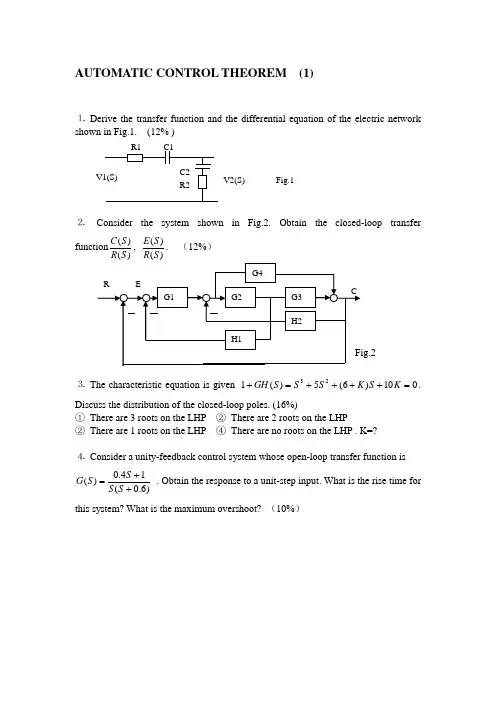
AUTOMATIC CONTROL THEOREM (1)
⒈ Derive the transfer function and the differential equation of the electric network
shown in Fig.1.
(12% )
⒉ Consider the system shown in Fig.2. Obtain the closed-loop transfer
function)()(SRSC, )()(SRSE. (12%)
Fig.2
⒊ The characteristic equation is given 010)6(5)(123KSKSSSGH.
Discuss the distribution of the closed-loop poles. (16%)
① There are 3 roots on the LHP ② There are 2 roots on the LHP
② There are 1 roots on the LHP ④ There are no roots on the LHP . K=?
⒋ Consider a unity-feedback control system whose open-loop transfer function is
)6.0(14.0)(SSSSG . Obtain the response to a unit-step input. What is the rise time for
this system? What is the maximum overshoot? (10%)
C G1 G2 G3 G4
H2
H1 R E C2