
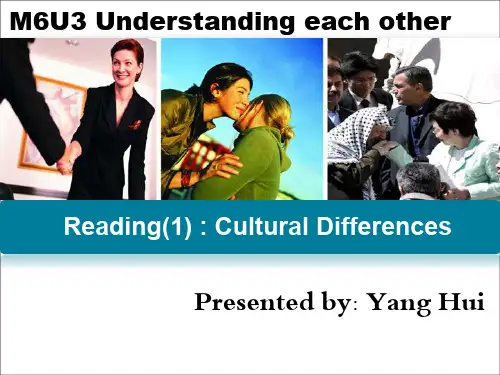
Reading(1):Culturaldifferences
- 格式:ppt
- 大小:8.62 MB
- 文档页数:29

跨文化交际试题答案(附翻译)一、选择题1. 以下哪项不是跨文化交际的核心要素?A. 语言差异B. 文化差异C. 沟通技巧D. 民族风俗答案:D翻译:Which of the following is not a core element of intercultural communication?A. Linguistic differencesB. Cultural differencesC. Communication skillsD. Folk customs2. 跨文化交际中,以下哪项行为可能导致误解?A. 打招呼B. 鞠躬C. 直接拒绝D. 礼貌地表达意见翻译:In intercultural communication, which behavior may lead to misunderstandings?A. GreetingB. BowingC. Direct refusalD. Politely expressing opinions二、填空题1. 跨文化交际中的文化差异主要体现在____、____、____等方面。
答案:价值观、行为规范、语言使用翻译:The cultural differences in intercultural communication are mainly reflected in values, behavioral norms, and language use.2. 跨文化交际能力包括____、____、____等方面。
答案:知识、技能、态度翻译:Intercultural communication competence includes knowledge, skills, and attitudes.三、简答题1. 简述跨文化交际的重要性。
跨文化交际在全球化背景下具有重要意义。
以下是跨文化交际的重要性:(1)促进国际交流与合作:跨文化交际有助于不同国家和地区的人们相互了解,增进友谊,促进国际合作。

六、语言学习与文化差异1.请阅读下面一篇短文,并按照要求用英语写一篇150 词左右的文章。
Dear Uncle,I am a senior three student who is facing great difficulty in English learning.My problem mostly lies on the learning and memorizing of English words.You know,in order to achieve a good score in the College Entrance English Examination,we are supposed to have a vocabulary of around 3,500 English words.However,it seems impossible for me to remember all of them,even half of them.Every week,we have to learn around 10 new words and review 20 words from our textbook.To help us,my teacher Miss Li usually first explains the meaning and usages of them in class.Then,I will spend a lot of time trying to memorize my notes taken in class.What troubles me is that I am always slower than most of my classmates who seem never to fail the next day's dictation given by the teacher to test our vocabulary mastery.Instead,I have been a frequent visitor to her re-dictation room.Watching her worried and tired face,I always think to myself,“Why am I so stupid as to trouble both her and me so much?” Or rather,there is something wrong with my strategies and the way my teacher helps me?I know you are good at English learning.Hope you can rescue me.Best regards!Xiaofang【写作内容】1.用约30个单词写出上文概要,写在下面回信的第一段空格处;2.用约120个单词发表你的看法,你应当:(1)结合对小芳同学词汇学习方法的分析,谈谈你认为较为有效的词汇学习策略;(2)结合对小芳老师教授词汇方法的分析,谈谈你认为老师在课堂内外该怎样进行词汇教学。
专业英语八级(听力)模拟试卷368(题后含答案及解析)题型有:1. LISTENING COMPREHENSIONPART I LISTENING COMPREHENSIONSECTION A MINI-LECTUREIn this section you will hear a mini-lecture. You will hear the mini-lecture ONCE ONLY. While listening to the mini-lecture, please complete the gap-filling task on ANSWER SHEET ONE and write NO MORE THAN THREE WORDS for each gap. Make sure the word(s) you fill in is (are) both grammatically and semantically acceptable. You may use the blank sheet for note-taking.You have THIRTY seconds to preview the gap-filling task.听力原文:Cultural Differences between East and West Good morning, everyone. Today I’d like to share with you one interesting topic, that is: cultural differences between East and West. But before we start, we have to look at an important question: What leads to the cultural differences? The cultures of the East and the West really distinguish each other a lot. This is because the culture systems are two separate systems on the whole. The origin of the Eastern cultures is mainly from two countries: China and India. Both of the two cultures are gestated by rivers. In China, the mother river is the Yellow River while the Indian one is the Hindu River. These two cultures were developed for several thousand years and formed their own styles. Then in the Tang Dynasty of China, the Chinese culture gradually went overseas to Japan, mixed into the Japanese society and shaped the Japanese culture nowadays. Though a bit different from the Chinese one, it belongs to the same system. When the two mother rivers gave birth to the Eastern culture, another famous culture was brought up on the Mesopotamian Plain—the Mesopotamian Civilization. This civilization later on developed into the cultures of the Ancient Greece and Ancient Rome. And these two are well-known as the base of European culture. Like the Chinese culture, the European one also crossed waters. When the colonists of England settled down in America, their culture went with them over the Atlantic Ocean. So the American culture doesn’t distinguish from the European one a lot. At the same time, the difference of the language systems adds to the cultural differences. In the East, most languages belong to the pictographic language while the Western languages are mostly based on the Latin system, for example, the one I’m using to write this paper. Other factors like human race difference count as well. But what’s more, due to the far distance and the steep areas between the East and the West, the two cultures seldom communicate until recent centuries. So they grew up totally in their own ways with almost no interference from the other. Now, I’d like to discuss with you another question, that is: how differently do people behave in daily life? The differences are everywhere. They affect people’s ways of thinking and their views of the world. Even in everyday life, the cultural differences show up from the moment the eyes are opened to the minute the dreams are invited. In the following, I’ll give sometypical examples of the differences. First example: greeting. Greeting is the first step to form a culture, because people begin to communicate with others. The individuals become a community. How do we Chinese greet each other? Informally, if we meet a friend in the street, we are used to saying: “Hi, have you had your meal?” or “Where are you going?”When it is the case of two gentlemen, they tend to shake hands. However, in western countries, the above questions are just questions, not greetings at all. They may think you’re inviting them to dinner if you ask about their meals. Usually, they’ll just give each other a smile or greet with a “Hi.” They’ll shake hands only in some formal situations. By the way, Westerners can leave a party or meeting hall without a formal conge, nor should they shake hands with every attendee like most of us will do here. Second example: expressing gratitude. Think of the situations below. Your mother is busy in the kitchen. She suddenly asks you to fetch a bowl for her. You do so. What’ll your mother’s response be? Probably she’ll just continue doing the cooking. After a while, the dinner is ready. Your mother hands you your bowl of rice. What’s your response? Probably just begin to eat. That’s what I want to say. In Chinese families, we rarely say “Thank you” to other family members for receiving help or service. Neither will we say so between good friends. It’s such an unpopular response that if you say it, the counterpart will think you are treating him as a stranger, otherwise you are lacking intimacy. But in the West, “thank you” is one of the most frequently used sentences. Teachers will thank a student for answering the question: husbands will thank his wife for making a coffee. However, as an interesting phenomenon, it’s a custom to say “thank you” in Japan. No matter in family or among friends, Japanese chronically use it all day. This is probably the aberrance of the culture. After the above discussions, now there is another question, that is: what can we do to treat the culture gap? Now we have seen that there exists such a huge gap between eastern culture and western one. Then what should we do to face this gap in the gradually globalizing world? Firstly, we cannot deny any of the cultures. Every nation has its own characteristics and it’s mainly through its culture that we first begin to know the nation and its characteristics. So we cannot say that this culture or custom is right and that is wrong. Equal respect should be attached to every culture in the world, even to those that are not in existence any more. Next, we should get to learn how to coordinate the different cultures. We say the world is becoming smaller and smaller. More foreigners come and go everyday. When it is in the same country, the same city, the same neighborhood, the cultural collision is expected to be more serious. So we should try to avoid this happening. One important thing is to get some basic knowledge about the other cultures so as not to misunderstand some actions or habits of the foreigners. When the above two are done, we can start to communicate. I mean we can take in some strong points from the foreign cultures. Though there doesn’t exist correctness in terms of culture, it does have the terms of more advanced or more suitable for the world nowadays. Of course, we cannot throw away our own culture and accept another one totally. Every culture is a treasure to the history of the Earth, so we should only pick out those we lack to perfect our own. To conclude what we have discussed today: first we have provided you with the underlying reasons of cultural differences, after that, we havepresented you with several specific examples to further prove this. Finally we have explained the differences from several perspectives. Last but not least, we should remember that different cultures add the most colorful element to the world of the 21st century. The cultural gap should not be the obstacle to the civilization of human beings. It ought to be the motivation of going farther.Cultural Differences between East and West I. Factors leading to the cultural differencesA. Different culture 【T1】______ 【T1】______—Eastern culture:a)China: Yellow Riverb)India: 【T2】______ 【T2】______—European culture:a)Base: Ancient Greece and Ancient Romeb)European culture crossed over the 【T3】______ 【T3】______B. Different language systems—Eastern: mostly belonging to pictographic language—Western: mostly based on 【T4】______ 【T4】______C. Other factors:—different 【T5】______ 【T5】______—infrequent 【T6】______between the East and West 【T6】______a)far distance and the steep areab)no 【T7】______ from each other 【T7】______II. Different behavior in people’s daily lifeA. 【T8】______ 【T8】______—the Chinese greeting:a)questions about whether you have your meal or notb)questions about where you are goingc)two gentlemen greet with 【T9】______ 【T9】______—the Western greeting:a)with a smile or with a “Hi”b)shaking hands only in formal situationsB. Expressing gratitude—the Eastern way:a)rarely say “Thank you”, otherwise, you’re 【T10】______ 【T10】______b)an exception: 【T11】______ 【T11】______—the Western way:a)thank you is the most 【T12】______ phrases 【T12】______III. How to handle culture gapA. No 【T13】______ any of the cultures 【T13】______—every nation has its own 【T14】______ 【T14】______—we should pay equal respect for each cultureB. Learning how to coordinate different cultures by avoiding 【T15】______ 【T15】______C. Starting to communicate by taking in strong points from the foreign cultures1.【T1】正确答案:origins//sources解析:录音开篇就指出讲座的主题是东西方文化差异。
Listen and interpret the following conversation alternatively into English and Chinese:A: 罗伯茨先生,很高兴再次见到您。
有什么需要我做的吗? I'm so happy to see you again , Mr. Roberts. May 1 help you in some way?B: Hi , Miss Chen, it's been ten months since 1 left China.1 would like to discuss with you the possibilities of establishing a joint venture with your company to manufacture cordless(无电线的)phones and mobile phones.A: 好极了。
您的投资意向是明智的。
我公司也正在寻求外资,合办一家生产元绳电话和移动电话的制造公司,您的提议很好。
罗伯茨先生,我还记得一年前曾同您讨论过有关外国在华投资的事情。
That's great. Your investment proposal(提议;建议;求婚)is a very wise decision. Our company is also seeking foreign investment in a manufacturing company for cordless and mobile phones. Your initiative is most welcome. 1 remember talking to you about the matter of foreign investment in China a year ago, Mr.Roberts.B: Yes, you did a good job. The whole idea of my investing in a joint enterprise with your company is the direct result of your wonderful lecture(演讲). Your answers were direct and honest. And your, explanations were sincere and persuasive.May 1 get on China's economic express train and share your economic gains? 是的,那次你谈得很好。