
10 Dynamic Games of incomplete information=Axelrod 竞赛
- 格式:ppt
- 大小:464.00 KB
- 文档页数:20

LECTURE 13
LEARNING OUTCOMES
By the end of this lecture, students will be able to:
Understand what is meant by Perfect Bayesian Equilibrium (PBE) Understand how a PBE relates to the other equilibrium concepts studied so far Understand how to find a PBE
INTRODUCTION
So far we have studied three equilibrium concepts:
- Nash equilibrium in static games of complete information. - SPNE in dynamic games of complete information. - Bayesian Nash Equilibrium in static games of incomplete information.
In this lecture, we will introduce a new equilibrium concept:
- Perfect Bayesian Equilibrium (PBE) in dynamic games of incomplete information.
Why do we require a “new” equilibrium concept for each class of games?
The equilibrium concepts above are closely related – they are not new per se. We also need to strengthen our equilibrium concept, as we consider progressively richer games. For example, a SPNE eliminates Nash equilibria that involve non-credible threats. Similarly, a Perfect Bayesian Equilibrium can be thought of as a refinement of a Bayesian Nash Equilibrium
125 第五章 完全信息动态博弈
本章将引入博弈顺序于博弈模型之中,并对不同博弈顺序对博弈均衡的影响作出评估。正如我们在第三章中所指出,在“动态”的博弈模型中,博弈中局中人的“出招”顺序对于均衡形成来说是十分重要的。所谓“动态”博弈模型,就是指在博弈中局中人的“出招”顺序对均衡的形成有实质性影响的博弈模型。
本章将表明,影响动态博弈的均衡形成除了局中人的博弈顺序要素外,还有博弈的时间长短这一重要因素,即有限次和无限次(重复)博弈可能会有完全不同的均衡。在本章还暂不考虑信息不完全对博弈均衡的影响,因而所表达的博弈是完全信息动态博弈。
本章将要指出的重要观点是,当我们在博弈中纳入决策的顺序结构时,纳什均衡作为模型的预测是不能令人满意的,并引入子博弈精炼纳什均衡这一概念来克服这一不足。这种新概念的引入实际上是将纳什均衡概念进一步精致化,消除了一些不可信的均衡,这也是一种有限度解决纳什均衡多重性的方案(尽管还不是终极性的)。
5.1 完全信息动态博弈:概念与定义
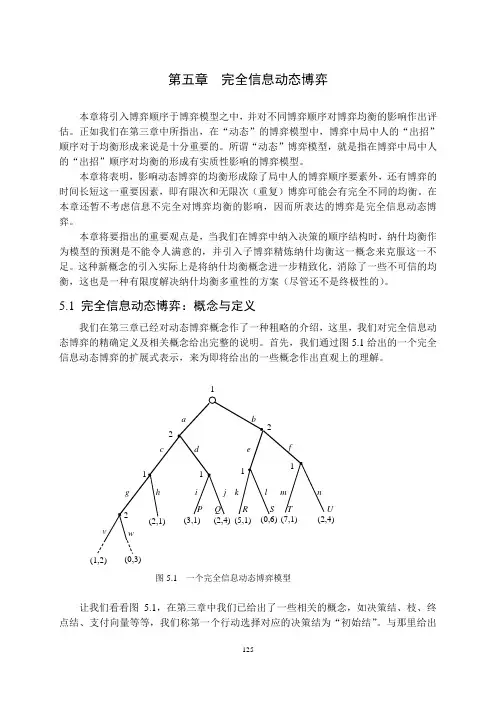
我们在第三章已经对动态博弈概念作了一种粗略的介绍,这里,我们对完全信息动态博弈的精确定义及相关概念给出完整的说明。首先,我们通过图5.1给出的一个完全信息动态博弈的扩展式表示,来为即将给出的一些概念作出直观上的理解。
1
a b
2
c d e
1 1
图5.1 一个完全信息动态博弈模型
让我们看看图5.1,在第三章中我们已给出了一些相关的概念,如决策结、枝、终点结、支付向量等等,我们称第一个行动选择对应的决策结为“初始结”。与那里给出2

第6讲 不完美信息博弈与不完全信息博弈
在这一节,我们简单了解“不完美信息博弈 (imperfect information games)”和“不完全信息
博弈 (incomplete information games)”,两者又都叫做“非对称信息博弈 (asymmetric information
games)”。博弈中的非对称信息,是指某些参与人拥有但另外一些参与人不拥有的信息。
1. 不完美信息博弈
—— 不完美信息
每个参与人的每个信息集都是单结点信息集的博弈,就是“完美信息博弈 (perfect information
games)”。与此相对,我们有“不完美信息博弈 (imperfect information games)”的概念:至少部分
参与人的部分信息集是多节点信息集的博弈。
换言之,在一个博弈中,如果当轮到一名参与人做出选择时,他不知道自己正处于其信息集
之中的哪一个节点上,则称其信息是不完美的。
显然,在现实世界的各种博弈中,不完美信息是常见的。
—— 所谓“信念”
在分析不完美信息博弈及其均衡时,“信念 (belief)”是一个基本的概念。
在轮到一名参与人做出选择时,即使他不知道自己正处于其信息集之中的哪一个节点上,他
也必定对此拥有某种“信念”:即自己正以何种概率分布位于该信息集之中的各个节点之上。
提出“信念”这一概念,既是为了分析不完美信息博弈的方便,也是合乎逻辑的:即使没有
完美的相关信息 (实际情况往往如此),当事人也要做出决策 —— 这种情况下当事人的决策是
任意的吗?
当然不是,他必定会对所有与其决策相关的信息做出“猜测”,其猜测的结果,就是其“信
念”。
所以,我们也可以将“信念”解释为某人为将自己的行为“合理化”而找到的“理由”。
***********************************************************************************

EE693HFall2007
GameTheory
TR,12:00pm–1:15pm,Holmes389
CourseInformation
Gametheoryprovidesthemostnaturalframeworktostudythestrategicinteractionsbetweenself-interesteddecisionmakers.Duetotheemergenceofdistributedcomplexsystemsmadeupofmanyautonomousagents(suchastheInternet),therehasbeenaresurgenceofinterestingametheorywithintheengineeringandthecomputersciencecommunities.Thiscoursewillintroducethestudentstothefundamentalsofnoncoopera-tivegametheoryaswellasthecomputationaltoolsprovidedbynoncooperativegametheory.Emphasiswillbeontheengineeringapplicationssuchascontrol,communications,transportationsystems,andresourceallocationproblems.Thecourseisintendedformathematicallyinclinedstudentswithsomebackgroundonprobabilitytheory.
Instructor:G¨urdalArslan,Holmes440,Phone:956–3432,E-mail:*****************
OfficeHours:Open
RecommendedTexts:DynamicNoncooperativeGameTheorybyBas.arandOlsder