
charpter 8
- 格式:ppt
- 大小:579.50 KB
- 文档页数:9


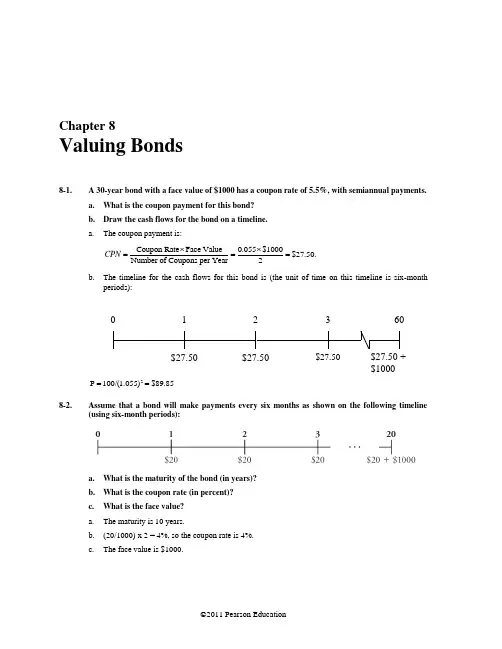
Chapter 8Valuing Bonds8-1.A 30-year bond with a face value of $1000 has a coupon rate of 5.5%, with semiannual payments. a. What is the coupon payment for this bond? b. Draw the cash flows for the bond on a timeline. a. The coupon payment is:Coupon Rate Face Value 0.055$1000$27.50.Number of Coupons per Year 2CPN ⨯⨯===b. The timeline for the cash flows for this bond is (the unit of time on this timeline is six-monthperiods):2P 100/(1.055)$89.85==8-2.Assume that a bond will make payments every six months as shown on the following timeline(using six-month periods):a. What is the maturity of the bond (in years)?b. What is the coupon rate (in percent)?c. What is the face value? a. The maturity is 10 years.b. (20/1000) x 2 = 4%, so the coupon rate is 4%.c. The face value is $1000.1 $27.50 02 $27.503 $27.5060$27.50 +$1000Berk/DeMarzo •Corporate Finance, Second Edition 1078-3.The following table summarizes prices of various default-free, zero-coupon bonds (expressed as a percentage of face value):a. Compute the yield to maturity for each bond.b. Plot the zero-coupon yield curve (for the first five years).c. Is the yield curve upward sloping, downward sloping, or flat?a. Use the following equation.1/nn n FV 1YTM P ⎛⎫+= ⎪⎝⎭1/1111001YTM YTM 4.70%95.51⎛⎫+=⇒= ⎪⎝⎭1/2111001YTM YTM 4.80%91.05⎛⎫+=⇒= ⎪⎝⎭1/3331001YTM YTM 5.00%86.38⎛⎫+=⇒= ⎪⎝⎭1/4441001YTM YTM 5.20%81.65⎛⎫+=⇒= ⎪⎝⎭ 1/5551001YTM YTM 5.50%76.51⎛⎫+=⇒= ⎪⎝⎭b. The yield curve is as shown below.Zero Coupon Yield Curve4.64.855.25.45.60246Maturity (Years)Y i e l d t o M a t u r i t yc. The yield curve is upward sloping.108 Berk/DeMarzo• Corporate Finance, Second Edition8-4. Suppose the current zero-coupon yield curve for risk-free bonds is as follows:a. What is the price per $100 face value of a two-year, zero-coupon, risk-free bond?b. What is the price per $100 face value of a four-year, zero-coupon, risk-free bond?c. What is the risk-free interest rate for a five-year maturity? a.2P 100(1.055)$89.85==b. 4P 100/(1.0595)$79.36==c. 6.05%8-5.In the box in Section 8.1, reported that the three-month Treasury bill sold for a price of $100.002556 per $100 face value. What is the yield to maturity of this bond, expressed as an EAR?410010.01022%100.002556⎛⎫-=- ⎪⎝⎭8-6.Suppose a 10-year, $1000 bond with an 8% coupon rate and semiannual coupons is trading for a price of $1034.74.a. What is the bond’s yield to maturity (expressed as an APR with semiannual compounding)?b. If the bond’s yield to maturity changes to 9% APR, what will the bond’s price be? a.2204040401000$1,034.747.5%(1)(1)(1)222YTM YTM YTM YTM +=+++⇒=+++Using the annuity spreadsheet: NPER Rate PV PMT FVExcel Formula Given: 20 -1,034.74 40 1,000Solve For Rate: 3.75%=RATE(20,40,-1034.74,1000)Therefore, YTM = 3.75% × 2 = 7.50% b.2204040401000$934.96..09.09.09(1)(1)(1)222PV L +=+++=+++ Using the spreadsheetWith a 9% YTM = 4.5% per 6 months, the new price is $934.96NPER Rate PV PMT FV Excel Formula Given: 20 4.50% 40 1,000 Solve For PV: (934.96) =PV(0.045,20,40,1000)Berk/DeMarzo • Corporate Finance, Second Edition 1098-7.Suppose a five-year, $1000 bond with annual coupons has a price of $900 and a yield to maturity of 6%. What is the bond’s coupon rate?25C CC 1000900C $36.26, so the coupon rate is 3.626%.(1.06)(1.06)(1.06)+=+++⇒=+++We can use the annuity spreadsheet to solve for the payment. NPER Rate PV PMT FV Excel Formula Given: 5 6.00% -900.00 1,000Solve For PMT: 36.26 =PMT(0.06,5,-900,1000)Therefore, the coupon rate is 3.626%.8-8.The prices of several bonds with face values of $1000 are summarized in the following table:For each bond, state whether it trades at a discount, at par, or at a premium. Bond A trades at a discount. Bond D trades at par. Bonds B and C trade at a premium.8-9.Explain why the yield of a bond that trades at a discount exceeds the bond’s coupon rate. Bonds trading at a discount generate a return both from receiving the coupons and from receiving a face value that exceeds the price paid for the bond. As a result, the yield to maturity of discount bonds exceeds the coupon rate.8-10.Suppose a seven-year, $1000 bond with an 8% coupon rate and semiannual coupons is trading with a yield to maturity of 6.75%.a. Is this bond currently trading at a discount, at par, or at a premium? Explain.b. If the yield to maturity of the bond rises to 7% (APR with semiannual compounding), whatprice will the bond trade for? a. Because the yield to maturity is less than the coupon rate, the bond is trading at a premium. b. 2144040401000$1,054.60(1.035)(1.035)(1.035)++++=+++NPER Rate PV PMT FV Excel Formula Given: 14 3.50% 40 1,000Solve For PV:(1,054.60)=PV(0.035,14,40,1000)8-11.Suppose that General Motors Acceptance Corporation issued a bond with 10 years until maturity, a face value of $1000, and a coupon rate of 7% (annual payments). The yield to maturity on this bond when it was issued was 6%. a. What was the price of this bond when it was issued?b. Assuming the yield to maturity remains constant, what is the price of the bond immediatelybefore it makes its first coupon payment? c. Assuming the yield to maturity remains constant, what is the price of the bond immediatelyafter it makes its first coupon payment?110 Berk/DeMarzo • Corporate Finance, Second Editiona. When it was issued, the price of the bond was1070701000P ...$1073.60.(1.06)(1.06)+=++=++b. Before the first coupon payment, the price of the bond is970701000P 70...$1138.02.(1.06)(1.06)+=++=++c. After the first coupon payment, the price of the bond will be970701000P ...$1068.02.(1.06)(1.06)+=+=++8-12.Suppose you purchase a 10-year bond with 6% annual coupons. You hold the bond for fouryears, and sell it immediately after receiving the fourth coupon. If the bond’s yield to maturity was 5% when you purchased and sold the bond,a. What cash flows will you pay and receive from your investment in the bond per $100 facevalue? b. What is the internal rate of return of your investment?a. First, we compute the initial price of the bond by discounting its 10 annual coupons of $6 and finalface value of $100 at the 5% yield to maturity.NPER Rate PV PMT FV Excel Formula Given:10 5.00%6 100Solve For PV:(107.72)= PV(0.05,10,6,100)Thus, the initial price of the bond = $107.72. (Note that the bond trades above par, as its coupon rate exceeds its yield.)Next we compute the price at which the bond is sold, which is the present value of the bonds cash flows when only 6 years remain until maturity.NPER Rate PV PMT FV Excel Formula Given: 6 5.00%6 100Solve For PV:(105.08)= PV(0.05,6,6,100)Therefore, the bond was sold for a price of $105.08. The cash flows from the investment are therefore as shown in the following timeline.Berk/DeMarzo • Corporate Finance, Second Edition 111b. We can compute the IRR of the investment using the annuity spreadsheet. The PV is the purchaseprice, the PMT is the coupon amount, and the FV is the sale price. The length of the investment N = 4 years. We then calculate the IRR of investment = 5%. Because the YTM was the same at the time of purchase and sale, the IRR of the investment matches the YTM. NPER Rate PV PMT FV Excel Formula Given: 4 –107.72 6 105.08Solve For Rate: 5.00% = RATE(4,6,-107.72,105.08)8-13.Consider the following bonds:a. What is the percentage change in the price of each bond if its yield to maturity falls from 6% to 5%?b. Which of the bonds A –D is most sensitive to a 1% drop in interest rates from 6% to 5% andwhy? Which bond is least sensitive? Provide an intuitive explanation for your answer. a. We can compute the price of each bond at each YTM using Eq. 8.5. For example, with a 6% YTM,the price of bond A per $100 face value is15100P(bond A, 6% YTM)$41.73.1.06== The price of bond D is101011100P(bond D, 6% YTM)81$114.72..06 1.06 1.06⎛⎫=⨯-+= ⎪⎝⎭ One can also use the Excel formula to compute the price: –PV(YTM, NPER, PMT, FV). Once we compute the price of each bond for each YTM, we can compute the % price change as Percent change =()()()Price at 5% YTM Price at 6% YTM .Price at 6% YTM -The results are shown in the table below.Coupon Rate Maturity Price at Price at Percentage Change(annual payments)(years)6% YTM 5% YTM A 0%15$41.73$48.1015.3%B 0%10$55.84$61.399.9%C 4%15$80.58$89.6211.2%D8%10$114.72$123.177.4%Bondb. Bond A is most sensitive, because it has the longest maturity and no coupons. Bond D is the leastsensitive. Intuitively, higher coupon rates and a shorter maturity typically lower a bond’s interest rate sensitivity.112 Berk/DeMarzo • Corporate Finance, Second Edition8-14.Suppose you purchase a 30-year, zero-coupon bond with a yield to maturity of 6%. You hold the bond for five years before selling it.a. If the bond’s yield to maturity is 6% when you sell it, what is the internal rate of return ofyour investment? b. If the bond’s yield to maturity is 7% when you sell it, what is the internal rate of return ofyour investment? c. If the bond’s yield to maturity is 5% when you se ll it, what is the internal rate of return ofyour investment? d. Even if a bond has no chance of default, is your investment risk free if you plan to sell itbefore it matures? Explain. a. Purchase price = 100 / 1.0630 = 17.41. Sale price = 100 / 1.0625 = 23.30. Return = (23.30 / 17.41)1/5– 1 = 6.00%. I.e., since YTM is the same at purchase and sale, IRR = YTM. b. Purchase price = 100 / 1.0630 = 17.41. Sale price = 100 / 1.0725 = 18.42. Return = (18.42 / 17.41)1/5– 1 = 1.13%. I.e., since YTM rises, IRR < initial YTM. c. Purchase price = 100 / 1.0630 = 17.41. Sale price = 100 / 1.0525 = 29.53. Return = (29.53 / 17.41)1/5– 1 = 11.15%. I.e., since YTM falls, IRR > initial YTM. d. Even without default, if you sell prior to maturity, you are exposed to the risk that the YTM maychange.8-15.Suppose you purchase a 30-year Treasury bond with a 5% annual coupon, initially trading at par. In 10 years’ time, the bond’s yield to maturity has risen to 7% (EAR).a. If you sell the bond now, what internal rate of return will you have earned on yourinvestment in the bond? b. If instead you hold the bond to maturity, what internal rate of return will you earn on yourinvestment in the bond? c. Is comparing the IRRs in (a) versus (b) a useful way to evaluate the decision to sell the bond?Explain. a. 3.17% b. 5%c. We can’t simply compare IRRs. By not selling the bond for its current price of $78.81, we willearn the current market return of 7% on that amount going forward.8-16.Suppose the current yield on a one-year, zero coupon bond is 3%, while the yield on a five-year, zero coupon bond is 5%. Neither bond has any risk of default. Suppose you plan to invest for one year. You will earn more over the year by investing in the five-year bond as long as its yield does not rise above what level?The return from investing in the 1 year is the yield. The return for investing in the 5 year for initialprice p 0 and selling after one year at price p1 is 101pp -. We have05151,(1.05)1.(1)p p y ==+Berk/DeMarzo • Corporate Finance, Second Edition 113So you break even when41105545/41/41(1)110.031(1.05)(1.05) 1.03(1)(1.05)1 5.51%.(1.03)p y y p y y +-=-===+=-=For Problems 17–22, assume zero-coupon yields on default-free securities are as summarized in the following table:8-17.What is the price today of a two-year, default-free security with a face value of $1000 and an annual coupon rate of 6%? Does this bond trade at a discount, at par, or at a premium?221260601000...$1032.091(1.04)(1)(1)(1.043)N N CPN CPN CPN FV P YTM YTM YTM ++=+++=+=+++++This bond trades at a premium. The coupon of the bond is greater than each of the zero coupon yields, so the coupon will also be greater than the yield to maturity on this bond. Therefore it trades at a premium8-18.What is the price of a five-year, zero-coupon, default-free security with a face value of $1000? The price of the zero-coupon bond is51000$791.03(1)(10.048)NN FV P YTM ===++ 8-19.What is the price of a three-year, default-free security with a face value of $1000 and an annual coupon rate of 4%? What is the yield to maturity for this bond? The price of the bond is223124040401000...$986.58.1(1.04)(1)(1)(1.043)(1.045)N N CPN CPN CPN FV P YTM YTM YTM ++=+++=++=++++++ The yield to maturity is2...1(1)(1)NCPN CPN CPN FVP YTM YTM YTM +=++++++234040401000$986.58 4.488%(1)(1)(1)YTM YTM YTM YTM +=++⇒=+++8-20.What is the maturity of a default-free security with annual coupon payments and a yield to maturity of 4%? Why?The maturity must be one year. If the maturity were longer than one year, there would be an arbitrage opportunity.114 Berk/DeMarzo • Corporate Finance, Second Edition8-21.Consider a four-year, default-free security with annual coupon payments and a face value of $1000 that is issued at par. What is the coupon rate of this bond? Solve the following equation:2344111110001000(1.04)(1.043)(1.045)(1.047)(1.047)$46.76.CPN CPN ⎛⎫=++++ ⎪+++++⎝⎭=Therefore, the par coupon rate is 4.676%.8-22.Consider a five-year, default-free bond with annual coupons of 5% and a face value of $1000. a. Without doing any calculations, determine whether this bond is trading at a premium or at adiscount. Explain. b. What is the yield to maturity on this bond?c. If the yield to maturity on this bond increased to 5.2%, what would the new price be? a. The bond is trading at a premium because its yield to maturity is a weighted average of the yieldsof the zero coupon bonds. This implied that its yield is below 5%, the coupon rate. b. To compute the yield, first compute the price.2122345...1(1)(1)50505050501000$1010.05(1.04)(1.043)(1.045)(1.047)(1.048)NN CPN CPN CPN FVP YTM YTM YTM +=+++++++=++++=+++++The yield to maturity is:2...1(1)(1)505010001010.05... 4.77%.(1)(1)NN CPN CPN CPN FVP YTM YTM YTM YTM YTM YTM +=+++++++=++⇒=++c. If the yield increased to 5.2%, the new price would be:2...1(1)(1)50501000...$991.39.(1.052)(1.052)NNCPN CPN CPN FV P YTM YTM YTM +=+++++++=++=++8-23.Prices of zero-coupon, default-free securities with face values of $1000 are summarized in thefollowing table:Suppose you observe that a three-year, default-free security with an annual coupon rate of 10% and a face value of $1000 has a price today of $1183.50. Is there an arbitrage opportunity? If so, show specifically how you would take advantage of this opportunity. If not, why not?First, figure out if the price of the coupon bond is consistent with the zero coupon yields implied by the other securities.Berk/DeMarzo • Corporate Finance, Second Edition 115111000970.87 3.0%(1)YTM YTM =→=+ 2221000938.95 3.2%(1)YTM YTM =→=+ 3331000904.56 3.4%(1)YTM YTM =→=+According to these zero coupon yields, the price of the coupon bond should be:231001001001000$1186.00.(1.03)(1.032)(1.034)+++=+++ The price of the coupon bond is too low, so there is an arbitrage opportunity. To take advantage of it:Today1 Year2 Years3 Years Buy 10 Coupon Bonds 11835.00 +1000 +1000 +11,000 Short Sell 1 One-Year Zero +970.87 1000Short Sell 1 Two-Year Zero +938.95 1000Short Sell 11 Three-Year Zeros +9950.16 11,000 Net Cash Flow 24.988-24.Assume there are four default-free bonds with the following prices and future cash flows:Do these bonds present an arbitrage opportunity? If so, how would you take advantage of this opportunity? If not, why not?To determine whether these bonds present an arbitrage opportunity, check whether the pricing is internally consistent. Calculate the spot rates implied by Bonds A, B, and D (the zero coupon bonds), and use this to check Bond C. (You may alternatively compute the spot rates from Bonds A, B, and C, and check Bond D, or some other combination.)111000934.587.0%(1)YTM YTM =⇒=+2221000881.66 6.5%(1)YTM YTM =⇒=+3331000839.62 6.0%(1)YTM YTM =⇒=+Given the spot rates implied by Bonds A, B, and D, the price of Bond C should be $1,105.21. Its price really is $1,118.21, so it is overpriced by $13 per bond. Yes, there is an arbitrage opportunity.To take advantage of this opportunity, you want to (short) Sell Bond C (since it is overpriced). To match future cash flows, one strategy is to sell 10 Bond Cs (it is not the only effective strategy; any multiple of this strategy is also arbitrage). This complete strategy is summarized in the table below.Today 1 Year 2Years 3Years Sell Bond C 11,182.10 –1,000 –1,000–11,000Buy Bond A –934.58 1,0000 0 Buy Bond B –881.66 0 1,0000 Buy 11 Bond D –9,235.82 0 0 11,000Net Cash Flow130.04Notice that your arbitrage profit equals 10 times the mispricing on each bond (subject to rounding error).8-25.Suppose you are given the following information about the default-free, coupon-paying yield curve:a. Use arbitrage to determine the yield to maturity of a two-year, zero-coupon bond.b. What is the zero-coupon yield curve for years 1 through 4?a. We can construct a two-year zero coupon bond using the one and two-year coupon bonds asfollows. Cash Flow in Year: 1 2 3 4 Two-year coupon bond ($1000 Face Value) 100 1,100 Less: One-year bond ($100 Face Value) (100) Two-year zero ($1100 Face Value) - 1,100Now, Price(2-year coupon bond) = 21001100$1115.051.03908 1.03908+=Price(1-year bond) =100$98.04.1.02= By the Law of One Price:Price(2 year zero) = Price(2 year coupon bond) – Price(One-year bond)= 1115.05 – 98.04 = $1017.01Given this price per $1100 face value, the YTM for the 2-year zero is (Eq. 8.3)1/21100(2)1 4.000%.1017.01YTM ⎛⎫=-= ⎪⎝⎭b. We already know YTM(1) = 2%, YTM(2) = 4%. We can construct a 3-year zero as follows:Cash Flow in Year:1 2 3 4Three-year coupon bond ($1000 face value) 60 60 1,060 Less: one-year zero ($60 face value) (60) Less: two-year zero ($60 face value) - (60) Three-year zero ($1060 face value) -- 1,060Now, Price(3-year coupon bond) = 2360601060$1004.29.1.0584 1.0584 1.0584++=By the Law of One Price:Price(3-year zero) = Price(3-year coupon bond) – Price(One-year zero) – Price(Two-year zero) = Price(3-year coupon bond) – PV(coupons in years 1 and 2)= 1004.29 – 60 / 1.02 – 60 / 1.042 = $889.99.Solving for the YTM:1/31060(3)1 6.000%.889.99YTM ⎛⎫=-= ⎪⎝⎭Finally, we can do the same for the 4-year zero:Cash Flow in Year:1 2 3 4Four-year coupon bond ($1000 face value) 120 120 120 1,120 Less: one-year zero ($120 face value) (120) Less: two-year zero ($120 face value) — (120) Less: three-year zero ($120 face value) — — (120) Four-year zero ($1120 face value) —— —1,120Now, Price(4-year coupon bond) = 2341201201201120$1216.50.1.05783 1.05783 1.05783 1.05783+++=By the Law of One Price:Price(4-year zero) = Price(4-year coupon bond) – PV(coupons in years 1–3)= 1216.50 – 120 / 1.02 – 120 / 1.042 – 120 / 1.063 = $887.15. Solving for the YTM:1/41120(4)1 6.000%.887.15YTM ⎛⎫=-= ⎪⎝⎭Thus, we have computed the zero coupon yield curve as shown.8-26.Explain why the expected return of a corporate bond does not equal its yield to maturity. The yield to maturity of a corporate bond is based on the promised payments of the bond. But there is some chance the corporation will default and pay less. Thus, the bond’s expected return is typically less than its YTM.Corporate bonds have credit risk, which is the risk that the borrower will default and not pay all specified payments. As a result, investors pay less for bonds with credit risk than they would for an otherwise identical default-free bond. Because the YTM for a bond is calculated using the promised cash flows, the yields of bonds with credit risk will be higher than that of otherwise identical default-free bonds. However, the YTM of a defaultable bond is always higher than the expected return of investing in the bond because it is calculated using the promised cash flows rather than the expected cash flows.8-27.Grummon Corporation has issued zero-coupon corporate bonds with a five-year maturity. Investors believe there is a 20% chance that Grummon will default on these bonds. If Grummon does default, investors expect to receive only 50 cents per dollar they are owed. If investors require a 6% expected return on their investment in these bonds, what will be the price and yield to maturity on these bonds? Price =5100((1)())67.251.06d d r -+=Yield=1/510018.26%67.25⎛⎫-= ⎪⎝⎭8-28.The following table summarizes the yields to maturity on several one-year, zero-couponsecurities:a. What is the price (expressed as a percentage of the face value) of a one-year, zero-couponcorporate bond with a AAA rating? b. What is the credit spread on AAA-rated corporate bonds? c. What is the credit spread on B-rated corporate bonds? d. How does the credit spread change with the bond rating? Why? a. The price of this bond will be10096.899.1.032P ==+b. The credit spread on AAA-rated corporate bonds is 0.032 – 0.031 = 0.1%.c. The credit spread on B-rated corporate bonds is 0.049 – 0.031 = 1.8%.d. The credit spread increases as the bond rating falls, because lower rated bonds are riskier.8-29.Andrew Industries is contemplating issuing a 30-year bond with a coupon rate of 7% (annual coupon payments) and a face value of $1000. Andrew believes it can get a rating of A from Standard and Poor’s. However, due to recent financial difficulties at the company, Standard and Poor’s is warni ng that it may downgrade Andrew Industries bonds to BBB. Yields on A-rated, long-term bonds are currently 6.5%, and yields on BBB-rated bonds are 6.9%. a. What is the price of the bond if Andrew maintains the A rating for the bond issue? b. What will the price of the bond be if it is downgraded? a. When originally issued, the price of the bonds was3070701000...$1065.29.(10.065)(1.065)P +=++=++b. If the bond is downgraded, its price will fall to3070701000...$1012.53.(10.069)(1.069)P +=++=++8-30.HMK Enterprises would like to raise $10 million to invest in capital expenditures. The companyplans to issue five-year bonds with a face value of $1000 and a coupon rate of 6.5% (annual payments). The following table summarizes the yield to maturity for five-year (annualpay) coupon corporate bonds of various ratings:a. Assuming the bonds will be rated AA, what will the price of the bonds be?b. How much total principal amount of these bonds must HMK issue to raise $10 million today,assuming the bonds are AA rated? (Because HMK cannot issue a fraction of a bond, assume that all fractions are rounded to the nearest whole number.) c. What must the rating of the bonds be for them to sell at par?d. Suppose that when the bonds are issued, the price of each bond is $959.54. What is the likelyrating of the bonds? Are they junk bonds?a. The price will be565651000...$1008.36.(1.063)(1.063)P +=++=++b. Each bond will raise $1008.36, so the firm must issue:$10,000,0009917.139918 bonds.$1008.36=⇒This will correspond to a principle amount of 9918$1000$9,918,000.⨯=c. For the bonds to sell at par, the coupon must equal the yield. Since the coupon is 6.5%, the yieldmust also be 6.5%, or A-rated. d. First, compute the yield on these bonds:565651000959.54...7.5%.(1)(1)YTM YTM YTM +=++⇒=++Given a yield of 7.5%, it is likely these bonds are BB rated. Yes, BB-rated bonds are junk bonds.8-31.A BBB-rated corporate bond has a yield to maturity of 8.2%. A U.S. Treasury security has ayield to maturity of 6.5%. These yields are quoted as APRs with semiannual compounding. Both bonds pay semiannual coupons at a rate of 7% and have five years to maturity.a. What is the price (expressed as a percentage of the face value) of the Treasury bond?b. What is the price (expressed as a percentage of the face value) of the BBB-rated corporatebond? c. What is the credit spread on the BBB bonds? a. 103535 1000...$1,021.06 102.1%(1.0325)(1.0325)P +=++==++b.103535 1000...$951.5895.2%(1.041)(1.041)P +=++==++ c. 0. 178-32.The Isabelle Corporation rents prom dresses in its stores across the southern United States. It has just issued a five-year, zero-coupon corporate bond at a price of $74. You have purchased this bond and intend to hold it until maturity. a. What is the yield to maturity of the bond?b. What is the expected return on your investment (expressed as an EAR) if there is no chanceof default? c. What is the expected return (expressed as an EAR) if there is a 100% probability of defaultand you will recover 90% of the face value? d. What is the expected return (expressed as an EAR) if the probability of default is 50%, thelikelihood of default is higher in bad times than good times, and, in the case of default, you will recover 90% of the face value? e. For parts (b –d), what can you say about the five-year, risk-free interest rate in each case? a.1/51001 6.21%74⎛⎫-= ⎪⎝⎭b. In this case, the expected return equals the yield to maturity.c.1/51000.91 3.99%74⨯⎛⎫-= ⎪⎝⎭d. 1/51000.90.51000.51 5.12%74⨯⨯+⨯⎛⎫-= ⎪⎝⎭e. Risk-free rate is 6.21% in b, 3.99% in c, and less than 5.12% in d.AppendixProblems A.1–A.4 refer to the following table:A.1.What is the forward rate for year 2 (the forward rate quoted today for an investment that beginsin one year and matures in two years)? From Eq 8A.2,22221(1) 1.055117.02%(1) 1.04YTM f YTM +=-=-=+A.2.What is the forward rate for year 3 (the forward rate quoted today for an investment that begins in two years and matures in three years)? What can you conclude about forward rates when the yield curve is flat? From Eq 8A.2,3333222(1) 1.05511 5.50%(1) 1.055YTM f YTM +=-=-=+When the yield curve is flat (spot rates are equal), the forward rate is equal to the spot rate.A.3.What is the forward rate for year 5 (the forward rate quoted today for an investment that begins in four years and matures in five years)? From Eq 8A.2,5555444(1) 1.04511 2.52%(1) 1.050YTM f YTM +=-=-=+When the yield curve is flat (spot rates are equal), the forward rate is equal to the spot rate.A.4.Suppose you wanted to lock in an interest rate for an investment that begins in one year and matures in five years. What rate would you obtain if there are no arbitrage opportunities? Call this rate f 1,5. If we invest for one-year at YTM1, and then for the 4 years from year 1 to 5 at rate f 1,5, after five years we would earn 1YTM 11f 1,54with no risk. No arbitrage means this must equal that amount we would earn investing at the current five year spot rate:(1 + YTM 1)(1 + f 1,5)4 + (1 + YTM 5)5.。