
EE6740_Chapter 14
- 格式:pdf
- 大小:3.10 MB
- 文档页数:54
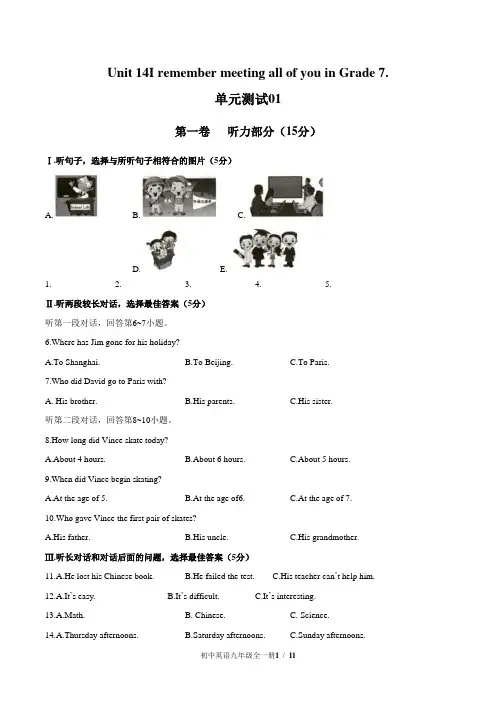
Unit 14I remember meeting all of you in Grade 7.单元测试01第一卷听力部分(15分)Ⅰ.听句子,选择与所听句子相符合的图片(5分)A. B. C.D. E.1.________2.________3.________4.________5.________Ⅱ.听两段较长对话,选择最佳答案(5分)听第一段对话,回答第6~7小题。
6.Where has Jim gone for his holiday?A.To Shanghai.B.To Beijing.C.To Paris.7.Who did David go to Paris with?A. His brother.B.His parents.C.His sister.听第二段对话,回答第8~10小题。
8.How long did Vince skate today?A.About 4 hours.B.About 6 hours.C.About 5 hours.9.When did Vince begin skating?A.At the age of 5.B.At the age of6.C.At the age of 7.10.Who gave Vince the first pair of skates?A.His father.B.His uncle.C.His grandmother.Ⅲ.听长对话和对话后面的问题,选择最佳答案(5分)11.A.He lost his Chinese book. B.He failed the test. C.His teacher can’t help him.12.A.It’s easy. B.It’s difficult. C.It’s interesting.13.A.Math. B. Chinese. C. Science.14.A.Thursday afternoons. B.Saturday afternoons. C.Sunday afternoons.15.A.At school. B.At Ann’s home. C.At Peter’s home.第二卷笔试部分(85分)Ⅳ.单项选择(10分)16.Many students write to Language Doctor to ________ advice about learning English.A.look throughB.ask forC.give upD.worry about17.If you want to change the world, you have to ________ yourself first.A. enjoyB. ask forC. give upD.change18.Who taught you to ________ in music class?A.play the keyboardB.play keyboardC.play on the keyboardD.play on keyboard19.Read the ________ carefully before you take the medicine.A.instructionsB.descriptionsC.collectionsD.expressions20.Who are supposed to be responsible ________ the traffic accident?A.forB.toC.inD.about21.Lily is afraid to speak in public.We should try to help her ________ shyness.A.developB.improveC.overcomeD.reduce22.We have a lot of things to do.But ________ we must get some sleep.A.at onceB. at firstC.first ofallD.all in all23.Many kids ________ volunteers to help others since the terrible earthquake.A.have become;happenedB.have been;happenedC.became;have happenedD.became;happened24.Congratulations ________ all the winners ________ your excellent grades!A.to;onB.to;forC.on;onD.on;for25.I think young people should be ________ knowledge.A.good atB.friendly withC. ready toD. thirsty forV.完形填空(10分)Dear Jenny,How’s it going?Are you busy with your study these days?I’ve been back at school 26 nearly four weeks.I’m very glad to tell you that great 27 have takenplace in our school this term.First of all, we’re asked to"clear our plates" when having our meals and say 28 to wasting.Some of us used to order more than what we could eat.That was a big waste of food.Now we need to 29 the food we order.We should also stop wasting in some other ways.For example, we should turn off the lights when we 30 the classroom.And our school has opened up some fields for us to learn how to grow vegetables.Each class is given a small garden and our class has decided to grow some tomatoes and beans(豆类)in our 31 time.I think that’ll be very interesting.Maybe I’ll be able to 32 you some beans we’ve grown by ourselves next time! What’s more, we have only two classes in the afternoon 33 we have more time for after-school activities.I’m one of the traffic safety volunteers in our school. After school, we take turns to go to the streets near our school and ask people to 34 the traffic rules.Ithink we are having a different school life now!Please write back soon and tell 35 more about your school.Yours,Wang Wei26.A.in B.for C.on D.at27.A.changes B.things C.interests D.lessons28.A.yes B. hello C. no D.thanks30.A.leave B.reach C.open D.build31.A.busy B.free C.happy D.sad32.A.plant B.buy C.post D.lend33.A.because B.when C.before D.so34.A.follow B.make C.break D.thinkⅥ.阅读理解(30分)AWe spend hours, days and years of our lives in our school.Imagine(想象)you could design(设计)your dream school, what would it be like?What would you be doing?We wanted to find out what teenagers around the world thought.Here is what they said:Richard from the USA:My dream school would have a big swimming pool and two soccer fields.It would also have a cinema, a gym and a shopping centre.My school has none of these, and I think there should be more pleasant things for students to do while they are studying.Sonic from Italy:I’d like a room where we can relax and play computer games.I’d also like to have a music room.I think there should be a place for everyone to go and relax after class.Wu from Beijing:I think it would be great to have another day off(休息日)every week besides the weekend.If that day was a Friday or a Monday, we would have a long weekend every week.What fun! I also think school should start later, at about 10 o’clock, and finish earlier.Hannah from Australia:In my dream school, I think the teachers should give us more freedom(自由)and choice about how we study and what we study.I also think it’s not necessary for us to wear school uniforms every day.I really don’t like wearing it.36.There would be ________ in Richard’s dream school.A.a big swimming pool and a music roomB.a room to relax and play computer gamesC.a big swimming pool and a shopping centre37.How many days off does Wu want to have in a week?A.2B.3C.438.Which country is not mentioned(提到)in the passage?A. Italy.B. Japan.C. Australia.39.From the passage we know that ________.A.Sonic from Italy would like a room where she can relax and play computer gamesB.Richard from the USA thinks his dream school should start at 10 o’clockC.Hannah from Australia likes wearing a school uniform every day40.Which is the best title(标题)for the passage?A.Schools in the pastB.Schools todayC.Dream schoolsBMrs Thompson, a school teacher, told the children on the first day that she loved them all the same.But that was a lie.There in the front row was a little boy named Teddy Stoddard.He didn’t get along well with the other children and he always needed a bath. She did not like him.Then Mrs Thompson got to know that Teddy was a very good boy before the death of his mother. Mrs Thompson was ashamed of herself. She felt even worse when, like all her other students, Teddy bought her a present, too. It was his mother’s perfume(香水)。

商学精要第⼗版英⽂教师⼿册ebert_be10e_im14Chapter 14: Information Technology (IT) for Business Chapter OverviewInformation technology (IT) has had a tremendous impact on the business world in the last few years. Think of how much the Internet alone affects your life. Some people feel complete ly “out of touch” going just one day without it. We are connected to the remotest corners of the world. Businesses have a variety of IT resources at their disposal, and information systems and how these systems are used play an integral role in businesses.This chapter provides the latest details on business IT. It discusses the impacts IT has had on the business world and identifies the IT resources businesses have at their disposal. It also describes the role of information systems, the different types of information systems, and how businesses use such systems. Finally, it looks at the various threats and risks IT poses for businesses, as well as the ways in which businesses protect themselves from these threats and risks. Even if you are apprehensive about IT and its uses, this chapter will help you become more familiar with and comfortable with IT. Learning Objectives1.Discuss the impacts information technology has had on the business world.2.Identify the IT resources businesses have at their disposal and how these resources areused.3.Describe the role of information systems, the different types of information systems, andhow businesses use such systems.4.Identify the threats and risks information technology poses on businesses.5.Describe the ways in which businesses protect themselves from the threats and risksinformation technology poses.CHAPTER OUTLINELearning Objective 1:Discuss the impacts information technology has had on the business world.IT ImpactsInformation technology (IT) includes the various appliances and devices for creating, storing, exchanging, and using information in diverse modes, including visual images, voice, multimedia, and business data. E-commerce is the use of the Internet and other electronic means for retailing and business-to-business transactions. Businesses are using IT to bolster productivity, improve operations and processes, create new opportunities, and communicate and work in ways not possible before.A. Creating Portable OfficesTechnology built into various devices offers businesses powerful tools that save time and travel expenses.B. Enabling Better Service by Coordinating Remote DeliveriesCompany activities may be geographically scattered, but remain coordinated through a networked system that also provides better service for customers.C. Creating Leaner, More Efficient OrganizationsNetworks and technology allow organizations to operate with fewer employees and simpler structures.D. Enabling Increased CollaborationCollaboration software and other IT communication devices enable greater collaboration among internal units and with outside firms.E. Enabling Global ExchangeThe global reach of IT is enabling business collaboration on a huge scale.F. Improving Management ProcessesWith databases, specialized software, and networks, instantaneous information is now accessible and useful to all levels of management.G. Providing Flexibility for CustomizationIT networks and other IT advances create new manufacturing capabilities that enable businesses to offer customers greater variety and faster delivery cycles. Mass-customization allows manufacturers to produce in large volumes, with each unit featuring the unique options the customer prefers.H. Providing New Business OpportunitiesIT is creating entirely new businesses where none existed before.I. Improving the World and Our LivesNumerous businesses across various industries use IT to create improvements that enhance the standard of living.KEY TEACHING TIPSRemind students that information technology (IT) includes the various devices for creating, storing, exchanging, and using information in diverse modes, including visual images, voice, multimedia, and business data.Students need to keep the meaning of standardization separate from mass-customization, which allows companies to produce in large volumes and provide unique features and options for customers.QUICK QUESTIONSHow are portable offices bolstering productivityHow has IT allowed marketers to provide better serviceHow does IT allow firms to create leaner, more efficient organizationsHow has IT changed the nature of the management process within organizationsUse In-Class Activity 1: Ice-Breaker: IT DevicesTime Limit: 20 minutesHOMEWORKThe Impact of ITNow might be a good time to assign Application Exercise 9 from the end-of-chapter materials as homework. This assignment asks students to think about how IT systems affect their daily lives, and whether their encounters with IT leave them at risk for identity theft.At-Home Completion Time: 30 MinutesLearning Objective 2:Identify the IT resources businesses have at their disposal and how these resources are used. IT Building Blocks: Business ResourcesBusinesses have numerous IT resources at their disposal.A. The Internet and Other Communication ResourcesThe Internet is a gigantic system of interconnected computers; the World Wide Web is a standardized code for accessing information and transmitting data over the Internet.1. Intranets.Intranets are private networks of internal Web sites linked throughout anorganization that are accessible only to employees.2.Extranets. Extranets al low outsiders limited access to a firm’s internal informationnetwork.1.Electronic Conferencing.Electronic conferencing allows groups of people tocommunicate simultaneously from various locations via e-mail, phone, or video.4. VSAT Satellite Communications.VSAT satellite communications have a transmitter-receiver that sits outdoors with a direct line-of-sight to a satellite; the hub sends signals to and receives signals from the satellite, exchanging voice, video, and data transmission. B. Networks: System ArchitectureA computer network is a group of two or more computers linked together by some form ofcabling or by wireless technology to share data or resources, such as a printer; a client-server network is a common type of network used in businesses in which the clients are usually the laptop or desktop computers being used, and the servers are any number of computers that provide services shared by users.1.Wide Area Networks (WAN s). Wide area networks (WANs) are computers linked overlong distances (statewide or even nationwide) through telephone lines, microwave signals, or satellite communications.2.Local Area Networks (LANs). In local area networks (LANs), computers are linked in asmaller area, such as all of a firm’s computers within a single building. The arrangement requires only one computer system with one database and one software system.3. Wireless Networks. Wireless networks use airborne electronic signals to link networkcomputers and devices. For example, the BlackBerry system consists of devices that send and receive transmissions on wireless wide area networks (WWANS) of more than 100 service providers.4. Wi-Fi. A Wi-Fi is a hotspot, or access point, for the Internet. Each hotspot is actually itsown small network, called a wireless local area network (Wireless LAN or WLAN).C. Hardware and SoftwareHardware includes the physical components, such as keyboards, monitors, system units, and printers; software includes the programs that tell the computer how to function.KEY TEACHING TIPMake sure students understand the distinction between intranets (private networks accessible only to employees) and extranets (networks that allow out siders limited access to a firm’s internal information).QUICK QUESTIONSFor what purposes might data conferencing be used What about videoconferencingWhat are the clients and what are the servers in a client-server networkWhat is the difference between a wide area network (WAN) and a local area network (LAN)What are some benefits of Wi-FiWhen does data become informationUse In-Class Activity 2: Small-Group Discussion: LaidOffCampTime Limit: 30 minutesLearning Objective 3:Describe the role of information systems, the different types of information systems, and how businesses use such systems.Information Systems: Harnessing the Competitive Power of ITAn information system is a system that uses IT resources and enables managers to take data—raw facts and figures—and transform that data into information—the meaningful, useful interpretation of data. Information systems managers operate the systems used for gathering, organizing, and distributing information.A. Leveraging Information Resources: Data Warehousing and Data MiningData warehousing involves the collection, storage, and retrieval of data in electronic files.1.Data Mining.Data mining is the application of electronic technologies for searching,sifting, and reorganizing pools of data to uncover useful information.2. Information Linkages with Suppliers.Coordinated planning avoids excessiveinventories, speeds up deliveries, and holds down costs throughout the supply chain.B. Types of Information SystemsEach user group and department in an organization may need a special information system./doc/07b0ee29504de518964bcf84b9d528ea80c72f67.html rmation Systems for Knowledge Workers.Knowledge information systemssupport knowledge workers by providing resources to create, store, use, and transmit new knowledge for useful applications. Computer-aided design (CAD) helps knowledge workers design products by simulating them and displaying them in three-dimensional graphics./doc/07b0ee29504de518964bcf84b9d528ea80c72f67.html rmation Systems for Managers.Each manager’s information activities andinformation system needs vary according to his or her functional area.a.Management Information Systems (MIS). Management information systems (MIS)support managers by providing reports, schedules, plans, and budgets that can then beused for making decisions.b. Decision Support Systems (DSS). Decision support systems (DSS) are interactivesystems that create virtual business models and test them with different data to seehow they respond.KEY TEACHING TIPSStudents often confuse this point: Data warehousing is the collection, storage, and retrieval of data in electronic files; data mining is the application of electronic technologies for searching, sifting, and reorganizing data to uncover useful information.Reinforce that an information system enables managers to collect, process, and transmit that information for use in decision making.Make sure students understand that a management information system provides reports, schedules, plans, and budgets that managers use to make decisions.QUICK QUESTIONSHow do knowledge workers benefit from knowledge information systemsWhat is the role of a decision support system (DSS)What are some advantages that radio frequency identification can provide to individual stores and to the supply chain as a whole?Use In-Class Activity 3: Supplemental Case Study Discussion: The Tweet Smell of Success! Time Limit: 30 minutes HOMEWORKSystem ArchitectureNow might be a good time to assign Application Exercise 10 from the end-of-chapter materials as homework. This assignment asks students to assess the impact of changes in IT on the higher education.At-Home Completion Time:1 hourIdentify the threats and risks information technology poses on businesses.IT Risks and ThreatsIT has attracted abusers that are set on doing mischief, with severity ranging from mere nuisance to outright destruction. A. HackersHackers are cybercriminals who gain unauthorized access to a computer or network, either to steal information, money, or property or to tamper with data.B. Identity TheftIdentity theft is the unauthorized stealing of personal information to get loans, credit cards, or other monetary benefits by impersonating the victim.C. Intellectual Property TheftIntellectual property includes products of the minds—something produced by the intellect, with great expenditure of human effort, that has commercial value. Nearly every company faces the dilemma of protecting product plans, new inventions, industrial processes, and other intellectual property.D. Computer Viruses, Worms, and Trojan HorsesA computer virus exists in a file that attaches itself to a program and migrates fromcomputer-to-computer as a shared program or as an e-mail attachment. Worms are a particular kind of virus that travels from computer to computer within networked computer systems, without needing you to open any software to spread the contaminated file. Unlike viruses, a Trojan horse does not replicate itself.E.Spyware is unintentionally downloaded on a computer and crawls around to monitor thehost’s computer activities. For example, Internet users open files that promise “freegiveaways,” not suspecting that they are downloading spyware onto their systems.F. Spam is junk e-mail sent to a mailing list or a newsgroup.QUICK QUESTIONSCan hackers ever do goodHow can identity theft be avoidedWhat types of damage might a worm and a Trojan horse doDescribe the ways in which businesses protect themselves from the threats and risks information technology poses.IT Protection MeasuresBusinesses guard themselves against intrusion, identity theft, and viruses by using firewalls, special software, and encryption.A. Preventing Unauthorized Access: FirewallsFirewalls are security systems with special software or hardware devices designed to keep computers safe from hackers. A firewall contains two components for filtering each incoming message: (1) the company’s security policy, which contains access rules; and (b) a router, which involves a “traffic switch” that determines on which network routes or paths to send each message after it is tested against the security policy.B. Preventing Identity TheftThe Fair and Accurate Credit Transactions Act (FACTA) strengthens identity-theft protections by specifying how organizations must destroy information, rather than simply dropping it in a dumpster.C. Preventing Infectious Viruses: Anti-Virus SoftwareAnti-virus software protects systems by searching incoming e-mail and data files for “signatures” of known viruses and virus-like characteristics.D. Protecting Electronic Communications: Encryption SoftwareAn encryption system works by locking an e-mail message to a unique code number for each computer, so only that computer can open and read the message.E. Avoiding Spam and SpywareAnti-spyware and spam filtering software on business systems helps employees avoid privacy invasion and improves worker productivity.F. Ethical Concerns in ITIt is app arent that IT developments and usage are progressing faster than society’sappreciation for the potential consequences, including new ethical concerns.KEY TEACHING TIPReinforce that an encryption system works by locking an e-mail message to a unique code number for each computer, so only that computer can open and read the message.QUICK QUESTIONWhat are a firewall’s two components for filtering incoming messages?Use In-Class Activity 5: Up for Debate: Is That Ethical?Time Limit: 30 minutesIN-CLASS ACTIVITIESIn-Class Activity 1: Ice-BreakerIT DevicesActivity Overview:This activity asks students to come up with a list of technological devices that reflect the many ways in which the class as a whole creates, stores, exchanges, and uses information.Time Limit: 20 minutesWhat to Do:1. Ask the class as a whole to brainstorm, coming up with a list of technological devices thatthey use in their personal lives, at work, or at school to create, store, exchange, and use information.2. Ask the class to comment on these questions:a.Do students in the class as a whole use more or fewer devices than what you expectedprior to brainstorming?b.In what way(s) do you see your individual use of these devices changing in the comingyears?c.In what way(s) have these devices impacted your personal lives, such as at school, at thebank, while shopping, and so on?Don’t Forget:Some people are more technologically savvy than others. Many students will say they take advantage of every gadget available, while others do not have Internet access at home.Wrap-Up:Bring the activity to a close by reminding students that new technologies are always looming on the horizon and that no one can accurately predict how much IT will change and affect our lives in the future.In-Class Activity 2: Small-Group Discussion LaidOffCampActivity Overview:This activity encourages students to think about how information technology can be used to develop new products and services even in difficult economic times.Time Limit: 30 minutesWhat to Do:1. Divide the class into small groups and ask them to read the Entrepreneurship and NewVentures feature on page 342 of the textbook. (10 minutes)2. Ask students to discuss the following questions within their small groups (10 minutes):a.What do you think about the idea of LaidOffCamp? If you were given the opportunity,would you invest in LaidOffCamp?b.Think of another product of service that information technology might make viable in asown economy. What would you call the product or service? What would be its unique selling points?3. Regroup the class as a whole and discuss each group’s conclusions. (10 minutes)Don’t Forget:Information technology is rapidly changing. As new technologies become available so do new possibilities. Encourage your students to keep their eyes on technology blogs to keep abreast of new developments.Wrap-Up:Bring the activity to a close by reminding students of the vast differences in communication between and among various cultures.In-Class Activity 3: Up for DebateIs That Ethical?Activity Overview:This activity asks students to discuss the ethical issues that may arise from an employer having the ability to access and track employees’ computer usage.Time Limit: 30 minutesWhat to Do:1. Divide the class into small groups and ask them to consider this tidbit that a coworkero verheard at the water cooler: “I guess it was as simple as that! Once Jeremy looked into everything Jason had been doing on the Internet, he asked Jason to hit the road. He was playing card games, placing personal stock market transactions, and sending e-mails to his friends and wife. I guess we all need to be m ore careful.” Ask each group to discuss whether firing an employee based on their Internet activities is ethical; groups should take notes on the pros and cons of such a company policy. (15 minutes)2. Reassemble the class as a whole and discuss each group’s conclusion. (15 minutes)Don’t Forget:Many companies have such policies stated clearly in the employee handbook; on the other hand, some employers may use such tactics as an excuse to get rid of an employee.Wrap-Up:Bring the debate to a close by reminding students that company policies stated in the employee handboo k must be adhered to. However, one side of the argument is: “If you don’t want me to use the Internet, then don’t give it to me.” The other side of the argument is: “While working on company time, I should do what the employer wants.” Most group comments w ill fall somewhere between those two extremes.ANSWERS FOR END OF CHAPTER ACTIVITIES QUESTIONS FOR REVIEW/doc/07b0ee29504de518964bcf84b9d528ea80c72f67.html rmation is an asset. Like any other asset, information must be planned for, developed,and protected. (Learning Objective 1 – AACSB – application of knowledge)2. It is easy, quick, and relatively low-cost, eliminating the need for expensive travel for face-to-face meetings. (Learning Objective 1 – AACSB – application of knowledge)3. The cloud enhances user flexibility, especially for employees working remotely becauseusers can access e-mails and data files from any online location, rather than from oneparticular location The cloud computing has become a cost saver for companies byeliminating the need for buying, installing, and maintaining in-house server computers, many of which have excessive unused storage capacity. The risks of cloud computing include: hacking and privacy issues. (Learning Objective 2 – AACSB – application of knowledge) 4. Hackers can cause serious damage: stealing company and customer informationcompromising company files and records. This can cause a company serious financial problems. (Learning Objective 4 –AACSB – application of knowledge)5. Intellectual property is a product of the mind, something produced by the intellect, with greatexpenditure of human effort. Examples include new inventions, product plans, and manufacturing processes. (Learning Objective 4 – AACSB – application of knowledge) QUESTIONS FOR ANALYSIS6. Data warehousing involves the collection, storage, and retrieval of data in electronic files;data mining is the application of electronic technologies for searching, sifting, and reorganizing pools of data to uncover useful information. (Learning Objective 3 – AACSB – application of knowledge)7. IT presents opportunities such as online banking and online investing, among other options.(Learning Objective 1 – AACSB – application of knowledge)8. Answers will vary, but students should recognize that information networks streamline andautomate communications operations and allow firms to accomplish more with fewer resources. (Learning Objective 1 –AACSB – application of knowledge) APPLICATION EXERCISES9. Answers will vary, but most students will mention their access to ATMs and their use ofcredit cards, often daily, in making consumer purchases. Identity theft can happen at any time, either during or after the sharing of personal information. (Learning Objective 2 – AACSB – application of knowledge, reflective thinking)10. Answers will vary, but many students will mention online classes and testing, applying andregistering for college/classes online, and accessing their academic records online.(Learning Objective 1, 2 – AACSB – application of knowledge)BUILDING A BUSINESS: CONTINUING TEAM EXERCISE ASSIGNMENT 14-11-15 (Learning objectives 2, 3, 4, 5 -AACSB interpersonal relations and teamwork, analytical and reflective thinking, application of knowledge)Students should develop a comprehensive IT plan that focuses on meeti ng customers’ needs, improves efficiencies, operations, and processes bolsters productivity, create new opportunities, and communicate and work. They should also address the various threats and risks it poses for their businesses, as well as the ways to protect themselves from threats and risks information technology might pose for their business.BUILDING YOUR BUSINESS SKILLS: THE ART AND SCIENCE OF POINT-AND-CLICK RESEARCH(Learning objectives 1, 2- AACSB interpersonal relations and teamwork, analytical and, application of knowledge)16. The “Help” function can help students save time by using the site’s specific features andcapabilities to narrow the search.17. Students should relate various ways in which advanced search pages allow them to improve,refine, and expand their searches.18. The Web has made information more accessible, less expensive, and easier to find, but it hasalso increased the volume of information that managers must sift through to find what they need and to ensure that their information is reliable, accurate, objective, and timely. EXERCISING YOUR ETHICS: TO READ OR NOT TO READ 14 - 19– 21(AACSB – Ethical understanding and reasoning, reflective thinking)19. The ethical issues focus on the trust issues between employees and employer.20. Answers will vary, but many students will recognize that companies do monitor employees’activities to try to increase employee productivity but there is also the perspective of the trust issue from the employees’perspective.21. Answers will vary, but many students will suggest that their advice would depend on thesituation and the employee needs to understand that work obviously comes first.TEAM EXERCISE:THIS GAME IS GETTING SERIOUS 14 -22 – 26(AACSB – Ethical understanding and reasoning, interpersonal relations and teamwork, reflective thinking)This exercise should get students to think about some issues that they probably have not considered. Students often think that they can “modify” and disseminate products that the y purchase. Since so many products, videos, games, etc. are “shared” online, they often forget that companies spent money developing these products and have intellectual property rights to said products. T he students’ responses to the Action Steps will var y widely due to differences in perception.CASES:ONLINE PIRATES FEAST ON ECONOMIC DOWNTURN 10- 27– 31(Learning objectives 1, 2, 3, 4 - AACSB analytical and reflective thinking, application of knowledge)27. The intruders were seeking passwords, personal financial data, credit card numbers, etc.28. Most students are technically savvy and immediately identified the “s ca ms”.29. An open message may carry a virus, spyware, or worm that can capture personal informationand permit identity theft.30. Answers will vary but most students will probably mention firewalls and other anti-theftsoftware.31. Again, answers will vary depending on the IT devices used by students.INFORMATION TECHNOLOGY FOR BETTER HEALTH CARE(Learning objectives 1, 2, 3, 4 - AACSB analytical and reflective thinking, application of knowledge)32. IT developments that have impacted health care include devices that enhance patient care andoperations, permitting more complicated surgeries, remote/virtual surgeries, and lower health care costs.33. Healthcare customers are being affected by a myriad of IT developments includingpreventive care, surgery, recovery, and length of hospital care. Most of the developments are positive but there might be some negatives such as security issues.34. The MIS system for the robotic system would need a decision support system designedspecifically to serve the intricate nature of the surgery. The MIS system would need aninternet and extranet, electronic conferencing, anti-virus software, encryption software, a firewall.35. Risks could include release of patient information, hackers disabling the surgical systems,viruses, and worms, spyware, and destruction of equipment. Most students will hire security experts to review the network security operations.36. The IT system would need at the minimum anti-virus software, encryption software, afirewall to reduce the threat. Most students will way the costs versus the benefits of each protection measure.。

竞争市场上的企业Firms in Competitive Markets第14章Chapter 142竞争的含义The Meaning of Competition完全竞争市场具有下列特征:A perfectly competitive market has the following characteristics:市场中有许多买者和卖者There are many buyers and sellers in the market.各个卖者提供的物品大体上是相同的The goods offered by the various sellers are largely the same.企业可以自由地进入或退出市场Firms can freely enter or exit the market.3竞争的含义The Meaning of Competition这些特征,使得完全竞争市场具有如下结果:As a result of its characteristics, the perfectly competitive market has the following outcomes:任何一个买者或卖者的行动对市场价格的影响都可以忽略不计。
The actions of any single buyer or seller in the market have a negligible impact on the market price.每一个买者和卖者都接受市场决定的价格。
Each buyer and seller takes the market price as given.4竞争的含义The Meaning of Competition竞争市场中的买者和卖者被称为价格接受者。
Buyers and sellers in competitive markets are said to be price takers.5竞争企业的收益Revenue of a Competitive Firm企业的总收益是销售价格乘以销售量。

CHAPTER 11 AND 14 LIABILITIESTrue/False Questions:1.A liability is a probable future payment of assets or services that a company is presently obligatedto make as a result of past transactions or events.Answer: True2.A single liability can be divided between current and noncurrent liabilities.Answer: True3. 6.A liability does not exist if there is any uncertainty about whom to pay, when to pay, or how much topay.Answer: False4.Trade accounts payable are amounts owed to suppliers for products or services purchased on credit.Answer: True5.Unearned revenues is another name for sales.Answer: False6.Sales taxes payable is credited and cash is debited when companies send sales taxes collected fromcustomers to the government.Answer: False7.Known liabilities are obligations set by agreements, contracts, or laws, and are measurable and definitely determinable.Answer: True8.A contingent liability is a potential obligation that depends on a future event arising from a futuretransaction or event.Answer: False9.The full disclosure principle requires the reporting of contingent liabilities that are reasonably possible.Answer: True10.Debt guarantees are not disclosed because the guarantor is not the primary debtor.Answer: False11.Accounting for contingent liabilities covers three categories. (1) The future event is probable and theamount cannot be reasonably estimated. (2) The future event is remote or unlikely to recur.(3) The likelihood of the liability to occur is impossible.Answer: False12.A high value for the times interest earned ratio means that a company is a higher risk borrower.Answer: False13.The times interest earned ratio is calculated by dividing income before interest expense and incometaxes by interest expense.Answer: True14.When the times interest earned ratio declines, the likelihood of default on liabilities increases.Answer: True15.A short-term note payable is a written promise to pay a specified amount on a definite future datewithin one year or the operating cycle, whichever is longer.Answer: True16. A Premium on Bonds Payable reduces the interest expense of the bond over its life.Answer: True17、A bond listed at 103 on a stock exchange is selling at 103% of its par value.Answer: True18.Callable bonds can be exchanged for a fixed number of shares of the issuing corporation's commonstock.Answer: False19.There are two common payment patterns for installment notes: (1) accrued interest plus equal principalpayments and (2) equal payments.Answer: True20、The carrying value of a long-term note is computed as the present value of all remaining futurepayments, discounted using the market rate at the time of issuance.Answer: True21、A basic present value concept is that cash received in the future is worth more value than the sameamount of cash received today.Answer: False22.An annuity is a series of equal payments at equal time intervals.Answer: True23.The present value of an annuity factor for 6 years at 10% is 4.3553. This implies that an annuity of six$2,000 payments at 10% would equal $8,711.Answer: TrueCalculation: $2,000 x 4.3553 = $8,71124、Both interest on bonds and dividends on stock are tax deductible.Answer: False25、Interest payments on bonds are determined by multiplying the par value of the bond by the stated contract rate.Answer: True26、.Return on equity increases when the expected rate of return from the acquired assets is higher than theinterest rate on the debt issued to finance the acquired assets.Answer: True27.Bond interest paid by a corporation is an expense, whereas dividends paid are not an expense of thecorporation.Answer: True28、The debt-to-equity ratio enables financial statement users to assess the risk of a company’s financingstructure.Answer: True29、A company’s debt-to-equity ratio was 1.0 at the end of Year 1. By the end of Year 2, it had increasedto 1.7. Since the ratio increased from Year 1 to Year 2, the degree of risk in the firm’sfinancing structure decreased during Year 2.Answer: False30、The carrying (book) value of a bond payable is the par value of the bonds plus the discount.Answer: FalseMultiple Choice:1、The characteristics of a liability include:A) A past transaction or event.B) A present obligation.C) A future payment of assets or services.D) Both (a) and (b).E) All of the above.Answer: E2. Obligations not expected to be paid within the longer of one year or the company's operating cycleare reported as:A)Current assets.B) Current liabilities.C) Long-term liabilities.D) Operating cycle liabilities.E) Bills.Answer: C3.Amounts received in advance from customers for future products or services:A)Are revenues.B) Increase income.C) Are liabilities.D) Are not allowed under GAAP.E) Require an outlay of cash in the future.Answer: C4.Contingent liabilities must be recorded if:A)The future event is probable and the amount owed can be reasonably estimated.B) The future event is remote.C) The future event is reasonably possible.D) The amount owed cannot be reasonably estimated.E) All of the above.Answer: A5.Debt guarantees:A)Are never disclosed in the financial statements.B) Are considered to be a contingent liability.C) Are a bad business practice.D) Are recorded as a liability even though it is highly unlikely that the original debtor will default.E) All of the above.Answer: B6.The times interest earned ratio reflects:A) A company's ability to pay its operating expenses on time.B) A company's ability to pay interest even if sales decline.C) A company's profitability.D) The relation between income and debt.E) The relation between assets and liabilities.Answer: B7.If the times interest ratio:A)Increases, then risk increases.B) Increases, then risk decreases.C) Is greater than 1.5, then the company is in default.D) Is less than 1.5, the company is carrying too little debt.E) Is greater than 1.5, the company is likely carrying too much debt.Answer: B8. The times interest earned computation is:A)(Net income + Interest expense + Income taxes)/Interest expense.B) (Net income + Interest expense - Income taxes)/Interest expense.C) (Net income - Interest expense - Income taxes)/Interest expense.D) (Net income - Interest expense + Income taxes)/Interest expense.E) Interest expense/(Net income + Interest expense + Income taxes expense).Answer: A9. Short-term notes payable:A)Can replace an account payable.B) Can be issued in return for money borrowed from a bank.C) Are negotiable.D) Are an unconditional promise to pay.E) All of the above.Answer: E10. On December 1, Martin Company signed a $5,000 3-month 6% note payable, with the principleplus interest due on March 1 of the following year. What amount of interest expense is accrued at December 31 on the note?A)$0B) $25C) $50D) $75E) $300Answer: B$5,000 x 0.06 x 1/12 = $2511. On November 1, Carter Company signed a $9,000 4-month 10% note payable, with the principle plusinterest due on March 1 of the following year. What is the adjusting entry for the accrued interest at December 31 on the note?A)Debit interest expense, $0; credit interest payable, $0.B)Debit interest expense, $100; credit interest payable, $100.C)Debit interest expense, $150; credit interest payable, $150.D)Debit interest expense, $200; credit interest payable, $200.E)Debit interest expense, $300; credit interest payable, $300.Answer: CCalculation: $9,000 x .10 x 2/12 = $15012. The employer should record payroll deductions as:A)Employee receivables.B) Payroll taxes.C) Current liabilities.D) Wages payable.E) Employee payables.Answer: C13.An estimated liability:A)Is an unknown liability of a certain amount.B) Is a known obligation of an uncertain amount that can be reasonably estimated.C) Is a liability that may occur if a future event occurs.D) Can be the result of a lawsuit.E) Is not recorded until the amount is known for certain.Answer: B14. Employee vacation benefits:A)Are estimated liabilities.B) Are contingent liabilities.C) Are recorded as an expense when the employee takes a vacation.D) Are recorded as an expense when the employee retires.E) Increase net income.Answer: A15.Bonds that have an option exercisable by the issuer to retire them at a stated dollar amount prior tomaturity are known as:A) Convertible bonds.B) Sinking fund bonds.C) Callable bonds.D) Serial bonds.E) Junk bonds.Answer: C16、A bond traded at 102½ means that:A) The bond pays 2.5% interest.B) The bond traded at $1,025 per $1,000 bond.C) The market rate of interest is 2.5%.D) The bonds were retired at $1,025 each.E) The market rate of interest is 2 ½ % above the contract rate.Answer: B17、Promissory notes that require the issuer to make a series of payments consisting of both interest andprincipal are:A) Debentures.B) Discounted notes.C) Installment notes.D) Indentures.E) Investment notes.Answer: C18、An advantage of bond financing is:A) Bonds do not affect owners' control.B) Interest on bonds is tax deductible.C) Bonds can increase return on equity.D) It allows firms to trade on the equity.E) All of the above.Answer: E19、Which of the following statements is true?A) Interest on bonds is tax deductible.B) Interest on bonds is not tax deductible.C) Dividends to stockholders are tax deductible.D) Bonds do not have to be repaid.E) Bonds always decrease return on equity.Answer: A20、A disadvantage of bonds is:A) Bonds require payment of periodic interest.B) Bonds require payment of principal.C) Bonds can decrease return on equity.D) Bond payments can be burdensome when income and cash flow are low.E) All of the above.Answer: E21、The debt-to-equity ratio:A) Is calculated by dividing book value of secured liabilities by book value of pledged assets.B) Is a means of assessing the risk of a company’s financing structure.C) Is not relevant to secured creditors.D) Can always be calculated from information provided in a company’s income statement.E) Must be calculated from the market values of assets and liabilities.Answer: B22、When a bond sells at a premium:A) The contract rate is above the market rate.B) The contract rate is equal to the market rate.C) The contract rate is below the market rate.D) It means that the bond is a zero coupon bond.E) The bond pays no interest.Answer: A23、Amortizing a bond discount:A) Allocates a part of the total discount to each interest period.B) Increases the market value of the Bonds Payable.C) Decreases the Bonds Payable account.D) Decreases interest expense each period.E) Increases cash flows from the bond.Answer: A24、The effective interest amortization method:A) Allocates bond interest expense using a changing interest rate.B) Allocates bond interest expense using a constant interest rate.C) Allocates a decreasing amount of interest over the life of a discounted bond.D) Allocates bond interest expense using the current market rate for each period.E) Is not allowed by the FASB.Answer: B25、The Premium on Bonds Payable account is a(n):A) Revenue account.B) Adjunct or accretion liability account.C) Contra revenue account.D) Asset account.E) Contra expense account.Answer: B26、A company received cash proceeds of $206,948 on a bond issue with a par value of $200,000. Thedifference between par value and issue price for this bond is recorded as a:A) Credit to Interest Income.B) Credit to Premium on Bonds Payable.C) Credit to Discount on Bonds Payable.D) Debit to Premium on Bonds Payable.E) Debit to Discount on Bonds Payable.Answer: B27、A company may retire bonds by:A) Exercising a call option.B) The holders converting them to stock.C) Purchasing the bonds on the open market.D) Paying them off at maturity.E) All of the above.Answer: E28、The contract rate of interest is also called the:A) Coupon rate.B) Stated rate.C) Nominal rate.D) Market rate.E) Each of A, B, and C.Answer: E29、The Discount on Bonds Payable account is:A) A liability.B) A contra liability.C) An expense.D) A contra expense.E) A contra equity.Answer: B30、The Premium on Bonds Payable account is a(n):A) Revenue account.B) Adjunct or accretion liability account.C) Contra revenue account.D) Asset account.E) Contra expense account. Answer: B。