
2018-2019学年高考英语一轮复习 Module 5 Cloning 外研版选修6
- 格式:ppt
- 大小:2.33 MB
- 文档页数:78


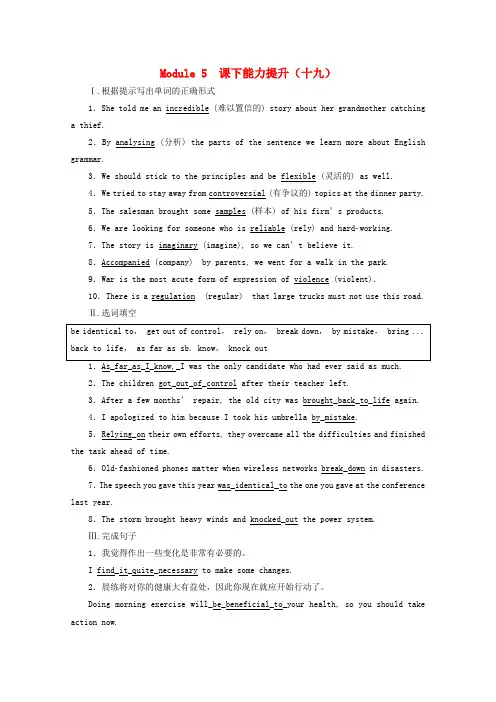
Module 5 课下能力提升(十九)Ⅰ.根据提示写出单词的正确形式1.She told me an incredible (难以置信的) story about her grandmother catching a thief.2.By analysing (分析) the parts of the sentence we learn more about English grammar.3.We should stick to the principles and be flexible (灵活的) as well.4.We tried to stay away from controversial (有争议的) topics at the dinner party.5.The salesman brought some samples (样本) of his firm’s products.6.We are looking for someone who is reliable (rely) and hardworking.7.The story is imaginary (ima gine), so we can’t believe it.8.Accompanied (company) by parents, we went for a walk in the park.9.War is the most acute form of expression of violence (violent).10.There is a regulation (regular) that large trucks must not use this road.Ⅱ.选词填空.As_far_as_I_know,_I was the only candidate who had ever said as much.2.The children got_out_of_control after their teacher left.3.Af ter a few months’ repair, the old city was brought_back_to_life again.4.I apologized to him because I took his umbrella by_mistake.5.Relying_on their own efforts, they overcame all the difficulties and finished the task ahead of time.6.Oldfashioned pho nes matter when wireless networks break_down in disasters.7.The speech you gave this year was_identical_to the one you gave at the conference last year.8.The storm brought heavy winds and knocked_out the power system.Ⅲ.完成句子1.我觉得作出一些变化是非常有必要的。
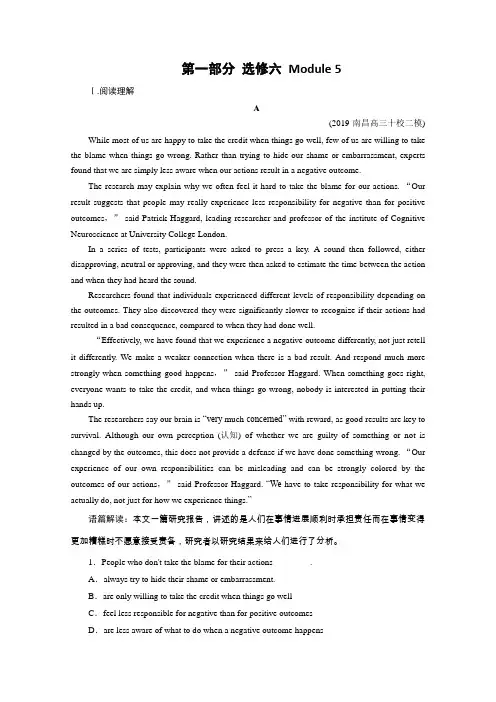
第一部分选修六Module 5Ⅰ.阅读理解A(2019·南昌高三十校二模) While most of us are happy to take the credit when things go well, few of us are willing to take the blame when things go wrong. Rather than trying to hide our shame or embarrassment, experts found that we are simply less aware when our actions result in a negative outcome.The research may explain why we often feel it hard to take the blame for our actions. “Our result suggests that people may really experience less responsibility for negative than for positive outcomes,” said Patrick Haggard, leading researcher and professor of the institute of Cognitive Neuroscience at University College London.In a series of tests, participants were asked to press a key. A sound then followed, either disapproving, neutral or approving, and they were then asked to estimate the time between the action and when they had heard the sound.Researchers found that individuals experienced different levels of responsibility depending on the outcomes. They also discovered they were significantly slower to recognize if their actions had resulted in a bad consequence, compared to when they had done well.“Effectively, we have found that we experience a negative outcome differently, not just retell it differently. We make a weaker connection when there is a bad result. And respond much more strongly when something good happens,” said Professor Haggard. When something goes right, everyone wants to take the credit, and when things go wrong, nobody is interested in putting their hands up.The researchers say our brain is “very much concerned” with reward, as good results are key to survival. Although our own perception (认知) of whether we are guilty of something or not is changed by the outcomes, this does not provide a defense if we have done something wrong. “Our experience of our own responsibilities can be misleading and can be strongly colored by the outcomes of our actions,” said Professor Haggard. “We have to take responsibility for what we actually do, not just for how we experience things.”语篇解读:本文一篇研究报告,讲述的是人们在事情进展顺利时承担责任而在事情变得更加糟糕时不愿意接受责备,研究者以研究结果来给人们进行了分析。
