【月考试卷】江苏省江阴市2017届九年级英语10月月考试题 牛津译林版
- 格式:doc
- 大小:225.50 KB
- 文档页数:18
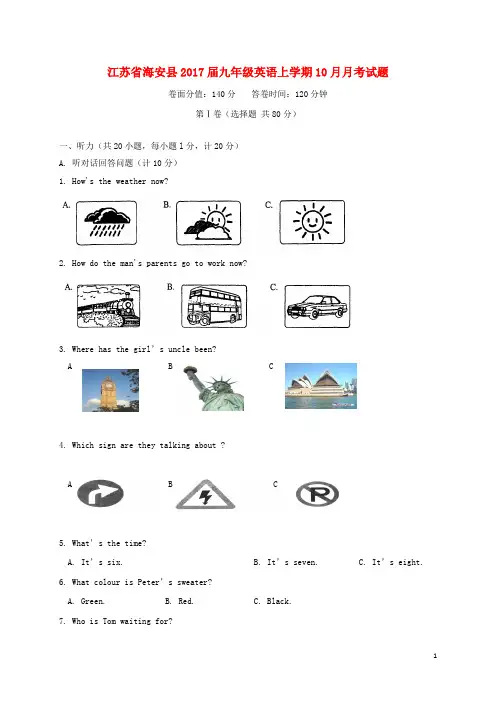
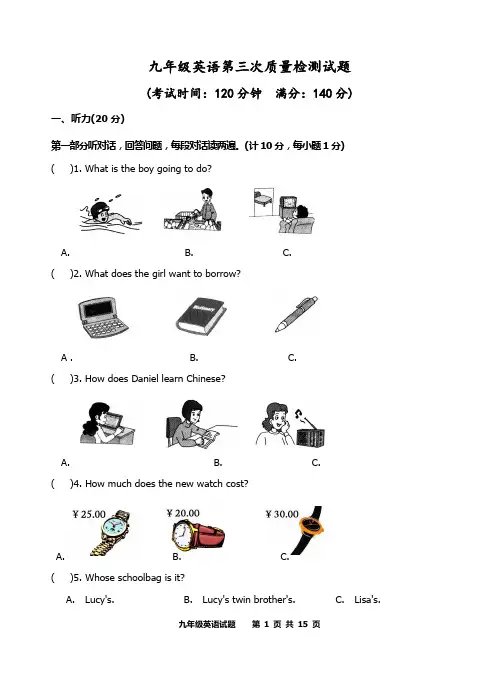
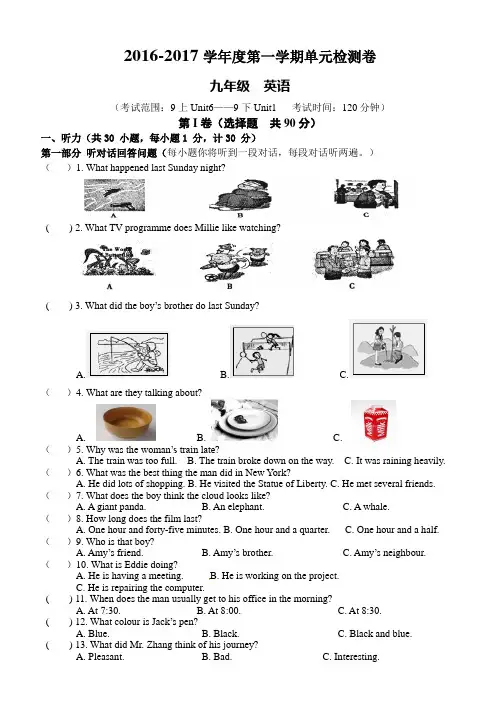
江苏省江阴市南闸实验学校2017届九年级英语10月月考试题 听力部分(20分) I听力(共20小题,每小题1分,计20分) A. 听下面10段对话,每段对话后有一个小题,从题中所给的A、B、C三个选项中选出最佳选项。每段对话读两遍。 ( )1. How does Jack go to work when it rains?
A B C
( )2. Which pen did the boy buy?
A B C ( ) 3. How is the weather this afternoon?
A B C ( )4. What kind of TV programme does the man’s son like? A B C ( )5. How did John go to school this morning? A. By bus. B. On foot. C. By bike. ( )6. What does Simon do now? A. He is a student. B. He is a doctor. C. He is a teacher. ( )7. When will Susan arrive? A. At 4:30. B. At 4:45. C. At 5:20. ( )8. Where did the dialogue probably happen? A. In a street. B. In a shop. C. In a school. ( )9. Why does the man advise the woman to wear red? A. Because she likes red most. B. Because the woman looks good in red. C. Because she feels weak. ( )10. Why does the man want to change his shirt? A. Because it is too small. B. Because it is out of style. C. Because he doesn’t like its colour. B. 听下面两段对话和一篇短文,每段对话和短文后有几个小题,从题中所给的A、B、C三个选项中选出最佳选项。每段对话和短文读两遍。 听第一段对话,回答第11至12题。 ( )11. What does the woman think of the rainy days? A. She thinks it very boring. B. She thinks it helpful for the plants. C. She thinks it good for playing outside. ( )12. What will the weather be like the next day? A. It will rain heavily and cause a flood. B. It will be better, but still rain. C. It will be a sunny day. 听第二段对话,回答第13至15题。 TV programmes The man Like TV programmes about 13 best , think they are useful The woman Her favourite TV programme is 14 programme. Time spent in watching TV The woman spent 15 hours every day.
( )13. A. News B. sports C. history ( )14. A. Animals B. News C. history ( )15. A. one hour B. two hours C. one and a half 听下面一篇短文,回答第16至20小题。 ( )16. What does Steve do in the factory? A. A worker. B. An engineer. C. A manager. ( )17. How does he go to work? A. On foot. B. By bus. C. By train. ( )18. How does he spend his time on the way? A. Reading newspapers. B. Reading novels. C.Chatting with someone else. ( )19. Why was he late for work one Thursday? A. He woke up late. B. He forgot to get off at the right station. C. He deserved to be late. ( )20. How did the boss treat him for his being late? A. The boss encouraged him to carry on with his work. B. The boss shouted to him angrily. C. The boss said nothing to him. 笔试部分(90分) 第I卷 (客观题 共50分) 一、单项选择.( 本大题共14 分,每小题1分) 21. –Look at the sign. It ______ “NO smoking”. -- Oh, sorry, I did not see it. A. says B. writes C. shows D. tells 22. She devoted as much time as she could ______ after the poor children. A. to looking B. to look C. looked D. in looking 23. He is ______ fat because he eats ______. A. too much; too much B. much too; too much C. much too; too many D. too much; much too 24. He played golf with some famous people, ______ he surprised everyone. A. whether B. if C. or D. and 25. –I’m sorry, Mr Li. I ______ my English homework at home. --Don’t forget______ it to school tomorrow. A. left; to bring B. forget; to take C. lost; to bring D. left; to take 26. None of the shoes in the shop are the right size. They are ___ too big ___ too small. A. both; and B. neither; nor C. either; or D. not only; but also 27. We found it ______ with him. He’s quite an easy-going guy. A. easily to communicate B. easily communicating C. easy to communicate D. easy communicating 28. It’s clever ______ her to come up with ______ many good ideas. A. for; as B. of; to C. for; at D. of; so 29. –Let’s go and listen to Mr Smith’s speech on Western Culture, shall we? -- ______. It’s going to the end. A. Why not? B. That’s all right C. I’m afraid not D. Never mind 30. The boy looks nice ______ white and the red sweater looks good ______ the girl. A. with; on B. in; on C. on; in D. in; with 31. ______ green or ______ in a light green room ______ good for us. A. Wear; sleep; is B. Wear; sleep; are C. Wearing; sleeping; is D. Wearing; sleeping; are 32. I prefer skiing to ______. The snow makes me ______. A. swim; excited B. swimming; exciting C. swimming; excited D. swim; exciting 33. The film show us ______ life was like in Beijing in the past. A. what everyday B. what every day C. how every day D. how every day