
口译第13单元第四组
- 格式:ppt
- 大小:389.00 KB
- 文档页数:11
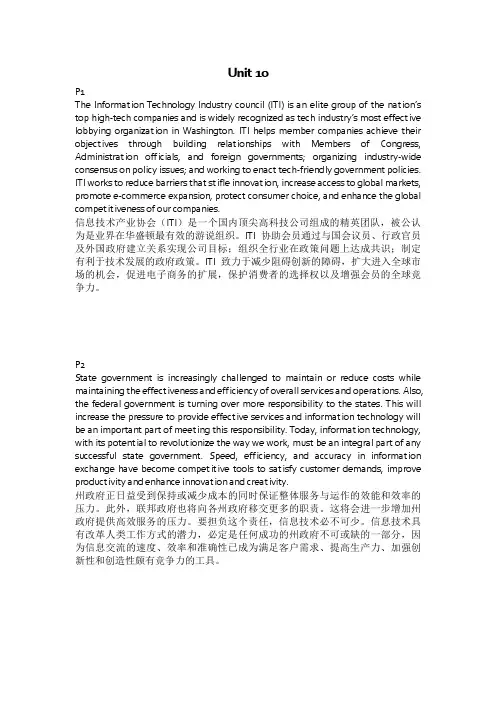
Unit 10P1The Information Technology Industry council (ITI) is an elite group of the nation’s top high-tech companies and is widely recognized as tech industry’s most effective lobbying organization in Washington. ITI helps member companies achieve their objectives through building relationships with Members of Congress, Administration officials, and foreign governments; organizing industry-wide consensus on policy issues; and working to enact tech-friendly government policies. ITI works to reduce barriers that stifle innovation, increase access to global markets, promote e-commerce expansion, protect consumer choice, and enhance the global competitiveness of our companies.信息技术产业协会(ITI)是一个国内顶尖高科技公司组成的精英团队,被公认为是业界在华盛顿最有效的游说组织。
ITI协助会员通过与国会议员、行政官员及外国政府建立关系实现公司目标;组织全行业在政策问题上达成共识;制定有利于技术发展的政府政策。
ITI致力于减少阻碍创新的障碍,扩大进入全球市场的机会,促进电子商务的扩展,保护消费者的选择权以及增强会员的全球竞争力。
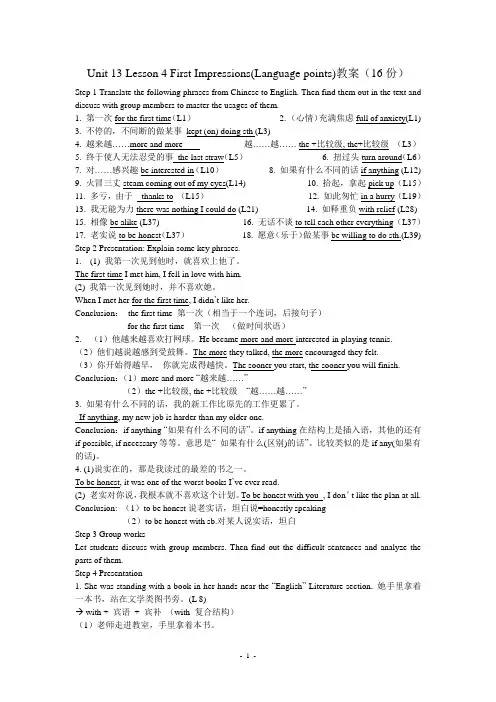
Unit 13 Lesson 4 First Impressions(Language points)教案(16份)Step 1 Translate the following phrases from Chinese to English. Then find them out in the text and discuss with group members to master the usages of them.1. 第一次for the first time(L1)2. (心情)充满焦虑full of anxiety(L1)3. 不停的,不间断的做某事kept (on) doing sth (L3)4. 越来越……more and more 越……越…… the +比较级, the+比较级(L3)5. 终于使人无法忍受的事the last straw(L5)6. 扭过头turn around(L6)7. 对……感兴趣be interested in(L10)8. 如果有什么不同的话if anything (L12)9. 火冒三丈steam coming out of my eyes(L14) 10. 拾起,拿起pick up(L15)11. 多亏,由于thanks to (L15)12. 如此匆忙in a hurry(L19)13. 我无能为力there was nothing I could do (L21) 14. 如释重负with relief (L28) 15. 相像be alike (L37) 16. 无话不谈to tell each other everything(L37)17. 老实说to be honest(L37)18. 愿意(乐于)做某事be willing to do sth.(L39) Step 2 Presentation: Explain some key phrases.1.(1) 我第一次见到他时,就喜欢上他了。

U n i t T h i r t e e nB u s i n e s s M e e t i n gUnit Objectives (单元目标)After reading this unit, you should➢understand the difficulties and skills of idioms interpreting.➢find ways to improve your interpreting skills and performance.➢master the basic words and expressions about business meeting.➢know some cultural background knowledge about business meeting.PreparingI. Interpreting Skills (口译技能)Read the following presentation about idioms interpreting and try tounderstand the difficulties and skills of idioms interpreting. Thencomplete the following task:1. Please interpret the following idioms into English and Chineserespectively.1) 隔墙有耳;破釜沉舟;三思而后行;无风不起浪;一言既出,驷马难追;谋事在天,成事在人。
20 The burnt child dreads the fire. /Better be the head of a dog than thetail of a lion. /Where there is a will, there is a way. /Strike while theiron is hot. /Don’t wash your dirty linen in public. /All good things mustcome to an end.2. You are going to hear a short passage, note down what you hear, payattention to the idioms and try to interpret them accurately.Idioms Interpreting(成语口译)Both Chinese and English are particularly rich in idioms. Idioms are so vivid and forcible in conveying a particular meaning that they are frequently used by speakers of both languages. Chinese and English idioms came into being under different historical, geographical, cultural and social backgrounds, so they contain different stories reflecting different environment, life, history, culture and values of the native speakers. It is surely no easy thing to understand idioms, let alone interpret them. One can hardly expect to provide a satisfactory rendition of an idiom unless he is guided by the correct method and manages to get an accurate understanding of its implied meaning through its surface structure according to the context.The Definition of IdiomAn idiom can be defined as a group of words with a meaning different from the combined meanings of its component words. One can hardly guess its meaning from the individual words that form it, for these words have already lost their original meaning. Idioms can be understood both in a broad sense and in a narrow one. In the narrow sense, they simply refer to the set phrases or clauses used in a language. Broadly speaking, they comprise all the idiomatic and special expressions in that language.Methods of Idioms InterpretingThere are quite a number of methods in interpreting idioms, but the following four are the most common ones:1. Idiom for IdiomAs we mentioned previously, both Chinese and English are rich in idioms. Some idioms in one language contain images, descriptions and meanings identical to idioms in the other language. There are also idioms that express the same meanings though they don’t have identical metaphors or images. In both cases, we might borrow them directly from the target language so as to retain their vividness and achieve equivalence in effect, such as “滴水石穿”for “constant dripping wear the stone”; “Hungry dogs will eat dirty puddings” for “饥不择食” and so on.2. Literal TranslationLiteral translation means word-for-word rendition, bringing the whole image into the target language. This approach is used when the speakers of the target language can easily understand the image contained in an idiom. For example,“易如反掌”can be literally interpreted into “as easy as turning over one’s palm”, and “To head a wolf into a house” into “引狼入室”.3. Free TranslationSome idioms which exhibit strong national or cultural characteristics can neither be handled by borrowing idioms from the target language nor translated literally because it would cause misunderstanding or could not be easily accepted by native speakers of the other language. In this case, it is necessary to resort to paraphrasing according to the context. For example, “王小二过年,一年不如一年” is interpreted into “to be going from bad to worse”, and “Every dog has its day” is interpreted into “人人皆有得意之日”.4. Literal Translation combined with paraphrasingThis approach is used when certain idioms, particularly those with historical stories or names involved, can hardly be understood and accepted by the listener, and the interpreter cannot find their proper equivalents in the target language. If literal translation were used, they would lose their original vividness. For example, “杀鸡给猴看”is interpreted into “to kill the chicken to frighten the monkey—to punish somebody as a warning to others”.II. Phrase Interpreting (短语口译)Work on the following words and phrases. Interpret them into Chineseand English respectively.A. English to Chinese1. Sino-US Joint Commission on Commerce and Trade (JCCT)2. WEF (World EconomicForum)3. World Economic Development Summit4. Adjourn5. Agenda6. In favor of7. Against 8. Abstain9. May I come in here? 10 If you ask me,... I tend to thinkthat...B. Chinese to English1. 太对了2. 我明白你的意思3. 例会4. 欢迎会5. 悬而未决6. 双方达成共识/一致意见7. 高层会谈8. 一切争端应首先通过友好会谈进行解决9. 我宣布会议开始。