
跨文化交际UNIT-
- 格式:ppt
- 大小:537.00 KB
- 文档页数:17

Unit1 Sportsmanship: It is the ability to practise a sport according to its rules,
while also showing generosity to one’s opponent and good temper in defeat.
2. Traditionally, an Englishman is thought to be reserved, unemotional, courteous, shy
of strangers, suspicious of change, and slow to accept new ideas.
3. It is the ability to practise a sport according to its rules, while also showing
generosity to one’s opponent and good temper in defeat. Moreover, sportsmanship as
an idea is applied to life in general.
The pioneering spirit: Except for the brought from Africa, immigrants came to
America voluntarily, early in search of greater prosperity and freedom.
Rags-to-riches: It is story about a poor boy who, because he was hardworking,
honest, and lucky, grew up to become rich and respected.
American dream: The belief that any individual, no matter how poor, can achieve

参考资料
Unit 1 Communication Across Cultures
Reading I
Intercultural Communication:An Introduction
Comprehension questions
1. Is it still often the case that “everyone‟s quick to blame the alien” in the
contemporary world
This is still powerful in today‘s social and political rhetoric. For instance,
it is not uncommon in
today‘s society to hear people say that most, if not all, of the social and economic
problems are
caused by minorities and immigrants.
2. What‟s the difference between today‟s intercultural contact and that of any time
in the past
Today‘s intercultural encounters are far more numerous and of greater importance
than in any
time in history.
3. What have made intercultural contact a very common phenomenon in our life today
New technology, in the form of transportation and communication systems, has
1 跨文化交际考试题型
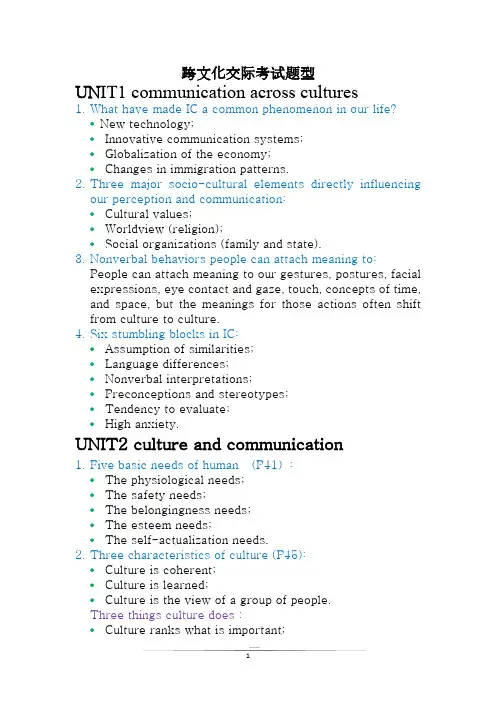
UNIT1 communication across cultures
1. What have made IC a common phenomenon in our life?
• New technology;
• Innovative communication systems;
• Globalization of the economy;
• Changes in immigration patterns.
2. Three major socio-cultural elements directly influencing
our perception and communication:
• Cultural values;
• Worldview (religion);
• Social organizations (family and state).
3. Nonverbal behaviors people can attach meaning to:
People can attach meaning to our gestures, postures, facial
expressions, eye contact and gaze, touch, concepts of time,
and space, but the meanings for those actions often shift
from culture to culture.
4. Six stumbling blocks in IC:
• Assumption of similarities;
• Language differences;
• Nonverbal interpretations;
• Preconceptions and stereotypes;
• Tendency to evaluate;
Intercultural Communication
跨文化交际
国家哲学社会科学项目
“英语专业基础阶段内容依托式教学改革
研究”项目组
Intercultural Communication
Contents
Unit 1 An Introduction to Intercultural Communication...................1
Unit 2 Understanding Communication..........................................21
Unit 3 Underatanding Culture........................................................38
Unit 4 Cultural Diversity................................................................52
Unit 5 Cultural Influence on Perception………………………....69
Unit 6 Cultural Shock....................................................................86
Unit 7 Verbal Communication (I)................................................100
Unit 8 Verbal Communication (II)……………………………....115
Unit 9 Nonverbal Communication (I) .........................................131
Unit 10 Nonverbal Communication (II)…..………….……….157