
语言学第六章
- 格式:ppt
- 大小:288.50 KB
- 文档页数:4



第六章语言的运用特点──语用教学要求与目的:了解语境的类型、语境和语句意义的关系、语境和词语所指的关系;了解会话的合作原则和礼貌原则、违反会话准则产生的会话含义,区分蕴含义和预设义;了解“言有所为”、直接和间接的言语行为第一节语用概说一、什么是语用语用就是语言运用,指人们在一定的交际环境中对语言的实际运用。
语用主要包括以下一些性质。
1、情境性:语言的实际运用是要讲求交际效果,正式场合和非正式场合话语的表现风格不同,要切合语境,表达得体2、社会性:语言运用从本质上说是一种与他人密切相关的社会行为3、规约性:语言运用过程必须遵从语言使用的社会习惯和表达规则,按照社会的行为规范行事二、语用研究的范围语用学是一门对立的语言学分支学科,主要研究句法学、语义学、语言的发出者和理解者;使用语言的环境,语言在语境中产生的临时意义和附加意义第二节语境和语句的意义一、语境的类型语境指言语交际活动的环境,语境大致分为两类:言内语境和言外语境(1)言内语境:又称上下文语境,指语言表达中的前言后语或上下文,是狭义语境(2)言外语境:指言语交际活动相关的时间、空间、场景等交际情景和社会情境,是广义语境二、语境和语句意义1、言内语境的作用:对语言的表达和理解有着明显的制约作用2、言外语境的作用:主要是用来解释词语的非义项和句子的非命题,解释特殊词义和句子,解释不但超过了词语的义项义和句子的命题义三、语境和词语所指1、指示词语和指示意义(1)指示词语:主要是指示词语的所指问题,是随着语境变化而变化的(2)指示意义:包括“人称指示”“时间指示”“地点指示”,指示意义都要借助语境来确定2、一般名词的指称意义区分名词指称中的“有指”和“无指”。
“有指”就是名词有指称性,“无指”就是名词没有指称性第三节会话准则和会话含义一、“合作原则”和“礼貌原则”1、合作原则:在言语交际中,为确保交谈双方相互配合而遵守的语用规则,包括“质量准则”“数量准则”“相关准则“方式准则”2、礼貌原则:是人类交际的普遍现象,也是人与人会话必须遵守的准则;要做到“得体和慷慨”“赞誉和谦逊”“一致和同情”二、违反会话准则产生的会话含义1、被迫违反或放弃会话准则:说话人在某些场合或条件下只能迁就一种会话原则放弃另一种会话原则2、故意违反会话准则产生的会话含义:说话人故意违反会话原则来表达某种特殊的意义,或者说是在语句背后还暗含其他意义甲:我这副山水图怎么样/乙:嗯:装裱的不错三、蕴含义和预设义1、蕴含义:句子的基本信息中包含的上位义或整体义,具体分为“衍推义”和“隐含义”两种2、预设义:不在句子断言的范围之内,指句子包含的某个背景信息如:他哥哥在北京上大学第四节言语行为一、言有所为用语句做事,说话本身就是在做“建议、劝告、请求、命令”这一些事,通过语言形式来完成交际的行为就是言语行为二、言内、言外、言后1、言内:言内行为是一种述事行为,指的是“说话”这一行为本身,即通过语音、语汇、语法的等语言形式和手段来传递信息2、言外:言外行为是说话人用某种语言的语音形式说出了这句话,就完成了述事这一行为3、言后:言后是指说话带来的效果三、直接与间接的言语行为1、直接言语行为:用字面意义来实现交际如:我们把空调关了好吗?2、间接言语行为:委婉暗示自己的交际信息如:今天有点冷。
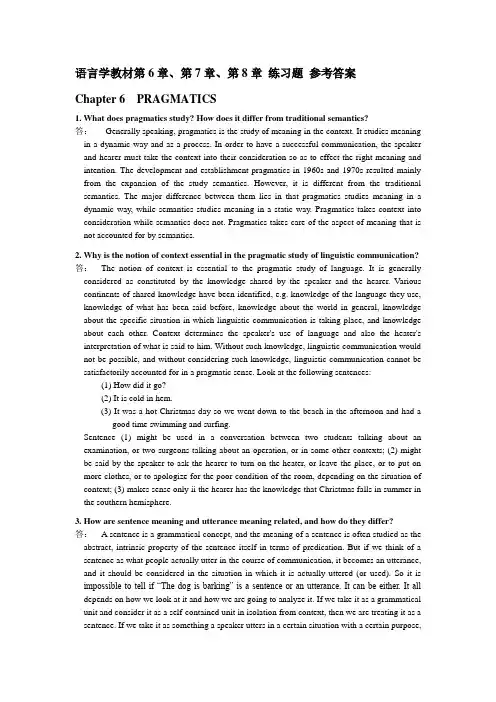
语言学教材第6章、第7章、第8章练习题参考答案Chapter 6 PRAGMATICS1. What does pragmatics study? How does it differ from traditional semantics?答:Generally speaking, pragmatics is the study of meaning in the context. It studies meaning in a dynamic way and as a process. In order to have a successful communication, the speaker and hearer must take the context into their consideration so as to effect the right meaning and intention. The development and establishment pragmatics in 1960s and 1970s resulted mainly from the expansion of the study semantics. However, it is different from the traditional semantics. The major difference between them lies in that pragmatics studies meaning in a dynamic way, while semantics studies meaning in a static way. Pragmatics takes context into consideration while semantics does not. Pragmatics takes care of the aspect of meaning that is not accounted for by semantics.2. Why is the notion of context essential in the pragmatic study of linguistic communication? 答:The notion of context is essential to the pragmatic study of language. It is generally considered as constituted by the knowledge shared by the speaker and the hearer. Various continents of shared knowledge have been identified, e.g. knowledge of the language they use, knowledge of what has been said before, knowledge about the world in general, knowledge about the specific situation in which linguistic communication is taking place, and knowledge about each other. Context determines the speaker's use of language and also the heater's interpretation of what is said to him. Without such knowledge, linguistic communication would not be possible, and without considering such knowledge, linguistic communication cannot be satisfactorily accounted for in a pragmatic sense. Look at the following sentences:(1) How did it go?(2) It is cold in hem.(3) It was a hot Christmas day so we went down to the beach in the afternoon and had agood time swimming and surfing.Sentence (1) might be used in a conversation between two students talking about an examination, or two surgeons talking about an operation, or in some other contexts; (2) might be said by the speaker to ask the hearer to turn on the heater, or leave the place, or to put on more clothes, or to apologize for the poor condition of the room, depending on the situation of context; (3) makes sense only ii the hearer has the knowledge that Christmas falls in summer in the southern hemisphere.3. How are sentence meaning and utterance meaning related, and how do they differ?答: A sentence is a grammatical concept, and the meaning of a sentence is often studied as the abstract, intrinsic property of the sentence itself in terms of predication. But if we think of a sentence as what people actually utter in the course of communication, it becomes an utterance, and it should be considered in the situation in which it is actually uttered (or used). So it is impossible to tell if “The dog is barking” is a sentence or an utterance. It can be either. It all depends on how we look at it and how we are going to analyze it. If we take it as a grammatical unit and consider it as a self-contained unit in isolation from context, then we are treating it as a sentence. If we take it as something a speaker utters in a certain situation with a certain purpose,then we are treating it as an utterance.Therefore, while the meaning of a sentence is abstract, and decontextualized, that of an utterance is concrete, and context-dependent. The meaning of an utterance is based on sentence meaning; it is the realization of the abstract meaning of a sentence in a real situation of communication, or simply in a context. Now, take the sentence "My bag is heavy" as an example. Semantic analysis of the meaning of the sentence results in the one-place predication BAG (BEING HEA VY). Then a pragmatic analysis of the utterance meaning of the .sentence varies with the context in which it is uttered. For example, it could be uttered by a speaker as a straightforward statement, telling the hearer that his bag is heavy. It could also be intended by the speaker as an indirect, polite request, asking the hearer to help him carry the bag. Another possibility is that the speaker is declining someone's request for help. All these are possible interpretations of the same utte rance “My bag is heavy”. How it is to be understood depends on the context in which it is uttered and the purpose for which the speaker utters it.While most utterances take the form of grammatically complete sentences, some utterances do not, and some cannot even be restored to complete sentences.4. Try to think of contexts in which the following sentences can be used for other purposes than just stating facts:a) The room is messy.b) Oh, it is raining!c) The music of the movie is good.d) You have been keeping my notes for a whole week now.答:a) A father entered his son‟s room and found it is very messy. Then when he said, “The room is messy,” he was blaming his son for not tidying it up.b) A son asked his father to play with him o utside. So when the father said, “Oh, it‟s raining”,he meant they couldn‟t play outside.c) Two persons just watched a movie and had a discussion of it. One person said, “The story ofthe movie is very moving”, so when the other person said, “The music of the movie is good”, he meant he didn't think the story of the movie was good.d) A person wanted his notes back, so when he said, “you have been keeping my notes for awhole week now”, he was demanding the return of his notes.5. According to Austin, what are the three acts a person is possibly performing while making an utterance. Give an example.答:According to Austin's new model, a speaker might be performing three acts simultaneously when speaking: locutionary act, illocutionary act, and perlocutionary act.A locutionary act is the act of uttering words, phrases, clauses. It is the act of conveying literal meaning by means of syntax, lexicon and phonology. An illocutionary act is the act of expressing the speaker‟s intention; it is the act perf ormed in saying something. A perlocutionary act is the act performed by or resulting from saying something; it is the consequence of, or the change brought about by the utterance; it is the act performed by saying something. Let's look at an example:You have left the door wide open.The locutionary act performed by the speaker is his utterance of the words “you”, “have”, “door”, “open”, etc. thus expressing what the words literally mean.The illocutionary act performed by the speaker is that by making such an utterance he has expressed his intention of speaking, i.e. asking someone to close the door, or making a complaint, depending on the context.The perlocutionary act refers to the effect of the utterance. If the hearer gets the speaker's message and sees that the speaker means to tell him to close the door, the speaker has successfully brought about the change in the real world he has intended to; then the perlocutionary act is successfully performed.6. What are the five types of illocutionary speech acts Searle has specified? What is theillocutionary point of each type?答:(1) representatives: stating or describing, saying what the speaker believes to be true(2) directives: trying to get the hearer to do something(3) commissives: committing the speaker himself to some future course of action(4) expressives: expressing feelings or attitude towards an existing(5) declarations: bringing about immediate changes by saying somethingThe illocutionary point of the representatives is to commit the speaker to something's being the case, to the truth of what has been said, in other words, when performing an illocutionary act of representative, the speaker is making a statement or giving a description which he himself believes to be true. Stating, believing, sweating, hypothesizing are among the most typical of the representatives.Directives ate attempts by the speaker to get the hearer to do some- thing. Inviting, suggesting, requesting, advising, wanting, threatening and ordering are all specific instances of this class.Commissives are those illocutionary acts whose point is to commit the speaker to some future course of action, i.e. when speaking the speaker puts himself under a certain obligation. Promising, undertaking, vowing are the most typical ones.The illocutionary point of expressives is to express the psychological state specified in the utterance. The speaker is expressing his feelings or attitudes towards an existing state of affairs, e.g. apologizing, thanking, congratulating.The last class “declarations” has the characteristic that the successful performance of an act of this type brings about the correspondence between what is said and reality.7. What is indirect language use? How is it explained in the light of speech act theory?答:When someone is not saying I an explicit and straightforward manner what he means to say, rather he is trying to put across his message in an implicit, roundabout way, we can say he is using indirect language.Explanation (略) (见教材p.84-85)8. What are the four maxims of the CP? Try to give your own examples to show how floutingthese maxims gives rise to conversational implicature?答:Cooperative Principle, abbreviated as CP. It goes as follows:Make your conversational contribution such as required at the stage at which it occurs by the accepted purpose or direction of the talk exchange in which you are engaged.To be more specific, there are four maxims under this general principle:(1) The maxim of quantity①Make your contribution as informative as required (for the current purpose of theexchange).②Do not make your contribution more informative than is required.(2) The maxim of quality①Do not say what you believe to be false.②Do not say that for which you lack adequate evidence.(3) The maxim of relationBe relevant.(4) The maxim of manner①Avoid obscurity of expression.②Avoid ambiguity.③Be brief (avoid unnecessary prolixity).④Be orderly.9. What is pragmatic failure? Try to find instances of pragmatic failure in the English usedby Chinese learners of English.答:The technical term for breakdowns in the course of communication is pragmatic failure.Pragmatic failure occurs when the speaker fails to use language effectively to achieve a specific communication purpose, or when the hearer fails to recognize the intention or the illocutionary force of the speaker‟s utterance in the context of communication.Instances (略) (见教材p.89)Chapter 7 Language Change1. The vocabulary of English consists of native and also thousands of borrowed words. Look up the following words in a dictionary which provides the etymologies (history) of words. In each case speculate as to how the particular word came to be borrowed from a particular language.a. sizeb. skillc. royald. ranche. robotf. potatog. astronaut h. emerald i. pagodaj. khaki k. bulldoze 1. hoodlum答:a. size (< old French)b. skill (< old Norse)c. royal (< old French < Latin)d. ranch (< Spanish < French)e. robot (< Czech < old Church Slavonic)f. potato (< Spanish < Taino)g. astronaut (< French)h. emerald (< Middle English & old French)i. pagoda (< Persian < Sanskrit)j. khaki (< Hindi <Persian)k. bulldoze (< bull(Botany Bay Slang) < old English)l. hoodlum (< German)2. The Encyclopedia Britannica Yearbook has usually published a new word list, which is, in the Britannica’s editor's view, a list of those words that had entered the language during the year. Would you expect a yearbook to publish a “lost-word list” recording the words dropped from the language during the year? Defend your answer.答:(略)3. Below is a passage from Shakespeare's Hamlet,King: Where is Pelonius?Hamlet: In heaven, send thither to see.If your messenger find him not there, seek him i' theother place yourself. But indeed, if you find him notwithin this month, you shall nose him as you go up thestairs into the lobby.Act IV, scene iiiStudy these lines and identify every difference in expression between Elizabethan and Modern English that is evident.答:In modern English, these lines are more likely written as:King: Where is Pelonius?Hamlet: In heaven, send to see there. If your messenger cannot find him there, yourself seek him at the other place. But indeed, if you cannot find him within this month, you shallnotice him as you go up the stairs into the lobby.4. Comment with examples on the following statement “Words and expressions will be forced into use in spite of all the exertions of all the writers in the world.”答:The statement means that when necessary, people will make use of available uses even if there is no writers' efforts. For example, there are more and more new words and expressions which are introduced into language not by writers, e.g., email, hacker, IBM (international big mouth, means a person who acts like a gossip.)5. Suppose you are outside a government office where doors still bear the notice, “This door must not be left in an open position.” Now try to explain the notice in simple and plain English.答:“Keep the door dote. ” or “The door must be kept close.”6. Give at least two examples showing the influence of American English on British English. 答:(略)7. Find in any books, newspapers, or journals newly coined words in association with social and political needs, internet or computer language.答:For example: SARS, Golden week, euro, e-mail, bi-media(双媒体的), cybernaut计算机(网络)漫游者, DVD, eyephone(视像耳机), etc.8. With examples, give some plausible explanations for linguistic change.答:(略)Chapter 8 Language and Society1. How is language related to society?答:There are many indications of the inter-relationship between language and society. One of them is that while language is principally used to communicate meaning, it is also used to establish and maintain social relationships. This social function of language is embodied in the use of such utterances as “Good morning!”, “Hi!”, “How's your family?”, “Nice day today, isn't it?”.Another indication is that users of the same language in a sense all speak differently. The kind of language each of them chooses to use is in part determined by his social background. And language, in its turn, reveals information about its speaker. When we speak, we cannot avoid giving clues to our listeners about ourselves.Then to some extent, language, especially the structure of its lexicon, reflects both the physical and the social environments of a society. For example while there is only one word in English for “snow”, there are several in Eskimo. This is a reflection of the need for the Eskimos to make distinctions between various kinds of snow in their snowy living environment.As a social phenomenon language is closely related to the structure of the society in which it is used, and the evaluation of a linguistic form is entirely social. To a linguist, all language forms and accents are equally good as far as they can fulfill the communicative functions they are expected to fulfill. Therefore, judgments concerning the correctness and purity of linguistic varieties are social rather than linguistic. A case in point is the use of the postvocalic [r]. While in English accents without postvocalic [r] are considered to be more correct than accents with it, in New York city, accents with postvocalic [r] enjoys more prestige and are considered more correct than without it.2. Explain with an example that the evaluation of language is social rather than linguistic. 答:The evaluation of language is social rather than linguistic. This is because every language or language variety can express all ideas that its native speakers want to express. That is to say, language and language variety are equal in expressing meaning. For example, the much-prejudiced Black English can be used by the black people to communicate with each other without feeling any hindrance. But many other people think Black English is not pure English because it does not conform to their grammar and not adopted by educated people. As a result, many people feel shameful to use Black English. From this example we can know that the evaluation of language is social, not linguistic.3. What are the main social dialects discussed in this chapter? How do they jointly determineidiolect?答:The main social dialects discussed in this chapter are regional dialect, sociolect, gender and age. Idiolect is a personal dialect, of an individual speaker that combines elements regarding regional, social, gender, and age variations. These factors jointly determine the way he/she talks. While the language system provides all its users with the same set of potentials, the realization of these potentials is individualized by a number of social factors, resulting in idiolects.4. In what sense is the standard dialect a special variety of language?答:First of all, the standard dialect is based on a selected variety of the language, usually it is the local speech of an area which is considered the nation's political and commercial center. Forexample, standard English developed out of the English dialects used in and around London as they were modified over the centuries by speakers in the court, by scholars from universities and writers. Gradually the English used by the upper classes in the capital city diverged markedly from the English used by other social groups and came to be regarded as the model for all those who wished to speak and write well.Second, the standard dialect is not dialect a child acquires naturally like his regional dialect. It is a superimposed variety; it is a variety imposed from above over the range of regional dialects. Some government agency writes grammar books and dictionaries to …fix‟ this variety and everyone agrees on what is correct usage of the language. So it has a widely accepted codified grammar and vocabulary. Once codification takes place, it is necessary for an ambitious citizen to learn to use the correct language and to avoid …incorrect‟ language. Therefore, the standard dialect is the variety which is taught and learnt in schools.Then the standard dialect has some special functions. Also designated as the official or national language of a country, the standard dialect is used for such official purposes as government documents, education, news reporting; it is the language used on any formal occasions.5. What is register as used by Halliday? Illustrate it with an example of your own.答:According to Halliday, “Language varies as its function varies; it differs in different situations.” The type of language which is selected as appropriate to the type of situation is a register. Halliday further distinguishes three social variables that determine the register: field of discourse, tenor of discourse, and mode of discourse.For example, a lecture on linguistics could be identified asField: scientific (linguistic)Tenor: teacher — students (formal, polite)Mode: oral (academic lecturing)6. What linguistic features of Black English do you know? Do you think Black English is an illogical and inferior variety of English? Why (not)?答:(1) A prominent phonological feature of Black English is the simplification of consonant clusters at the end of a word. According to this consonant deletion rule, the final-position consonants are often deleted; thus “passed” is pronounced [pa:s], mend [men], desk [des], and told [təʋl].A syntactic feature of Black English that has often been cited to show its illogicality is the deletion of the link verb “be”. In Black English we frequently come across sentences without the copula verb: “They mine”, “You crazy”, “Her hands cold”, and “That house big”. In fact, copula verb deletion is not a unique feature of Black English; it is also found in some other dialects of English and in languages like Russian and Chinese. Another syntactic feature of Black English that has been the target of attack is the use of double negation constructions, e.g.(8 — 2) He don't know nothing. (He doesn't know anything.)(8 — 3) I ain't afraid of no ghosts. (I'm not afraid of ghosts.)Some people consider these sentences illogical because they claim that two negatives make a positive. But in fact such double negative constructions were found in all dialects of English of the earlier periods.(2) (略)7. What peculiar features docs pidgin have?答:Pidgins arose from a blending of several languages such as Chinese dialects and English, African dialects and French, African dialects and Portuguese. Usually a European language serves as the basis of the pidgin in the sense that some of its grammar and vocabulary is derived from the European language used by traders and missionaries in order to communicate with peoples whose languages they did not know.Pidgins typically have a limited vocabulary and a very reduced grammatical structure characterized by the loss of inflections, gender end case, The “simplified” variety performs its functions as trading and employment.8. How do bilingualism and diglossia differ, and what do they have in common?答:Bilingualism refers to the situation that in some speech communities, two languages are used side by side with each having a different role to play; and language switching occurs when the situation changes. But instead of two different languages, in a diglossic situation two varieties of a language exist side by side throughout the community, with each having a definite role to play.The two languages of bilingualism and the two varieties of diglossia each has different role to play as situation changes.。
