
英语:Unit 2《Poems—Warming Up,Pre-reading and Reading Ⅱ
- 格式:ppt
- 大小:1.92 MB
- 文档页数:29
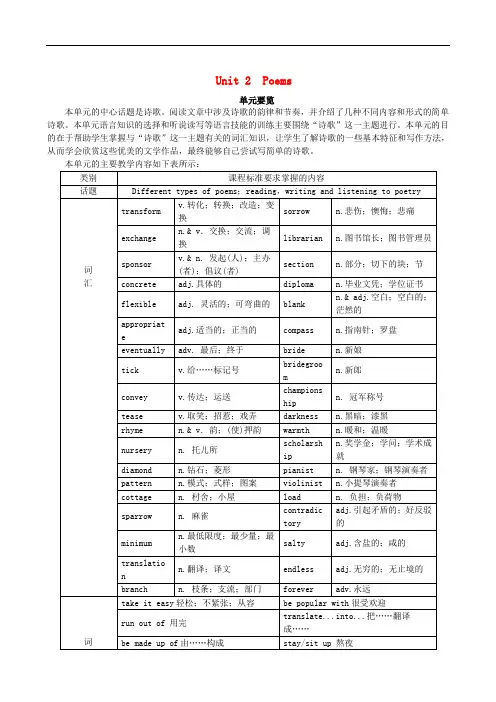
Unit 2 Poems单元要览本单元的中心话题是诗歌。
阅读文章中涉及诗歌的韵律和节奏,并介绍了几种不同内容和形式的简单诗歌。
本单元语言知识的选择和听说读写等语言技能的训练主要围绕“诗歌”这一主题进行。
本单元的目的在于帮助学生掌握与“诗歌”这一主题有关的词汇知识,让学生了解诗歌的一些基本特征和写作方法,从而学会欣赏这些优美的文学作品,最终能够自己尝试写简单的诗歌。
汇try out测试;试验(sb./sth.)be likely to do sth.有可能……let out发出;放走look forward to盼望in particular尤其;特别by chance/accident 碰巧句型1.List poems have a flexible line length and repeated phraseswhich_give_both_a_pattern_and_a_rhythm_to_the_poem.(the attributive clause)2.We would_have_won if Jack had_scored that goal.(the subjunctive mood)3.Another simple form of poem that students can easily write is the cinquain,a poem made_up_of_five_lines.(past participle as the attributive)4.When I was a baby,my mother used_to read me nursery rhymes.(used to do sth.)5.With_so_many_different_forms_of_poetry_to_choose_from,students may eventually want to write poems of their own.(with+object+objective complement)功能语法虚拟语气(Subjunctive Mood)(2)If Rob hadn't injured himself,we would have won.If she had studied harder,she would have got the diploma.教学重点1.Get students to know about different types of poems,some poetic devices like rhythm,rhyme,repetition,sound patterns and imagery.2.Have students learn some useful new words and expressions about poetry and let them learn effective ways to master them.3.Enable students to grasp and use the expressions of intention and plans. 4.Let students learn the new grammar item:the subjunctive mood(2).5.Develop students' listening,speaking,reading and writing ability.教学难点1.Enable students to master the use of the subjunctive mood. 2.Let students learn to create their own poems.3.Develop students' integrative skills.课时安排Periods needed:6Period 1 Warming Up,Pre-reading,Reading and Comprehending Period 2 Language StudyPeriod 3 Grammar—the Subjunctive Mood(2)Period 4 Listening and SpeakingPeriod 5 Reading and WritingPeriod 6 Summing Up,Learning Tip and AssessmentPeriod 1 Warming Up,Pre-reading,Reading and Comprehending整体设计教学内容分析This is the first teaching period of this unit.The central part of this period is the reading passage with the name of A Few Simple Forms of English Poems showing the students a few kinds of simple English poems.Warming Up gives three questions for students to discuss so that they can recall any poems they have ever learned and think about different reasons why people write poems.Pre-reading provides one question for students to think about and a table for students to fill in so as to help students focus on the topic of the reading passage and lead the students to skim the poems on the following pages and know about the general idea of the text.Reading mainly explains the reasons why people write poetry and introduces five simple forms of English poems.Nursery rhymes are the first poems that children will hear.These poems may not make any sense but they are easy to learn and recite.It is a good way for children to learn about language.List poems often list things,usually having many lines.They have repetition in them and sometimes they have words that rhyme.Cinquains are all made up of five lines and have the fixed structure.Haiku is a Japanese form of poetry that is made up of 17 syllables.It is almost like a photo or painting as it creates a strong image using very few words.Tang poems are famous poems from Ancient China.They have strong imagery and are often about the bringing together of opposites.Comprehending consists of three groups of exercises for the students to do so as to help the students to get a better understanding of the text,that is to say,to help the teacher to check how much the students have understood the text.三维目标设计Knowledge and skills1.To know the meanings of the following new words and phrases:tick(给……标记号),rhyme(韵;押韵),convey(传达;运送),nursery(托儿所),concrete(具体的),contradictory(引起矛盾的;好反驳的),diamond(钻石;菱形),flexible(灵活的;可弯曲的),pattern(模式;式样;图案),cottage(村舍;小屋),sparrow(麻雀),take it easy(轻松;不紧张;从容),run out of(用完),be made up of(由……构成),tease(取笑;招惹;戏弄),salty(含盐的;咸的),endless(无穷的;无止境的),minimum(最低限度;最少量),translation(翻译;译文),branch(枝条;支流;部门),in particular(尤其;特别)2.To learn about some simple forms of English poems.3.To develop the students' reading ability by skimming and scanning the passage.4.To develop the students' speaking ability by talking about some features of some simple forms of English poems.Process and methods1.While doing Warming Up the teacher can ask the students to think back and try to remember poems from both their early childhood and more recent years.Ask students to complete Exercise 1 in groups.Ask them what they notice about these poems,then get students to recite any poems or parts of poems they can remember so as to arouse their interest in studying the whole unit.2.During Pre-reading the teacher can go around the classroom and discuss the questions with several students.This discussion should be student-centered and arouse students' interest in English poetry.The teacher should also ask the students to skim the text so as to let them have a general knowledge of some simple forms of English poems.3.While doing Reading and Comprehending,the teacher may first have the students close their books and listen to the text with their eyes closed.This gives the students the opportunity to listen to the sounds or “music” of the poems before reading them in more detail.Then ask the students to read the text quickly to get the general idea of the passage.After detailed readingof the passage,students are encouraged to answer some questions and discuss the features of each kind of the poems.4.To consolidate the contents of the reading passage,the students should be required to retell the five kinds of poems in their own words at the end of the class.Emotion,attitude and value1.To cultivate students' appreciation of poetry and the ability of understanding,enjoying and writing poems.2.To develop students' sense of cooperative learning.教学重、难点1.To enable the students to learn about some simple forms of English poetry and to develop their reading ability.2.To enable the students to write their own poems.教学过程Step 1Warming up1.Vocabulary in ReadingMatch the words and phrases with their proper meanings.1.convey ( )A.sameness of sound between words or syllables,esp.in the end oflines2.cottage ( )B.a strong feeling such as love,fear or anger3.tease ( )C.make fun of somebody in an unkind way4.rhyme ( )D.a place where young children are cared for5.translate ( )E.make(ideas,feelings,etc.)known to another person6.endless ( )e up7.nursery ( )G.small simple house,esp.in the country8.emotion ( )H.relax9.take it easy ( )I.express sth.in a different language10.run out of ( )J.without endSuggested answers:1.E 2.G 3.C 4.A 5.I 6.J 7.D 8.B 9.H 10.F2.Warming up by asking students to complete Exercise 1 in groups.Get the students to recite the little poems and songs they can remember.Ask them what they notice about these poems.For example,perhaps they have a strong beat,or they rhyme,or they play with words and sounds,or perhaps some of them are funny because they make no sense.3.Warming up by doing Exercise 2 with students.Then get them into groups as this might prompt their memories.Get the students to recite any poems or parts of poems they can remember.(If the students can't recite any poems or parts of poems,prepare a couple of poems that they would know,in Chinese or English.)4.Tell students that there are many reasons why people write poetry.Give the examples in Exercise 3.Ask students the reasons they think the poets wrote the poems they have just recited.Write their suggestions on the blackboard.Step 2Pre-reading1.Match the following information.Du Fu Tang DynastyFan Zhongyan Song DynastyMeng Haoran ModernGuo Moruo ModernXu Zhimo Tang DynastyByron AmericaShelly EnglandWhitman EnglandTagore IndiaSuggested answers:Du Fu:Tang Dynasty;Fan Zhongyan:Song Dynasty;Meng Haoran:Tang Dynasty;Guo Moruo:Modern;Xu Zhimo:Modern;Byron:England;Shelly:England;Whitman:America;Tagore:India2.Ask students to do Exercise 1 in groups.Get them to tell the class their favourite poems and the reasons.This might be something they find hard to articulate as the poem might just give them a special feeling that's hard to talk about.Or they might say things like:It makes me feel sad.I like the sounds in it.I like its language,it's funny,and my mother used to recite it to me...3.The purpose of Exercise 2 is to practice an important reading skill:scanning a text,that is,looking through a text quickly to find specific information.Which poem A B C D E F G H describes a person?√tells a story?√describes an aspect of a season?√√√is about sport?√is about things that don't make√sense?is recited to a baby?√describes a river scene?√has rhyming words at the end of√√lines?repeats words or phrases?√√√1.Fast-reading:Read the reading passage quickly,try to get its general idea and answer the following questions.(1)What is the main idea of the reading passage?________________________________________________________________________(2)How many kinds of poems does the reading passage talk about? And which of the following is not mentioned?A.Nursery rhymes. B.Tang poems. C.Haiku. D.Adverb poems. E.List poems. F.Cinquain.Suggested answers:(1)A brief introduction of a few simple forms of English poems.(2)Five.D is not mentioned.2.Detailed-reading:Read the text thoroughly and do the following exercises.(You may do some searching reading when necessary.)(1)Give out the names of the forms of poems according to the descriptions.①______ are the first poems that children will hear.They are often sung.Children love to move and dance to them because they have strong regular rhythms.They enjoy the rhymes and the way they play with sounds.②______ is made up of five lines and has the following structure:Line 1:a noun that names the subject of the poemLine 2:two adjectives that describe the subjectLine 3:three verbs ending with-ing that describe the subject's actionsLine 4:four words that give the writer's opinions or feelings about the subjectLine 5:a word that gives another name for the subject③______ is a centuries-old form of Japanese poetry.It is made up of 17 syllables and has the following structure:Line 1:5 syllablesLine 2:7 syllablesLine 3:5 syllables④______ are a list of things.They can have as many lines as the writer likes.Sometimes they have repetition in them and sometimes they have words that rhyme.When a list poem has rhyming words,it also has a regular rhythm.⑤When translated into Eng lish,______ have a free form(that is,without a regular rhythm)and do not rhyme.They have strong imagery and are often about the bringing together of opposites.(2)Find the strong rhythm and rhyme in Poem A.e.g.In the first two lines,there are word_&_mockingbird. So in the following lines,there are ______;______;______;______.(3)What's the difference between Poems B and C though they are both list poems?________________________________________________________________________(4)Which of the poems in the reading passage can give you a clear picture in your mind?________________________________________________________________________(5)Can you find out the 17 syllables in Poem F?e.g.“A” has 1 syllable,“fallen” has 2 syllables,while “blossom” has 2 syllabl es.________________________________________________________________________.(6)Can you give a proper title to Poem H either in English or Chinese?________________________________________________________________________Suggested answers:(1)①Nursery rh ymes ②The cinquain③Haiku④List poems⑤Tang poems(2)sing & ring;brass & looking-glass;broke & billy-goat;away & today(3)Poem B repeats phrases and rhymes,while Poem C does not.(4)Most probably Poems D,F,G and H.(5)A(1);fallen(2);blossom(2);Is(1);coming(2);back(1);to(1);the(1);branch(1);Look(1);a(1);butterfly(3)(6)望夫石/A Loyal WifeStep 4Language studyDeal with language problems if any(words or sentences students might not understand)to help the students to have a better understanding of the text.Step 5Listening,reading aloud and underliningAsk students to read the passage aloud to the tape and let them pay attention to the pronunciation of each word and the pauses within each sentence.Tell them to pick out all the useful expressions or collocations from the passage while reading and copy them to the notebook after class as homework.Collocations:make sense,give...a strong impression,on fire,take it easy,run out of,make up of,be translated into,day by day,in particular.Step 6Structure analyzingAfter reading,ask students to discuss the text structure.Keys for reference:This passage is an introduction of some of the simple forms of English poems.The first paragraph introduces the topic and the theme of the text,explaining the purpose of poetry writing,that is,to give readers a strong impression or to convey certain emotions.From the second paragraph,the text analyses the different kinds of poems and gives examples for reference.The last paragraph encourages students to have a try and write poems of their own.Step 7RetellingAsk students to talk about the different kinds of poems in their own words.Give them some key words and expressions on the blackboard.Then let them try to retell the passage.Step 8Homework1.Learn the useful new words and expressions in this period by heart.2.Try to find some selections of poems and appreciate their beauty and eventually try to write some poems of your own.Step 9Reflection after teaching________________________________________________________________________________________________________________________________________________Reading:A Few Simple Forms of English Poems李东玲,海南省儋州市民族中学,本教案获2008年度“教科杯”教学课题Unit 2PoemsA Few Simple Forms Of English Poems(Reading)教学设计理论依据《基础教育课程改革纲要(试行)》对于课程实施和教学过程有明确的要求:倡导学生主动参与、乐于探究、勤于动手,培养学生搜集和处理信息的能力、获取新知识的能力、分析和解决问题的能力以及交流与合作的能力。

Unit 2 A FEW SIMPLE FORMS OF ENGLISH POEMSStep I: Read and remember the following wordspoet(s) 诗人rhyme n. 韵脚(c)poem(s) 诗歌vi. 押韵poetry 诗歌总称,不可数rhythm n. 节奏,韵律Step II: Feel the beauty of poems(1)Summer 夏天Sleepy, salty 困乏,咸涩Drying, drooping, dreading 干涸,枯萎,恐怖Week in, week out 周而复始Endless 永无止境(2)面朝大海,春暖花开海子从明天起,做一个幸福的人From tomorrow on, I will be a happy man;喂马,劈柴,周游世界Grooming, chopping, and traveling all over the world.从明天起,关心粮食和蔬菜From tomorrow on, I will care foodstuff and vegetables,我有一所房子,面朝大海,春暖花开I have a house, towards the sea, with spring flowers blossoming.从明天起,和每一个亲人通信From tomorrow on, I will write to each of my dear ones,告诉他们我的幸福Telling them of my happiness,那幸福的闪电告诉我的What the lightening of blessedness has told me,我将告诉每一个人I will spread it to each of them.给每一条河每一座山取一个温暖的名字And give a warm name for every river and every mountain.陌生人,我也为你祝福Strangers, I will also give you my well-wishing.愿你有一个灿烂的前程May you have a brilliant future!愿你有情人终成眷属May you lovers eventually become spouse!愿你在尘世获得幸福May you enjoy happiness in this earthly world!我只愿面朝大海,春暖花开I only wish to face the sea, with spring flowers blossoming.(3)望夫石唐王健望夫处,江悠悠。

Unit 2 PoemsWu Yishu,a student at the High School Affiliated to Fudan University in Shanghai,beat other petitors in the second season of the Chinese Poetry Conference on China Central Television on Feb.7,2017.It helped her win fans over with her keen knowledge of the country’s ancient culture and works.“I get feelings from ancient poetry that modern people cannot give me.I pay little attention to the petition result,but I love poetry,and it is enough as long as I enjoy the happiness brought by the poetry,〞 Wu said.In the final,Wu performed strongly in many sections,such as petitors recalling poems by looking at sand paintings and reciting poems as many as they could think of relating to the Chinese character “Jiu〞,meaning liquor(烈性酒).As early as Feb.1,when Wu recited an ancient Chinese poem about the months of the year,the judges estimated(估计) that Wu must have remembered at least more than 2,000 Chinese ancient works.Wu’s strong performance in the Chinese ancient rhythm works earned her many fans and inspired others to learn ancient works.The 1.8meter tall Wu said that she kept only one ancient poetry book on bookshelves at her dormitory room instead of other books such as math,physics and chemistry books that her classmates have kept on their bookshelves.She is known among her classmates and teachers as she loves reading poetry and wearing ancient Chinese clothes.Zhou Hong,a professor from the Department of Chinese Language and Literature of East China Normal University,said that he had read some of the girl’s poetry in 2015,and had published some on his blog.判断正(T)误(F)1.Wu Yishu beat others in the second season of the Chinese Poetry Conference.(T) 2.Wu said that she kept all kinds of books on her bookshelves.(F)Period One Warming Up & Reading—Prereading匹配左边的单词与右边的汉语意思[第一组]1.rhyme A.adj.具体的2.convey B.n.韵;押韵3.concrete C.n.钻石;菱形4.contradictory D.vt.传达;运送5.diamond E.adj.引起矛盾的;好反驳的答案 1.B 2.D 3.A 4.E 5.C[第二组]6.flexible A.vi.&vt.取笑;招惹;戏弄7.pattern B.n.模式;式样;图案8.cottage C.adj.含盐的;咸的9.tease D.n.小屋;村舍10.salty E.adj.灵活的;可弯曲的;柔顺的答案 6.E 7.B 8.D 9.A 10.C[第三组]11.endless A.n.枝条;支流;部门12.minimum B.adj.无穷的;无止境的13.translation C.n.最低限度;最少量;最小数14.branch D.vi.融化;溶化15.melt E.n.翻译;译文答案11.B 12.C 13.E 14.A 15.D[第四组]16.eventually A.vt.等候;期待17.await B.n.悲伤;悲痛;懊悔18.transform C.vi. & vt.(使)旋转19.revolve D.adv.最后;终于20.sorrow E.vt.&vi.转化;转换;变换;改造答案16.D 17.A 18.E 19.C 20.BStep 1FastreadingWhat does the passage mainly talk about? It’s about .A.the development of English poemsB.the future of English poemsC.all kinds of poemsD.some kinds of English poems答案 DStep 2CarefulreadingRead the passage carefully and choose the best answer.1.Poem A tells us .A.a father is going to buy his baby a billygoatB.a father is going to buy his baby a mockingbirdC.a father shows his love for his babyD.a father is going to buy his baby a diamond ring答案 C2.Which of the following can we find in poem A?A.Anger. B.Sorrow.C.Darkness. D.Joy.答案 D3.Which two poems have rhyming words at the end of lines? A.B and C. B.A and E.C.A and B. D.G and F.答案 C4.The reason why the players in poem C lost the game is that . A.they stayed up too late the night beforeB.they didn’t have thousands of fans screamingC.they ran out of energyD.they didn’t play well enough答案 DStep 3PostreadingAfter reading the passage,please fill in the following blanks.Some poems tell a story or describe something in a way 1.that/which will give the reader a strong impression.Others try to convey certain emotions.Poets use many different forms of poetry to express 2.themselves(they).For example,the language of nursery rhymes is concrete but 3.imaginative(imagine),and they delight small children because they have strong rhythm and a lot of repetition.And list poems have a flexible line length and repeated phrases which give 4.a rhythm to the poem.5.Another simple form of poem is the cinquain,a poem 6.made(make) up of five lines,with which students can convey strong 7.feelings(feel) in just a few words.Haiku is a Japanese form of poetry that is made up of 17 syllables.And of course there are Tang poems from China which you may enjoy 8.in particular.9.With so many different forms of poetry to choose from,students may 10.eventually(eventual) want to write poems of their own.Step 4Sentenc elearning1.Some poems tell a story or describe something in a way that will give the reader a strong impression.[句式分析] 本句是主从复合句。