
小学英语人称代词和物主代词讲解(3)
- 格式:ppt
- 大小:952.00 KB
- 文档页数:13

英语中的代词英语中的代词英语作为一种广泛使用的语言,其中一个重要的语法范畴是代词。
代词在英语中起着重要的作用,它们在句子中代表了已经提到的人、物或事情。
这些代词通常用于简化句子结构,并使文本更加流畅。
在英语中,代词通常用于替代已经提到的事物,以避免重复。
它们可以替代名词、名词短语,甚至整个句子。
通过使用代词,我们可以更有效地传达我们的意思,同时使我们的文本不显得冗长。
英语中的代词有很多种,以下是一些主要的代词类型:1、人称代词:这是用来代替人的代词。
例如,我(I)、你(you)、他(he)、她(she)、它(it)、我们(we)、他们(they)。
2、指示代词:这些代词用于表示特定的对象。
例如,这个(this)、那个(that)、这些(these)、那些(those)。
3、疑问代词:这些代词用于提问中,用于询问人、物或事情。
例如,谁(who)、什么(what)、哪里(where)、何时(when)、怎样(how)。
4、关系代词:这些代词用于引导从句,并表示从句与主句之间的关系。
例如,谁(who)、什么(what)、哪里(where)、何时(when)、怎样(how)。
5、不定代词:这些代词用于表示不确定的或未知的人、物或事情。
例如,一个(a)、一些(some)、任何(any)、每个人(everyone)。
正确地使用代词可以帮助我们创建清晰、易于理解的文本。
也需要注意不要误用或错用代词,以免引起混淆或误解。
总的来说,英语中的代词是一个重要的语言工具,可以帮助我们更好地表达自己的意思。
小学英语语法代词小学英语语法代词:介绍、用法和注意事项在英语学习过程中,代词起着非常重要的作用。
尤其是对于小学生,掌握代词的用法能够更好地理解和运用英语。
本文将为大家介绍小学英语语法中的代词,包括其特点、用法和注意事项,以帮助孩子们更准确地使用英语。
一、代词的种类和特点在小学英语语法中,常见的代词有:人称代词、物主代词、反身代词、指示代词和不定代词等。
5. Excuse(me / my / I).6. Are(your / you)Miss Li?7.(I/ My)am Ben. 8.(She / Her)is my sister.9. Fine , thank (your / you). 10. How old is (he / his)二、用所给代词的正确形式填空。
1. These are ______ ( he ) brothers.2. That is _______( she ) sister.3. Lily is _______ ( Lucy ) sister.4. Tom, this is _____ ( me ) cousin, Mary.5. Now _____________(her parent) are in America.6. Those __________ ( child ) are _____ ( I ) father’s students.7. Do you know ______ ( it ) name?8. Mike and Tom __________ ( be ) friends.9. Thanks for helping ________( I ).10. ______(Ann安)mother is ______(we) teacher.三、单项选择。
()1. My family ____ a big family. My family ____all here.A. is, isB. are, areC. is, areD. are, is()2. This is __________.A. a picture of familyB. a picture of my familyC. a family’s pictureD. a family of my picture()3. Let’s __________ good friends.A. beB. areC. isD. am()4. Is she your aunt? Yes, __________.A. she’sB. her isC. she isD. he is ()5. Are __________ coats yours? Yes, they are .A. theyB. theseC. thisD. there ()6. Is that __________ uncle? No, it isn’tA. heB. sheC. herD. hers()7. Mrs. Green is __________ grandmother.A. Jim and KateB. Jim and Kate’sC. Jim’s and Kate’sD. Jim and Kates’()8. Do you know the name _____Mr. Green’s son?A. inB. ofC. onD. or ()9. __________ the great photo of your family.A. thank forB. Thanks forC. Thank forD. thanks for()10. Are those your friends? __________.A. Yes, they’reB. No, they areC. Yes, they areD. Yes, those are答案:一.my you His her me you I she you he二.1.his 2.her 3.Lucy’s 4.my 5.her parents 6. children my 7. its 8.are 9. me 10.Ann’s our三.CBACBCBBBC。

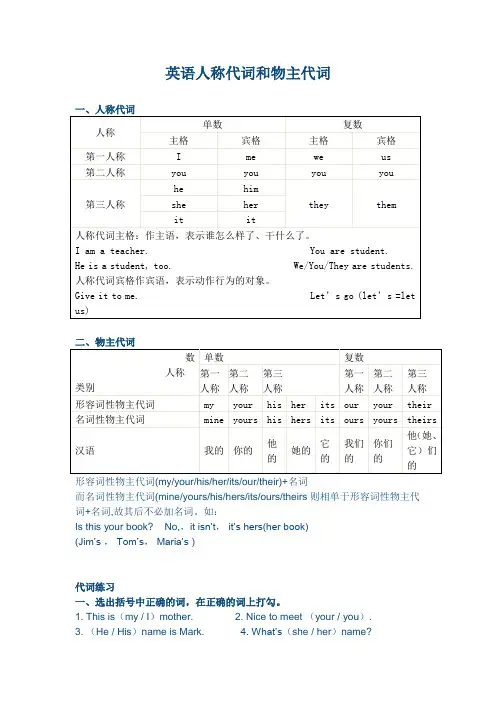
人称代词和物主代词一、人称代词表示“我”、“你”、“他”、“她”、“它”、“我们”、“你们”、“他们”的词,叫做人称代词。
人称代词有人称、数和格的变化,见下表:(1)人称代词主格:作主语,表示谁怎么样了、干什么了。
如:I am a teacher. You are student. He is a student, too. We / You / They are students.(2)人称代词宾格作宾语,表示动作行为的对象。
如:Give it to me. Let’s go (let’s =let us)二、物主代词表示所有关系的代词叫做物主代词,也可叫做代词所有格。
物主代词分形容词性物主代词和名词性物主代词二种,其人称和数的变化见下表。
(1) 形容词性物主代词( my / your / his / her / its / our / their )+名词。
如:her book my teacher his bike(2)名词性物主代词则相当于“形容词性物主代词+名词”,故其后不必加名词。
如:Is this your book?No,,it isn’t, it’s hers(her book)人称单数复数主格宾格 主格 宾格 第一人称 I me we us 第二人称you you youyou第三人称hehim theythemshe her itit 数、人称、类别单 数复 数第一人称第二人称第三人称 第一人称 第二人称 第三人称 形容词性物主代词 myyourhisheritsouryourtheir名词性物主代词mineyourshishersitsoursyourstheirsThis pen is mine.人称代词与物主代词用法的练习题一、填表二、填空:1.Let _____ (I) help ____ (you).2.Let _____ (we) go.3.(I) _____ are students.4.I can't find _____ (they).5.Give ____ (he) the book. 三、选择1.________are in the same class.A.Her and meB.She and lC.Me and herD.l and she 2.Please call ___ at 256-5896 A me B my C I D mine 3.-Do you like these computers? -No,I don't like_______. A it B them C they5.Our tercher think_______are right. A.We C it D she6.______go to the party.A.He,I and youB.I, you and heC.You,I and heD.You,he and I 四、用括号中的适当形式填空: (1)Are these ________(you )pencils?Yes, they are ________(our ).人称单数复数主格宾格 主格 宾格 第一人称 I we 第二人称you youyou第三人称him theyshe it(2)—Whose is this pencil?—It’s ________(I).(3)I love ________(they)very much.(4)She is________(I)classmate.五、代词练习:A. 写出各个代词的对应项。

小学英语人称代词、物主代词用法整理一、人称代词的用法人称代词有主格和宾语之分:主格用作主语,宾语用作宾语。
但在口语中,当人称代词用作表语,用于than, as 之后或用于强调句中被强调时,用主格(较正式)和宾格(较口语化)均可以。
如:“Who is it?” “It’s me.”“是谁呀?”“是我。
”注:单独使用的人称代词通常用宾格,即使它代表主语时也是如此。
详见下表:英语人称代词用法口诀:人称代词主宾格,作用不同莫用错。
主格动词前做主,动词介词后宾格。
You和it主宾同,其他主宾须分清。
人称代词并列现,尊重他人礼当先。
单数人称二三一,复数人称一二三。
若把错误责任担,第一人称我靠前。
二、物主代词的用法物主代词分形容词性物主代词和名词性物主代词。
形容词性物主代词在句中只用作定语;名词性物主代词则不能用作定语,但可以用作主语、宾语、表语、连用of作定语等。
如:Here is my dog. Its name is Tom.这是我的狗,它的名字叫汤姆。
注:可以说 a friend of mine (ours, yours, hers, his, theirs),但是不能说 a friend of me (us, you, her, him, them)。
英语物主代词用法口诀:物主代词分两种,形容词性名词性。
形容词性能力差,自己不能来当家。
句子当中作定语,身后定把名词加。
物主代词名词性,相当名词可单用。
句中充当主宾表,身后没有名词影。
两种代词形不同,添个 s 形变名。
his,its不用变,my变mine要记清。
三、反身代词的用法反身代词可用作宾语、同位语、表语等。
用作同位语时,主要用于加强被修饰词的语气,可紧放在被修饰名词后或句末。
如:She is too young to look after herself.她太小,无法照顾自己。
注:用于 be, feel, seem, look 等后作表语表示身体或精神处于正常状态。