过去进行时讲解与习题
- 格式:doc
- 大小:45.00 KB
- 文档页数:19
过去进行时讲解与习题
1.概念
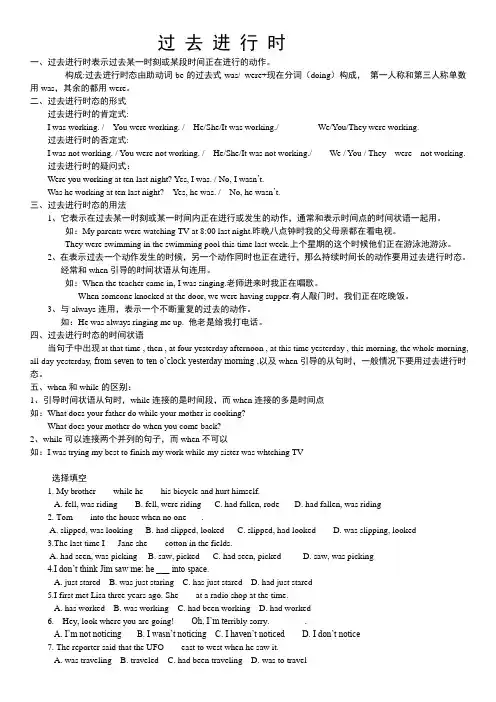
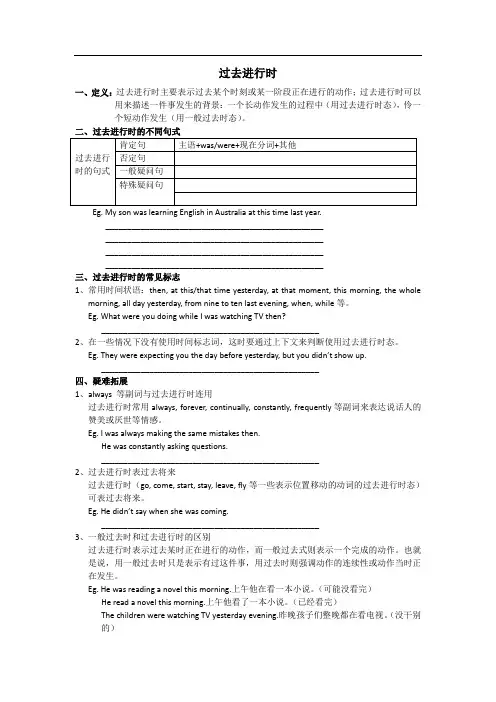
过去进行时是表示过去某一时刻或某一时间内正在进行或发生的动作,可以从两个方面来理解:
1 过去某一时刻正在进行或发生的动作。
如: They were playing football at ten
o’clock yesterday morning.
My mother was cooking when I got
home.
I was washing my clothes at this
time yesterday.
2 过去某阶段持续进行的动作。
如:I was staying at home last weekend.
常与过去某一特定的时间状语连用,如
last night, at that time, at 8:00 yesterday,
last Sunday , at this time yesterday, from 7
to 9 last night等。 /
也有时没有时间状语,要通过上下文的暗示来确定用过去进行时。. The students all
worked hard. Everyone knew what he was
working for.
另外,也可用于when/while引导的时间状语从句中。但在复合句中,若主要动作和背景动作是同时发生的,那么主从句都可用过去进行时。
如:It was raining when they left the
hospital.
Jenny was reading while Danny was
writing.
2.句型结构
⑴肯定句:主语 + was/were + 动词现在分词(doing) + 其他.
如:I was playing basketball at 6:30
yesterday. He was playing the piano at that
moment.
They were doing homework at
8:00 last night
?
⑵否定句:主语 + was/were + not + 动词现在分词(doing) + 其他
如: I was not playing basketball at
6:30 yesterday.
He wasn’t playing the piano at
that moment.
They weren’t doing homework at
8:00 last night.
⑶一般疑问句: Was/Were + 主语 + 动词现在分词(doing) + 其他
如: Were you playing basketball at
6:30 yestetday
---Yes, I was./No, I wasn’t. Was he playing the piano at
that moment
---Yes, he was./No, he wasn’t.
⑷特殊疑问句: 特殊疑问词 + 一般疑问句
`
如: What were you doing at 8:00pm
yesterday
Where was he working at that
time
注:其句式变化仍然要在be上做文章
练习
㈠ 用所给动词的正确形式填空。
1. Jim _____(write) a letter at that moment.
2. When the telephone _______(ring),she
______(do) her homework.
3. When I ______(leave) the part,the people
______(enjoy) themselves. they______ (feed) the animals at 5:00
yesterday afternoon
5. _____ _____ (not wash) clothes at this
time yesterday.
<
6. Grandpa ______ ______ (mend) his clock
when I reached home.
I _____ (walk) in the park, I saw some
children playing games.
㈡、单选
1 What ______ from three to four yesterday
afternoon
A have you done B had you done C
did you do D were you doing
2 – I call you yesterday evening, but there was
no answer.
- Oh., I’m sorry I _____ dinner at my
friend’s home. A home B had C was having D have
had
3 My mother _____ while my father _____TV.
A cooked; was watching B was cooking;
was watching
—
C was cooked; watched D cooked;
watched
4 When I got home, my son _____ the music.
A am listening to B listened to C was
listening to D was listening
5 We heard a cry when we ______ TV last
night.
A were watching B would watch C
watch D watched
6 Could you tell me when ______
A she is coming B she was coming C
will be come D is he coming 7 The teacher ______ when I came into the
classroom.
A is drawing B draws C has drawn D
was drawing
8 Nobody noticed what she ______ at the
moment.
|
A will do B was doing C has done D
had done
9 Was it raining hard when you _____ this
morning
A left B leaves C was leaving D would
leave
现在完成时讲解与习题
1. 概念
⑴表示过去发生的动作对现在的影响和结果依然存在(已完成)。常与副词already(肯定),yet(否定,疑问),just,ever,never,once,twice,befoe等连用。
如: We have already known each other.
I have just washed my face.
He has been to this island before.
,
⑵也表示过去发生的动作或状态一直持续到现在,且有可能继续下去(未完成)。常与for(+时间段),since(+时间点或过去时的句子),so far等表示一段时间的状语连用。如:
如: We have lived there since 2000.
has been in Beijing for over thirty
years.
He has learned English since he was 6
years old. 注:这种用法中的动词用延续性动词。非延续性动词要用延续性动词代替。常见非延续性动词与延续性动词的转换:buy—have
borrow—keep come—be here
leave/go—be away begin/start—be on
die—be dead join—be in
如:I have kept(borrow) the book for two
weeks.
She has had(buy) this bike for a year.
The old man has been dead(die) since
last year.
They have been away(leave) for two
hours.
2. 句型结构
|
⑴肯定句:主语 + have/has + 动词过去分词 + 其他。(主语是第三人称单数时用has,其他人称用have)。
如:I have done my homework since 6:00. They have found the lost boy.
She has gone to Beijing since she
was 16 years old.
⑵否定句:主语 + have/has + not + 动词过去分词 + 其他。
如: They have worked for 20
hours.→They haven’t worded for 20 hours.
He has had his breakfast.→He
hasn’t had his breakfast.
⑶一般疑问句: Have/Has + 主语 + 动词过去分词 + 其他
如:She has been to Beijing.→Has she
been to Beijing
---Yes,she has./No,she hasn’t.
%