
见索即付保函统一规则URDG758介绍=上海
- 格式:ppt
- 大小:184.50 KB
- 文档页数:52

见索即付保函统一规则(URDG758)英文版URDG758是URDG458的升级,是URDG458的延续,在历经17年(1992–2022)的实践后,URDG458被证明是成功而可靠的,它在世界范围内的众多业务领域获得了银行和商界的广泛应用。
国际商会自1991年制定《见索即付保函统一规则》(URDG)以来,这是首次对该规则进行修订。
作为修订工作成果的URDG758在获得银行委员会和商业法律与惯例委员会委员的通过后,在2022年12月3日获得了国际商会执委会的批准,并将于2022年7月1日生效。
URDG758是URDG458的升级,是URDG458的延续,在历经17年(1992–2022)的实践后,URDG458被证明是成功而可靠的,它在世界范围内的众多业务领域获得了银行和商界的广泛应用。
国际商会自1991年制定《见索即付保函统一规则》(URDG)以来,这是首次对该规则进行修订。
作为修订工作成果的URDG758在获得银行委员会和商业法律与惯例委员会委员的通过后,在2022年12月3日获得了国际商会执委会的批准,并将于2022年7月1日生效。
URDG758是URDG458的升级,是URDG458的延续,在历经17年(1992–2022)的实践后,URDG458被证明是成功而可靠的,它在世界范围内的众多业务领域获得了银行和商界的广泛应用。
国际商会自1991年制定《见索即付保函统一规则》(URDG)以来,这是首次对该规则进行修订。
作为修订工作成果的URDG758在获得银行委员会和商业法律与惯例委员会委员的通过后,在2022年12月3日获得了国际商会执委会的批准,并将于2022年7月1日生效。
URDG758是URDG458的升级,是URDG458的延续,在历经17年(1992–2022)的实践后,URDG458被证明是成功而可靠的,它在世界范围内的众多业务领域获得了银行和商界的广泛应用。
国际商会自1991年制定《见索即付保函统一规则》(URDG)以来,这是首次对该规则进行修订。
![URDG758见索即付保函统一规则[中英对照]](https://imgs-1438308264.cos.ap-hongkong.myqcloud.com/8121d34c59eef8c75fbfb396.webp)
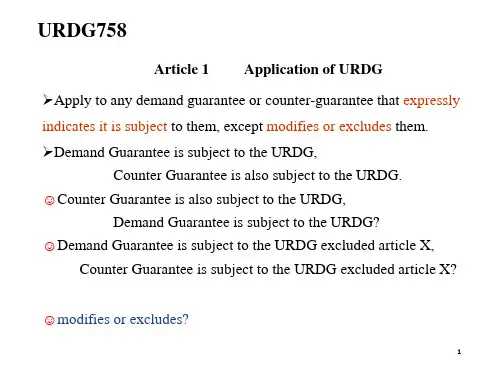
URDG 758The URDG 758 are the Uniform Rules for Demand Guarantees ‐ effective 01 July 2010.ForewordThis revision of ICC's Uniform Rules for Demand Guarantees (URDG) is the first since the rules were developed by ICC in 1991. The original rules, URDG 458, gained broad international acceptance in recent years following their incorporation by the World Bank in its guarantee forms and their endorsement by UNCITRAL and leading industry associations, such as FIDIC.This first revision of the rules was meticulously prepared over a period of two and a half years, and is the result of a collective effort by a number of ICC constituent groups. It was developed as a joint project by two ICC commissions ‐ the Banking Commission and the Commission on Commercial Law and Practice ‐ therefore taking into account the legitimate expectations of all relevant sectors. ICC national committees contributed substantially to the final product: some 52 national committees submitted several hundred pages of valuable suggestions on successive drafts, a number of which were incorporated into the final text.The ICC Task Force on Guarantees, which consisted of 40 members from 26 countries, reviewed the various drafts and added their own suggestions. The URDG Drafting Group, ably chaired by Dr Georges Affaki, met on a number of occasions, carefully reviewed all comments submitted by national committees and the Task Force and developed the final draft.This collective effort has borne fruit; it has produced rules that reflect a broad consensus among bankers, users and all members of the guarantee community. In fact, the present revision of the URDG does not merely update the existing rules. It is the result of an ambitious project to create a new set of rules for the twenty‐first century that is clearer, more precise and more comprehensive. As such, URDG 758 is destined to become the standard text for demand guarantees worldwide.Jean RozwadowskiSecretary GeneralInternational Chamber of CommerceJanuary 2010IntroductionThe new URDG 758 succeed URDG 458. Over 17 years of practice (1992 ‐ 2009), URDG 458 proved to be both successful and reliable. They were used by banks and businesses across continents and industry sectors. URDG 458 were endorsed by international organizations, multilateral financial institutions, bank regulators, lawmakers and professional federations. In contrast to the failed Uniform Rules for Contract Guarantees (URCG 325), URDG 458 reflected the reality of the international demand guarantee market and struck the most reasonable balance between the interests of all the parties involved. By choosing to instruct a guarantor to issue a demand guarantee subject to URDG, applicants renounced their ability to obstruct payment for reasons derived from their relationship with the beneficiary. In turn, beneficiaries were expected to state in general terms ‐ but not to justify, establish or prove ‐ the nature of the applicant's breach in the performance of the underlying relationship. Finally, because a demand guarantee is an independent undertaking, guarantors were assured that their commitment was subject to its own terms. They were insulated from the performance contingencies of the underlying relationship.Their incremental use, backed by the support of ICC, enabled URDG 458 to make a critical contribution towards levelling the playing field among demand guarantee issuers and users regardless of the legal, economic or social system in which they operate.Yet, URDG 458 formed the first attempt by ICC to codify independent guarantee practice. Over the years, the application of their provisions shed light on the need for drafting adjustments, clarifications, expansion of scope or clear corrections of the adopted standard. Views reported to the ICC Task Force on Guarantees from URDG users worldwide provided the necessary material to launch a revision of URDG 458 that both the lapse of time and the evolution of practice made necessary. The revision was launched in 2007 and was conducted under the aegis of both the ICC Banking Commission and the Commission on Commercial Law and Practice (CLP).The ICC Task Force on Guarantees, the standing expert body created by ICC in 2003 to monitor international guarantee practice, acted as a consultative body to a Drafting Group that produced five comprehensive drafts during the two and a half year revision process. Each draft was submitted for review and comments to ICC national committees. Over 600 sets of comments were received from a total of 52 countries and were thoroughly examined. These comments were instrumental in shaping the new rules. Regular progress reports were presented to meetings of each of the ICC commissions considering the rules and were comprehensively debated. This method ensured that the revision takes into account views received from a broad cross‐sector of concerned parties.The resulting URDG 758 were adopted by the ICC Executive Board on 3 December 2009, following endorsement by the members of the two sponsoring commissions. They will come into force on July 1, 2010. The new rules apply to any demand guarantee or counter‐guarantee where incorporated by reference in the text. They can also apply as trade usage or by implication from a consistent course of dealing between the parties to the demand guarantee or counter‐guarantee where so provided by the applicable law.The new URDG 758 do not merely update URDG 458; they are the result of an ambitious process that seeks to bring a new set of rules for demand guarantees into the 21st century, rules that are clearer, more precise and more comprehensive.Clearer URDG. The new URDG 758 aim for clarity. They adopt the drafting style of ICC's universally accepted Uniform Rules for Documentary Credits (UCP 600) by bringing together the definitions of terms in one article. They also bring a much needed clarification of the process according to which a presentation will be checked for conformity.More precise URDG. A number of the standards contained in URDG 458 left a margin for interpretation that varied according to the particular facts of the case. This was particularly true for the terms "reasonable time" and "reasonable care". The new URDG have excluded all imprecise standards with an aim to foster certainty and predictability. Examples are time durations for the examination of a demand, the extension of a guarantee in the case of force majeure, and the suspension of the guarantee in the case of an extend or pay demand.More comprehensive URDG. Important practices were left out of URDG 458. This was particularly the case for the advice of a guarantee, amendments, standards for examination of presentations, partial, multiple and incomplete demands, linkage of documents, and transfer of guarantees. In addition, there was only fragmentary treatment of counter‐guarantees. What was understandable at the time of the first attempt to codify demand guarantee practice can no longer be accepted 17 years later. The new URDG 758 now cover all of these practices and make clear that provisions governing guarantees apply equally to counter‐guarantees.Balanced URDG. The new URDG 758 endorse and build on the balanced approach that characterized URDG 458. For example:‐ The beneficiary is entitled to payment upon presentation of a complying demand without the need for the guarantor to seek the applicant's approval. The new URDG also correct an unfair situation that would have left the beneficiary without recourse to the guarantee in the case of force majeure if its expiry coincided with the interruption of the guarantor's business.‐ The guarantor's independent role is expressed in stronger and clearer terms and, more importantly, it is now expressed in exclusively documentary terms. The new URDG expect the guarantor to act diligently. For instance, a guarantor is expected to reject a non‐complying demand within five business days by sending a rejection notice that lists all of the discrepancies; otherwise, the guarantor will be precluded from claiming that the demand is non‐complying and will be compelled to pay. Largely accepted in documentary credit practice under the UCP, the preclusion sanction is necessary to discipline unfair practices that work to the detriment of the beneficiary.‐ The applicant's right to be informed of the occurrence of the key stages in the lifecycle of the guarantee is acknowledged in the new rules. However, this information should not be a prerequisite for payment when a complying demand is presented.Innovative URDG. The new URDG 758 feature a number of innovations dictated by the development of practice and the need to avoid disputes. An example is the new rule that proposes a substitution of currencies when payment in the currency specified in the guarantee becomes impossible. Another example is the new termination mechanism for guarantees that state neither an expiry date nor an expiry event. This solution is expected to reduce the number of open‐ended guarantees that severely penalize applicants and are incompatible with the banks' capital requirements.The Guide. The rationale, preparatory work and interpretation of each article of the new URDG 758 can be found in a separately released Guide to the rules (ICC Publication No. 702).The new URDG 758 package. The new rules are accompanied by a model guarantee and counter‐guarantee form featured at the end of this publication. They are destined to evolve into an indispensable companion to the new URDG 758 and their users. Experience shows that a comprehensive ready‐to‐use package that combines both the rules and model forms is more attractive to users than the previously separate ICC publications Nos. 458 and 503. It should also be conducive to more harmonized a practice.In drafting the new URDG 758 model guarantee form, a unitary approach was preferred to one that would have consisted of multiple forms linked to the purpose of each guarantee. Tender, performance, advance payment, retention money, warranty and other types of demand guarantees share the same nature and have similar features. This was evidenced by the five nearly identical basic model guarantee forms in ICC publication No. 503 that accompanied URDG 458. Of course, URDG 758 users have the option of enriching the unitary model form with one or more of the clauses proposed at the end of this publication such as the reduction of amount clause for advance payment guarantees or even drafting any other clause outright.A final message: the need for clear drafting. Clear drafting is the linchpin of a successful international demand guarantee practice. This has proven to be the case over time and across cultures and industry sectors. Using the new URDG 758 model guarantee form levels the playing field and avoids misunderstandings. As such, it will hopefully significantly curb the worrying tendency that a few courts have shown in recent years to re‐characterize demand guarantees as accessory suretyships ‐ or the reverse. While sometimes warranted by the ambiguous terms used by the parties, such interference has considerably destabilized the international guarantee market by adding a particularly prejudicial element of uncertainty. Such a regrettable situation can be remedied by a consistent use of URDG 758 and their accompanying model form in any type of demand guarantee or counter‐guarantee or, indeed, any other independent undertaking.Acknowledgments. I would like to express my deep appreciation to the members of the ICC Task Force on Guarantees*, the ICC national committees and members of both the Banking Commission and CLP for their guidance, support and constructive participation in the revision. The Guarantees Department of RZB was very helpful in processing the hundreds of national comments received throughout the revision process and compiling them for the Drafting Group's review.It was my privilege to chair the Drafting Group that undertook the revision. The members of the Drafting Group are listed below in alphabetical order:Roger Carouge (Germany), Sir Roy Goode (United Kingdom),Dr Andrea Hauptmann (Austria), Glenn Ransier (United States), Pradeep Taneja (Bahrain), and Farideh Tazhibi(Islamic Republic of Iran).Rarely has a chairman been blessed with a group whose members are so experienced and enthusiastic about the subject at hand, animated by team spirit, complementary in their regional and sectoral experience and able to endure with admirable patience the inevitable challenges of a fast‐track revision process.The result is the new URDG 758, which we proudly offer to the world.Dr. Georges AffakiVice‐Chair, ICC Banking CommissionBNP ParibasJanuary 2010目 录Article 1 Application of URDG 本规则的适用范围 (8)Article 2 Definitions 定义 (8)Article 3 Interpretation 解释 (11)Article 4 Issue and effectiveness 开立和生效 (12)Article 5 Independence of guarantee and counter‐guarantee 保函和反担保函的独立性 (13)Article 6 Documents v. goods, services or performance 单据和货物、服务或者履约行为 (13)Article 7 Non‐documentary conditions 非单据条件 (13)Article 8 Content of instructions and guarantees 指示和保函的内容 (14)Article 9 Application not taken up 拒绝接受申请 (15)Article 10 Advising of guarantee or amendment 保函或者保函修改的通知 (15)Article 11 Amendments 修改 (16)Article 12 Extent of guarantor's liability under guarantee 保函项下担保人责任的范围 (17)Article 13 Variation of amount of guarantee 保函金额的变动 (17)Article 14 Presentation 交单 (17)Article 15 Requirements for demand 对索偿要求的要求 (19)Article 16 Information about demand 关于索偿要求的告知 (19)Article 17 Partial demand and multiple demands; amount of demands 部分索偿要求和多次索偿要求,索偿要求的金额................................ .. (20)Article 18 Separateness of each demand 每一次索偿要求的独立性 (21)Article 19 Examination 审核 (21)Article 20 Time for examination of demand; payment 审核索偿要求的时间,付款 (22)Article 21 Currency of payment 支付的货币 (22)Article 22 Transmission of copies of complying demand 相符索偿要求副本的传递 (23)Article 23 Extend or pay 展期或付款 (23)Article 24 Non‐complying demand, waiver and notice 非相符索偿要求,放弃决定和通知 (25)Article 25 Reduction and termination 减额与终止 (26)Article 26 Force majeure 不可抗力 (27)Article 27 Disclaimer on effectiveness of documents 关于单据有效性的免责 (28)Article 28 Disclaimer on transmission and translation 关于传递和翻译的免责 (29)Article 29 Disclaimer for acts of another party 关于其他当事方行为的免责 (29)Article 30 Limits on exemption from liability 责任豁免的限度 (30)Article 31 Indemnity for foreign laws and usages 外国法律和惯例的补偿 (30)Article 32 Liability for charges 关于费用的责任 (30)Article 33 Transfer of guarantee and assignment of proceeds 保函的转让和款项让渡 (30)Article 34 Governing law 管辖法律 (32)Article 35 Jurisdiction 司法管辖权 (32)Article 1 Application of URDG 本规则的适用范围a.The Uniform Rules for Demand Guarantees ("URDG") apply to any demand guarantee orcounter‐guarantee that expressly indicates it is subject to them. They are binding on all parties to the demand guarantee or counter‐guarantee except so far as the demand guarantee or counter‐guarantee modifies or excludes them.《见索即付保函统一规则》(以下简称“本规则”)适用于任何在其文本中清楚地表示受本规则约束的见索即付保函或者反担保函。

UNIFORM RULES FOR DEMAND GUARANTEES ICC PUBLICATION NO.458 1992国际商会见索即付保函统一规则编号458 1992INTRODUCTION引言《见索即付保函统一规则》(国际商会第458号出版物)是国际商会国际商业惯例委员会和银行技术与惯例委员会联合工作组以及为最后定稿而设立的起草小组的工作成果。
本规则旨在于全球范围内适用于见索即付保函,也就是保函、保证或者其他付款承诺,在该承诺项下,当提交书面的付款要求以及保函所规定的其他单据后担保人或者出具人即有义务进行付款,而不以基础交易中被担保人是否实际违约为转移。
见索即付保函与跟单信用证的区别是,只有当被担保人违约时,支用见索即付保函才是适当的。
但是,如同跟单信用证的开证人一样,担保人仅仅处理单据,而不考察事实上是否发生了违约。
备用信用证业已由《跟单信用证统一惯例(UCP)》(1983年版,第400号出版物)来调整。
它已经发展成为一种全能的金融支持工具,较见索即付保函更为广泛地应用于金融和商业活动中,并且经常涉及到见索即付保函很少遇到的做法和程序(例如,保兑、为银行自身开立、向开立人以外的一方提交单据),从而使得备用信用证更类似于跟单信用证。
因此,虽然备用信用证在技术上属于见索即付保函的定义范围,可以预见的是备用信用证的开证人将继续使用UCP,因为就备用信用证的特别需求而言,UCP更为详细和适合。
本规则不适用于有条件的保证或者其他从属性的承诺,在该承诺项下担保人仅在被担保人实际违约时才承担付款义务。
上述担保工具被广泛地使用,但是在性质上与见索即付保函不同,不属于本规则调整的范围和目的。
之所以制定本套新规则,是由于1978年国际商会《合同担保统一规则》(第325号出版物)未获得普遍接受。
这一新规则更准确地反映了见索即付保函交易所涉各方的不同利益。
但是,由于第325号出版物继续在某些范围内适用,因此,该出版物在现时仍然有效,以便能够适用于那些更愿意使用该规则的当事人。
URDG 758The URDG 758 are the Uniform Rules for Demand Guarantees - effective 01 July 2010.ForewordThis revision of ICC's Uniform Rules for Demand Guarantees (URDG) is the first since the rules were developed by ICC in 1991. The original rules, URDG 458, gained broad international acceptance in recent years following their incorporation by the World Bank in its guarantee formsand their endorsement by UNCITRAL and leading industry associations, such as FIDIC.This first revision of the rules was meticulously prepared over a period of two and a half years, and is the result of a collective effortby a number of ICC constituent groups. It was developed as a jointproject by two ICC commissions - the Banking Commission and the Commission on Commercial Law and Practice - therefore taking into account the legitimate expectations of all relevant sectors. ICCnational committees contributed substantially to the final product: some52 national committees submitted several hundred pages of valuable suggestions on successive drafts, a number of which were incorporated into the final text.The ICC Task Force on Guarantees, which consisted of 40 members from 26 countries, reviewed the various drafts and added their own suggestions. The URDG Drafting Group, ably chaired by Dr Georges Affaki, met on a number of occasions, carefully reviewed all comments submitted by national committees and the Task Force and developed the final draft.This collective effort has borne fruit; it has produced rules thatreflect a broad consensus among bankers, users and all members of the guarantee community. In fact, the present revision of the URDG does not merely update the existing rules. It is the result of an ambitiousproject to create a new set of rules for the twenty-first century thatis clearer, more precise and more comprehensive. As such, URDG 758 is destined to become the standard text for demand guarantees worldwide.Jean RozwadowskiSecretary GeneralInternational Chamber of CommerceJanuary 2010IntroductionThe new URDG 758 succeed URDG 458. Over 17 years of practice (1992 - 2009), URDG 458 proved to be both successful and reliable. They wereused by banks and businesses across continents and industry sectors.URDG 458 were endorsed by international organizations, multilateralfinancial institutions, bank regulators, lawmakers and professional federations. In contrast to the failed Uniform Rules for ContractGuarantees (URCG 325), URDG 458 reflected the reality of theinternational demand guarantee market and struck the most reasonable balance between the interests of all the parties involved. By choosingto instruct a guarantor to issue a demand guarantee subject to URDG, applicants renounced their ability to obstruct payment for reasonsderived from their relationship with the beneficiary. In turn,beneficiaries were expected to state in general terms - but not tojustify, establish or prove - the nature of the applicant's breach inthe performance of the underlying relationship. Finally, because ademand guarantee is an independent undertaking, guarantors were assured that their commitment was subject to its own terms. They were insulated from the performance contingencies of the underlying relationship.Their incremental use, backed by the support of ICC, enabled URDG 458 to make a critical contribution towards levelling the playing fieldamong demand guarantee issuers and users regardless of the legal, economic or social system in which they operate.Yet, URDG 458 formed the first attempt by ICC to codify independent guarantee practice. Over the years, the application of their provisionsshed light on the need for drafting adjustments, clarifications,expansion of scope or clear corrections of the adopted standard. Views reported to the ICC Task Force on Guarantees from URDG users worldwide provided the necessary material to launch a revision of URDG 458 that both the lapse of time and the evolution of practice made necessary. The revision was launched in 2007 and was conducted under the aegis of both the ICC Banking Commission and the Commission on Commercial Law and Practice (CLP).The ICC Task Force on Guarantees, the standing expert body created by ICC in 2003 to monitor international guarantee practice, acted as a consultative body to a Drafting Group that produced five comprehensive drafts during the two and a half year revision process. Each draft was submitted for review and comments to ICC national committees. Over 600sets of comments were received from a total of 52 countries and were thoroughly examined. These comments were instrumental in shaping the new rules. Regular progress reports were presented to meetings of each ofthe ICC commissions considering the rules and were comprehensively debated. This method ensured that the revision takes into account views received from a broad cross-sector of concerned parties.The resulting URDG 758 were adopted by the ICC Executive Board on 3 December 2009, following endorsement by the members of the two sponsoring commissions. They will come into force on July 1, 2010. Thenew rules apply to any demand guarantee or counter-guarantee where incorporated by reference in the text. They can also apply as tradeusage or by implication from a consistent course of dealing between the parties to the demand guarantee or counter-guarantee where so providedby the applicable law.The new URDG 758 do not merely update URDG 458; they are the result of an ambitious process that seeks to bring a new set of rules fordemand guarantees into the 21st century, rules that are clearer, moreprecise and more comprehensive.Clearer URDG. The new URDG 758 aim for clarity. They adopt the drafting style of ICC's universally accepted Uniform Rules forDocumentary Credits (UCP 600) by bringing together the definitions ofterms in one article. They also bring a much needed clarification of the process according to which a presentation will be checked for conformity.More precise URDG. A number of the standards contained in URDG 458 left a margin for interpretation that varied according to the particularfacts of the case. This was particularly true for the terms "reasonabletime" and "reasonable care". The new URDG have excluded all imprecise standards with an aim to foster certainty and predictability. Examplesare time durations for the examination of a demand, the extension of a guarantee in the case of force majeure, and the suspension of theguarantee in the case of an extend or pay demand.More comprehensive URDG. Important practices were left out of URDG 458. This was particularly the case for the advice of a guarantee, amendments, standards for examination of presentations, partial,multiple and incomplete demands, linkage of documents, and transfer of guarantees. In addition, there was only fragmentary treatment ofcounter-guarantees. What was understandable at the time of the firstattempt to codify demand guarantee practice can no longer be accepted 17 years later. The new URDG 758 now cover all of these practices and make clear that provisions governing guarantees apply equally to counter-guarantees.Balanced URDG. The new URDG 758 endorse and build on the balanced approach that characterized URDG 458. For example:- The beneficiary is entitled to payment upon presentation of a complying demand without the need for the guarantor to seek theapplicant's approval. The new URDG also correct an unfair situation that would have left the beneficiary without recourse to the guarantee in thecase of force majeure if its expiry coincided with the interruption ofthe guarantor's business.- The guarantor's independent role is expressed in stronger andclearer terms and, more importantly, it is now expressed in exclusively documentary terms. The new URDG expect the guarantor to act diligently.For instance, a guarantor is expected to reject a non-complying demandwithin five business days by sending a rejection notice that lists allof the discrepancies; otherwise, the guarantor will be precluded fromclaiming that the demand is non-complying and will be compelled to pay. Largely accepted in documentary credit practice under the UCP, the preclusion sanction is necessary to discipline unfair practices thatwork to the detriment of the beneficiary.- The applicant's right to be informed of the occurrence of the keystages in the lifecycle of the guarantee is acknowledged in the newrules. However, this information should not be a prerequisite forpayment when a complying demand is presented.Innovative URDG. The new URDG 758 feature a number of innovations dictated by the development of practice and the need to avoid disputes.An example is the new rule that proposes a substitution of currencieswhen payment in the currency specified in the guarantee becomes impossible. Another example is the new termination mechanism for guarantees that state neither an expiry date nor an expiry event. Thissolution is expected to reduce the number of open-ended guarantees that severely penalize applicants and are incompatible with the banks'capital requirements.The Guide. The rationale, preparatory work and interpretation ofeach article of the new URDG 758 can be found in a separately releasedGuide to the rules (ICC Publication No. 702).The new URDG 758 package. The new rules are accompanied by a model guarantee and counter-guarantee form featured at the end of this publication. They are destined to evolve into an indispensable companionto the new URDG 758 and their users. Experience shows that a comprehensive ready-to-use package that combines both the rules and model forms is more attractive to users than the previously separate ICC publications Nos. 458 and 503. It should also be conducive to more harmonized a practice.In drafting the new URDG 758 model guarantee form, a unitary approach was preferred to one that would have consisted of multipleforms linked to the purpose of each guarantee. Tender, performance, advance payment, retention money, warranty and other types of demand guarantees share the same nature and have similar features. This was evidenced by the five nearly identical basic model guarantee forms inICC publication No. 503 that accompanied URDG 458. Of course, URDG 758 users have the option of enriching the unitary model form with one ormore of the clauses proposed at the end of this publication such as the reduction of amount clause for advance payment guarantees or even drafting any other clause outright.A final message: the need for clear drafting. Clear drafting is the linchpin of a successful international demand guarantee practice. Thishas proven to be the case over time and across cultures and industry sectors. Using the new URDG 758 model guarantee form levels the playing field and avoids misunderstandings. As such, it will hopefullysignificantly curb the worrying tendency that a few courts have shown in recent years to re-characterize demand guarantees as accessory suretyships - or the reverse. While sometimes warranted by the ambiguous terms used by the parties, such interference has considerablydestabilized the international guarantee market by adding a particularly prejudicial element of uncertainty. Such a regrettable situation can beremedied by a consistent use of URDG 758 and their accompanying model form in any type of demand guarantee or counter-guarantee or, indeed,any other independent undertaking.Acknowledgments. I would like to express my deep appreciation tothe members of the ICC Task Force on Guarantees*, the ICC national committees and members of both the Banking Commission and CLP for their guidance, support and constructive participation in the revision. The Guarantees Department of RZB was very helpful in processing the hundreds of national comments received throughout the revision process and compiling them for the Drafting Group's review.It was my privilege to chair the Drafting Group that undertook the revision. The members of the Drafting Group are listed below in alphabetical order:Roger Carouge (Germany), Sir Roy Goode (United Kingdom),Dr Andrea Hauptmann (Austria), Glenn Ransier (United States), Pradeep Taneja (Bahrain), and Farideh Tazhibi(Islamic Republic of Iran).Rarely has a chairman been blessed with a group whose members are so experienced and enthusiastic about the subject at hand, animated by team spirit, complementary in their regional and sectoral experience andable to endure with admirable patience the inevitable challenges of afast-track revision process.The result is the new URDG 758, which we proudly offer to the world.Dr. Georges AffakiVice-Chair, ICC Banking CommissionBNP ParibasJanuary 2010目录Article 1 Application of URDG 本规则的适用范围 8Article 2 Definitions 定义 8Article 3 Interpretation 解释 11Article 4 Issue and effectiveness 开立和生效 12Article 5 Independence of guarantee and counter-guarantee 保函和反担保函的独立性 13Article 6 Documents v. goods, services or performance 单据和货物、服务或者履约行为 13Article 7 Non-documentary conditions 非单据条件 13Article 8 Content of instructions and guarantees 指示和保函的内容 14Article 9 Application not taken up 拒绝接受申请 15Article 10 Advising of guarantee or amendment 保函或者保函修改的通知 15Article 11 Amendments 修改 16Article 12 Extent of guarantor's liability under guarantee 保函项下担保人责任的范围 17Article 13 Variation of amount of guarantee 保函金额的变动 17Article 14 Presentation 交单 17Article 15 Requirements for demand 对索偿要求的要求 19Article 16 Information about demand 关于索偿要求的告知 19Article 17 Partial demand and multiple demands; amount of demands部分索偿要求和多次索偿要求,索偿要求的金额 (20)Article 18 Separateness of each demand 每一次索偿要求的独立性 21Article 19 Examination 审核 21Article 20 Time for examination of demand; payment 审核索偿要求的时间,付款 22Article 21 Currency of payment 支付的货币 22Article 22 Transmission of copies of complying demand 相符索偿要求副本的传递 23Article 23 Extend or pay 展期或付款 23Article 24 Non-complying demand, waiver and notice 非相符索偿要求,放弃决定和通知 25Article 25 Reduction and termination 减额与终止 26Article 26 Force majeure 不可抗力 27Article 27 Disclaimer on effectiveness of documents 关于单据有效性的免责 28Article 28 Disclaimer on transmission and translation 关于传递和翻译的免责 29Article 29 Disclaimer for acts of another party 关于其他当事方行为的免责 29Article 30 Limits on exemption from liability 责任豁免的限度 30Article 31 Indemnity for foreign laws and usages 外国法律和惯例的补偿 30Article 32 Liability for charges 关于费用的责任 30Article 33 Transfer of guarantee and assignment of proceeds 保函的转让和款项让渡 30Article 34 Governing law 管辖法律 32Article 35 Jurisdiction 司法管辖权 32Article 1 Application of URDG 本规则的适用范围a. The Uniform Rules for Demand Guarantees ("URDG") apply to any demand guarantee or counter-guarantee that expressly indicates it issubject to them. They are binding on all parties to the demand guaranteeor counter-guarantee except so far as the demand guarantee or counter-guarantee modifies or excludes them.《见索即付保函统一规则》(以下简称“本规则”)适用于任何在其文本中清楚地表示受本规则约束的见索即付保函或者反担保函。