
彭雪梅For和since在现在完成时应用共23页文档
- 格式:ppt
- 大小:3.18 MB
- 文档页数:23
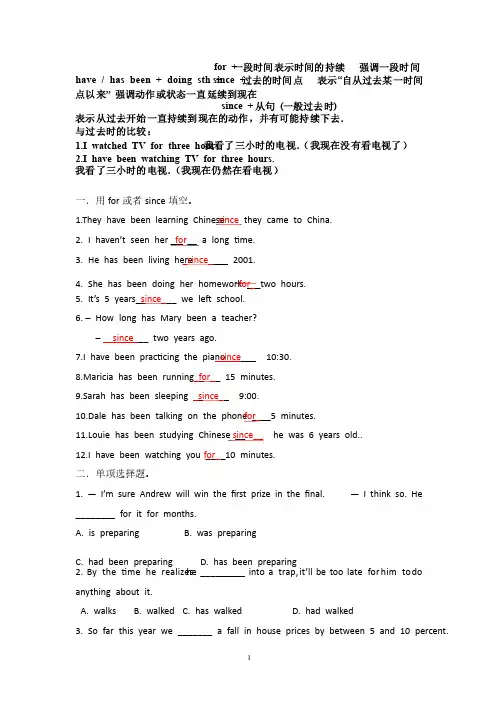
for +一段时间表示时间的持续 强调一段时间 have / has been + doing sth + since +过去的时间点 表示“自从过去某一时间 点以来” 强调动作或状态一直延续到现在 since + 从句 (一般过去时) 表示从过去开始一直持续到现在的动作,并有可能持续下去.与过去时的比较:1.I watched TV for three hours.我看了三小时的电视.(我现在没有看电视了)2.I have been watching TV for three hours. 我看了三小时的电视.(我现在仍然在看电视)一.用for 或者since 填空。
填空。
1.They have been learning Chinese since they came to China. 2. I haven’t seen her ___for __ a long me. 3. He has been living here _since____ 2001. 4. She has been doing her homework __for__two hours. 5. It’s 5 years __since___ we le school. 6. – How long has Mary been a teacher? – __since___ two years ago. 7.I have been prac cing the piano _since ___ 10:30. 8.Maricia has been running __for__ 15 minutes. 9.Sarah has been sleeping ___since__ 9:00. 10.Dale has been talking on the phone __for___5 minutes. 11.Louie has been studying Chinese __since__ he was 6 years old.. 12.I have been watching you __for__10 minutes. 二.单项选择题。
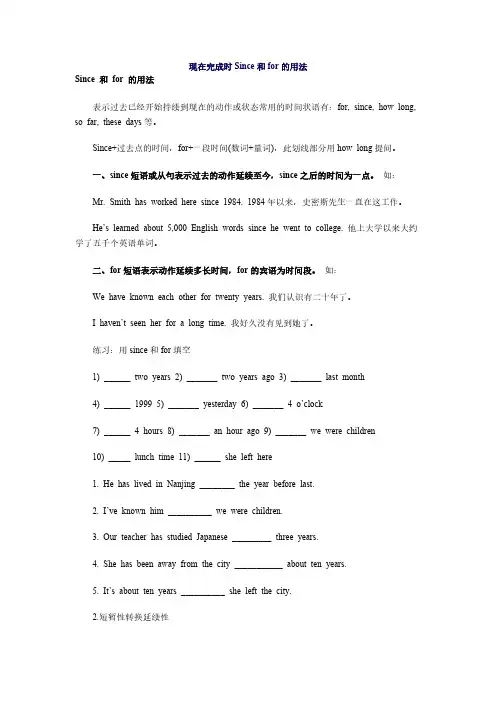
现在完成时Since和for的用法Since 和for 的用法 表示过去已经开始持续到现在的动作或状态常用的时间状语有:for, since, how long, so far, these days等。
Since+过去点的时间,for+一段时间(数词+量词),此划线部分用how long提问。
一、since短语或从句表示过去的动作延续至今,since之后的时间为一点。
如: Mr. Smith has worked here since 1984. 1984年以来,史密斯先生一直在这工作。
He’s learned about 5,000 English words since he went to college. 他上大学以来大约学了五千个英语单词。
二、for短语表示动作延续多长时间,for的宾语为时间段。
如: We have known each other for twenty years. 我们认识有二十年了。
I haven’t seen her for a long time. 我好久没有见到她了。
练习:用since和for填空 1) ______ two years 2) _______ two years ago 3) _______ last month 4) ______ 1999 5) _______ yesterday 6) _______ 4 o’clock 7) ______ 4 hours 8) _______ an hour ago 9) _______ we were children 10) _____ lunch time 11) ______ she left here 1. He has lived in Nanjing ________ the year before last. 2. I’ve known him __________ we were children. 3. Our teacher has studied Japanese _________ three years. 4. She has been away from the city ___________ about ten years. 5. It’s about ten years __________ she left the city. 2.短暂性转换延续性 ①arrive at/in sw. get to/reach sw. come/go/move to sw. →be in sw./at school/at home/on the farm/be here/be there 1) He got to Beijing five minutes ago. He ________ _________ _________ Beijing for _________ _________. 2) I moved to the USA last year. I ________ ________ __________ the USA since __________ __________. 3) I went home yesterday. I _______ ________ _________ home for _________ __________. 4) They came here last week. They _________ _________ here since _________ __________. ②come/go back, return →be back come/go out →be out 1) He came out two years ago. He _________ __________ _________ for __________ __________. 2) We return to Fuzhou yesterday. We ________ ________ _________ to Fuzhou since __________. ③become →be 1) I became a teacher in 2000. I ________ __________ a teacher for _________ _________. 2) The river became dirty last year. The river _________ _________ dirty for _________ __________. ④close →be closed open →be open 1) The shop closed two hours ago. The shop ________ _________ _________ for _________ _________. 2) The door opened at six in the morning. The door ________ ________ ________ for six hours. ⑤get up →be up die →be dead leave sw. →be away from sw. fall asleep/get tot sleep →be asleep finish/end →be over marry →be married 1) I got up two hours ago. I ________ ________ ________ since ________ ________. 2) He left Fuzhou just now. He _______ ________ ________ _________ Fuzhou for five minutes. 3) My grandpa died in 2002. My grandpa _______ _______ ________for _______ ________. 4) The meeting finished at six. The meeting ________ ______ ______ for six hours. 5) I got to sleep two hours ago. I ________ _________ _________ since _________ __________. 6) They married in 1990. They ________ _________ __________since _________. ⑥start/begin to do sth. →do sth. begin →be on 1) I began to teach at this school in 1995. I ____ ____ at this school since ____. 2) The film began two minutes ago. The film ____ ____ ____ for ____ ____. ⑦borrow →keep lose →not have buy →have put on →wear catch/get a cold →have a cold get to know →know 1) They borrowed it last week. They _________ _________ it since __________ __________. 2) I bought a pen two hours ago. I _________ _________ a pen for ________ __________. 3) I got to know him last year. I _________ __________ him since __________ __________. 4) I put on my glasses three years ago. I __________ __________ my glasses for _________ _________. ⑧have/has gone to →have been in 1) He has gone to Beijing. He ____ ____ _____ Beijing for two days. ⑨join the league/the Party/the army →be a league/a Party member/a soldier →be a member of the league/the Party →be in the league/the Party/the army 1) He joined the league in 2002. He ________ _________ a _________ _________ for two years. He ________ __________ a __________ ___________ the __________ for two years. He ____________ ___________ ___________ the league for two years. 2) My brother joined the army two years ago. My brother __________ __________ a ___________ for ___________ ___________. My brother ___________ ___________ in ____________ ___________ for two years. 3.汉译英 1)这本字典我已买了三年了。

“for”和“since”在现在完成时中的用法如下:
“for”用于表示一个时间段,即动作持续的时间长度。
它通常与表示时间的名词(如年、月、日、小时等)连用,表示某个动作或状态持续了多长时间。
例如:“I have lived here for five years.”(我已经在这里住了五年了。
)
“since”用于表示一个时间点,即动作开始的时间。
它通常与表示过去某个时间点的词语(如从句、过去分词等)连用,表示某个动作或状态从何时开始一直持续到现在。
例如:“I have not seen him since last year.”(自从去年以来我就没有见过他。
)
需要注意的是,“for”和“since”在现在完成时中的用法是有所区别的,需要根据具体语境进行区分。
同时,在使用现在完成时时,还需要注意动词的正确形式,以及与时间状语的搭配等问题。