
小升初英语第一节 动词
- 格式:ppt
- 大小:996.00 KB
- 文档页数:41

动词加ing 的变化规则直接加ing cook-cooking swing-swinging eat-ea ng draw-drawing 以不发音的e 结尾,去e 加ing dance dance——dancing make-making, write —wri ng ride ride——riding have have——having skate skate——ska ng have-having take-taking hike-hiking 双写末尾的辅音字母run-ru nning swim-swi mming get-ge tting shop shop——sho pping动词+s 的变化规则 直接加-s cook→cooks, look→looks, like→likes以o. s. x. sh. ch.结尾,加-es do→does, go go→→goes watch→watches, wash→washes 以“辅音字母+y”结尾,变y 为i, 再加-es study→studies fly→flies 元音字母(a i e o u) +y 结尾,则直接加s: buy→buys play→plays say→says 特殊:have----has He has a small nose. 动词末尾加-ed cook-cooked ,cleaned, washed, listened, looked, played 结尾是e 加d taste-tasted, loved, used, liked 双写末尾的辅音字母 stop-stopped plan--planned 以“辅音字母+y”结尾的,变y 为i , 再加-ed study-studied worry---worried 词义词义 原形原形 过去式过去式 词义词义 原形原形 过去式过去式 是 am, is (be) was 走 go went 是 are (be) were 有 have, has had 买 buy bought 受伤受伤 hurt hurt 来 come came 制造制造 make made 做 do, does did 唱歌唱歌 sing sang 画 draw drew 睡觉睡觉 sleep slept 吃 eat ate 跑 run ran 感觉感觉 feel felt 说 say said 飞 fly flew 看见看见 see saw 读read read 听到听到hear heard 四、be 动词和行为动词的用法区别1.Be动词包括:is, am, are, was, were 2.实义动词:某个实际做出来的动作词语,如:swim, wash, do, go, buy, fly, sleep等等。
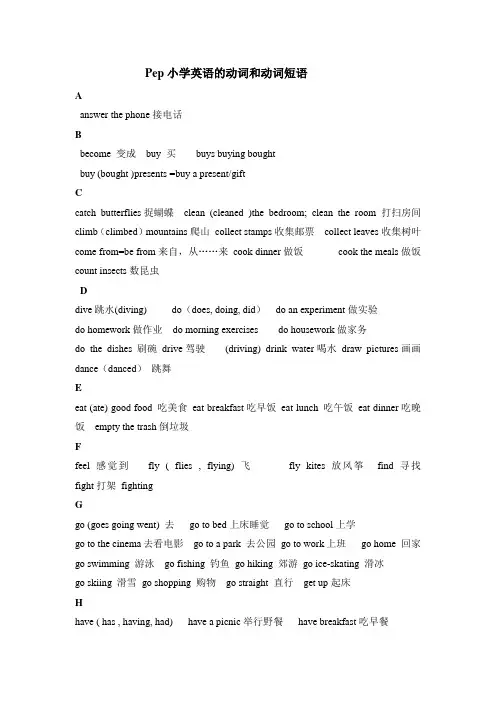
Pep小学英语的动词和动词短语Aanswer the phone接电话Bbecome 变成buy 买buys buying boughtbuy (bought )presents =buy a present/giftCcatch butterflies捉蝴蝶clean (cleaned )the bedroom; clean the room 打扫房间climb(climbed)mountains爬山collect stamps收集邮票collect leaves收集树叶come from=be from来自,从……来cook dinner做饭cook the meals做饭count insects数昆虫Ddive跳水(diving) do(does, doing, did)do an experiment做实验do homework做作业do morning exercises do housework做家务do the dishes 刷碗drive驾驶(driving) drink water喝水draw pictures画画dance(danced)跳舞Eeat (ate) good food 吃美食eat breakfast吃早饭eat lunch 吃午饭eat dinner吃晚饭empty the trash倒垃圾Ffeel感觉到fly ( flies , flying) 飞fly kites放风筝find寻找fight打架fightingGgo (goes going went) 去go to bed上床睡觉go to school上学go to the cinema去看电影go to a park 去公园go to work上班go home 回家go swimming 游泳go fishing 钓鱼go hiking 郊游go ice-skating 滑冰go skiing 滑雪go shopping 购物go straight 直行get up起床Hhave ( has , having, had) have a picnic举行野餐have breakfast吃早餐have lunch吃午餐have dinner吃晚饭have Chinese class上语文课have English class上英语课have music class上音乐课have P.E. class上体育课have math class上数学课have a cold 感冒have a fever 发烧have a sore throat 嗓子疼have a headache 头疼have a toothache 牙疼Jjump跳Llike + doing 喜欢做某事look at看……live居住(lives, living , lived)listen to music听音乐learn (learned) Chinese (学中文)look at看=have a look at look for 寻找 强调过程look up 查找look out 小心=be careful look after 照顾Mmeet遇到,碰见make a snowman堆雪人make kites制作风筝(makes, making) make the bed铺床Oopen打开Ppick up leaves采摘树叶plant trees种树play chess下棋play football踢足球play ping-pong 打乒乓球play sports进行体育活动play the violin拉小提琴play the piano弹钢琴play with……玩…put (puts , putting, put) put away the clothes收拾衣服Rrun ( runs, running) 跑read (reads, reading, read) read a book看书read books看书read a magazine阅读杂志ride a bike骑自行车(riding)Ssleep 睡觉sweep the floor扫地swing荡秋千(swinging) stop 停set the table摆餐具swim (swims, swimming) sing (sings , singing, sang)sing and dance (唱歌跳舞) sang and dancedTtake a trip去旅行take (takes , taking, took) take (took) pictures照相teach (teaches ) 教teach English 教英语turn left ( right) 向左(右)转Uuse a computer使用计算机Vvisit grandparents看望(外)祖父母Wwrite (writes, writing) write a letter写信write an e-mail写电子邮件write a report写报告water the flowers浇花wash (washes, washed)wash the windows擦窗户wash the clothes洗衣服watch (watches , watched) watch insects观察昆虫watch TV看电视小升初英语重点动词短语和句用法(2013.4.17)do表示用动词的原形(V原形)doing表示用动词的现在分词(V-ing)Sb 表示用人名或人称代词Sth表示用事物名词don’t / doesn’t / didn’t +动词原形介词(at /in /about / with /for ...)+ sth / V-ing/ 代词的宾格To + 动词原形be+ 形容词/ V-ing1. like doing sth 喜欢做某事(爱好)like to do sth 想要做某事(暂时)2.want sth 想要某物want to do sth 想要做某事3.help sb do sth 帮助某人做某事help sb with sth 帮助某人某事4.Let sb do sth 让某人做某事make sb do sth 使某人做某事5. would like sth 喜欢某物would like to do sth 想要做什么6.buy sb sth 买某物给某人buy sth for sb7.thanks /thank you for sth 因.....而感谢某人thanks /thank you for doing sth8. write a letter / an e-mail to sb 写一封信/邮件给某人9. turn off 关掉 (电视、电灯、开关等)turn on 打开 (电视、收音机、灯、煤气、自来水等)10.on duty 值日 值班11.stay in bed 卧床休息12.just now 刚才 刚刚13.in hospital 住院in the hospital 在医院(上班,看望病人)14.get off 从…… 下来 下车get on 上 车 船等15. a bit of 有点 用来修饰形容词a lot = very much 很、非常(放在句末)a group of 一群 a group of people 一群人a kind of 一种 一类 a kind of animal 一种动物a little 少许 一点(修饰不可数名词) a little water 一点水a few 少许 一点(修饰不可数名词)a few days 几天a lot of 许多 大量= lots of + 可数/不可数名词a pair of 一双 一副(shoes/ glasses眼镜/ trousers裤子/ gloves手套)a piece of 一 块、张、片、件(bread/ newspaper/ cake.....)16.after school 放学后17.be angry with sb 生某人的气18. 为什么不……(表建议的句型,注意用动词原形)Why don't you do sth ?Why not do sth ?表示建议的句型还有:What /How about……?(如果是动词,要用ing形式)Shall we……?be good at + 名词/ doing 在....方面做得好;擅长于......19.do well in + 名词/ doing为实义动词20. It is time (for sb) to do sthIt is time (for sb ) for sthdoing sth 是(某人)该做......的时候了。

Lesson8动词(一)实义动词,系动词,助动词,情态动词一.动词的定义表示动作、状态或性质的词称为动词。
二.动词的分类按照其在句子中的功能和意义,动词可以分为实义动词,系动词,助动词和情态动词四大类别。
三.实义动词1. 实义动词又称行为动词,在句子中能独立做谓语。
2. 实义动词又分为可以后面直接跟宾语的及物动词和后面不需要跟宾语的不及物动词。
Eg: He sends me a rose. (他送我一朵玫瑰花。
)send是及物动词,后面直接跟宾语。
Eg: The sun rises in the east. (太阳从东方升起.)rise是不及物动词,后面不需跟宾语。
四.系动词1. 系动词不能单独作谓语,而必须和表语(名词,形容词等)一起构成谓语部分,形成系表结构。
2.常用的系动词:(1)be动词(am/is/are/was/were)(2)5个感官系动词:look 看起来smell 闻起来taste 闻起来sound 听起来feel 摸起来(后+形容词)Eg: She looks beautiful today. 她今天看起来很漂亮。
The flowers smell sweet. 这些花闻起来很香。
That sounds good. 那听起来不错。
(3)get/become/turn/go 表变化,后加形容词。
Eg: It gets warmer and warmer. 天气变得越来越暖和。
In fall, the leaves turn yellow. 秋天树叶变黄。
The food goes bad easily in summer. 食物在夏天很容易变坏。
五.助动词1. 助动词本身没有词义,不能单独做谓语,只能和主要动词一起构成谓语动词,表示否定、疑问、时态、语态等语法形式,或用来加强语气。
常用的助动词有:be, do, have, shall, will。
2. 助动词be(1)可用于构成时态,主要是进行时:I am looking at you.(2)可用于构成被动语态: You are being looked.(3)可与动词不定式构成谓语: My job is to look at you every minute.3. 助动词have(1) 构成完成时态:We have learned English for many years.(2)和动词不定式构成谓语,表示因客观环境促使不得不做的事情:We have to learn English very well.4. 助动词do(1) 构成疑问句和否定句:Dose he do his homework after school?(2)用来加强语气:I do want to buy a new car.(3)用来代替动词词组:Write a letter “L” as I do.5.助动词shall构成将来时态,单纯表示未来情况:Shall I begin?6.助动词will构成将来时,用于第一,二,三人称。