语言学第五章chapter five partII
- 格式:ppt
- 大小:256.50 KB
- 文档页数:13


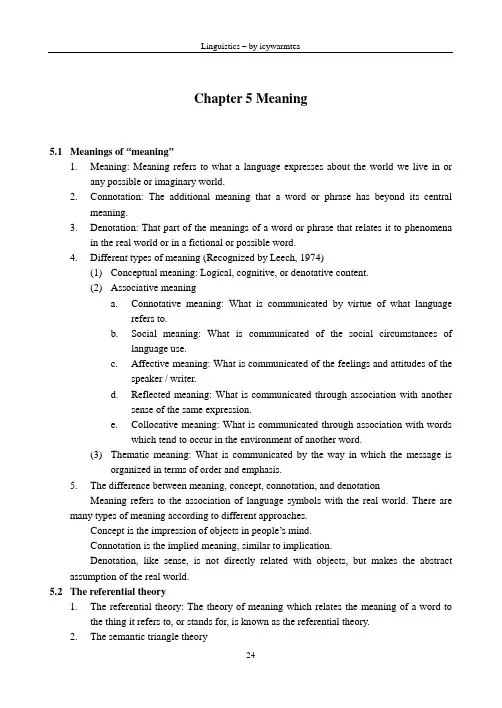
Chapter 5 Meaning5.1 Meanings of “meaning”1. Meaning: Meaning refers to what a language expresses about the world we live in orany possible or imaginary world.2. Connotation: The additional meaning that a word or phrase has beyond its centralmeaning.3. Denotation: That part of the meanings of a word or phrase that relates it to phenomenain the real world or in a fictional or possible word.4. Different types of meaning (Recognized by Leech, 1974)(1) Conceptual meaning: Logical, cognitive, or denotative content.(2) Associative meaninga. Connotative meaning: What is communicated by virtue of what languagerefers to.b. Social meaning: What is communicated of the social circumstances oflanguage use.c. Affective meaning: What is communicated of the feelings and attitudes of thespeaker / writer.d. Reflected meaning: What is communicated through association with anothersense of the same expression.e. Collocative meaning: What is communicated through association with wordswhich tend to occur in the environment of another word.(3) Thematic meaning: What is communicated by the way in which the message isorganized in terms of order and emphasis.5. The difference between meaning, concept, connotation, and denotationMeaning refers to the association of language symbols with the real world. There are many types of meaning according to different approaches.Concept is the impression of objects in people’s mind.Connotation is the implied meaning, similar to implication.Denotation, like sense, is not directly related with objects, but makes the abstract assumption of the real world.5.2 The referential theory1. The referential theory: The theory of meaning which relates the meaning of a word tothe thing it refers to, or stands for, is known as the referential theory.2. The semantic triangle theoryOgden and Richards presented the classic “Semantic Triangle”as manifested in the following diagram, in which the “symbol”refers to the linguist elements (word, sentence, etc.), the “referent”refers to the object in the world of experience, and the “thought”or “reference”refers to concept or notion. Thus the symbol of a word signifies “things”by virtue of the “concept,” associated with the form of the word in the mind of the speaker of the language. The concept thus considered is the meaning of the word. The connection (represented with a dotted line) between symbol and referent is made possible only through “concept.”Concept / notionThought / reference----------------------Symbol objectWord stands for realitySignifier referentCode signified5.3 Sense relations5.3.1 SynonymySynonymy is the technical name for the sameness relation.5.3.2 AntonymyAntonymy is the name for oppositeness relation. There are three subtypes: gradable, complementary and converse antonymy.1. Gradable antonymyGradable antonymy is the commonest type of antonymy. They are mainly adjectives, e.g. good / bad, long / short, big / small, etc.2. Complementary antonymyThe members of a pair in complementary antonymy are complementary to each other. That is, they divide up the whole of a semantic filed completely. Not only theassertion of one means the denial of the other, the denial of one also means the assertionof the other, e.g. alive / dead, hit / miss, male / female, boy / girl, etc.3. Converse antonymyConverse antonyms are also called relational opposites. This is a special type of antonymy in that the members of a pair do not constitute a positive-negative opposition.They show the reversal of a relationship between two entities, e.g. buy / sell, parent /child, above / below, etc.5.3.3 HyponymyHyponymy involves us in the notion of meaning inclusion. It is a matter of class membership. That is to say, when x is a kind of y, the lower term x is thehyponym, and the upper term y is the superordinate. Two or more hyponyms of thesame one superordinate are called co-hyponyms, e.g. under flower, there are peony,jasmine, tulip, violet, rose, etc., flower is the superordinate of peony, jasmine, etc.,peony is the hyponym of flower,and peony, jasmine, tulip, violet, rose, etc. areco-hyponyms.5.4 Componential analysisComponential analysis defines the meaning of a lexical element in terms of semantic components. That is, the meaning of a word is not an unanalyzable whole. It may be seen as a complex of different semantic features. There are semantic units smaller than the meaning of a word. E.g.Boy: [+human][-adult][+male]Girl: [+human][-adult][-male]Son: child (x, y) & male (x)Daughter: child (x, y) & -male (x)Take: cause (x, (have (x, y)))Give: cause (x, (-have (x, y)))。