英语国家概况Chapter2
- 格式:ppt
- 大小:3.63 MB
- 文档页数:86
英语国家概况精讲:第一章英国的国土与人民Chapter 1: Land and People 英国的国土与人民I. Different Names for Britain and its Parts 英国的不同名称及其各组成部分1.Geographical names: the British Isles, Great Britain and England.地理名称:不列颠群岛,大不列颠和英格兰。
2.Official name: the United Kingdom of Great Britain and Northern Ireland.官方正式名称:大不列颠及北爱尔兰联合王国。
3.The British Isles are made up of two large islands-Great Britain (the larger one) and Ireland, and hundreds of small ones.不列颠群岛由两个大岛—大不列颠岛(较大的一个)和爱尔兰岛,及成千上万个小岛组成。
4.Three political divisions on the island of Great Britain: England, Scotland and Wales.大不列颠岛上有三个政治区:英格兰、苏格兰和威尔士。
(1) England is in the southern part of Great Britain. It is the largest, most populous section.英格兰位于大不列颠岛南部,是最大,人口最稠密的地区。
(2) Scotland is in the north of Great Britain. It has three natural zones (the Highlands in the north; the Central lowlands; the south Uplands) Capital: Edinburgh苏格兰位于大不列颠的北部。
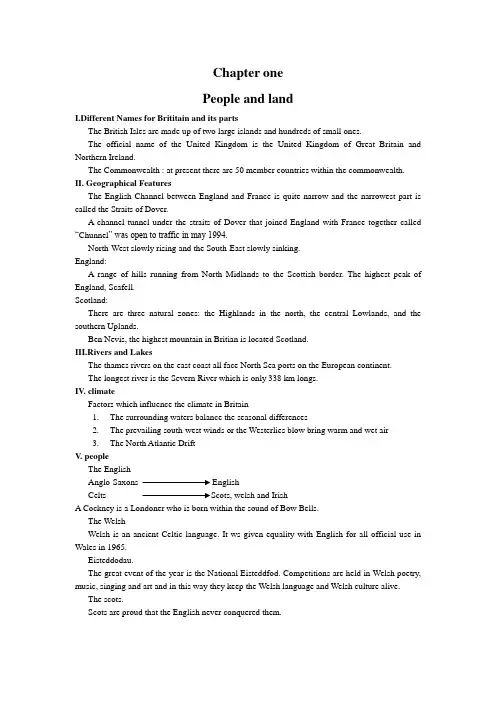
Chapter onePeople and landI.Different Names for Brititain and its partsThe British Isles are made up of two large islands and hundreds of small ones.The official name of the United Kingdom is the United Kingdom of Great Britain and Northern Ireland.The Commonwealth : at present there are 50 member countries within the commonwealth. II. Geographical FeaturesThe English Channel between England and France is quite narrow and the narrowest part is called the Straits of Dover.A channel tunnel under the straits of Dover that joined England with France together called “Chunnel” was open to traffic in may 1994.North-West slowly rising and the South-East slowly sinking.England:A range of hills running from North Midlands to the Scottish border. The highest peak of England, Scafell.Scotland:There are three natural zones: the Highlands in the north, the central Lowlands, and the southern Uplands.Ben Nevis, the highest mountain in Britian is located Scotland.III.Rivers and LakesThe thames rivers on the east coast all face North Sea ports on the European continent.The longest river is the Severn River which is only 338 km longs.IV. climateFactors which influence the climate in Britain1.The surrounding waters balance the seasonal differences2.The prevailing south-west winds or the Westerlies blow bring warm and wet air3.The North Atlantic DriftV. peopleThe EnglishAnglo-Saxons EnglishCelts Scots, welsh and IrishA Cockney is a Londoner who is born within the sound of Bow Bells.The WelshWelsh is an ancient Celtic language. It ws given equality with English for all official use in Wales in 1965.Eisteddodau.The great event of the year is the National Eisteddfod. Competitions are held in Welsh poetry, music, singing and art and in this way they keep the Welsh language and Welsh culture alive.The scots.Scots are proud that the English never conquered them.Chapter 2The Origins of a Nation(5000 BC------AD1066)I.Early Settles1.The first known settles Iberians. 3000 BC from Iberian peninsula, now spain.2.The second Beaker Folk 2000BC from Holland and the Rhineland.3.The third Celts 700 BC from eastern and central Europe.FranceThe Belgae were the most industrious and vigorous of the Celtic tribes.Their religion was Druidism. They offered up human sacrifices to their gods. Groups of men in immense wickerwork cages.II.Roman Britain(55BC-AD410)British recorded history begins with the Roman invasion.1.Julius Caesar 55BC2.Claudius AD433.Romans 400 pulled out in AD410The reason Julius Caesar invadedA.To get information about the island was so little.B.To punish the Belgae who had helped their fellow tribesmen fight against theconquering Romans in Gual,now France.Romans didn’t control Britain completely:A.Some parts of the country resistedB.Roman troops were oftern withdraw form Britain to fight in other parts of the RomanEmpireThe Romans also brought the new religion, Christianty, to Britain.III. The Anglo-SaxonsIn the mid-5th, the three Teutonic tribes, Jutes, Saxons, and Angles came to Britain.Jutes Hengist ( Jutish chief) 499Saxons end of 5th to the beginning of the 6th century.Angles in the second half of the 6th century.The primary contribution the Anglo-Saxons made:1.They laid the foundations of the English state. They divided the country into shires.2.They devised the narrow-strip, three-field farming system.3.They established the manorial system, the lord collected taxes, and organized the local army.4.They created the Witan.IV. The Viking and Danish InvasionsThe norwegian Vikings and the Danes from Denmark attacked various parts of England form the end of the 8th century.The contribution of King , Alfred1.He founded a strong fleet which first beat the Danes at sea, and is called “the father of theBritish navy.2.He protected the coasts and encouraged trade.3.He encourage learning and established schools and formulated a legal system.Alfred Ethelred Canute hardicanute Edward haroldV.The Norman Conquest(1066)October 14, 1066 the King Harold was killed by Duke of Normandy, william’s Cavalry.The Norman Conquest of 1066 is the best-known event in English history. After the conquest.1.William the Conqueror confiscated almost all the land and gave it to his Norman followers2.He replaced the weak Saxon rule with a strong Norman government. The fedual systemestablished completely in England.3.Relations with the continent were opened, civilization and commerce were extended4.The church was got closer connection with Rome, the church courts were seperated from thecivil courts.。