
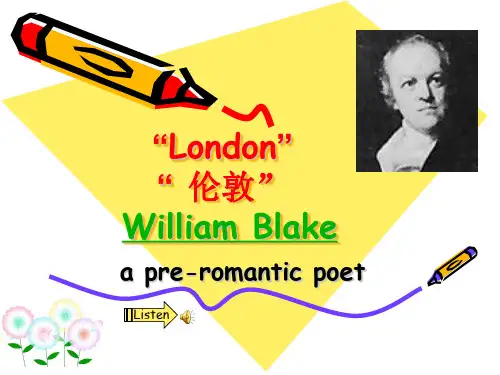
William Blake the chimney sweeper 译文及解析
- 格式:ppt
- 大小:161.00 KB
- 文档页数:12


The Chimney SweeperIntroductionThe chimney sweeper is a poetic work that sheds light on the harsh lives of young boys working as chimney sweepers in 18th-century England. This article will delve into the deep layers of this poem, analyzing its thematic elements, rhyme scheme, and the social critique that it presents.BackgroundThe chimney sweeper trade during the 18th century involved children as young as four or five years old being employed to clean chimneys. They faced dangerous working conditions, health risks, and a life of poverty. The poem, “The Chimney Sweeper” by William Blake, focuses on theplight of these young boys.ThemeThe Loss of InnocenceThe poem centers on the loss of innocence experienced by the chimney sweepers. It depicts their vulnerability and the corruption of their youth. The innocence is symbolized by the white hair of the young boys, which is initially seen as a sign of purity before it is tainted bytheir circumstances.Social Critique“The Chimney Sweeper” serves as a critique of the socio-economic conditions and practices prevalent during that time. It highlights the exploitation of child labor and the moral decay of society. Blake’s poem questions the ethics and compassion of a society that allows such atrocities to occur.Structure and Rhyme SchemeRhyme SchemeThe poem follows a rhyming pattern of AABB throughout, except for the two final lines, which rhyme with each other (CC). This consistent and repetitive rhyme scheme reinforces the sad and monotonous nature of the chimney sweepers’ lives.Stanza Structure“The Chimney Sweeper” is divided into six quatrains. Each quatrain consists of four lines, contributing to the organized structure of the poem. The stanzas provide a sense of rhythm and create a distinct separation between different ideas.Analysis of the PoemFirst StanzaThe poem begins with the introduction of a young chimney sweeper, Tom Dacre. He is depicted as naïve and innocent, having been taught to accept his grim fate. The imagery of Tom’s hair being shaved symbolizes the loss of his innocence and the removal of his identity.Second StanzaBlake introduces the image of locked coffins, implying the death-like conditions faced by the chimney sweepers. The use of the word “coffin” serves as a metaphor for their living conditions and the inevitable mortality that accompanies their work.Third StanzaIn the third stanza, Tom has a dream where the chimney sweepers are released from their misery. The image of the Angel freeing the boys and clothing them in white represents salvation and redemption from theirsuffering. This dream gives Tom hope, contrasting with the bleak reality he faces.Fourth StanzaBlake uses contrast in the fourth stanza to emphasize the hypocrisy and cruelty of society. The reference to a “blackening church” impliesthat even religion, which is meant to provide moral guidance, is tainted and disregards the lives of the chimney sweepers.Fifth StanzaThe fifth stanza introduces the character of the narrator, who shares his own tragic story. The narrator had been sold into chimney sweeping by his own father, further emphasizing the societal indifference towards these children and family bonds being disregarded for profit.Sixth StanzaIn the final stanza, the narrator tries to find solace in the beliefthat after their death, the chimney sweepers will find happiness in heaven. This reflects the prevalent religious beliefs of the time, which offered some consolation in the face of immense suffering.Conclusion“The Chimney Sweeper” serves as a powerful indictment of the inhumane treatment faced by child laborers during 18th-century England. Through its vivid imagery and social critique, William Blake’s poem highlights the loss of innocence, the dire living conditions, and the hypocrisy of society. By exploring these themes, the poem urges readers to challenge such societal injustices and fight for the rights and well-being of all individuals.。
英美文学重点(2)<To the Right Honorable the Earl of Chesterfield>约翰逊致切斯特菲尔德伯爵书Richard Brinsley Sheridan - the only important English dramatist of the 18th century谢立丹-18世纪英国最著名的戏剧家<The Rivals> and <The School for Scandal> are regarded as important links between the masterpieces of Shakespeare and those of Bernard Shaw.《竞争》和《造谣学校》被认为是莎士比亚与萧伯纳巨著中的重要连接点Thomas Gray 格雷The Graveyard School <Elegy Written in a Country Churchyard>墓园派的《墓地哀歌》Romantic - emotion over reason, spontaneous emotion, a change from the outer world of social civilization to the inner world of the human spirit, poetry should be free from all rules, imagination, nature, commonplace浪漫—超越理性和自然的情感,一种从外部世界的社会文明到内心世界的人文主义的转变,浪漫主义诗人不应该受到规则、想象、自然、尝试的限制The romantic period began with the publication of Wordsworth and Coleridge’s <Lyrical Ballads>浪漫主义时期开始于华滋华斯和柯尔律治《抒情歌谣集》William Blake威廉·布莱克-engraver雕刻家<The Chimney Sweeper> from <Songs of Innocence> a happy and innocence world from children’s eye在儿童的眼里,《天真之歌》到《扫烟囱的孩子》都被视为快乐、纯真的世界<The Chimney Sweeper> from <Songs of Experience> a world of misery, poverty, disease, war and repression with a melancholy 忧郁的tone from men eyes Childhood, paradoxes, a pairing of opposites在成人的眼里,从《经验之歌》到《扫烟囱的孩子》描绘了一个相互对立、自相矛盾的,悲惨、贫穷、疾病、战争和有着忧郁色调的压抑世界<The Tyger> 老虎William Wordsworth - the leading figure of the English romantic poetry, simple, spontaneous, worshipper of nature’Lake Poets’ - William Wordsworth, Samuel Taylor Coleridge & Robert SoutheyHe defines the poet as a ’man speaking tomen’, and poetry as ’the spontaneous overflow of powerful feelings, which originates in ’emotion recollected in tranquillity’.威廉·华兹华斯-英国浪漫主义诗词的带头人,朴实、自然,湖畔诗人的崇拜者,塞缪尔泰勒科尔里奇和索西·罗伯特将他定义为“一个人说话的人”,将他的诗歌定义为“源于安宁的情绪引起的强烈情感的自然流露”<I Wandered Lonely as a Cloud> the poet is very cheerful with recalling the beautiful sights. In the poem on the beauty of nature, the reader is presented a vivid picture of lively and lovely daffodils 水仙and poet’s philosophical ideas and mystical thoughts.回忆起美丽的景物,诗《我像一片云样孤独地徘徊》充满着愉悦的氛围,诗中描绘美丽自然的同时,展现给了读者一副生动可爱的水仙图画和诗人的哲学理念及神秘思想<Composed upon Westminster Bridge, September 3, 1802> the sonnet describes a vivid picture of a beautiful morning in London, silent, bright, glittering, smokeless & mildly. It is so touching a sight that the poet expressed his religion piety 虔诚for nature.十四行诗《作曲于威斯敏斯特大桥上,1802年9月3日》描绘了伦敦一个美丽、安静、欢快、善良、清晰与温和的早晨画面,她是如此动人的景象,通过她诗人表达了自己对自然的虔诚信仰<She Dwelt Among the Untrodden Ways> 《她住在人迹罕见的乡间》<The Solitary Reaper> thanks to poet’s rich imagination, the mass of associations, this commonplace happening becomes a striking event, the poet succeeds in making the reader’s share his emotion. The poem also shows the poet’s passionate love of natu re.由于诗人丰富的想象力和大量的联想,诗《孤独的割麦者》使得一件平凡的事情变成一件令人震惊的事件,在此诗人成功的将自己的情感与读者分享。

1. 介绍格律诗格律诗是一种以音节、音韵、长度、重音等为特点的诗歌形式。
它具有严格的韵律和节奏,常常要求诗句的长短和音节的数目符合一定的规定,体现了诗歌的美学追求和技巧要求。
2. 简述“chimney sweeper”主题“chimney sweeper”主题是英国文学中常见的一个主题,指的是烟囱扫黑工人的生活。
这一主题常常反映了贫困、苦难、童工等社会问题,同时也具有对人性、生存状态的深刻探讨。
3. 了解《烟囱扫黑工人》《烟囱扫黑工人》是威廉·布莱克(William Blake)的一首诗歌作品,描写了一位被剥削、被压迫的烟囱扫黑工人的悲惨命运,通过对他的生活境况和内心世界的描写,展现了对社会现实的深刻关注和对人性的深刻体察。
4. 分析《烟囱扫黑工人》的格律特点《烟囱扫黑工人》采用了典型的格律诗形式,其中包括了对韵脚、音节、节奏的严格要求。
这种严格的诗歌形式与诗歌中所反映的悲惨命运形成了鲜明的对比,体现了诗人对生活真实的描绘和对美学要求的追求。
5. 探讨《烟囱扫黑工人》的意义《烟囱扫黑工人》作为一首反映社会现实的诗歌作品,具有深刻的社会意义。
它不仅反映了当时英国社会的阶级分化和童工问题,也成为了对当时社会现状的批判和对人性、尊严的呼吁。
也作为一种优秀的格律诗形式,为诗歌创作和美学追求提供了一个典范。
6. 总结《烟囱扫黑工人》是一首具有深刻社会意义和优秀诗歌形式的诗歌作品。
通过对这首诗歌的分析和探讨,可以更好地理解格律诗的特点和社会意义,也可以更深入地认识当时英国社会的现实问题和人文关怀。
希望通过对这样优秀的文学作品的研究和传播,能够激发人们对文学艺术的兴趣和对社会问题的关注,推动人文精神的发展和人类文明的进步。
7. 深入对“烟囱扫黑工人”主题的探讨“烟囱扫黑工人”主题在英国文学中占据重要地位,它不仅仅是一种对贫困、苦难、童工等社会问题的反映,更是对人性、尊严、平等的深刻探讨。
格律诗作为一种形式严谨的诗歌形式,被用来表达这些深刻的思想和情感。