虚拟语气(人教版高二英语上册教案教学设计)
- 格式:doc
- 大小:22.00 KB
- 文档页数:6
1)虚拟语气用来表示说话人的主观愿望或假想,所说的是一个条件,不一定是事实,或与事实相反。虚拟语气在条件句中应用比较多。
2)条件句可分为两类,一类为真实条件句,一类为非真实条件句。非真实条件句表示的是假设的或实际可能性不大的情况,故采用虚拟语气。
1 真实条件句用于陈述语气,假设的情况有可能发生。各种结构参见下表: 句型 条件从句 主句 一般现在时 shall/will + 动词原形 祈使句 情态动词一般现在时 例如:If he comes, he will bring his violin. 如果他来,会带小提琴来的。 典型例题: The volleyball match will be put off if it ___. A. will rain B. rains C. rained D. is rained 答案B。真实条件句主句为将来时,从句用一般现在时。 注意: 1)在真实条件句中,主句不能用be going to表示将来,该用shall, will. (错) If you leave now, you are never going to regret it. (对) If you leave now, you will never regret it. 2)表示真理时,主句谓语动词不用shall (will) +动词原形,而直接用一般现在时的动词形式。
2 非真实条件句 1)虚拟语气可以表示过去,现在和将来的情况,时态的基本特点是时态往后推移。
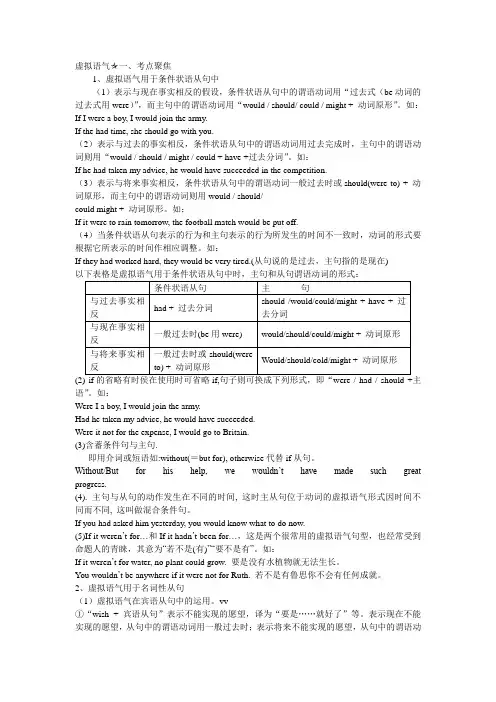
a. 与现在事实相反的假设 条件从句 主句 一般过去时(be用were) should(would)等 +动词原形 例如:If they were here, they would help you. 如果他们在这儿,会帮助你的。
含义:They are not here, they can’t help you. b. 与过去事实相反的假设 条件从句 主句 过去完成时 should(would)等+ have+ 过去分词 例如:If he had come yesterday, I should / would have told him about it.如果他昨天来的话,我会把这件事告诉他的。
含义:He did not come yesterday, so I did not tell him about it. c. 表示对将来不大可能发生的事情的假想 条件从句 主句 一般过去时 should/would等 + 动词原形 were+ 不定式 should+ 动词原形 例如:If you succeeded, everything would be all right. 如果你将来成功了,一切都会好的。
If you should succeed, everything would be all right. If you were to succeed, everything would be all right. 含义:You are not likely to succeed, everything will be what it is now.
3 混合条件句 有时,主句与从句的动作发生在不同的时间,主句从句谓语动词的虚拟语气形式因时间不同而不同,这种条件句叫做混合条件句。例如:
If you had asked him yesterday, you would know what to do now. 如果你昨天问过他,今天就知道做什么了。
(从句与过去事实相反,主句与现在事实相反。) If it had rained last night(过去), it would be very cold today (现在).如果昨晚下过雨,今天就会很冷了。 4 虚拟条件句的倒装 虚拟条件句的从句部分含有were, should, 或had时, 可省略if,再把were, should或had 移到从句的句首,实行倒装。例如:
Were they here now, they could help us. =If they were here now, they could help us.他们现在在的话,就会帮助我们了。
Had you come earlier, you would have met him. =If you had come earlier, you would have met him.你来得早一点,就碰到他了。
Should it rain, the crops would be saved. =Were it to rain, the crops would be saved.假如下雨,庄稼就有救了。
注意:在虚拟语气的从句中,动词'be'的过去时态一律用"were",不用was,即在从句中be用were代替。例如:
If I were you, I would go to look for him. 如果我是你,就会去找他。 If he were here, everything would be all right. 如果他在这儿,一切都会好的。
典型例题 _____ to do the work, I should do it some other day. A. If were I B. I were C. Were I D. Was I 答案C. 在虚拟条件状语中如果有were, should, had这三个词,通常将if省略,主语提前, 变成 were, should, had +主语的形式。但要注意,在虚拟条件状语从句中,省略连词的倒装形式的句首不能用动词的缩略形式。如我们可说 Were I not to do, 而不能说 Weren't I to do。
5 特殊的虚拟语气词should 1)在主语从句中的应用 It is demanded / necessary / a pity + that…等结构的主语从句,谓语动词用should 加动词原形,should 可省略。
It is 可用的词有三类 that (should)do suggested, ordered, required, proposed, demanded, requested, insisted等
important, necessary, natural, imperative, strange等 a pity, a shame, no wonder等 2)在宾语从句中的应用 在表示命令、建议、要求等一类动词后面的从句中,像order, suggest, propose, require, demand, request, insist, command, insist + (should) do等。例如:
I suggest that we (should) hold a meeting next week. 我建议下周召开个会议。
He insisted that he (should ) be sent there.他要求被派到那儿去。 注意:如suggest, insist不表示"建议" 或"坚持要某人做某事时",即它们用于其本意"暗示、表明"、"坚持认为"时,宾语从句用陈述语气。
判断改错: (错) You pale face suggests that you(should)be ill. (对) Your pale face suggests that you are ill. (错) I insisted that you(should)be wrong. (对) I insisted that you were wrong. 3)在表语从句,同位语从句中的应用 suggestion, proposal, idea, plan, order, advice等名词后面的表语从句、同位语从句中要用虚拟语气,即(should)+动词原形。例如:
My idea is that we(should)get more people to attend the conference.我的想法是让更多的人来参加会议。
I make a proposal that we(should)hold a meeting next week.我提了个建议,下周我们开个会。
6 wish的用法 1)wish后面的从句,表示与事实相反的情况,或表示将来不太可能实现的愿望。其宾语从句的动词形式为:
主句 从句 从句动作先于主句动词动作(be的过去式为 were) 现在时 过去时 从句动作与主句动作同时发生(had + 过去分词) 过去时 过去完成时 将来不大可能实现的愿望 将来时 would/could +动词原形 例如:I wish I were as tall as you. 我希望和你一样高。 He wished he hadn't said that. 他希望他没讲过那样的话。 I wish it would rain tomorrow. 我希望明天下雨就好了。 2)wish to do;wish sb / sth to do。例如: I wish to see the manager. = I want to see the manager. 我希望见一见经理。
I wish the manager to be informed at once. (= I want the manager to be informed at once.)我希望经理能马上得到消息。
7 比较if only与only if only if表示"只有";if only则表示"如果……就好了"。If only也可用于陈述语气。例如:
I wake up only if the alarm clock rings. 只有闹钟响了,我才会醒。 If only the alarm clock had rung. 当时闹钟响就好了。 If only he comes early. 但愿他早点回来。 8 It is (high) time that It is (high) time that 后面的从句谓语动词要用过去式或用should加动词原形,但should不可省略。例如:
It is time that the children went to bed. 孩子们该睡觉了。 It is high time that the children should go to bed. 9 need "不必做"和"本不必做" didn't need to do表示过去不必做某事, 事实上也没做。 needn't have done表示过去不必做某事, 但事实上做了。例如: John went to the station with the car to meet Mary, so she didn't need to walk back home.