压力与流量的计算公式
- 格式:docx
- 大小:36.53 KB
- 文档页数:1
压力与流量的计算公式
Calculation Formula for Pressure and Flow Rate
Pressure and flow rate are two important parameters in fluid mechanics. The pressure of a fluid refers
to the force applied by the fluid on a unit area, while the flow rate represents the amount of fluid
passing through a certain point in a given time.
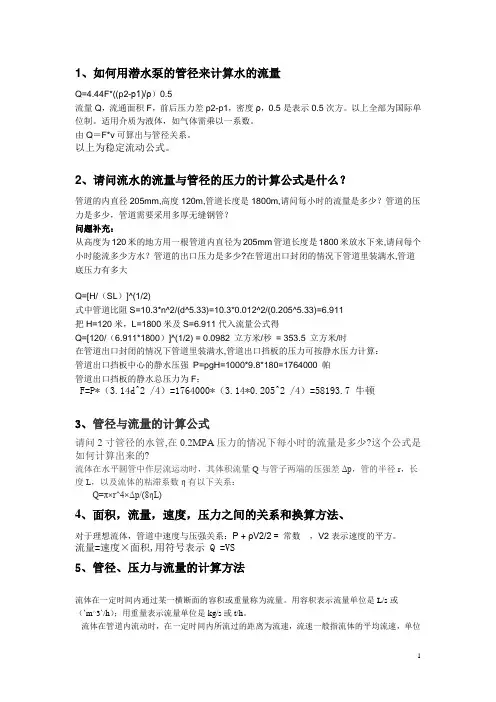
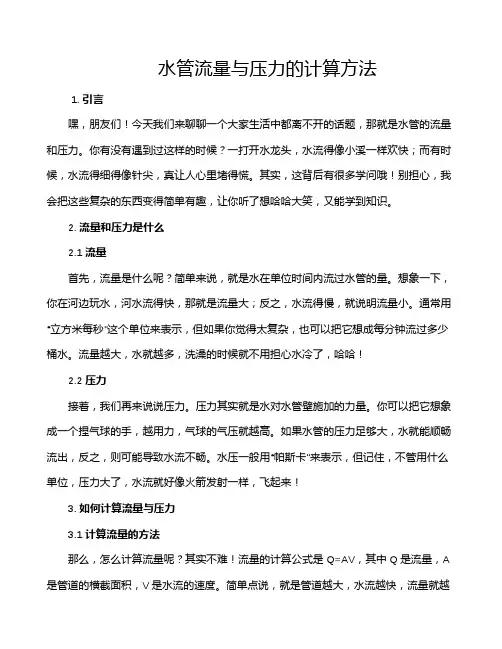
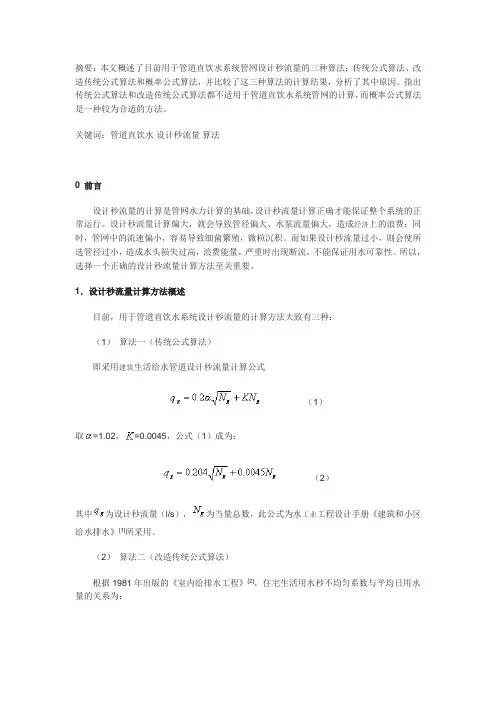
In general, the calculation formula for pressure can be expressed as:
P = F / A
where P is the pressure, F is the force exerted by the fluid, and A is the area on which the force is
applied. This formula indicates that pressure is directly proportional to force and inversely
proportional to area.
The flow rate can be calculated using the formula:
Q = A * v
where Q is the flow rate, A is the cross-sectional area through which the fluid flows, and v is the
velocity of the fluid. This formula implies that the flow rate is equal to the product of the area and the
velocity.
It is important to note that these formulas are applicable to ideal conditions and assume a constant and
steady flow. Real-world scenarios may involve additional factors like viscosity, turbulence, and
friction, which can affect the accuracy of the calculations.
In conclusion, understanding the calculation formulas for pressure and flow rate is crucial in various
fields such as engineering, fluid dynamics, and hydraulic systems. These formulas provide a
foundation for analyzing and designing fluid systems, helping to ensure efficient and safe operations.