
人教八年级上Unit 5 Can you come to my party
- 格式:ppt
- 大小:1.71 MB
- 文档页数:44


新修订初中阶段原创精品配套教材Can you come to my party教案教材定制 / 提高课堂效率 /内容可修改Can you come to my party教师:风老师风顺第二中学编订:FoonShion教育Can you come to my party教案unit 5 can you come to my party?teaching aims:1.learn how to make, accept, decline invitation.2.talk about obligations with “have to”3.talk about the schedule.sentence structure1.can you come to my party?sure, i’d love to.\ i’d like to.sorry, i can’t. i have to2.what’s the day?what day is it today?what’s the date today?vocabularycan, have to, have a piano lesson, help, invite, another, weekend, too much, join, the day after tomorrow, the day before yesterday, play tennis, on friday evening, go to the mall, this evening, really, busy, study for the test, whole & all, come overproceduresperiod 1step 1 lead in1.can you help me?hello, everyone! yesterday i received an invitation letter from my dear friend; she invites me to go to her halloween party. but i have something important to do. i’m studying for a test. i don’t know what to do. what should i say? can you help me?2.repeat the words above in chinese. tell them my obligations in chinese so that the students can use target phrase “have to”.昨天,我收到了一封我同学寄来的邀请函,她请我参加她的万圣节聚会,但是我有些重要事情要做,我不得不为考试学习,我不知道该怎么跟她说?如果你们是我,你们会怎么回答呢?3.ask one student to answer my question.“julia, can you come to my party?”4.introduce the topic of this unit.step 2 1a~1c1.tell students to look at the book and find talk about the obligations. (section a, 1a) look at the pictures and learn the phrases.have a piano lesson上一节钢琴课lesson与classgive sb. a lesson上课,teach sb. a lesson教训help my parents 与help sb. with something2.1b listen and check the answers.3.learn some language points while listeningon the saturday afternoon, how about…, next time4.groupwork. divide the students into groups of four and make conversations. ask one group to act it out.step31.listen to the tape and finish 2a, 2b2.pairwork. read the passage and learn the language pointstoo much, this weekend, another time, thank forstep4 grammar (3 minutes)1.can you…?情态动词can在这里起征求对方意见的作用。

Unit 5 Can you come to my party?I. Analysis of the Teaching Material1.Status and FunctionThe topic of this unit is about invitation. It teaches the students how to give or receive an invitation. It’s close to the everyday life. So we’d better raise the students learning interest first.2.Teaching aids and demands(1)Knowledge ObjectsStudents must learn to make invitation. They must learn to say yes and say no to aninvitation and give their reasons.(2)Ability ObjectsTo improve the students’ ability of listening, speaking, reading, writing.(3)Moral ObjectsWe teach this lesson in order to learn how to accept or refuse an invitation of foreigncountries politely. It will teach the students good manners. If he or she holds a partyat home, He or she will feel happy when they can do something for others.(4)Teaching Key PointsThe key vocabulary and the key phrases of this unit(5)Teaching DifficultiesUsing the target language to improve the abilities of the studentsII. Target languageCan you come to birthday party?Yes, I’d love to.Sorry, I can’t. I have to look after my mother.When is the party?It’s at six on Monday.III. VocabularyTomorrow, weekday, invitation, match, whole, whom, another, concert, pity, free, American,Chemistry, training…IV. Learning StrategiesInductingCooperatingV. Teaching procedures.It includes five periods. (5个课时)The First PeriodI. Teaching Aims and DemandsKey vocabulary and phrasesTarget languageTo improve the students ability of Listening and speakingII. Teaching Key Points(1) Key PhrasesStudy for a test, have a piano lesson, go to the doctor, visit my aunt (2) Target language_ Can you come to my party on Sunday?_ Sure, I’d love to._ Can you come to my party on Sunday?_ Sorry, I have too much homework this weekend.I have to help my mum.I have to go to the doctor.III. Teaching DifficultiesUsing the target language to practice the oral English in pairsIV. Teaching MethodsCommunicative methodsPairworkV. Teaching Aids多媒体VI. Teaching ProceduresStep 1Before the class, let the students listen to the music, this can guide to the new lesson. Afterthis, ask thestudents to watch the movie, this can guide to the target language.Step 2 (1a)Learn the phrases and do the exercise in 1a.The answer is: b, d, a, c, eStep 3 (1b and 1c )First let the students read the dialogue in the picture. Then listen to it. (This activity provides guided oral practice using the target language). After the listening practice, ask the student to practice some invitations and refusals.Step 6 (Blackboard design)Unit 5How about…? politeWhat about…? impolite The second periodI Teaching aims and demands1. Knowledge ObjectsKey vocabularyTarget languageGrammar focus2. Ability Objects_ ListeningII. Teaching key points1. key vocabularyhey, baseball game, too much homework2. Target languageA: Hey, Dave! Can you come to the movies on Saturday? B: I’m sorry, I can’tI have too much homework.I have to help my mum.I have to go to my guitar lesson.I have to visit my aunt.III Teaching difficultiesGrammar focusIV Teaching methodsListening and speaking methods.Communicative approachPairwork.VI Teaching procedureStep IGreet the class and check the homeworkStep II (2a)First, make the preparation for listening. Read the sentences twice to the class. The first time you can read “can”, the second time you can read “can”. Then let the students listen .The answers for activity 2a are : 1. can’t , 2.can 3. can’t 4. can’t 5.canStep III (2b)Ask a student to read the sentences in the box.. Tell the students these are the reason why people can’t go to the party. Listen to the recording again and number the reasons 1~3 why they can’t go to the party .The answers are : a . 2 d . 3 e . 1Step IV (2c)This is an oral practice about the target the language . You can ask the student if they can give other reasons besides the ones in 2a . If they can, make a dialogue in pair . ( First , ask two who can do it well to make a model dialogue , then let them do it in pairs .Step V . ( Grammar focus)First , let the students read the sentences in the grammar box . Then write “ have to , has to ” on the blackboard , and tell them they are used to say no to an invitatio n . And then write “ be going to do something ” on the blackboard , tell the students we can say no to an invitation by talking about the future plan . After that , let them do exercises in order to master to the grammar .Step V. Blackboard designUnit 51. have to /has to + verbThey have to go to the acting lesson on Sunday.Lucy has to help her mom with the housework.Do they have to go to the acting lesson on Sunday.Yes, they do. / No, they don’t.Does Lucy have to help her mom with the housework?Yes, she does. / No, she doesn’t.2. Can you come to…? Sure, I’d love to. / Sorry, I can’t. I haveto…Can she come to…? No, she can’t. She has to…Step VI . HomeworkPlease write as many reasons as you can to refuse an invitationThe Third PeriodI Teaching aims and demands1. Vocabulary and phrases Oral practice2. Ability objectsReading, writing, communicative competenceII. Teaching key PointsReview vocabulary items and grammar focusIII. Teaching difficultyOral practice using the target languageI. Teaching methodsReading, writing methods and communicative approachV. Teaching proceduresA computerVI. Teaching proceduresStep IGreet the class and let a student to make a duty report. And then check the homeworkStep II (3a writing)Show the invitation in 3a to the students. Ask the students to fill in the blanks according to the information of the invitation.The answers are: can, party, when, on Friday, June 30 4:30Step III (oral practice)Practice the dialogue in 3a in pairs and then let some of the act the dialogue.Step IV (writing)Let the students fill in the card with details of an event. Then call your friends and invite them to the event.Step V Invite a friend (oral practice)Tell the students how to do the activity: Student A, you are Eliza. Look at page 82. Eliza , invite Lu Qing to go to the mall . Look at the calendar for this week and find a time when you can both go there.Use the dialogue in the box to start the activity , and then ask more questions to learn when both people aren’t busy . Help students to start the work, give them a hand if needed.The answers: Lu Qing and Eliza are both free on Wednesday afternoon , Friday afternoon , Saturday and SundayStep VI. SummaryToday we have learnt how to write an invitation and done a lot of practice.Step VII HomeworkGive your best friend an invitation to an event.The student who receives it must give a reply.Step III . Blackboard designUnit 51. Lu Qing and Eliza are both Free on :2. have fun /have a great timeWednesday afternoon 3. join/take part inFriday afternoon 4. have a piano lessonSaturday have a swimSunday have a lookThe Fourth Period I. Teaching aims and demands.Target languageOral practiceII. Ability objects.Listening skillSpeaking skillCommunicative competenceIII. Teaching key points1.Key vocabulary.Sunday, Monday, Tuesday, Wednesday, Thursday, Friday, Saturday Yesterday, today, tomorrow, the day after tomorrow2.Target language.What’s today?It’s Monday the 14th.Can you play tennis with me?When?Today.Sorry, I can’t.IV. Teaching difficulties.The target languageV. Teaching methods.Listening and speaking methods.VI. Teaching aids.A calendarA computerVII. Teaching procedure.Step 1Greet the class and check the homework.Step 2 (Section B 1a)Show the students a calendar, and ask a student to point out today’s date. Point to the number which shows the dates, and ask the students to copy them into the calendar in their book.Read the dates and let the students read after you.Step III (1b)1.Show the words on the screen:Yesterday, today, tomorrow, the day after tomorrow, weekday2.Let the students write the words below the correct days on the calendar in 1a.Step IV (1c)First ask two students to read the dialogue in the box. Then let them practice it in pairs by using the calendar in 1a.Step IX Blackboard designThe Fifth period I. Teaching aims and demands.1. Knowledge objectsE-mail messageWriting practiceReading practice2Ability objectsReading and writing skillCommunicative competenceII. Teaching key pointsReading passage主语+verb+-ing I have to…III. Teaching difficultiesReading and wring practice.IV. Teaching methodsReading and writing methods and communicative approach.V. Teaching aidsA calendarVI. Teaching proceduresStep 1Greet the class, do the duty report.Step 2 (3a )First, read the e-mail message to the students. Ask the students if they have any questions.If they do, answer them. Then let the students fill in the calendar on the book. After this, explain the key language points to them.Language points:1. Thank you for… (为……表示感谢)Thank you for helping me.Thank you for your invitation.2On ( 在某天,在某天的上午、下午或晚上)I’m going to the dentist on Sunday.Unit 5Sunday, Monday, Tuesday, Wednesday, Thursday, Friday, Saturday The____ the_____ the_____ the______ the_____ the____ the_____ Yesterday, today, tomorrow, the day after tomorrowOn Friday afternoon, I often play soccer.The answers to the calendar are:SundayMonday Cousin’s birthday partyTuesday Go to the dentistWednesdayThursday Tennis trainingFriday Study for the chemistry testSaturday Go to the moviesStep 3 (3b)First, tell the students when we talk about our future plans, we often use: I’m+verb+ing When we talk about what we must do, we use have to.Ask the students to fill in the blanks in 3b.The answers are: shopping, go to see, a test, I’m going, my family.Step 4 (3c)Let the students write an e-mail message to a friend. Say why you can’t visit next.Before the exercise, ask the students to give some possible answers and write them on the blackboard. So the students will feel easy to finish the writing exercise. After they finish it, Let them to correct it in groups first. Each group chooses theirs best one to read in front of the whole class.Step 5 ( planning a party )First read the conversation in the box together. Then ask the students to turn to page 88. Write down everything you have to do next week. Write in all the things you have to do .Ask the students to look at the list. Ask them “What day are you free?” This is when you can have your party.Step 6 (Self check 1 )Let the students to fill in the blanks with the words given. Change the forms of the words if possible. Then make their own sentences. The answers are: visit, playing, have to, study, comeStep 7 (Self check 2)Imagine you are Marie. Read the information and look at your schedule. Write replies to the invitation.VII. Summary and homeworkToday we have learnt how to write a e-mail to a friend. You can write another one to your frien after class.Step 8 Blackboard designUnit 51. Thanks for…2. on Sunday at 4:00Thanks for helping me. I’m going to the dentist on Sunday.Thanks for your invitation. I often get up at 4:00.。
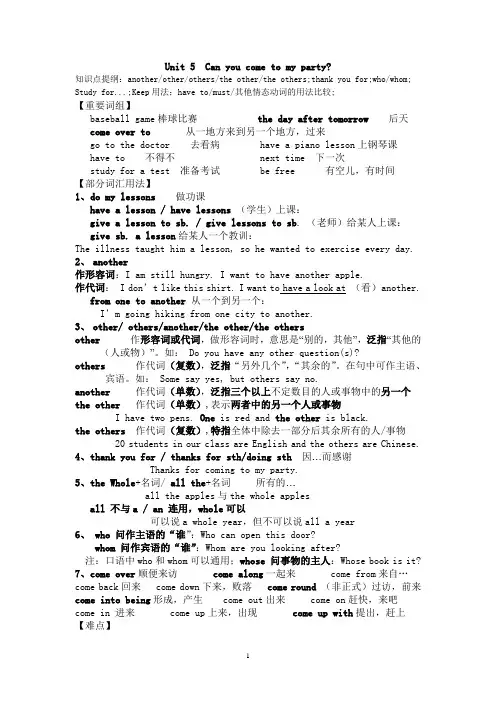
Unit 5 Can you come to my party?知识点提纲:another/other/others/the other/the others;thank you for;who/whom; Study for...;Keep用法;have to/must/其他情态动词的用法比较;【重要词组】baseball game棒球比赛the day after tomorrow 后天come over to 从一地方来到另一个地方,过来go to the doctor 去看病 have a piano lesson上钢琴课have to 不得不 next time 下一次study for a test 准备考试 be free 有空儿,有时间【部分词汇用法】1、do my lessons做功课have a lesson / have lessons (学生)上课:give a lesson to sb. / give lessons to sb. (老师)给某人上课:give sb. a lesson给某人一个教训:The illness taught him a lesson, so he wanted to exercise every day.2、another作形容词:I am still hungry. I want to have another apple.作代词: I don’t like this shirt. I want to have a look at (看)another. from one to another 从一个到另一个:I’m going hiking from one city to another.3、other/ others/another/the other/the othersother 作形容词或代词,做形容词时,意思是“别的,其他”,泛指“其他的(人或物)”。
