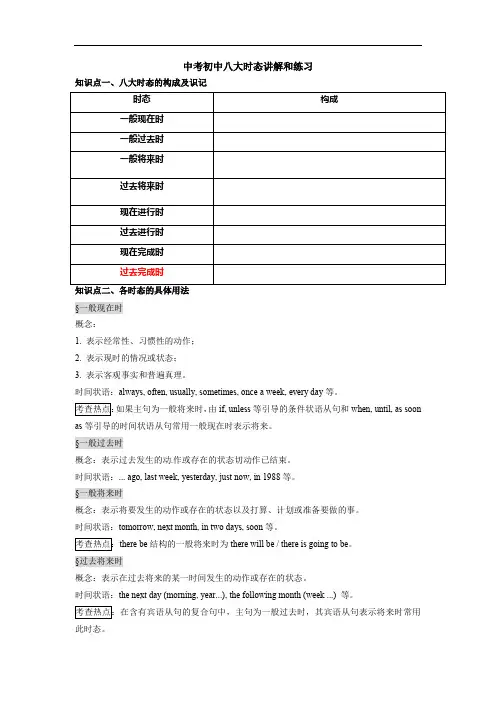
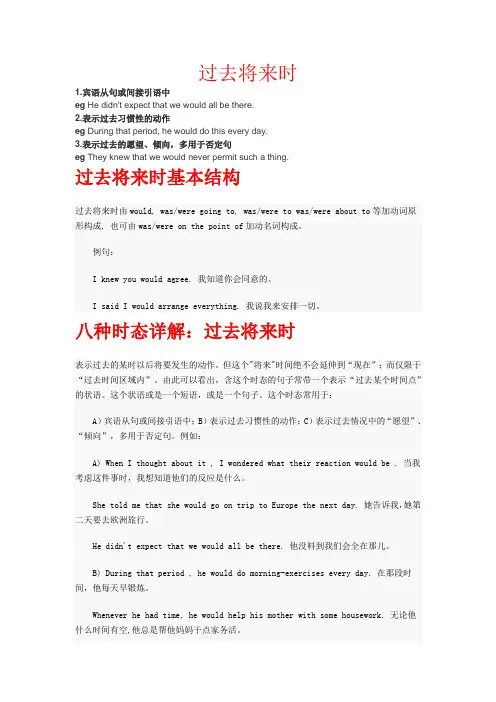
初中英语八大时态讲解及练习(全)
- 格式:docx
- 大小:39.40 KB
- 文档页数:37
1 / 37
一、一般现在时:
概念:经常、反复发生的动作或行为及现在的某种状况。
时间状语:always, usually, often, sometimes, every week (day, year, month…),
once a week, on Sundays, etc.
基本结构:①be动词;
②行为动词
否定形式:①am/is/are+not;
②此时态的谓语动词若为行为动词,则在其前加don't,如主语为第三人称单数,则用doesn't,同时还原行为动词。
一般疑问句:
①把be动词放于句首;
②用助动词do提问,如主语为第三人称单数,则用does,同时,还原行为动词。
在中,当主语是时,谓语动词要用形式,即常在后加-s或-es。
一、he, she, it是第三人称单数。如:
He likes watching TV. 他喜欢看电视。
She has lunch at twelve. 她十二点吃午餐。
It looks like a cat. 它看起来像只猫。(口诀:I用am,you用are,is用于它,单数名词用is,都用are)
二、单个人名、地名或称呼作主语;是第三人称单数。如:
①Han Mei looks like her mother. 看起来像她的母亲。
②Beijing is in China. 北京在中国。
2 / 37
③Uncle Wang often makes cakes. 王叔叔经常做蛋糕。
三、单数可数名词或"this / that / the+单数可数名词"作主语时,是第三人称单数。如:
①A horse is a useful animal. 马是有用的动物。
②This book is yours. 这本书是你的。
四、someone, somebody, nobody, everything, something等及指示代词this,
that作主语时,是第三人称单数。如:
①Everyone is here. 大家到齐了。
②There is something wrong with the watch. 这块手表有毛病。
五、作主语时为第三人称单数。如:
①The milk is in the glass. 牛奶在里。
②The bread is very small. 那面包很小。
六、当数字或字母作主语时,看作第三人称单数。如:
①"6" is a lucky number. "6"是个吉利数字。
【练习】
二、一般过去时:
概念:过去某个时间里发生的动作或状态;过去习惯性、经常性的动作、行为。
时间状语:ago, yesterday, the day before yesterday, last week(year, night,
month…), in 1989, just now, at the age of 5, one day, long long ago, once upon a
time, etc.
一般过去时的结构(可分三类不同的结构)
3 / 37
1.Be动词的一般过去时 在没有实义动词的句子中使用be动词, am is 的过去式为was; are的过去式为were
肯定句式:主语 + be(was , were) + 其它.
否定句式:主语 + be(was , were) + not + 其它.
一般疑问句:Be(was , were) + 主语 + 其它?
注:在这种构成中,be动词有人称和数的变化,即要根据主语选用was /
were。Be动词分为单数和复数,was是表示单数,were是表示复数。
2.实义动词的一般过去时态 肯定句要使用动词的过去式,否定句和疑问句要使用助动词do和 does 的过去式 did.
肯定句式:主语 + 动词(过去式)+ 其它
否定句式:主语 + didn’t + 动词(原形)+ 其它 【did not = didn’t】
一般疑问句:Did + 主语+ 动词(原形)+ 其它【do , does的过去时均为did】?
注:1. did和didn’t是构成一般过去时的助动词,其特点是要在其后跟动词的原形。
2. 实意动词do的一般过去时
I do my homework every day.(用yesterday改写句子)
I did my homework yesterday.
I didn’t do my homework yesterday.(否定句)
Did you do your homework yesterday?Yes ,I did. /No, I didn’t.(一般疑问句)
3. 情态动词的一般过去时态 含有情态动词的一般过去时与含有Be动词的一般过去时,是十分相似,请注意观察。
4 / 37
肯定句式:主语 + 情态动词 + 其它
否定句式:主语 + 情态动词 + not + 其它.
一般疑问句:情态动词 + 主语 + 其它?
注:情态动词的过去式:can→could , may→might , must→must ,will-would,should-should。
4.特殊疑问句式: 特殊疑问词+be过去式+主语+其他?
特殊疑问词+情态助动词过去式+主语+动词原形+其他?
特殊疑问词+do/does过去式+主语+动词原形+其他?
What was your former name? 你以前叫什么名字?
Why was he late for school last Monday? 上星期一他为什么迟到?
What could she do twenty years ago? 20年前她能做什么?
规则动词的过去式
1.一般情况下,在动词原形后面加-ed。 look→looked play→played
start→started visit→visited pull-pulled, cook-cooked
2.以不发音e结尾的动词,在词尾直接加-d。 live→lived use→used
taste-tasted
3.以“辅音字母+ y”结尾的动词,先将 y 改为i ,再加 –ed。 study→studied
try→tried fly→flied
4.以重读闭音节(即辅音+元音+辅音)或r音节结尾,末尾只有一个辅音字母的动词,要先双写这个辅音字母后,再加 –ed。 stop→stopped
plan→planned stop-stopped prefer→preferred
基本用法
① 表示过去某个特定时间发生的动作或存在的状态。
5 / 37
He suddenly fell ill last night. 他昨晚突然病倒了。
②表示过去的习惯性或经常发生的动作
She went to the cinema once a month when she was at alked by the riverside.
我在乡下时经常在河边散步。
③叙述过去连续发生的一件件事
She got up early, fetched water, cleaned the room and then went out for a walk.
她早早起床,提水,打扫房间然后出去散步。
【练习】
一、请用正确动词形式填空
1. He (live) in Wuxi two years ago.
2. The cat (eat) a bird last night.
3. We (have) a party last Halloween.
4. Nancy (pick) up oranges on the farm last week.
5. I (make) a model ship with Mike yesterday.
6. They (play) chess in the classroom last PE lesson.
7. My mother (cook) a nice food last Spring Festival.
8. The girls (dance) at the party last night.
9. I (watch) a cartoon on Saturday last week.
10. ______ you _______ (visit) your relatives last Spring Festival?
11. ______ he _______ (fly) a kite on Sunday? Yes, he ______.
12. Gao Shan _______ (put) up the picture last night.
13. I ____________ (sweep) the floor yesterday.
6 / 37
14. What ______ she _______ (find) in the garden last morning?
15. Her father _______ (read) a newspaper last night.
16. Mike _________________(not go) to bed until 12 o’clock last night.
17. I listened but ___________ (hear) nothing.
18. How many people ________ (be) there in your class last term?
二、按要求变换句型。
1. Frank read an interesting book about history. (一般疑问句)
_______ Frank _______ an interesting book about history?
2. He cleaned his roomjust now.. (划线提问) What________ he _______?
3. Thomas spent RMB 10 on this book. (否定句)
Thomas _______ _______ RMB 10 on this book.
4. My family went to the beach last week. (划线提问)
________ ________ ________ family _______ last week?
1. I _________ (have) an exciting party last weekend.
2. _________ she _________(practice) her guitar yesterday? No, she