2014江苏高考英语阅读理解高分密码 2
- 格式:doc
- 大小:160.00 KB
- 文档页数:23
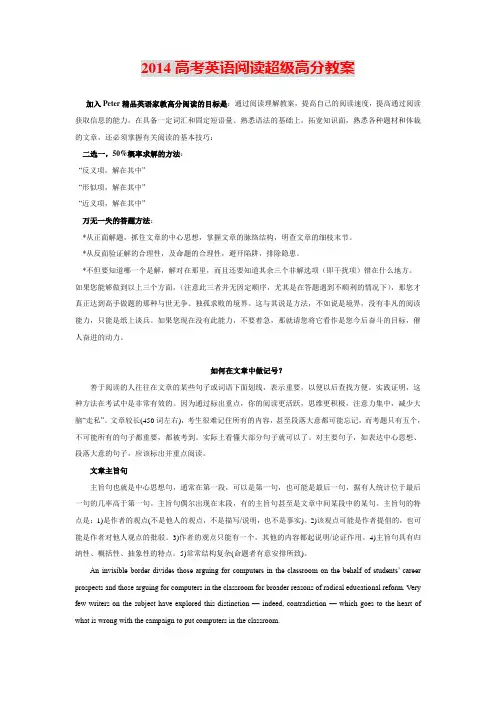
2014高考英语阅读超级高分教案加入Peter精品英语家教高分阅读的目标是:通过阅读理解教案,提高自己的阅读速度,提高通过阅读获取信息的能力。
在具备一定词汇和固定短语量、熟悉语法的基础上,拓宽知识面,熟悉各种题材和体裁的文章,还必须掌握有关阅读的基本技巧:二选一,50%概率求解的方法:“反义项,解在其中”“形似项,解在其中”“近义项,解在其中”万无一失的答题方法:*从正面解题,抓住文章的中心思想,掌握文章的脉络结构,明查文章的细枝末节。
*从反面验证解的合理性,及命题的合理性,避开陷阱,排除隐患。
*不但要知道哪一个是解,解对在那里,而且还要知道其余三个非解选项(即干扰项)错在什么地方。
如何在文章中做记号?善于阅读的人往往在文章的某些句子或词语下面划线,表示重要,以便以后查找方便。
实践证明,这种方法在考试中是非常有效的。
因为通过标出重点,你的阅读更活跃,思维更积极,注意力集中,减少大脑“走私”。
文章较长(450词左右),考生很难记住所有的内容,甚至段落大意都可能忘记,而考题只有五个,不可能所有的句子都重要,都被考到。
实际上看懂大部分句子就可以了。
对主要句子,如表达中心思想、段落大意的句子,应该标出并重点阅读。
文章主旨句主旨句也就是中心思想句,通常在第一段,可以是第一句,也可能是最后一句,据有人统计位于最后一句的几率高于第一句。
主旨句偶尔出现在末段,有的主旨句甚至是文章中间某段中的某句。
主旨句的特点是:1)是作者的观点(不是他人的观点,不是描写/说明,也不是事实)。
2)该观点可能是作者提倡的,也可能是作者对他人观点的批驳。
3)作者的观点只能有一个,其他的内容都起说明/论证作用。
4)主旨句具有归纳性、概括性、抽象性的特点。
5)常常结构复杂(命题者有意安排所致)。
An invisible border divides those arguing for computers in the classroom on the behalf of students‟ career prospects and those arguing for computers in the classroom for broader reasons of radical educational reform. Very few writers on the subject have explored this distinction — indeed, contradiction — which goes to the heart ofwhat is wrong with the campaign to put computers in the classroom.①是说明句,交代背景“计算机走进课堂的支持者有两派,这两派之间的界限是无形的。
”②是主旨句,说明主题——两派之间的这种差异说明“计算机走进课堂的运动”本质上是错误的。
Few creations of big technology capture the imagination like giant dams. Perhaps it is humankind‟s long suffering at the mercy of flood and drought that makes the ideal of forcing the waters to do our bidding so fascinating. But to be fascinated is also, sometimes, to be blind. Several giant dam projects threaten to do more harm than good.①引出话题“巨型水坝”。
②解释修水坝的原因。
③转折。
④是主旨句“一些巨型水坝弊大于利。
”Exceptional children are different in some significant way from others of the same age. For these children to develop to their full adult potential, their education must be adapted to those differences.①引出话题“超常儿童”。
②是主旨句“为了充分发展超常儿童的潜力,对他们的教育必须适应他们的特点”。
Money spent on advertising is money spent as well as any I know of . It serves directly to assist a rapid distribution of goods at reasonable price, thereby establishing a firm home market and so making it possible to provide for export at competitive prices. By drawing attention to new ideas it helps enormously to raise standards of living. By helping to increase demand it ensures an increased need for labour, and is therefore an effective way to fight unemployment. It lowers the costs of many services: without advertisements your daily newspaper would cost four times as much, the price of your television licence would need to be doubled, and travel by bus or tube would cost 20 per cent more.And perhaps most important of all, advertising provides a guarantee of reasonable value in the products and services you buy. Apart from the fact that twenty-seven acts of Parliament govern the terms of advertising, no regular advertiser dare promote a product that fails to live up to the promise of his advertisements. He might fool some people for a little while through misleading advertising. He will not do so for long, for mercifully the public has the good sense not to buy the inferior article more than once. If you see an article consistently advertised, it is the surest proof I know that the article does what is claimed for it claimed for it ,and that it represents good value.Advertising does more for the material benefit of the community than any other force I can think of.There is one more point feel I ought to touch on. Recently I heard a well-known television personality declare that he was against advertising because it persuades rather than informs. He was drawing excessively fine distinctions. Of course advertising seeks to persuade.If its message were confined merely to information —and that in itself would be difficult if not impossible to achieve, for even a detail such as the choice of the colour of a shirt is subtly persuasive — advertising would be so boring that no one would pay any attention. But perhaps that is what the well-known television personality wants.文章话题是广告。
这篇文章主旨句显然不在第一段,而是在第三段。
该段是前两段的内容的总结:广告是带来前所未有的物质上的好处的力量。
后两段(4、5段)话题为与他人争辩广告的劝说作用,认为广告就是要劝另人购买。
段落主题句(TOPIC SENTENCE)除了标出篇章的主旨句外,标出各段的主题句同样重要。
每一段都有一个段的中心句,也有人叫它段落大意句、段中心思想句等等。
主题句是考试重点,很多题目都是围绕着段中心设计的。
确定主题句不仅有利于确定文章主旨,还有利读懂细节题,因此主题句的确定是阅读的关键。
主题句的特点:1)通常是第一句话,偶尔是最后一句,段中少见。
2)是观点(不是描写/说明、不是事实)。
可能是作者的观点,也可能是他人的观点。
3)该观点可能是作者提倡的,也可能是作者认为其他人的观点是错误的/偏激的等等。
4)作者的观点只能有一个。
主题句只能有一个,其他的内容都起说明/论证作用。
5)具有归纳性、概括性、抽象性等特点。
You can begin to think of yourself as truly intelligent on the basis of how you choose to feel in the face of trying circumstances. The life struggles are pretty much the same for each of us. Everyone who is involved with other human beings in any social context has similar difficulties. Disagreements, conflicts and compromises are a part of what it means to be human. Similarly, money, growing old ,sickness, deaths, natural disasters and accidents are all events which present problems to virtually all human beings. But some people are able to make it , to avoid immobilizing depression and unhappiness despite such occurrences, while others collapse or havean N.B.D. Those who recognize problems as a human condition and don‟t measure happiness by an absence of problems are the most intelligent kind of humans we know; also,the most rare.1. In the paragraph, the author tells us that[A] dif ficulties are part of everyone‟s life.[B]depression and unhappiness are unavoidable in life.[C] everybody should learn to avoid trying circumstances.[D] good feelings can contribute to eventual academic excellence.2. According to the passage, what kind of people are rare?[A] Those who don‟t emphasize bookish excellence in their pursuit of happiness.[B]Those who are aware of difficulties in life but know how to avoid unhappiness.[C] Those who measure happiness by an absence of problems but seldom suffer from N.B.D.‟S.[D] Those who are able to secure happiness though having to struggle against trying circumstances.分析:①为主题句“知道如何面对逆境才是真正的聪明人。