B1U3travel journal
- 格式:ppt
- 大小:290.50 KB
- 文档页数:13


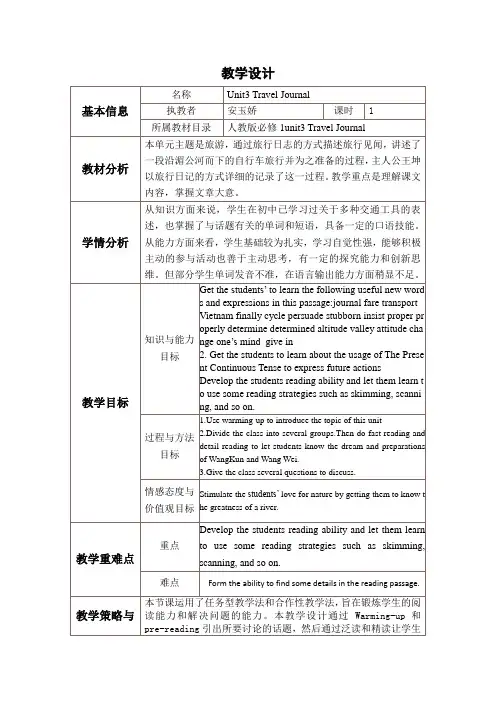
Book 1 Unit 3 Travel JournalJOURNEY DOWN THE MEKONGPART 1 THE DREAM AND THE PLANMy name is Wang Kun. Ever since middle school, my sister Wang Wei and I have dream ed about taking a great bike trip. Two years ago she bought an expensive mountain bike and then she persuad ed me to buy one. Last year, she visited our cousins, Dao Wei and Yu Hang at their college in Kunming. They are Dai and grew up in western Yunnan Province near the Lancang River, the Chinese part of the river that is call ed the Mekong River in other countries. Wang Wei soon got them interested in cycling too. After graduating from college.we finally got the chance to take a bike trip.I asked my sister, "Where are we going?" It was my sister who first had the idea to cycle along the entire Mekong River from where it begins to where it ends. Now she is plan ning our schedule for the trip.I am fond of my sister but she has one serious shortcoming. She can be really stubborn. Although she didn’t know the best way of getting to places, she insist ed that she organize the trip properly. Now, I know that the proper way is always her way. I kept asking her, “When are we leaving and when are we coming back?” I asked her whether she had looked at a map yet. Of course, she hadn’t; my sister doesn’t care about detail s. So I told her that the source of the Mekong is in Qinghai Province. She gave me a determined look — the kind that said she would not change her mind. When I told her that our journey would begin at an altitude of more than 5,000 metres, she seemed to be excited about it. When I told her the air would be hard to breathe and it would be very cold, she said it would be an interesting experience. I know my sister well. Once she has made up her mind, nothing can change it. Finally, I had to give in.Several months before our trip, Wang Wei and I went to the library. We found a large atlas with good maps that showed detail s of world geography. From the atlas we could see that the Mekong River begins in a glacier on a Tibetan mountain. At first the river is small and the water is clear and cold. Then it begins to move quickly. It becomes rapids as it pass es through deep valley s, travel ling across western Yunnan Province. Sometimes the river becomes a waterfall and enter s wide valleys. We were both surprised to learn that half of the river is in China. After it leave s China and the high altitude, the Mekong becomes wide,brown and warm. As it enters Southeast Asia, its pace slows. It makes wide bend s or meanders through low valleys to the plains where rice grows. At last, the river delta enters the South China Sea.PART 2 A NIGHT IN THE MOUNTAINSAlthough it was autumn, the snow was already beginning to fall in Tibet. Our legs were so heavy and cold that they felt like block s of ice. Have you ever seen snowmen ride bicycles? That’s what we looked like! Along the way children dressed in long wool coats stop ped to look at us. In the late afternoon we found it was so cold that our water bottles froze. However, the lakes shone like glass in the setting sun and looked wonderful. Wang Wei rode in front of me as usual. She is very reliable and I knew I didn’t need to encourage her. To climb the mountains was hard work but as we looked around us, we were surprised by the view. We seemed to be able to see for mile s. At one point we were so high that we found ourselves cycling through clouds. Then we began going down the hills. It was great fun especially as it gradually became much warmer. In the valleys colourful butterflies flew around us and we saw many yaks and sheep eating green grass. At this point we had to change our caps, coats, gloves and trousers for T-shirts and shorts.In the early evening we always stop to make camp. We put up our tent and then we eat. After supper Wang Wei put her head down on her pillow and went to sleep but I stayed awake. At midnight the sky became clear er and the stars grew bright er. It was so quiet. There was almost no wind —only the flame s of our fire for company. As I lay beneath the stars I thought about how far we had already travelled.We will reach Dali in Yunnan Province soon, where our cousins Dao Wei and Yu Hang will join us. We can hardly wait to see them!。

B1U3 Travel Journal满分:120分得分:__________第一步:单词拼写(根据汉语提示,写出该单词的正确形式。
每小题1分,满分20分)1. He kept a __________ (日记) during his visit to Japan.2. Although the __________ (旅行) was a long and lonely one, I decided to push on.3. The extra money could be spent on improving public __________ (运输).4. Eventually, the driver turned off the main __________ (路线) and suddenly did a U-turn.5. The doctor quickly stopped the __________ (流动) of blood from the wound.6. __________ (毕业生) from our school are working all over the world.7. The election will be held two months ahead of __________ (时间表).8. He is too proud to see this __________ (缺点) of him. More attention should be paid to it.9. He is so __________ (固执的) a boy that he is unwilling to change anything.10. Read the text carefully again for more __________ (细节).11. Fish is a rich __________ (来源) of protein, which is good for your health.12. Everything was fine. The plane was flying at an __________ (高度) of 20000 feet.13. It is your __________ (态度), not your aptitude (才能) that will determine your altitude. Remember to keep positive and good things will happen.14. I set off for the __________ (峡谷) to fetch some water, with the wind sighing through.15. The weather __________ (预报) said there would be showers. Take an umbrella with you.16. The road was so slippery that she stepped back a few __________ (步调) and fell down.17. She is amazed that people still risk travelling without __________ (保险).18. You should make your __________ (观点) known to the public.19. The clever student put out the __________ (火苗) with a wet blanket.20. The doctor was operating on the patient __________ (在下面) the blinding lights.(以上习题,填了空格就是完整的句子,填,念,用。

高一英语Book1 Unit3 Travel Journal说课稿教学内容分析本单元的中心话题是“旅游”,可以说这是一个世界性的时尚话题,随着经济发展、社会进步、人们生活水平的提高,旅游作为现代人的一种生活方式,越来越被更多的人们所接受与喜爱。
文中涵盖了有关这一话题的许多内容,如:“人们在旅游中的交通方式”“旅游点的选择”,还有新兴的旅游方式----“探险旅游”、“生态旅游”等等。
而所有的语言知识和语言技能几乎都是围饶这一中心话题而设计的。
而在上这一单元时,正赶上“十一”长假到哪去的话题,学生应该比较感兴趣。
Warming-up 由三部分组成:第一部分通过图例可以看出人们旅游过程中发生的不文明行为;第二、三部分要求讨论有哪些交通方式。
主要目的在于激活学生已有的相关背景知识,引出话题,为后面几堂课的讨论做好热身准备,是本单元的总动员。
比如:第一部分的图例内容与eco-travel联系比较紧密,我就把它作为这一课(第六课时)的导入。
Listening提供了两部分听力资料。
前面为三则飞机起飞前的广播通知;后面是写在五张明信片上的旅游者的自叙。
目的在于通过输入语言,掌握一些旅游中会碰到的常用表达法。
Speaking 提供的是关于“时光机器”的资料,幻想人们可以借助于这一神奇的交通工具,在过去、未来的时间长河里随心所欲地畅游,文后设计了表格。
这是一个比较开放性的话题,学生可以展开想象,结合学过的历史、地理知识畅所欲言,能充分调动他们“说”的兴趣。
整个活动涉及了“听、说、写”多个技能,按要求完成一定的表格,使之“说”的时候更言之有物。
Reading 分为三部分:pre-reading, reading, post-reading. pre-reading提供了与阅读材料相关的三个问题,启发学生预测课文内容;reading 是一篇关于探险旅游的材料,其中介绍了hiking 与rafting,话题较新颖;post-reading设计了一些帮助学生检测对课文作浅层、深层理解的巩固练习。