
外研版英语(一起)三上Module 3《Unit 1 These ducks are very naughty》ppt课件2
- 格式:ppt
- 大小:2.48 MB
- 文档页数:9
外研版(一起)三年级英语下册教案
Module 10 Unit1 There are fifty children in my class.
一、教学目标与要求
1.知识与能力目标
(1)能用英语询问数量,并回答。
例如:How many children are there in my class?
There are fifty.
(2)提高对数字的熟练程度,做到当别人提问”How many ……?”的时候自己能够流利的回答出来。
2.情感态度目标
(1)学生通过学习了解中西方文化的差异。
(2)培养学生团结友爱的良好品质。
二、教学重点及难点
1.重点:
(1)句子 How many …? 的运用和回答
(2)对数字的灵活运用。
2.难点:are 与were 区别与运用。
三、课前准备
1.教具:单词卡片、 配套课件、PowerPoint课件、教学挂图
2.学具:课本、活动手册
四、教学过程
Step 1 Warm up
1. Sing two poems.学生一起说两首小诗,P5 和P21.
2. Greetings.
3. Free talk.
What's the weather like today?
What day is it today?
What's your favorite fruit? (校本教材内容,学生两人一组问答)
Step 2 Presentation and extension
1.T:We saw many fruits just now. now let's see the pictures: (PPt 展示水果图片)
Ask:how many apples are there?
Ss: There are 10 apples.
(PPt展示一张空白图片,自此引入对过去时的练习。)
T: How many apples were there?
外研版一起六年级英语下册教案
Unit 1 He is playing but then the telephone rings.
教材分析
语言功能:谈论或描述某人正在做某事的时候,同时又发生了什么事情。
语言结构:He’s playing but then the telephone rings.
教学目标:
a.语言知识目标:学习目标语句
He’s playing but then the telephone rings.
b.语言技能目标:能够听懂会说本模块句型,能运用英语描述一件事情发生时,经常发生什么事情。
c.情感态度目标:激发学生学习英语的兴趣及运用英语交流的热情,使学生在学习中建立自信,提高学生参与语言活动的积极性。
教学重、难点:
重点:He’s playing but then the telephone rings.,并能在实际情景中运用。
难点:现在进行时和一般现在时的区分和综合运用。
学生分析
学生在以往的学习中已经学习了现在进行时和一般现在时的用法,有了一定的基础,因此在本课的学习中,他们需要更多的活动来参与,来实践,来运用他们所学的语言。而且六年级的学生对生活中的事情有一定的体验,并且具备了一定的语言表达能力和想象能力,只要通过教师的及时引导,就能够地出不得将语言运用起来。
设计理念
在本课的设计中,以学生为主体,教师为主导,采用多种教学形式,并与信息技术相整合,设计贴近学生实际的教学活动,培养学生的综合语言运用能力。
教学准备
单词卡片、录音机、课件、挂图、照片
教学过程
Ⅰ. Warm-up (热身活动)
a. 做“I say, you do”的游戏,教师通过指令让学生做各种动作,同时复习动词短语和句型。
b. 教师用实物投影,展示几张学生正在做某件事情时的照片,让学生对照片进行描述。
课前的游戏,既调节情绪、活跃气氛,又使学生快速进入英语学习状态,并激活学生已有的知识,为进行新课教学做好铺垫。
外研版(一起)三年级英语下册教案
Module 3 Unit 1 Maybe we'll go to the zoo.
教学目标
一、语言知识目标
1.能正确发音,能认读,will won’t
2.根据句子①This weekend, will you go to…? 能回答
Yes, I will. I will… / No, I won’t.
Yes, we will, we’ll… No, we won’t.
②This weekend, will she / he go to…?
Yes, she will. She’ll… No, she won’t.
Yes, he will. He’ll… No, he won’t..
3.能理解课文大意
二、语言技能目标
1.除了上学期所学的be going to 以外,学习用will表达自己或他人将来要干的事情
2.在扩展中,能用will 进行自由表达,讨论自己或他人的假期计划。
教学重点
不同人称对will 的用法
教学难点
Won’t 的读音
不能改变will 后面的动词形式,对于三年级的学生来说,go +地点是最常用的
教学准备
单词卡 磁带
教学过程
1. Warming-up
T:What day is it today?
S:Today is…
T:Will you go to school this weekend?
S:Yes, I will. /No, I won’t.
2. Presentation And Practice
T:Will you go to… this weekend? S:Yes, I will. No, I won’t.
T:Will she go to…this weekend? S:Yes, she will. She will…/No, she won’t. she will…
外研版(一起)二年级英语下册教案
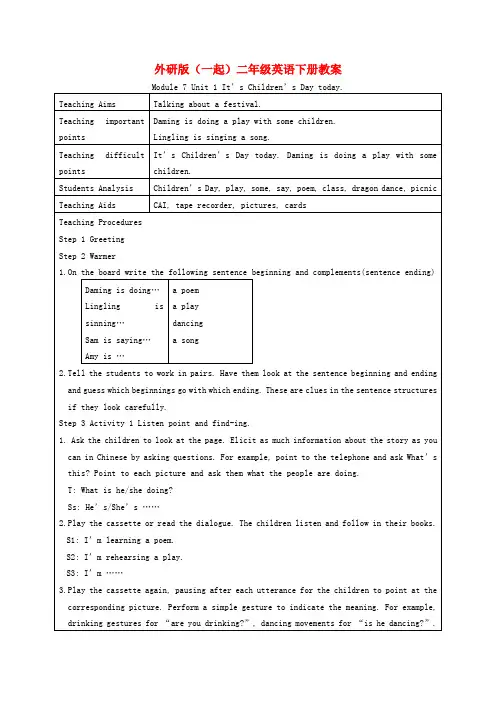
Module 7 Unit 1 It’s Children’s Day today.
Teaching Aims Talking about a festival.
Teaching important
points Daming is doing a play with some children.
Lingling is singing a song.
Teaching difficult
points It’s Children’s Day today. Daming is doing a play with some
children.
Students Analysis Children’s Day, play, some, say, poem, class, dragon dance, picnic
Teaching Aids CAI, tape recorder, pictures, cards
Teaching Procedures
Step 1 Greeting
Step 2 Warmer
1.On the board write the following sentence beginning and complements(sentence ending)
Daming is doing…
Lingling is
sinning…
Sam is saying…
Amy is … a poem
a play
dancing
a song
2.Tell the students to work in pairs. Have them look at the sentence beginning and ending
and guess which beginnings go with which ending. These are clues in the sentence structures