
杭州电子科技大学数据结构2015考研真题
- 格式:pdf
- 大小:6.12 MB
- 文档页数:11
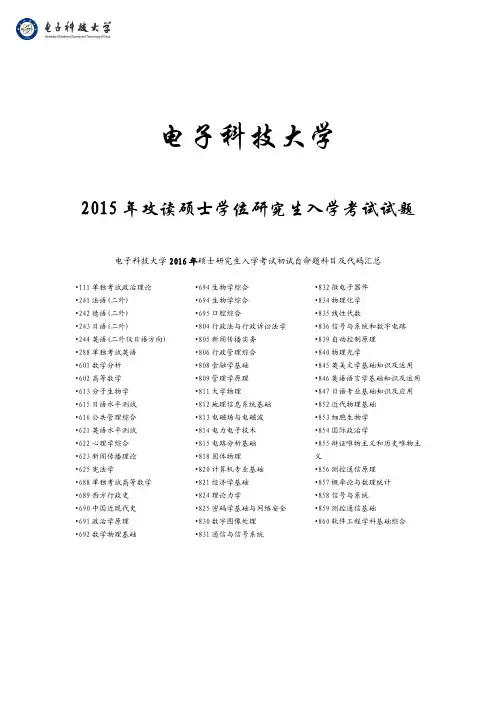
电子科技大学2015年攻读硕士学位研究生入学考试试题电子科技大学2016年硕士研究生入学考试初试自命题科目及代码汇总•111单独考试政治理论•241法语(二外)•242德语(二外)•243日语(二外)•244英语(二外仅日语方向) •288单独考试英语•601数学分析•602高等数学•613分子生物学•615日语水平测试•616公共管理综合•621英语水平测试•622心理学综合•623新闻传播理论•625宪法学•688单独考试高等数学•689西方行政史•690中国近现代史•691政治学原理•692数学物理基础•694生物学综合•694生物学综合•695口腔综合•804行政法与行政诉讼法学•805新闻传播实务•806行政管理综合•808金融学基础•809管理学原理•811大学物理•812地理信息系统基础•813电磁场与电磁波•814电力电子技术•815电路分析基础•818固体物理•820计算机专业基础•821经济学基础•824理论力学•825密码学基础与网络安全•830数字图像处理•831通信与信号系统•832微电子器件•834物理化学•835线性代数•836信号与系统和数字电路•839自动控制原理•840物理光学•845英美文学基础知识及运用•846英语语言学基础知识及运用•847日语专业基础知识及应用•852近代物理基础•853细胞生物学•854国际政治学•855辩证唯物主义和历史唯物主义•856测控通信原理•857概率论与数理统计•858信号与系统•859测控通信基础•860软件工程学科基础综合电子科技大学2015年攻读硕士学位研究生入学考试试题考试科目:621英语水平测试注:无机读卡,所有答案必须写在答题纸上,写在试卷或草稿纸上无效。
Part I Reading Comprehension (40 points)Directions: In this part there are 5 passages, each with some questions or incomplete statements. Read them carefully and then choose from the four suggested answers marked A, B, C and D to answer the questions or complete the statements. Please write your answers on the Answer Sheet.Passage 1Oh no, not Anthony Weiner again.The older generation never gets it. Anthony Weiner, a candidate for mayor of New York, admitted this week to having sent more snaps of himself to a digital acquaintance. As any youngster could have told him, the way to find love is to send photos of your face.Consider Will, a 24-year-old up-and-coming film director in California. He meets potential dates via a smartphone app called Tinder. It finds potential matches who are nearby—your phone always knows where you are—and shows him photos from their Facebook profiles. Will can like or reject each photo. If a woman he likes also likes him, both are alerted and can start chatting.Tinder is quick (you can scroll through dozens of photos in minutes) and spares your blushes (you never know if someone rejects you). Will has already had three romantic encounters and hundreds of matches, he says. Justin Mateen, a co-founder of Tinder, says it has made 100m matches since its launch in September, and led to 50 marriage proposals. He adds: “The app has only really been going for nine months. There could be a baby popping out soon.”Americans are dating longer, which creates opportunities for matchmakers. Some are quite direct.Bang with Friends (BWF), another app, allows users to specify which of their Facebook friends they would like to spend the night with. If both parties feel the same way, BWF notifies them. If not, no one is any the wiser. BWF was booted from Apple’s app store, but that hasn’t stopped it from creating 200,000 pairings since its January launch. BWF’s boss, admits he came up with the concept while “a bit tipsy”.Such apps make it easier to find potential partners, but don’t seem to have turned America into a nation of bed-hoppers. Young women claim to have had a median of 3.6 male intimate friends while young men 6.1 female ones. These figures may be inaccurate—men may exaggerate; women may undercount—but they have not changed much in years.Parents fret that staring at screens all day has made youngsters socially inept face-to-face. A第1 页共12 页survey by two dating sites found that 36-38% of Americans aged 21-34 ask for dates by text message. But when they meet, they must still make their moves in person. Witty joking and a well-placed wink still have their uses.1. It can be summarized from the first three paragraphs that _________.A. we used to judge a potential match by his or her appearanceB. one can find love by sending his photos to a digital acquaintanceC. Anthony Weiner is trying to win more votes from digital friendsD. Tinder will probably replace traditional matchmakers worldwide2. The sixth paragraph is focused on _________.A. the huge success that BWF has achievedB. the serious consequence of digital datingC. the evolution of matchmaking in the U.S.D. the future developments of Facebook3. The last paragraph implies that _________.A. excessive use of apps leaves youngsters socially awkwardB. most young people find love through text messagesC. people in love often move their homes before marriageD. verbal or non-verbal language is still used during dates4. Potential matches found by Tinder are probably _________.A. young, single, and nearbyB. poor, married, but lonelyC. illiterate, retired, but divorcedD. far-away, busy, and happyPassage 2The human body contains enormous quantities of energy. In fact, the average adult has as much energy stored in fat as a one-ton battery. That energy fuels our everyday activities, but what if those actions could in turn run the electronic devices we rely on? Today, innovators around the world are banking on our potential to do just that.Movement produces kinetic energy, which can be converted into power. In the past, devices that turned human kinetic energy into electricity, such as hand-cranked radios, computers and flashlights, involved a person’s full participation. But a growing field is tapping into our energy without our even noticing it.Consider, for example, a health club. With every step you take on a treadmill and with every muscle curl, you turn surplus calories into motion that could drive a generator and produce electricity. The energy from one person’s workout may not be much, but 100 people could contribute significantly to a facility’s power needs.That’s the idea behind the Green Microgym in Portland, Oregon, where machines likes tationary bikes harvest energy during workouts. Pedaling turns a generator, producing electricity that helps to power the building. For now, body energy supplies only a small fraction of the gym’s needs, but the amount should increase as more machines are adapted. “By being extremely energy-efficient and combining human power, solar and someday wind, I believe we’ll be able to be net-zero for electricity sometime this year,” says the gym’s owner, Adam Boesel. His bikes, by the way, aren’t the flirts to put pedal power to work. In some parts of the world, cyclists have been powering safety第2 页共12 页lights for years with devices called bicycle dynamos, which use a generator to create alternating current with every turn of the wheels.Dance clubs are also getting in on the action. In the Netherlands, Rotterdam’s new Club WATT has a floor that harnesses the energy created by the dancers’ steps. For now, it’s just enough to power LED lights in the floor, but in the future, more output is expected from newer technology.5. Using human body energy as power supplies _________.A. requires us to be strongB. is a great new ideaC. proves to be difficultD. is increasingly popular6. It can be learned that the Green Microgym _________.A. is using human, solar and wind power to produce electricityB. is the first to use bikes to harvest human body energyC. will be able to satisfy its power needs by using green energyD. will introduce the technology to other parts of the world7. What is the author’s most likely comment on the application of body energy?A. It is unrealistic at present.B. It has a promising future.C. Its effect is still unknown.D. It depends on the energy cost.Passage 3The first of Laurence Smith’s two weddings was meant to take place in the midwinter snow not far south of the Arctic Circle. The second foresaw balmy blue skies in Palm Springs, California. As it turned out, the guests were greeted by rain and slush in the far north, then by a chill and more rain in the Californian desert.If the weather is capable of surprising him, why should anyone trust Mr. Smith’s forecast for 2050? Because the growing freakiness of weather is precisely his point. Climate change is one of four mega-trends, along with globalization, population growth and surging demand for natural resources, that he thinks will shape the world over the coming decades. The first part of his book The New North: The World in 2050 is a familiar tale of teeming cities, roaring trade, harder-to-get-at oil and rising sea levels.But Mr. Smith comes into his own when he explores the consequences of these trends (climate change especially) for the quarter of the Earth that lies at latitudes above 45°N. A geographer at the University of California, Los Angeles, he specializes in the frozen lands of Russia, Canada, Alaska and Iceland. The region is about to undergo a great transformation.The planet’s warming may be global, but climate-change models predict it will be amplified in the north. Permafrost will melt and settlement patterns will change. Inland, construction will become trickier and ice roads less dependable, so development will gravitate to the coasts. By mid-century the Arctic Ocean may be briefly free of sea ice in September, a boon to shipping. Crops will spread north as seal hunters become farmers.Interest in the region’s vast and increasingly accessible natural resources is already growing, along with the potential for conflict over the rights to these riches. Mr. Smith believes there is every chance that the development of the “new north” will be peaceful, thanks to habits of cooperation and第3 页共12 页an internationally accepted rule book for laying down rights to the seabed. He sees a leading role for the region’s indigenous peoples.By 2050 the answers to some very big questions should be clear: what happens to the north’s massive stocks of carbon in the soil as it defrosts; whether great schemes to channel freshwater from north to south are attempted; how populous, resource-hungry China works with Russia’s emptying, resource-rich Far East. Mr. Smith reckons an area about one and a half times the size of the United States will be habitable, albeit for much of the year still cold and dark. The development of the new north, he thinks, might resemble that of the American West, dotted with settlements formed for mining and trade.Obscuring the view of 2050, however, is a caveat that looms as large as an Arctic iceberg. Mr. Smith sets ground rules that allow him to extrapolate into the future without worrying about disruptions such as game-changing leaps in technology. This is an “informed thought-experiment”rather than a proper prediction. But for anyone curious about the new north—let alone thinking of investing in Arctic derivatives—it is an instructive exercise.8. The word “boon” in the fourth paragraph can be replaced by _________.A. prohibitionB. prosperityC. benefitD. catastrophe9. According to Laurence Smith, the following are all very likely to happen in the future decadesEXCEPT _________.A. The local people in the “new north” will benefit from the climate changeB. The development of the “new north” will be on a peaceful processC. The natural resources in the “new north” will be able to exploitedD. The large amounts of carbon in the “new north” soils will be safely controlled10. What can be inferred from the passage?A. The author takes a skeptical attitude towards Laurence Smith’s predictions of the Arctic.B. The author reckons Laurence Smith is somewhat optimistic in imagining the “new north”C. Laurence Smith did a lot of experiments in combining geographical predictions andeconomic development.D. Laurence Smith shares with the author that the future of the Article depends on ourawareness and actions.11. Which of the following titles is more appropriate for the passage?A. The Arctic: The de-icing ageB. Climate Change: Humankind’s futureC. A Day Dreamer: Laurence Smith’s new writing styleD. 2050: The end of the worldPassage 4The newspaper must provide for the reader the facts, unalloyed, unslanted, objectively selected facts. But in these days of complex news it must provide more; it must supply interpretation, the meaning of the facts. This is the most important assignment confronting American journalism—to make clear to the reader the problems of the day, to make international news as understandable as第4 页共12 页community news, to recognize that there is no longer any such thing (with the possible exception of such scribbling as society and club news) as “local”news, because any event in the international area has a local reaction in manpower draft, in economic strain, in terms, indeed, of our very way of life.There is in journalism a widespread view that when you embark on interpretation, you are entering choppy and dangerous waters, the swirling tides of opinion. This is nonsense.The opponents of interpretation insist that the writer and the editor shall confine himself to the “facts”. This insistence raises two questions: What are the facts? And: Are the bare facts enough?As to the first query. Consider how a so-called “factual” story cones about. The reporter collects, say, fifty facts; out of these fifty, his space allotment being necessarily restricted, he selects the ten, which he considers most important. This is Judgment Number One. Then he or his editor decides which of these ten facts shall constitute the lead of the piece. This is important decision because many readers do not proceed beyond the first paragraph. This is Judgment Number Two. Then the night editor determines whether the article shall be presented on page one, where it has a large impact, or on page twenty-four, where it has little. Judgment Number Three.Thus, in the presentation of a so-called “factual” or “objective” story, at least three judgments are involved. And they are judgments not at all unlike those involved in interpretation, in which reporter and editor, calling upon their general background, and their “news neutralism,” arrive at a conclusion as to the significance of the news.The two areas of judgment, presentation of the news and its interpretation, are both objective rather then subjective processes—as objective, that is, as any human being can be. (Note in passing: even though complete objectivity can never be achieved, nevertheless the ideal must always be the beacon on the murky news channels.) Of an editor is intent on slanting the news, he can do it in other ways and more effectively than by interpretation. He can do it by the selection of those facts that prop up his particular plea. Or he can do it by the pay he gives a story—promoting it to page one or demoting it to page thirty.12. The title that best expresses the ideas of this passage is _________.A. Interpreting the News.B. Choosing Facts.C. Subjective versus Objective Processes.D. Everything Counts.13. Why does the writer of an article select ten out of fifty available facts?A. His editor is prejudiced.B. Space is limited.C. The subject is not important.D. The newspaper is arbitrary.14. What is the least effective way of “slanting” news?A. Placement.B. Concentration.C. InterpretationD. His editor is prejudiced.15. Why should the lead sentence present the most important fact?A. It will influence the reader to continue.B. It will be the best way to write.C. Some readers do not read beyond the first paragraph.D. It will gratify the editor.第5 页共12 页Passage 5One of the most pivotal moments in American literature occurred near the end of the nineteenth century as authors such as a young man named Stephen Crane began to embrace a literary style forged in Europe a bit earlier and which would come to be known as naturalism. Crane was born to parents in the ministry and grew up in a household grounded in religious beliefs and context. Yet, before long, Crane had, for the most part, rejected religion and the idea of divine intervention in favor of a more hands-on approach to the world. As he began to develop as a writer, naturalist themes of man versus nature, the unrelenting power of nature, and an objective view of the world began to dominate his writing. Naturalists attempted to depict the most accurate view of life unadulterated and unobstructed by external commentary or spiritual intervention. Ultimately Crane’s masterful short story The Open Boat stands as one of the most complete and developed works of the naturalist genre.The first apparent element of naturalism in The Open Boat is its subject matter—a shipwreck. Being as true to life as possible is one of the most common goals of a naturalistic writer, and, in this short story, Crane is no exception. It did not come from Crane’s imagination. Rather, it stemmed from his personal experience. As a young war reporter, Crane was on his way from Florida to Cuba when his vesse1, the Commodore, encountered a violent tempest. Within hours, the ship had sunk, leaving a few lucky survivors on a tiny lifeboat to be subjected to the full of nature. Throughout the story Crane depicts scene after scene as if they were snapshots or a shorn film of what the men in the boat were up against. Through his prose, Crane is able to reveal the unadulterated brutal realism manifest in nature itself.As Crane continues with the theme of man versus nature in The Open Boat, the element of pessimism crucial to any naturalistic work, becomes quite apparent. The men are at the mercy of the storms and the seas and cannot do much to save themselves. In this sense, Crane reveals the indifference of nature and the universe in relation to the life or plight of human beings in general. It’s obvious to him that angels will not swoop down and save the unfortunate men. The situation of the shipwreck is ideal because ordinary, everyday people must face an extreme situation from which it is more than likely that they will perish. Crane continually creates a mood of impending doom and the punishing nature of the universe throughout the story. Along the way, he provides little commentary on the situation, forcing readers to place themselves immediately on the boat with the men while enforcing the dark tone of the story. But, even to Crane and most naturalist writers, all is not lost.While Crane’s work The Open Boat is a dark account of a chance situation that turns fatal for many, but not all, of the crew of the Commodore, it also sets forth the main elements of a naturalistic literary work at the turn of the twentieth century. Despite the fact that nature can be unrelenting and compassionless towards humans at any given moment, Crane ultimately shows how individuals still always have the capacity to strive together to overcome hardships and disaster. Furthermore, the accuracy and detail by Crane shun any possibility of a sugarcoated reality and reveals the true ferocity of nature as it is.16. Which of the following can be inferred from the first paragraph about Stephen Crane?第6 页共12 页A. He enjoyed the ministry and listening to preachers.B. He did not enjoy writing when he was young.C. He was rivaled by no other author of his time.D. He was not in tune with the beliefs of his parents.17. Which of the sentences below best expresses the essential information in the underlinedsentence in the first paragraph?A. Naturalists liked to place their own opinions on spirituality in their writing.B. Naturalists placed more emphasis on representing life as it appeared to them.C. Naturalists tried to embody the most precise view of life by looking to religion.D. Naturalists believed the life was obstructed by outside ambition and spirituality.18. According to the second paragraph, The Open Boat is important as a naturalist work because_________.A. it is true account taken from Crane’s own personal experienceB. the story is completely fabricated from Crane’s imaginationC. it is based on a series of events in a shipwreck that Crane heard ofD. it does not attempt to glorify Crane’s heroism against nature19. The author discusses nature in the third paragraph in order to _________.A. show how Crane believes divine power will save humanityB. note that nature itself is stronger than all of humankindC. indicate that nature does not care for strife among peopleD. reveal how it is pessimistic toward life on Earth20. According to the fourth paragraph, the men in the boat are significant because _________.A. they show that by banding together, human beings can surviveB. they represent the ultimate downfall of life according to CraneC. they allow fate to run its course and decide their own futureD. they discount nature and do not take it seriously until the endPart II Structure and Vocabulary (20 points)Directions: Beneath each of the following sentences, there are four choices marked A, B, C and D. Choose the one that best completes the sentence. Please write your answers on the Answer Sheet.21. The general manager usually _________ a question before he gives his answer.A. pondersB. extractsC. imploresD. enlists22. His classmates dislike him for his _________ as he always boasts about his family.A. reclusionB. pomposityC. prideD. austerity23. The writer told several _________ about his colleagues and made everybody laugh.A. legendsB. mythsC. fablesD. anecdotes24. She must have been pretty _____ to fall for such an old trick.A. interestedB. gullibleC. enthusiasticD. shrewd25. This is the ______ piano on which the composer created some of his greatest works.A. trueB. originalC. realD. genuine第7 页共12 页26. A lack of appetite may be ________ of a major mental or physical disorder.A. inquisitiveB. initiativeC. indicativeD. informative27. The self-image controls a person’s attitudes or _________ of what happens to her.A. interpretationsB. approachesC. commitmentsD. simulations28. By the year 2040, Yale University will need over eight acres of land to _________ its library.A. manipulateB. accommodateC. illuminateD. obligate29. If you don’t know where you’ re going in life, you are _________ to wind up somewhere else.A. possibleB. inevitableC. optionalD. liable30. As far as marriage is concerned, it is mutual care and love that _________.A. mountsB. discountsC. countsD. calculates31. If the ten amendments that _________ the Bill of Rights of the US Constitution were a familyof ten children, you wouldn’t want to be the Third.A. includeB. embraceC. compriseD. involve32. The person in custody must, prior to interrogation, be clearly informed that he has the right toremain _________.A. silentB. taciturnC. speechlessD. consent33. The road wound rather _________ into a valley, in which the Pemberley House was situated.A. unprecedentedlyB. abruptlyC. promptlyD. irreversibly34. There is some reason for not giving up my career and _________ a different one.A. taking inB. bringing aboutC. arising fromD. embarking on35. Their house was in close _________ to ours, so we became intimate friends in time.A. vicinityB. contactC. relationD. community36. What all this _________ rhetoric obscured was the lack of hard evidence that violent mediaactually turns children into killers.A. multiculturalB. innovativeC. hyperbolicD. interactive37. A(n) _________ reading approach to reading is a combination of approaches—global, analyticand synthetic—used to suit the convenience of the reader.A. literalB. innovativeC. liberalD. eclectic38. _________ with languages gives you an edge in many jobs and professional opportunities, butis especially valuable in fields such as advertising, business, education and foreign affairs.A. ThresholdB. FacilityC. SpecializationD. Accommodation39. Rather than dictate how I think it ought to work, I would tell my employees to _________something that will work.A. get back toB. get out ofC. come along withD. come up with40. The visitors were impressed by the facilities planned and programmed ________ theirinterrelationships.A. in terms ofB. in aspects ofC. in units ofD. in case ofPart III Cloze (20 points)Directions: Fill in each blank with ONE appropriate word to complete the passage. Please write your answers on the Answer Sheet.第8 页共12 页Passage A:A new report published on November 4th takes a different approach.GlobalWebIndex (GWI), a market-research firm 41 local partners in 32 countries, surveys 170,000 consumers a year and recently began to ask detailed questions about internet use. It 42 China and India in the top three for Facebook users. SimilarWeb, 43 does IP-based analysis, does not even put China in the top ten.One reason for the 44 is that in many developing markets devices are widely shared. Conversely, more than three-quarters of respondents in the GWI report said they used more than one 45 . 46 factor is the spread of virtual private networks (VPNs) and proxy servers, which 47 it possible to surf the web through a foreign server.Once restricted to the tech-literate, these are now common and easy to use. Chinese citizens who want to vault the Great Firewall to use Facebook can do so with a couple of clicks. Foreign fans of the BBC can use the 48 trick to watch its programs via iPlayer, supposedly barred 49 Britain. Since VPNs and proxy servers are clustered in 50 with favorable rules, such as Sweden and the Netherlands, any count of visits to such sites will be skewed. 41. ____________42. ____________43. ____________44. ____________45. ____________46. ____________47. ____________48. ____________49. ____________50. ____________Passage B:Happy hours are not necessarily happy, 51 do they last for an hour, but they have become a part of the ritual of the office worker and businessman.52 weekdays in pubs and bars throughout America, there is the late afternoon happy hour. The time may 53 from place to place, but usually it is held from four to seven. 54 the workday is finished, office workers in large cities and small towns take a relaxing pause and do not go directly home. They head off 55 for the nearest bar or pub to be with friends, co-workers and colleagues. Within minutes the pub is filled to capacity 56 businessmen and secretaries, office clerks and stock executives. They gather 57 the bar like birds around a fountain or forest animals around a watering hole and chat about the trifles of office life or matters more personal. This is their desert garden, the place to relieve the day’s stress at the office.At these happy hours, social binding occurs 58 people who share the same workplace or similar professions. They may chat about each other or talk about a planned project that has 59 to meet a deadline. In this 60 , these places become extensions of the workplace and constitute a good portion of one’s social life. 51. ____________52. ____________53. ____________54. ____________55. ____________56. ____________57. ____________58. ____________59. ____________60. ____________第9 页共12 页Part IV Paraphrasing (20 points)Directions: Paraphrase the underlined parts. Please write your answers on the Answer Sheet.Consult any encyclopedia and you will find Charles Babbage credited with having conceived the first automatic digital computer. (61) Dig deeper, however, and it quickly becomes apparent that Babbage had a lot of help.Others before him had already tried to build calculating contraptions, notably Gottfried Leibniz, a German mathematician. (62) Babbage held regular salons and founded clubs where his ideas were sharpened. And there was also Ada Lovelace, his collaborator and the world’s first computer programmer.The argument against the great man theory of invention is not new. (63) But the main merit of Walter Isaacson’s new book The Innovators is to show that this is particularly true in information technology—despite the customary lionization of many of its pioneers, from Babbage and Alan Turing to Bill Gates and Linus Torvalds.All appear in Mr. Isaacson’s book, which explains its length. Whether their worlds revolved around the computer itself, the microchip, software, the PC, the internet or everything in between—these are all stories that show that invention always has many fathers (and mothers). (64) In fact, those who tried to go it alone tended to fail.(65) Mr. Isaacson thinks geniuses are important but they have to be seen in the context of times they lived in and the people they collaborated with. John von Neumann was a Hungarian-born polymath who worked on the ENIAC, one of the first programmable machines. His name is associated by many with early advances in programming and software architecture. (66) But it was a group of women who were at the forefront of programming, because back then it often involved plugging in wires and throwing switches. “If the ENIAC’s administrators had known how crucial programming would be…they might have been more hesitant to give such an important role to women,” he quotes one of them, Jean Jennings, as saying.(67) The ENIAC also shines a light on another issue: how innovation should best be commercialized. In 1945 von Neumann published a paper summarizing the project’s ideas—making it impossible for others on the team to patent them. The debate over whether innovation is better served by sharing intellectual property or by protecting it has been heated.(68) Mr. Isaacson clearly thinks that innovation is all about getting the mix right, though he doesn’t put it quite that way. If a brilliant leader is too self-involved, as was the case with William Shockley, an American physicist who helped invent the transistor radio, things fall apart. (69) Similarly, teams that lack a willful visionary often falter, as happened after Steve Jobs left Apple. Groups with a wide variety of specialities and experiences do much better than a bunch of left-brainers.The Innovators has not quite lived up to its own advice of getting the mix right. (70) Mr. Isaacson could have dedicated more pages to what he calls “lessons from the journey”, rather than retelling at length stories that other books have already laid out, even if he does give them credit. Then again, just like great technology, a good book doesn’t just emerge from nowhere.第10 页共12 页。

2015年考研必备资料2015年考研计算机数据结构试题及答案目录2015年考研计算机数据结构试题及答案(1) (2)2015年考研计算机数据结构试题(1) (2)2015年考研计算机数据结构试题答案(1) (5)2015年考研计算机数据结构试题及答案(2) (6)2015年考研计算机数据结构试题(2) (6)2015年考研计算机数据结构试题答案(2) (9)2015年考研计算机数据结构试题及答案(3) (11)2015年考研计算机数据结构试题(3) (11)2015年考研计算机数据结构试题答案(3) (13)2015年考研计算机数据结构试题及答案(4) (15)2015年考研计算机数据结构试题(4) (15)2015年考研计算机数据结构试题答案(4) (17)2015年考研计算机数据结构试题及答案(5) (19)2015年考研计算机数据结构试题(5) (19)2015年考研计算机数据结构试题答案(5) (21)2015年考研计算机数据结构试题及答案(1)2015年考研计算机数据结构试题(1)一、选择题(24分)1.下列程序段的时间复杂度为( )。
i=0,s=0; while (s(A) O(n1/2) (B) O(n1/3) (C) O(n) (D) O(n2)2.设某链表中最常用的操作是在链表的尾部插入或删除元素,则选用下列( )存储方式最节省运算时间。
(A) 单向链表 (B) 单向循环链表(C) 双向链表 (D) 双向循环链表3.设指针q指向单链表中结点A,指针p指向单链表中结点A的后继结点B,指针s指向被插入的结点X,则在结点A和结点B插入结点X的操作序列为( )。
(A) s->next=p->next;p->next=-s; (B) q->next=s; s->next=p;(C) p->next=s->next;s->next=p; (D) p->next=s;s->next=q;4.设输入序列为1、2、3、4、5、6,则通过栈的作用后可以得到的输出序列为( )。
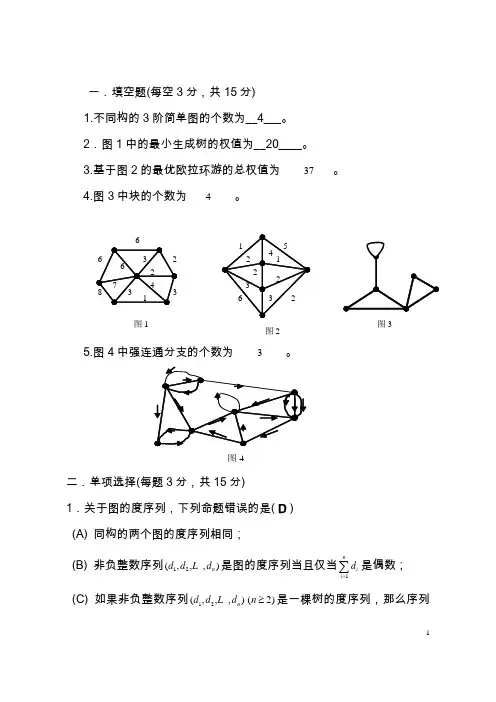
1一.填空题(每空3分,共15分)1.不同构的3阶简单图的个数为__4___。
2.图1中的最小生成树的权值为__20____。
3.基于图2的最优欧拉环游的总权值为____37___。
4.图3中块的个数为___4____。
5.图4中强连通分支的个数为____3____。
二.单项选择(每题3分,共15分)1.关于图的度序列,下列命题错误的是( D ) (A) 同构的两个图的度序列相同;(B) 非负整数序列12(,,,)n d d d 是图的度序列当且仅当1ni i d =∑是偶数;(C) 如果非负整数序列12(,,,)n d d d (2)n ≥是一棵树的度序列,那么序列6 图1图2图3图42中至少有两个整数的值为1;(D). 如果非负整数序列12(,,,)n d d d 是简单图的度序列,那么在同构意义下只能确定一个图。
2.关于n 阶简单图的邻接矩阵()ij n n A a ⨯=,下列说法错误的是( C ) (A) 矩阵A 的行和等于该行对应顶点的度数; (B) 矩阵所有元素之和等于该图边数的2倍;(C) 不同构的两个图,它们的邻接矩阵特征谱一定不同; (D) 非连通图的邻接矩阵一定可以表示为准对角矩阵形式。
3.关于欧拉图,下面说法正确的是( B ) (A) 欧拉图存在唯一的欧拉环游; (B) 非平凡欧拉图中一定有圈; (C) 欧拉图中一定没有割点; (D) 度数为偶数的图一定是欧拉图。
4.关于哈密尔顿图,下列命题错误的是( B )(A)设G 是3n ≥的简单图,若其闭包是完全图,则G 是哈密尔顿图; (B) 若n 阶单图的闭包不是完全图,则它一定是非哈密尔顿图; (C)若G 是哈密尔顿图,则对于V 的每个非空顶点子集S ,均有()G S S ω-≤;(D) 若G 是3n ≥的非H 单图,则G 度弱于某个,m n C 图。
5.关于偶图,下列说法错误的是( B ) (A) 偶图中不存在奇圈;(B) 非平凡偶图的最大匹配是唯一的;(C) (0)k k 正则偶图存在完美匹配;(D) 偶图中,最大匹配包含的边数等于最小点覆盖包含的顶点数。