
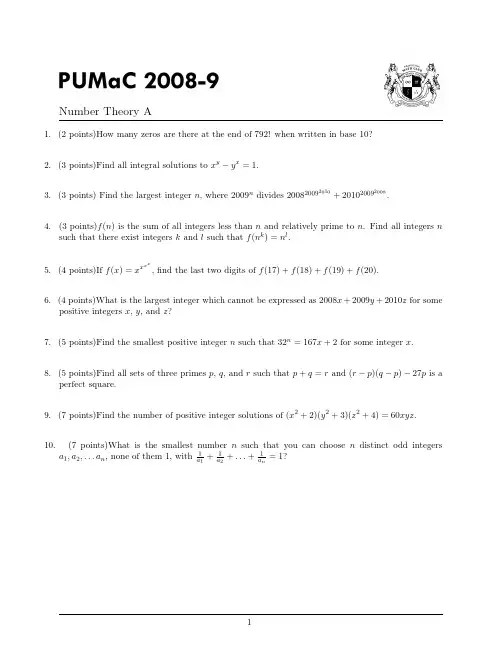
A Number Theory
- 格式:pdf
- 大小:152.82 KB
- 文档页数:1

数字相关英文知识点总结1. Number Systems:a. Decimal (base 10) systemb. Binary (base 2) systemc. Octal (base 8) systemd. Hexadecimal (base 16) system2. Types of Numbers:a. Natural numbersb. Whole numbersc. Integersd. Rational numberse. Irrational numbersf. Real numbersg. Complex numbers3. Operations on Numbers:a. Additionb. Subtractionc. Multiplicationd. Divisione. Exponentsf. Square roots4. Number Properties:a. Commutative propertyb. Associative propertyc. Distributive propertyd. Identity propertye. Inverse property5. Prime Numbers:a. Definition and propertiesb. Prime factorizationc. Sieve of Eratosthenes6. Divisibility:a. Divisibility tests for numbersb. Factors and multiplesc. Greatest common divisor (GCD)d. Least common multiple (LCM)7. Fractions and Decimals:a. Converting between fractions and decimalsb. Simplifying fractionsc. Operations on fractions and decimalsd. Equivalent fractions8. Percentages:a. Converting between percentages and decimals or fractionsb. Percentage changec. Percentage increase and decreased. Applications of percentages in real lifeAdvanced Concepts:1. Number Theory:a. Divisibility rulesb. Modular arithmeticc. Congruence relationsd. Fermat's little theoreme. Euler's totient function2. Irrational Numbers:a. Definitionb. Properties of irrational numbersc. Proof of the irrationality of certain numbers (e.g. square root of 2, e, pi)3. Complex Numbers:a. Definition and propertiesb. Operations on complex numbersc. Complex plane and polar formd. Applications of complex numbers in mathematics and physics4. Number Sequences and Series:a. Arithmetic sequencesb. Geometric sequencesc. Fibonacci sequenced. Convergent and divergent seriese. Summation notation5. Number Patterns:a. Pascal's triangleb. Fibonacci sequencec. Geometric patternsd. Patterns in prime numbers6. Number Systems in Computing:a. Binary and hexadecimal representationb. Fixed-point and floating-point representationc. Binary arithmeticd. Two's complement representation7. Number Systems in Cryptography:a. RSA algorithmb. Modular exponentiationc. Primality testingd. Discrete logarithm problem Applications:1. Financial Mathematics:a. Simple interest and compound interestb. Amortization schedulesc. Present value and future valued. Annuities and perpetuities2. Statistics and Probability:a. Mean, median, and modeb. Standard deviation and variancec. Probability distributionsd. Expected value and variance3. Geometry and Trigonometry:a. Pythagorean theoremb. Trigonometric functionsc. Area and volume calculationsd. Coordinate geometry4. Physics and Engineering:a. Calculus and differential equationsb. Vector mathematicsc. Fourier series and transformsd. Complex exponentials5. Computer Science:a. Data representation and bit manipulationb. Algorithms and data structuresc. Boolean algebra and logic gatesd. Cryptography and security6. Cryptography and Number Theory:a. Public key encryptionb. Digital signaturesc. Cryptographic hash functionsd. CryptanalysisConclusion:In conclusion, understanding the fundamentals of numbers and their properties is essential in various fields such as mathematics, science, engineering, finance, and technology. From basic arithmetic to advanced number theory, the applications of numbers are vast and diverse. Whether it's calculating interest on a loan, analyzing data in statistics, solving equations in physics, or encrypting data for security, numbers play a crucial role in our everyday lives. Mastering the concepts and applications of numbers can lead to a deeper understanding of the world around us and open doors to new opportunities and discoveries.。


数理逻辑(MathematicalLogic)数理逻辑(Mathematical logic)是用数学方法研究诸如推理的有效性、证明的真实性、数学的真理性和计算的可行性等这类现象中的逻辑问题的一门学问。
其研究对象是对证明和计算这两个直观概念进行符号化以后的形式系统。
数理逻辑是数学基础的一个不可缺少的组成部分。
数理逻辑的研究范围是逻辑中可被数学模式化的部分。
以前称为符号逻辑(相对于哲学逻辑),又称元数学,后者的使用现已局限于证明论的某些方面。
历史背景“数理逻辑”的名称由皮亚诺首先给出,又称为符号逻辑。
数理逻辑在本质上依然是亚里士多德的逻辑学,但从记号学的观点来讲,它是用抽象代数来记述的。
某些哲学倾向浓厚的数学家对用符号或代数方法来处理形式逻辑作过一些尝试,比如说莱布尼兹和朗伯(Johann Heinrich Lambert);但他们的工作鲜为人知,后继无人。
直到19世纪中叶,乔治·布尔和其后的奥古斯都·德·摩根才提出了一种处理逻辑问题的系统性的数学方法(当然不是定量性的)。
亚里士多德以来的传统逻辑得到改革和完成,由此也得到了研究数学基本概念的合适工具。
虽然这并不意味着1900年至1925年间的有关数学基础的争论已有了定论,但这“新”逻辑在很大程度上澄清了有关数学的哲学问题。
在整个20世纪里,逻辑中的大量工作已经集中于逻辑系统的形式化以及在研究逻辑系统的完全性和协调性的问题上。
本身这种逻辑系统的形式化的研究就是采用数学逻辑的方法.传统的逻辑研究(参见逻辑论题列表)较偏重于“论证的形式”,而当代数理逻辑的态度也许可以被总结为对于内容的组合研究。
它同时包括“语法”(例如,从一形式语言把一个文字串传送给一编译器程序,从而转写为机器指令)和“语义”(在模型论中构造特定模型或全部模型的集合)。
数理逻辑的重要著作有戈特洛布·弗雷格(Gottlob Frege)的《概念文字》(Begriffsschrift)、伯特兰·罗素的《数学原理》(Principia Mathematica)等。

number知识点总结IntroductionNumbers are an essential part of everyday life and play a crucial role in almost every aspect of human existence. From simple counting to complex mathematical calculations, numbers are used to quantify, measure, and represent various entities and concepts. Understanding the properties and characteristics of numbers is fundamental to developing mathematical proficiency and problem-solving skills. In this summary, we will discuss the key concepts and principles related to numbers, including their classification, operations, and applications.Classification of NumbersNumbers can be classified into different categories based on their properties and characteristics. The most common classifications of numbers include:1. Natural Numbers: Natural numbers are the set of positive integers starting from 1 and extending infinitely. They are used for counting and representing quantities.2. Whole Numbers: Whole numbers include all the natural numbers along with zero. They are used to represent quantities that do not have fractional or decimal parts.3. Integers: Integers are the set of all positive and negative whole numbers, including zero. They are used to represent quantities that can have positive or negative values.4. Rational Numbers: Rational numbers are numbers that can be expressed as a fraction of two integers, where the denominator is not zero. They include both integers and non-terminating, repeating decimals.5. Irrational Numbers: Irrational numbers are numbers that cannot be expressed as a fraction of two integers. They are non-terminating, non-repeating decimals and are represented by an infinite series of digits.6. Real Numbers: Real numbers include all rational and irrational numbers. They are used to represent quantities on the number line, including both whole numbers and fractions.7. Imaginary Numbers: Imaginary numbers are the set of numbers that are multiples of the square root of -1, denoted as "i." They are used in complex number systems and have important applications in mathematics and engineering.8. Complex Numbers: Complex numbers are the combination of real numbers and imaginary numbers, expressed in the form a + bi, where "a" and "b" are real numbers and "i" represents the imaginary unit.Operations with NumbersNumbers can be manipulated and combined using different operations, including addition, subtraction, multiplication, division, and exponentiation. Each operation has its own set of rules and properties, which are fundamental to understanding the relationships between numbers and performing mathematical calculations.1. Addition: Addition is the process of combining two or more numbers to find their sum. The result of an addition operation is called the "sum," and it is represented by the symbol "+." The commutative property of addition states that the order in which numbers are added does not affect the sum, i.e., a + b = b + a.2. Subtraction: Subtraction is the process of finding the difference between two numbers. The result of a subtraction operation is called the "difference," and it is represented by the symbol "−." The commutative property does not apply to subtraction, i.e., a - b ≠ b - a.3. Multiplication: Multiplication is the process of repeatedly adding a number to itself a certain number of times. The result of a multiplication operation is called the "product," and it is represented by the symbol "×" or "*." The commutative property of multiplication states that the order in which numbers are multiplied does not affect the product, i.e., a × b = b × a.4. Division: Division is the process of partitioning a quantity into equal parts. The result of a division operation is called the "quotient," and it is represented by the symbol "÷" or "/." Division is the inverse operation of multiplication, and it has its own set of rules and properties, such as the distributive property and the identity property.5. Exponentiation: Exponentiation is the process of raising a number to a certain power or exponent. The result of an exponentiation operation is called the "power," and it is represented by the notation a^b, where "a" is the base and "b" is the exponent. Exponentiation has its own set of rules and properties, including the product rule, the power rule, and the quotient rule.Applications of NumbersNumbers are used in a wide range of applications, including science, engineering, finance, and everyday life. The ability to work with numbers and perform mathematical calculations is essential for understanding and solving various real-world problems and challenges.1. Science: Numbers are used in science to quantify and measure physical quantities, such as length, mass, volume, time, and temperature. They are also used to represent numerical data and perform statistical analysis in scientific research and experimentation.2. Engineering: Numbers are used in engineering to design, analyze, and optimize systems and structures. They are used to represent physical properties, such as force, energy, power, and voltage, and to perform mathematical modeling and simulation of engineering processes.3. Finance: Numbers are used in finance to represent monetary values, such as income, expenses, assets, liabilities, and investments. They are also used to perform financial calculations, such as interest rate compounding, loan amortization, and investment valuation.4. Everyday Life: Numbers are used in everyday life for various purposes, such as timekeeping, scheduling, budgeting, shopping, and cooking. They are used to quantify and measure quantities, such as distance, speed, weight, and capacity, and to perform basic arithmetic operations, such as addition, subtraction, multiplication, and division.ConclusionIn conclusion, numbers are fundamental to understanding and representing quantities, and they play a central role in the development of mathematical knowledge and skills. Understanding the properties and characteristics of numbers, as well as their classification, operations, and applications, is essential for building a strong foundation in mathematics and for applying mathematical concepts to real-world problems and challenges. By mastering the principles and concepts related to numbers, individuals can develop proficiency in mathematical reasoning and problem-solving, which are valuable skills for success in academic, professional, and personal endeavors.。