新新目标英语八年级下册unit4知识点总结
- 格式:docx
- 大小:30.13 KB
- 文档页数:15
新新目标英语八年级下册unit4知识点总结
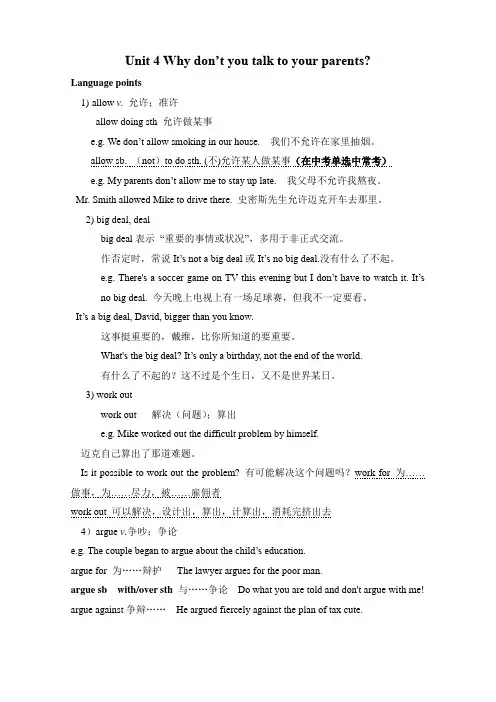
Unit 4 Why don’t you talk to your parents?
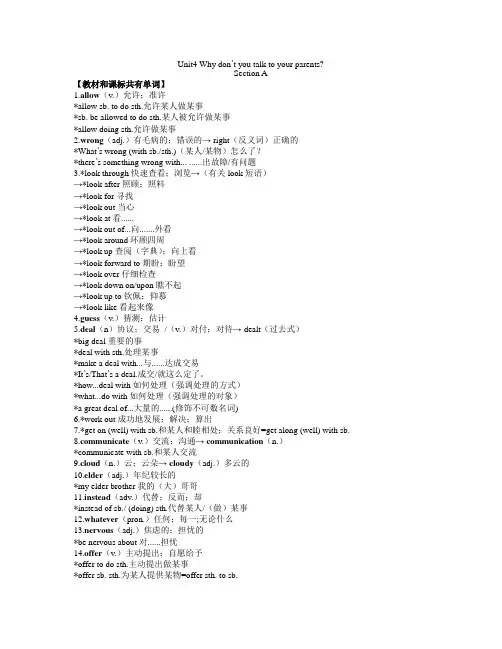
Section A
1. Why don't you do sth. ?= Why not do sth.? 为什么不......呢?
提建议的句型
(1) What about doing sth. ?=How about doing sth.? ….怎么样?
(2) Why don’t you do sth.?= Why not do sth.? 为什么不呢?
(3) Let’s do sth. 让我们一起做某事吧。
(4) Shall we/I do sth.? 我们做…好吗?
(5) had better do/not do sth. 最好做/不做某事
(6) Will/Would you please do sth. 请你做…好吗?
(7) Would you like to do sth.? 你想去做某事吗?
(8) Would you mind doing sth.?你介意做某事吗?
【回答】
(1). 同意对方的建议时,一般用
Good idea. / That’s good idea. 好主意 OK/ All right. / Great.
好/ 行/太好了Yes, please. / I’d love to. 是的/ 我愿意 I agree with
you. 我同意你的看法
No problem. 没问题 Sure./ Of course./ Certainly. 当然可以
Yes, I think so. 对,我也这样想
(2).对对方的帮助或要求表示委婉谢绝时,一般用:
I don’t think so. 我认为不是这样 S orry, I can’t. 对不起,我不能
I’d love to, but…我愿意,但恐怕…… I’m afraid… 恐怕……
2.(1)too many + 复数名词许多 too many people
(2)too much +不可数名词许多 too much homework
(3)much too +形容词太… much too cold
3. so conj. 因此 (表示因果关系,后面跟表示结果的句子,不与because同时使用)
v. 允许;准许
(1) allow doing sth 允许做某事
We don’t allow smoking in our house. 我们不允许在家里抽烟。
(2)allow sb.(not)to do sth. (不)允许某人做某事
My parents don’t allow me to stay up late. 我父母不允许我熬夜。
Mr. Smith allowed Mike to drive there. 史密斯先生允许迈克开车去那里。
(3)be allowed to do sth. 被允许做某事
(4)allow与let的辨析:
allow指允许,表示默许,听任,不加阻止
let 指让,let sb. do sth.让某人做某事,语意较弱,多用于口语中,let不能用于被动语态。
5.What’s wrong( with sb../ sth.) (某人/物)怎么了?
to sleep 去睡觉 (强调“入睡,睡着”这一动作)
fall asleep睡觉 (强调“入睡,睡着”这一状态)
看起来(系动词,后跟形容词作宾语)
系动词:后跟adj.作表语
一是:(be) am /is /are be quiet=keep quiet 保持安静
二保持:stay/keep (表示持续状态) stay healthy=keep
healthy 保持健康
三变化:become/get/turn (表示状态变化)
五起来:sound/look/smell/taste/feel (表示感觉)
8. call up (v + adv) call on 拜访;号召
9. find sb.. doing sth. 发现某人正在做某事
Mr. Wang found Li Dong reading a storybook in the class.
类似动词:hear,watch, see, feel
through 浏览翻阅仔细看 look for 寻找 look after=take care of照看 look like看起来像
look the same看起来一样
look over检查,复习 look through温习,检查 look out小心,从里向外看 look up向上看,查单词
look around环视 look forward to期望
11.angry adj.生气的→ angrily adv. 生气地
(1)be angry with sb.. =be mad at sb.. 对某人生气【with后接人】
(2)be angry at/about sth.对某事感到生气【at后接事】
(3)be angry to do sth. 做某事感到生气
My father was very __________(对……生气)his computer.
He hit the computer _______(angry)
= though 尽管 , 用来引导让步状语从句。 though / although 不能与but连用
although/however辨析
(1)although conj 虽然;即使;纵然,引导让步状语从句时放在主句前后都可。
Although he is very old, yet he is quite strong.他虽然年纪大了,但身体还很健壮。
(2) however adv 然而尽管如此插入语,起连词作用,一般用逗号与句子分开,可放在句首或句中
It’s raining hard, however, I think we should go out. 雨下的很大,尽管如此,我认为我们还应该出去。
deal 表示重要的事情或状况,多用于非正式交流。
否定: It’s not a big deal=It’s no big deal.没有什么了不起; 没什么大不了;不是什么大事(常用于口语中)
It’s a big deal. 这事挺重要的。
What's the big deal? 有什么了不起的?
14..hope v 希望
(1)hope to do sth. I hope to visit Guilin. (2) hope + that 从句(表示希望)I hope that you’ll be better
soon
(3)wish v 希望 wish to do sth. I wish to visit Guilin.
wish sb..to do sth. 希望某人做某事 I wish you to go.
wish +that 从句表示愿望,从句用虚拟语气 I wish I were you.
15.work out 解决;成功地发展,后跟fine,well, badly等词,表明产生的结果如何。
(1)计算出(答案、数量、价格等) The math problem is too
difficult for me to work out
(2)制定出(计划等),设计出 I have worked out a new way of
doing it.
(3)解决;找出…的答案 The government has many problems
to work out.
(4)work for 为……做事,为……尽力,被……雇佣者
16. get on with sb. =get along with sb. 和某人和睦相处;和某人关系良好
get on well/ badly with 相处的好/坏
get on=get along 进展,进步
How are you getting on these days? 你近来生活如何?
v 争吵→argument n 争论 have an argument with sb..与某人辩论
(1)argue with sb与某人争吵 argue with sb about /over sth. 为某事与某人争吵
(2)argue about sth. 争论某事
(3)argue against 争辩;反对 He argued against the plan
(4) argue for 为……辩护 The lawyer argues for the poor man.
18. hang over 挂在......之上;悬浮在......之上
(1)hang out 闲逛;常去某处 He likes reading and he often
hangs out in the bookshop.
(2) hang on to 紧紧抓住You’d better hang on to me in the crowd.
(3) hang up 挂电话;悬挂 After she finished her conversation
19.elder/older elder adj.年纪较长的 His elder brother is ill.
(1)elder 表示兄弟姐妹及子女之间的长幼关系,表示“前辈的”、“年纪较长的”,仅用于同一家庭成员的比
较;older则不限于此。
older泛指新旧、老幼或年龄的大小关系,是old的比较级形式。
My younger son is five and my elder son is nine。我的小儿子5岁,大儿子9岁。
Tom is two years older than I.汤姆比我年长两岁。
(2)elder在句中只用作定语,不作表语;older两者皆可。
My elder sister does her homework all by herself. 我的姐姐独自做作业。
His elder son got married last week. 他的长子是上星期结婚的。
I think his mother is older. 我认为他的母亲年龄大引起。
(3)elder只能用来指人;older既可修饰人,也可修饰物。
My elder brother joined the army when he was only fifteen.我哥年仅15就参了军。 This dog is older than any other dogs here.这条狗在这里是最老的一条。
I have a sister older than myself.我有位比我大的姐姐。
nice to sb.. 对某人友好be friendly to sb.. be good to sb..
=say no to v拒绝 refuse to do sth.拒绝去做某事
22. instead 代替,反而,却