新版新目标英语八年级下册unit9知识点总结
- 格式:docx
- 大小:46.19 KB
- 文档页数:5
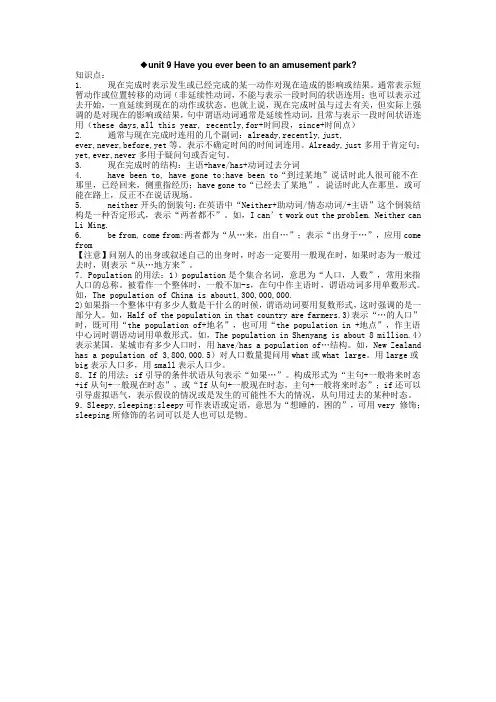
Unit 9 Have you ever been to a museum
一、要点 与短 :
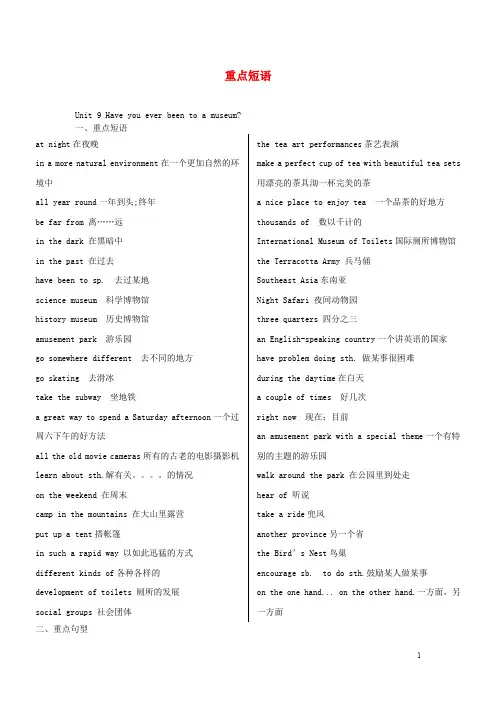
1. space museum 太空博物
2. amusement park 公园
3. water park 水上公园
4. take the subway 乘地
5. last year 昨年
6. next year 明年
7. have a great time 玩得快乐
8. end up 束
9. a theme park 主 公园
10. of course 自然
11. all the time 向来
12. many famous characters 多着名的人物
13. hear of 听
14. in the same place 在同一个地方
15 most of ⋯ 大部分的 ...
16.. in fact 事 上
17. an English-speaking country 一个 英 的国家
18. a tour guide 一名 游
19help sb. (to) do 帮助某人做某事
20. start doing sth. 开始做某事
to do sth. 开始做某事
22. take a holiday 度假
23.. on the one hand, ⋯ on the other hand一方面, ⋯另一方面 ⋯
24.. three quarters 四分之三
25. wake up 醒来
26. all the year round 一年到 , 年
二、要点 短 精 曾 (用于 在达成 。 ever 用于疑 句、否认句 ) Have you ever seen the filmNo, never.
has been to / have / has gone to / have/ has been in 辨析: (1)have/ has been to + 地名 曾 去 某地 , 在已 回到原地。 He has been to England twice. ( 在已 不在英国了 ) Have you ever been to the Great Wall ( 在已 不在 城上)
(2)have gone to 已 去某地了 , 人不在 。 He has gone to England。 (已 不在 的地方,抵达英国或许在去英国的路上 ) (3)have been in +地址 待在某地,常与 段搭配。 I have been in Shanghai for three years.
3. (1) Let ’中s的 us 包含 方,反意疑 句用 shall we Let ’ s go and listeno the music, _________ (2)Let us 不包含 方 , 反意疑 句用 will you
Let us wait for you in the reading room, _________ (3) Let sb. do sth 某人做某事 ( sb. 用人称代 的 格形式)
4. It ’ s really interesting,isn’ t it 【反意疑 句】 (1)定 :即附带疑 句。表示提 人的见解 ,没有掌握 ,需要 方 。 (2) 构: 述句 + 附带疑 句 It ’ s hot today ,isn ’ t it
(3)原 : 1.前肯后否,前否后肯 2.前名后辈 3. 一致
(4)做 方法
A. 找
假如句中有助 、情 、 be ,反意疑 句中也相 的用助 、情 、 be 。
He is a student ,__________
be ,只有 ,就要借助助 。
假如句中没有助 、情 、 She often get up at 6:30 every morning,_______
B.判断句子是一定 能否认, “前肯后否,前否后肯 ”The students have planted many trees,______
C.反意疑 句的主 必 成人称代 主格。 The boy can ’ t swim,_______
5. invent v 明 → inventor n 明家 → invention n 明
【 】 Edison , a great _________, ________over 1 ’000______ all his life.(invent)
invent 明 指事物从无到有(客 上没有)
discover 事物自己存在,只不 从 “未知 ”到 “已知 ”(客 上从前存在)
→ led → ledv 引 ,引 → leader n 人 All roads lead to Rome. 条条大路通
(1)lead to sth 致 ⋯⋯
(2) lead sb. to sw 引 某人去某地 (3) lead sb. to do sth 引 某人干某事
up 搭起; 起; put away 把 ⋯收起来
put on 穿上 put up put out 熄 put ⋯ into ⋯把 ⋯⋯放
put down 放下
信息; 料
(1) information 指 、 或其余 志等 得的信息, 不行数名 ;
a piece of information 一条信息
You can get much information on the Internet
(2)message信息、口信、 指 面、口 、无 等 来的信息, 可数名 ;
I ’ ll leave a message for her.
(3) news 新 ,信息 , 指通 、 台、 等新 媒介 道的最新信息, 不行数名 。 a piece of news 一
新 No news is good news 没有信息就是好信息
9. progress v 步; 展 n(不行数 n) make progress 获得 步 make progress in 在......方面 获得 步
I have made much progress in English.
adj.快速的;快速的 = quick /fast
He has made rapid progress in his studies.
rapid 反 “矫捷 ”等 She made a rapid decision.
quick “短 “ There will be a quick visit.
fast 速度 “快” I can run fast .
adj.特 的;不一样 常的(反)usual
an unusual experience 不一样 常的 un + adj. unhappy unfortunate uneasy unlucky
unable unfriendly unimportant
12. encourage sb. to do sth 鼓舞某人做某事
encourage sb. in sth 在某方面鼓舞某人
13. social 社会的 → society n 社会 → socialist 社会想法者 social problem 社会
14. peaceful adj. 和平的,平和的
peace n 和平 → peaceful adj. 和平的 → peacefully adv 和平川
beauty n 美 → beautiful adj. 美 的 help n 帮助 → helpful adj. 有帮助的 use n 用途 → useful adj. 实用的 thank n 感 → thankful adj. 感谢的
v 表演;演出 performance n 演出;表演 musical performance 音 演奏
adj. 完满的 Practice makes perfect. 勤能补拙
17. tea sets 茶具
(1) tea sets 茶具 the tea art 茶 the tea art performance 茶 表演
(2)green tea 茶 black tea 茶 milk tea 奶茶 Oolong tea 茶
(3)make tea 沏茶 serve tea to ... .......敬茶
它自己反身代
(1)反身代 的组成
一、二人称的反身代 组成 :形容 性物主代 +self/selves 组成
数 myself yourself
复数 ourselves yourselves
第三人称的反身代 组成 :第三人称 格 +self/selves
数: himself herself itself
复数: themselves
(2)反身代 的常 搭配:
(3) 反身 人 称 的
19.
收 集
藏
【 】He
enjoy oneself=have fun =have a good time 玩得高
by oneself =alone 单独
teach oneself=learn⋯ by oneself 自学 代 必 与主 保持 help oneself to 随意吃 一致。
introduce oneself to 自我介
hurt oneself 到自己 collect v 收 集 → improve oneself 提升自己 collection n 收 藏 look after oneself 照 自己 → collector n 珍藏家
leave sb by oneself 把某人 独留下 collect stamps /coins
lose oneself in 沉浸于 票 / 硬 have a
say to oneself 自言自
collection of books 收
for oneself 了某人自己
dress oneself 某人自己穿衣服 is a famous ____________ and he has _________ a lot of _________(collect).
德国人 (pl) Germans 国家 国籍形容 居民 言
中国 China 中国的 Chinese 中国人 Chinese Chinese