
PREFACE
- 格式:ppt
- 大小:92.01 KB
- 文档页数:11

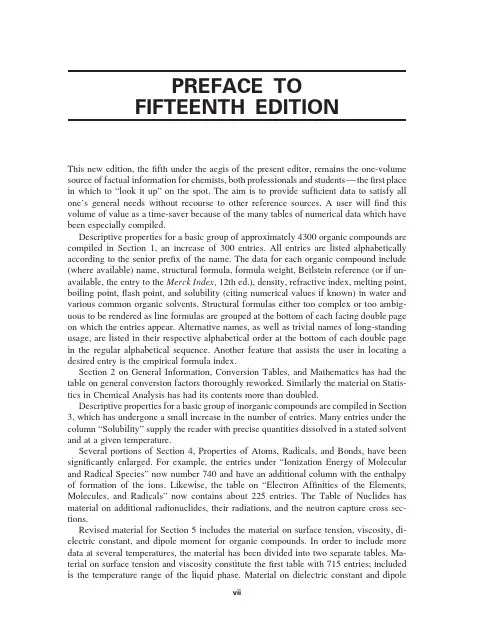
PREFACE TOFIFTEENTH EDITIONThis new edition,thefifth under the aegis of the present editor,remains the one-volume source of factual information for chemists,both professionals and students—thefirst place in which to“look it up”on the spot.The aim is to provide sufficient data to satisfy all one’s general needs without recourse to other reference sources.A user willfind this volume of value as a time-saverbecause of the many tables of numer ical data which have been especially compiled.Descriptive properties for a basic group of approximately4300organic compounds are compiled in Section1,an increase of300entries.All entries are listed alphabetically according to the senior prefix of the name.The data for each organic compound include (where available)name,structural formula,formula weight,Beilstein reference(or if un-available,the entry to the Merck Index,12th ed.),density,refractive index,melting point, boiling point,flash point,and solubility(citing numerical values if known)in water andvarious common organic solvents.Structural formulas either too complex or too ambig-uous to be rendered as line formulas are grouped at the bottom of each facing double page on which the entries appear.Alternative names,as well as trivial names of long-standing usage,are listed in their respective alphabetical order at the bottom of each double page in the regular alphabetical sequence.Another feature that assists the user in locating a desired entry is the empirical formula index.Section2on General Information,Conversion Tables,and Mathematics has had the table on general conversion factors thoroughly reworked.Similarly the material on Statis-tics in Chemical Analysis has had its contents more than doubled.Descriptive properties for a basic group of inorganic compounds are compiled in Section 3,which has undergone a small increase in the number of entries.Many entries under the column“Solubility”supply the reader with precise quantities dissolved in a stated solvent and at a given temperature.Several portions of Section4,Properties of Atoms,Radicals,and Bonds,have been significantly enlarged.For example,the entries under“Ionization Energy of Molecular and Radical Species”now number740and have an additional column with the enthalpy of formation of the ions.Likewise,the table on“Electron Affinities of the Elements, Molecules,and Radicals”now contains about225entries.The Table of Nuclides has material on additional radionuclides,their radiations,and the neutron capture cross sec-tions.Revised material for Section5includes the material on surface tension,viscosity,di-electric constant,and dipole moment for organic compounds.In order to include more data at several temperatures,the material has been divided into two separate tables.Ma-terial on surface tension and viscosity constitute thefirst table with715entries;included is the temperature range of the liquid phase.Material on dielectric constant and dipoleviiviii PREFACE TO FIFTEENTH EDITIONmoment constitute another table of1220entries.The additional data at two or more tem-peratures permit interpolation for intermediate temperatures and also permit limited ex-trapolation of the data.The Properties of Combustible Mixtures in Air has been revised and expanded to include over450compounds.Flash points ar e to be found in Section1. Completely revised are the tables on Thermal Conductivity for gases,liquids,and solids. Van derWaals’constants forgases has been br ought up to date and expanded to over500 substances.Section6,which includes Enthalpies and Gibbs Energies of Formation,Entropies,and Heat Capacities of Organic and Inorganic Compounds,and Heats of Melting,Vaporization, and Sublimation and Specific Heat at Various Temperatures for organic and inorganic compounds,has expanded by11pages,but the majoradditions have involved data in columns where it previously was absent.More material has also been included for critical temperature,critical pressure,and critical volume.The section on Spectroscopy has been retained but with some revisions and expansion. The section includes ultraviolet-visible spectroscopy,fluorescence,infrared and Raman spectroscopy,and X-ray spectrometry.Detection limits are listed for the elements when usingflame emission,flame atomic absorption,electrothermal atomic absorption,argon induction coupled plasma,andflame atomicfluorescence.Nuclear magnetic resonance embraces tables for the nuclear properties of the elements,proton chemical shifts and coupling constants,and similar material for carbon-13,boron-11,nitrogen-15,fluorine-19,silicon-19,and phosphorus-31.In Section8,the material on solubility constants has been doubled to550entries. Sections on proton transfer reactions,including some at various temperatures,formation constants of metal complexes with organic and inorganic ligands,buffer solutions of all types,reference electrodes,indicators,and electrode potentials are retained with some revisions.The material on conductances has been revised and expanded,particularly in the table on limiting equivalent ionic conductances.Everything in Sections9and10on physiochemical relationships,and on polymers, rubbers,fats,oils,and waxes,respectively,has been retained.Section11,Practical Laboratory Information,has undergone significant changes and expansion.Entries in the table on“Molecular Elevation of the Boiling Point”have been increased.McReynolds’constants for stationary phases in gas chromatography have been reorganized and expanded.The guide to ion-exchange resins and discussion is new and embraces all types of column packings and membrane materials.Gravimetric factors have been altered to reflect the changes in atomic weights for several elements.Newly added are tables listing elements precipitated by general analytical reagents,and giving equations for the redox determination of the elements with their equivalent weights.Discussion on the topics of precipitation and complexometric titrations include primary standards and indicators for each analytical technique.A new topic of masking and demasking agents includes discussion and tables of masking agents forvar ious elements,foranions and neutral molecules,and common demasking agents.A table has been added listing the common amino acids with theirpI and p Kvalues and their3-letterand1-letterabbr evi-astly a9-page table lists the threshold limit value(TLV)for gases and vapors.As stated in earlier prefaces,every effort has been made to select the most useful and reliable information and to record it with accuracy.However,the editor’s50years ofPREFACE TO FIFTEENTH EDITION ix involvement with textbooks and handbooks bring a realization of the opportunities for gremlins to exert their inevitable mischief.It is hoped that users of this handbook will continue to offer suggestions of material that might be included in,or even excluded from, future editions and call attention to errors.These communications should be directed to the editor.The street address will change early in1999,as will the telephone number. However,the e-mail address should remain as“pd105@.”Knoxville,TN John A.DeanPREFACE TOFOURTEENTH EDITIONPerhaps it would be simplest to begin by stating the ways in which this new edition,the fourth under the aegis of the present editor,has not been changed.It remains the one-volume source of factual information for chemists,both professionals and students—thefirst place in which to“look it up”on the spot.The aim is to provide sufficient data to satisfy all one’s general needs without recourse to other reference sources.Even the worker with the facilities of a comprehensive library willfind this volume of value as a time-saverbecause of the many tables of numer ical data which have been especially compiled.The changes,however,are both numerous and significant.First of all,there is a change in the organization of the subject matter.For example,material formerly contained in the section entitled Analytical Chemistry is now grouped by operational categories:spectroscopy;electrolytes,electro-motive force,and chemical equilibrium;and practical laboratory information.Polymers,rubbers, fats,oils,and waxes constitute a large independent section.Descriptive properties for a basic group of approximately4000organic compounds are compiledin Section1.These follow a concise introduction to organic nomenclature,including the topic of stereochemistry.Nomenclature is consistent with the1979rules of the Commission on Nomencla-ture,International Union of Pure and Applied Chemistry(IUPAC).All entries are listed alphabeti-cally according to the senior prefix of the name.The data for each organic compound include(where available)name,structural formula,formula weight,Beilstein reference,density,refractive index, melting point,boiling point,flash point,and solubility(citing numerical values if known)in water and various common organic solvents.Structural formulas either too complex or too ambiguous to be rendered as line formulas are grouped at the bottom of the page on which the entries appear. Alternative names,as well as trivial names of long-standing usage,are listed in their respective alphabetical order at the bottom of each page in the regular alphabetical sequence.Another feature that assists the user in locating a desired entry is the empirical formula index.Section2combines the former separate section on Mathematics with the material involving General Information and Conversion Tables.The fundamental physical constants reflect values rec-ommended in1986.Physical and chemical symbols and definitions have undergone extensive re-vision and expansion.Presented in14categories,the entries follow recommendations published in 1988by the IUPAC.The table of abbreviations and standard letter symbols provides,in a sense,an alphabetical index to the foregoing tables.The table of conversion factors has been modified in view of recent data and inclusion of SI units;cross-entries for“archaic”or unusual entries have been curtailed.Descriptive properties for a basic group of approximately1400inorganic compounds are com-piled in Section3.These follow a concise,revised introduction to inorganic nomenclature that follows the recommendations of the IUPAC published in1990.In this section are given the exact atomic(or formula)weight of the elements accompanied,when available,by the uncertainty in the finalfigure given in parentheses.In Section4the data on bond lengths and strengths have been vastly increased so as to include not only the atomic and effective ionic radii of elements and the covalent radii for atoms,but also the bond lengths between carbon and other elements and between elements other than carbon.Allxixii PREFACE TO FOURTEENTH EDITIONlengths are given in picometers(SI unit).Effective ionic radii are tabulated as a function of ion charge and coordination number.Bond dissociation energies are given in kilojoules per mole with the uncertainty of thefinalfigure(s)given in parentheses when known.New tables include bond dipole moments,group dipole moments,work functions of the elements,and relative abundances of the naturally occurring elements.The table of nuclides has been shortened and includes only the more commonly encountered nuclides;tabulations list half-life,natural abundance,cross-section to thermal neutrons,and radiation emitted upon disintegration.Entries have been updated.Revised material in Section5includes an extensive tabulation of binary and ternary azeotropes comprising approximately850entries.Over975compounds have values listed for viscosity,di-electric constant,dipole moment,and surface tension.Whenever possible,data for viscosity and dielectric constant are provided at two temperatures to permit interpolation for intermediate tem-peratures and also to permit limited extrapolation of the data.The dipole moments are often listed for different physical states.Values for surface tension can be calculated over a range of temperatures from two constants that can befitted into a linear equation.Also extensively revised and expanded are the properties of combustible mixtures in air.A table of triple points has been added.The tables in Section6contain values of the enthalpy and Gibbs energy of formation,entropy, and heat capacity atfive temperatures for approximately2000organic compounds and1500inor-ganic compounds,many in more than one physical state.Separate tabulations have enthalpies of melting,vaporization,transition,and sublimation for organic and inorganic compounds.All values are given in SI units(joule)and have been extracted from the latest sources such as JANAF Ther-mochemical Tables,3d ed.(1986);Thermochemical Data of Organic Compounds,2d ed.(1986); and Enthalpies of Vaporization of Organic Compounds,published underthe auspices of the IUPAC (1985).Also updated is the material on critical properties of elements and compounds.The section on Spectroscopy has been expanded to include ultraviolet-visible spectroscopy,fluorescence,Raman spectroscopy,and mass spectroscopy.Retained sections have been thoroughly revised:in particular,the tables on electronic emission and atomic absorption spectroscopy,nuclear magnetic resonance,and infrared spectroscopy.Detection limits are listed for the elements when usingflame emission,flame atomic absorption,electrothermal atomic absorption,argon ICP,and flame atomicfluorescence.Nuclear magnetic resonance embraces tables for the nuclear properties of the elements,proton chemical shifts and coupling constants,and similar material for carbon-13, boron-11,nitrogen-15,fluorine-19,silicon-29,and phosphorus-31.Section8now combines all the material on electrolytes,electromotive force,and chemical equi-librium,some of which had formerly been included in the old“Analytical Chemistry”section of earlier editions.Material on the half-wave potentials of inorganic and organic materials has been thoroughly revised.The tabulation of the potentials of the elements and their compounds reflects recent IUPAC(1985)recommendations.An extensive new Section10is devoted to polymers,rubbers,fats,oils,and waxes.A discussion of polymers and rubbers is followed by the formulas and key properties of plastic materials.For each member and type of the plastic families there is a tabulation of their physical,electrical, mechanical,and thermal properties and characteristics.A similar treatment is accorded the various types of rubber materials.Chemical resistance and gas permeability constants are also given for rubbers and plastics.The section concludes with various constants of fats,oils,and waxes.The practical laboratory information contained in Section11has been gathered from many of the previous sections of earlier editions.This material has been supplemented with new material under separation methods,gravimetric and volumetric analysis,and laboratory solutions.Significant new tables under separation methods include:properties of solvents for chromatography,solvents having the same refractive index and the same density,McReynolds’constants for stationary phases in gas chromatography,characteristics of selected supercriticalfluids,and typical performances in HPLC for various operating conditions.Under gravimetric and volumetric analysis,gravimetric factors,equations and equivalents for volumetric analysis,and titrimetric factors have been retainedPREFACE TO FOURTEENTH EDITION xiii along with the formation constants of EDTA metal complexes.In this age of awareness of chemical dangers,tables have been added for some common reactive and incompatible chemicals,chemicals recommended for refrigerated storage,and chemicals which polymerize or decompose on extended storage at low temperature.Updated is the information about the U.S.Standard Sieve Series.Ther-mometry data have been revised to bring them into agreement with the new International Temper-ature Scale–1990,and data for type N thermocouples are included.Every effort has been made to select the most useful and most reliable information and to record it with accuracy.However,the editor’s many years of involvement with handbooks bring a realiza-tion of the opportunities for gremlins to exert their inevitable mischief.It is hoped that users of this handbook will offer suggestions of material that might be included in,or even excluded from,future editions and call attention to errors.These communications should be directed to the editor at his home address(or by telephone).John A.DeanPREFACE TOFIRST EDITIONThis book is the result of a number of years’experience in the compiling and editing of data useful to chemists.In it an effort has been made to select material to meet the needs of chemists who cannot command the unlimited time available to the research specialist,or who lack the facilities of a large technical library which so often is not conveniently located at many manufacturing centers. If the information contained herein serves this purpose,the compiler will feel that he has accom-plished a worthy task.Even the worker with the facilities of a comprehensive library mayfind this volume of value as a time-saverbecause of the many tables of numer ical data which have been especially computed forthis pur pose.Every effort has been made to select the most reliable information and to record it with accuracy. Many years of occupation with this type of work bring a realization of the opportunities for the occurrence of errors,and while every endeavor has been made to prevent them,yet it would be remarkable if the attempts towards this end had always been successful.In this connection it is desired to express appreciation to those who in the past have called attention to errors,and it will be appreciated if this be done again with the present compilation for the publishers have giventheir assurance that no expense will be spared in making the necessary changes in subsequent printings.It has been aimed to produce a compilation complete within the limits set by the economy of available space.One difficulty always at hand to the compilerof such a book is that he must decide what data are to be excluded in order to keep the volume from becoming unwieldy because of its size.He can hardly be expected to have an expert’s knowledge of all branches of the science nor the intuition necessary to decide in all cases which particular value to record,especially when many differing values are given in the literature for the same constant.If the expert in a particularfield will judge the usefulness of this book by the data which it supplies to him fromfields other than his specialty and not by the lack of highly specialized information in which only he and his co-workers are interested(and with which he is familiar and for which he would never have occasion to consult this compilation),then an estimate of its value to him will be apparent.However,if such specialists will call attention to missing data with which they are familiar and which they believe others less specialized will also need,then works of this type can be improved in succeeding editions.Many of the gaps in this volume are caused by the lack of such information in the literature.It is hoped that to one of the most important classes of workers in chemistry,namely the teachers,the book will be of value not only as an aid in answering the most varied questions with which they are confronted by interested students,but also as an inspiration through what it suggests by the gaps and inconsistencies,challenging as they do the incentive to engage in the creative and experimental work necessary to supply the missing information.While the principal value of the book is for the professional chemist or student of chemistry,it should also be of value to many people not especially educated as chemists.Workers in the natural sciences—physicists,mineralogists,biologists,pharmacists,engineers,patent attorneys,and librar-ians—are often called upon to solve problems dealing with the properties of chemical products or materials of construction.For such needs this compilation supplies helpful information and will serve not only as an economical substitute for the costly accumulation of a large library of mono-graphs on specialized subjects,but also as a means of conserving the time required to search forxvxvi PREFACE TO FIRST EDITIONinformation so widely scattered throughout the literature.For this reason especial care has been taken in compiling a comprehensive index and in furnishing cross references with many of the tables.It is hoped that this book will be of the same usefulness to the worker in science as is the dictionary to the worker in literature,and that its resting place will be on the desk rather than on the bookshelf. Cleveland,Ohio nge May2,1934。


------------------------------------------------------------------------------------------Annual most popular English classics, hope for your study help, support baidu, hope baidu library collections more and more good.------------------------------------------------------------------------------------------TWENTY YEARS AT HULL-HOUSEBY JANE ADDAMSHULL-HOUSE, CHICAGOTOTHE MEMORY OFMY FATHERPREFACEEvery preface is, I imagine, written after the book has been completed and now that I have finished this volume I will state several difficulties which may put the reader upon his guard unless he too postpones the preface to the very last.Many times during the writing of these reminiscences, I have become convinced that the task was undertaken all too soon.One's fiftieth year is indeed an impressive milestone at which one may well pause to take an accounting, but the people with whom I have so long journeyed have become so intimate a part of my lot that they cannot be written of either in praise or blame; the public movements and causes with which I am still identified have become so endeared, some of them through their very struggles and failures, that it is difficult to discuss them.It has also been hard to determine what incidents and experiences should be selected for recital, and I have found that I might give an accurate report of each isolated event and yet give a totally misleading impression of the whole, solely by the selection of the incidents. For these reasons and many others I have found it difficult to make a [Page viii] faithful record of the years since the autumn of 1889 when without any preconceived social theories or economic views, I came to live in anindustrial district of Chicago.If the reader should inquire why the book was ever undertaken in the face of so many difficulties, in reply I could instance two purposes, only one of which in the language of organized charity, is "worthy." Because Settlements have multiplied so easily in the United States I hoped that a simple statement of an earlier effort, including the stress and storm, might be of value intheir interpretation and possibly clear them of a certain charge of superficiality. The unworthy motive was a desire to start a "backfire," as it were, to extinquish two biographies of myself, one of which had been submitted to me in outline, that made life in a Settlement all too smooth and charming.The earlier chapters present influences and personal motives with a detail which will be quite unpardonable if they fail to make clear the personality upon whom various social and industrial movements in Chicago reacted during a period of twenty years. No effort is made in the recital to separate my own history fromthat of Hull-House during the years in which I was "launched deep into the stormy intercourse of human life" for, so far as a mind is pliant under the pressure of events and experiences, it becomes hard to detach it.It has unfortunately been necessary to abandon [Page ix] the chronological order in favor of the topical, for during the early years at Hull-House, time seemed to afford a mere framework for certain lines of activity and I have found in writing this book, that after these activities have been recorded, I can scarcely recall the scaffolding.More than a third of the material in the book has appeared in The American Magazine, one chapter of it in McClure's Magazine, and earlier statements of the Settlement motive, published years ago, have been utilized in chronological order because it seemed impossible to reproduce their enthusiasm.It is a matter of gratification to me that the book isillustrated from drawings made by Miss Norah Hamilton ofHull-House, and the cover designed by another resident, Mr. Frank Hazenplug. I am indebted for the making of the index and for many other services to Miss Clara Landsberg, also of Hull-House.If the conclusions of the whole matter are similar to those I have already published at intervals during the twenty years atHull-House, I can only make the defense that each of the earlier books was an attempt to set forth a thesis supported by experience, whereas this volume endeavors to trace the experiences through which various conclusions were forced upon me.。

PREFACE 卷首语作者:暂无来源:《杭州(下半月)》 2019年第17期神舟飞天、“蛟龙”探海、高铁飞驰、北斗组网……70年弹指一挥间。
从“世界工厂”到创新高地,从“中国制造”到“中国创造”,70年风雨兼程,70年砥砺奋进,中国走过了发达国家几百年的工业化历程。
据世界银行数据显示, 2010年中国制造业增加值首次超过美国,成为全球第一,此后连续多年稳居世界第一。
今天,我国工业增加值突破30万亿元大关,按不变价格计算增长900余倍。
一个制造大国正屹立世界东方。
制造业是强国富民的根基,也是经济持续健康发展的“脊梁”。
在新一轮科技革命、产业变革与我国转变发展方式形成历史性交汇的今天,制造业强,则中国更强。
日前,工信部发布《关于促进制造业产品和服务质量提升的实施意见》,提出19条建议,明确力争到2022年,实现制造业质量总体水平显著提升,质量基础支撑能力明显提高,质量发展环境持续优化,行业质量工作体系更加高效。
为使杭州的制造业发展更硬、更强、更优,近期,杭州召开了高规格的全面实施“新制造业计划”动员大会。
杭州提出“新制造业计划”,不是只要新的制造业,不要旧的制造业,而是要推进制造业全面优化升级,实现新旧融合、动能接续。
苟日新,日日新,又日新,一个“新”字,充分彰显了杭州拥抱新时代的使命、担当与责任,充分传递了杭州举全市之力推进新时代制造业高质量发展的最强信号。
杭州,曾经是共和国历史上的工业重镇。
全亚洲最大的麻纺织企业——浙江麻纺织厂、我国第一座现代化丝绸联合企业——杭丝联、浙江历史最悠久的机械纺织企业——杭州第一棉纺厂、华东地区最大的制氧厂——杭氧……无数个中国第一、浙江第一,都曾在这里诞生。
杭州,如今正蓬勃发展数字经济,而制造业的短板也要补齐,要通过全面实施“新制造业计划”推进产业提档、企业提效、平台提能,实施大规模技术改造和绿色改造,全面激发制造业与数字经济“两个引擎一起转”的强大动能,为杭州发展提供源源不断的强劲支撑。