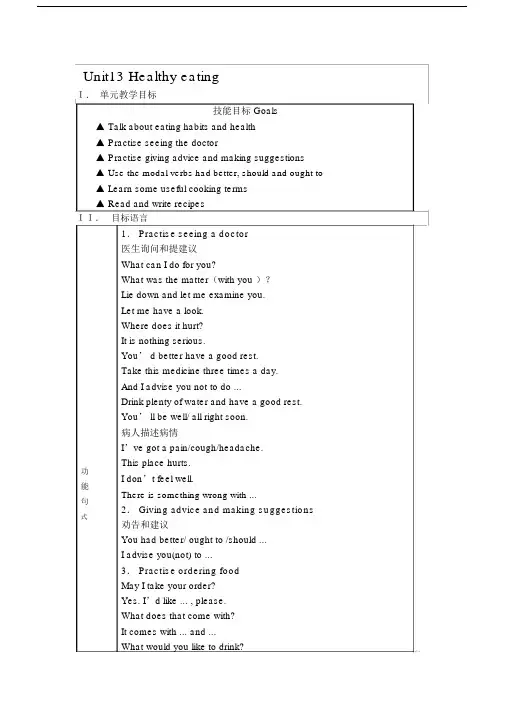
Unit13Healthyeating
- 格式:docx
- 大小:32.68 KB
- 文档页数:16
Unit13Healthyeating
1. Look at the pictures above. Decide if they are junk food or
healthy food. Give reasons for your decisions.
看看上面的图画,确定它们是垃圾食品还是健康食品,并给出理由。
above在句中是副词作后置定语。再如:Soon the whole floor
was on fire and it was impossible for people on the floors above
to escape.很快整层楼都烧起来,楼上的人难以脱身。
②Have a dialogue like the one above about keeping a bird.编一个跟上面一样的有关养鸟的对话。
英语中有很多副词可用作后置定语,如:the day before前天 the
way ahead前面的路 the man here这儿的这个人 the street below下面的街道
【提示」above也可用作前置定语,如:
③Please send the parcel to the above address.请把包裹寄到上述地址。
reason的介词用法
表示什么方面的原因时,reason后有介词for;表示因为某种原因时,用for…reason.
①There are many reasons for animals dying out. 动物的绝种有许多原因。
②He had to move abroad for political reasons.因为政治上的原因他不得不移居国外。
【拓展】reason作主语时,表语从句用that引导,而不用because;reason后的定语
从句根据引导词在从句中的作用,分别用 why(=for which),that或 which。如:
③The reason was that he was having a high fever.原因是他正发高烧。 ④The reason why we are late is that our car did not come.
我们来晚的原因是我们的汽车没来。(why在从句中作状语,可以换成 for which,此时也可用that,还可以不用引导词。)
⑤The reason(that/which)he gave was not very
sound.他给出的理由不太充分。(hat/which在从句中作宾语,所以可以省略,此时不用 why或 for which。)
2.I think that vegetables are healthy food because they
contain lots of vitamins. 我认为在莱是不错的食品,因为它们含有大量维生素。
contain的用法 用作及物动词,意为“包含;包括;容纳(不用进行时);控制,抑制”。如:
①What does the medicine contain. Dr. Yang?杨大夫,这药含什么成分?
②Sea water contains salt.海水含有盐分。
③The hall can contain five hundred people.大厅可容纳 500人。(=hold)
④She couldn't contain herself for joy.她高兴地难以自制。
辨析:contain与include
contain指作为组成部分而被“包含”或“容纳”在内。include侧重于作为整体中的一部分而被包括进去。
⑤How much does this bottle contain?这个瓶子能装多少?
⑤Books contain knowledge.书籍蕴含知识。
①Everyone here took part in the fight against the flood,including old people.这里所有的人,包括老人,都参加了抗洪斗争。
③Everybody had something to say,me included.所有的人,包括我在内,都有些话要说。
3.Ask your classmates what they like to eat. Make a list of
the foods and decide if what they eat is junk food or not.
问问你的同学他们喜欢吃什么。列出这些食物并确定它们是否是垃圾食品。 make a list of=list列出清单 如:
①Please make a list of the things I must buy.请列出我要买的东西。
②Try to make a list of the books which Philip is to read.设法列出菲力蒲要读的那些书。
if与whether表示“是否”时的区别 在动词后引起宾语从句时,二者可以换用。如:
①Please see if the children are dressed for school.请看一下孩子们是否穿好衣服要去上学了。(if=whether)
if不和 or not直接连用,而 whether可以。如:
②He didn't say if he'll be staying here or not.他没说是否要留在这儿。(不能说计 or not he’11 be staying her,)
③Please tell me whether or not you agree.请告诉我你是否同意。(或 whether you agree or not)
与不定式连用时,只能用whether。如:
④I don't know whether to answer it (or not). 我不知道是否应当给予回答。(不用if)
引起同位语从句时,只能用whether。如:
⑤You have yet to answer my question whether can count on
your vote.你还得回答我的问题:我是否能指望你的选票。(不用if)
引起表语从句时,只能用whether。如:
⑤What we want to know is whether he'll come on time. 我们想知道他是否会准时来。(不用if)
引起主语从句时,if从句不能位于句首,而whether可以。如:
① It is not clear to me if/whether she likes the present.
她是否喜欢这件礼物,我还不清楚。(或 Whether she likes the
present is not clear to me.)
1. What's wrong with Mike?麦克怎么了?
本句中的 wrong也可换成the matter或 the trouble,意为“麻烦事,毛病,差错”,常与介词With连用。如: ①What's wrong/the matter/the trouble with her eyes?她眼睛怎么啦?
相关句式
②There's nothing wrong/the matter with the machine.这机器设毛病。
③Something must have gone wrong with your watch.你的表肯定有毛病了。
④He said that he didn't feel well and I asked him what was
wrong/the matter. 他说他感到不舒服,我问他怎么回事。(what在从句中作主语,所以不能说… what the matter was.)
2. Can you give Mike some advice? What should he eat less
of ? 你能给麦克提些忠告吗?他应该少吃什么?
advice是不可数名词,表示“一条建议”时,需用a piece of
advice。如:
①Now I want to give you some advice.现在我想给你提点建议。
②Let me give you a piece of advice.我给你提个建议吧。
advice的常用搭配 give advice 提出建议 ask(for)one’s
advice 征求意见 take/follow one’s advice 听从劝告
eat less中的 less为 little的比较级,由于此处不表示可数概念,所以不能换成 fewer.
3.Which side of Mike’s stomach hurts?麦克的胃部哪边痛?
hurt在本句中用作不及物动词,意为“疼”。如:
①My arm hurts.我胳膊疼。 ②Does your leg still hurt?你的腿还疼吗?
拓展」hurt也可用作及物动词。如:③The wound still hurts
him.他仍然感到伤口疼。
辨析:hurt,harm,wound与 iujure
hurt常指精神上或肉体上的伤害,含有强烈的疼痛。harm指对人或事物造成危害,这种危害不一定是直接的,也不一定有痛楚。wound通常指外界暴力造成创伤,多指枪、刀伤害,也可指感情上的伤害。injure着重指健康、机能、外貌的伤害或损害,多指意外或事故造成伤害。
④His words hurt me/my feelings.他的话伤了我/我的感情。
⑤He fell and hurt his leg,他掉下来伤了腿。
⑤Smoking seriously harmed his health.吸烟严重伤害了他的健康。
①He got wounded in the battle.他在战斗中受伤。
③Several children were injured in the accident.好几个孩子在那次事故中受伤。
4.Does Mike have a fever?麦克发烧吗?
have a fever意为“发烧”,fever一般用作不可数名词,有时可与不定冠词连用。如:
①He has a high fever.他发高烧。 ②She hasn’t much
fever.她发烧不厉害。
③I ran a high fever and was sick at my stomach.我发着高烧,肚子又疼。
1.I’ve got a pain here.我这儿疼。
pain的用法 (1)表示身体某部位的疼时,为可数名词。如:She
has a pain In her back/leg/head.她背(腿、头)疼。
(2)表示由损伤或疾病引起的痛苦、疼痛时,为不可数名词。如:Her back causes her a lot of Pain.她的背使她很疼。