
moral learning
- 格式:ppt
- 大小:246.50 KB
- 文档页数:8

Morality is a fundamental aspect of human society that guides our actions and decisions.It is a set of principles and values that dictate what is right and wrong,good and bad.In this essay,we will explore the importance of morality,its sources,and how it influences our lives.The Importance of MoralityMorality plays a crucial role in maintaining social order and harmony.It helps individuals to distinguish between acceptable and unacceptable behaviors,promoting a sense of responsibility and respect for others.Without a moral compass,society would likely descend into chaos,as individuals would act solely based on their selfinterests without considering the consequences of their actions on others.Sources of MoralityThe sources of morality are diverse and can be traced to various influences such as:1.Religion:Many moral codes are derived from religious teachings,which often providea framework for ethical living.For instance,the Ten Commandments in Christianity,the Five Pillars of Islam,and the Dharma in Buddhism all offer guidance on moral conduct.2.Culture and Tradition:Cultural norms and traditions also shape moral values.What is considered moral in one culture may not be in another,reflecting the diversity of moral perspectives across the globe.3.Philosophy:Philosophers throughout history have contributed to the understanding of morality.For example,Immanuel Kants categorical imperative and John Stuart Mills utilitarianism offer different approaches to ethical decisionmaking.w:Legal systems often reflect and enforce moral standards,although they may not always align perfectly with individual or societal moral beliefs.5.Personal Experience and Reasoning:Individuals develop their own moral understanding through personal experiences,education,and reasoning.Influence of Morality on Personal and Social LifeMorality impacts both personal and social life in several ways:1.Personal Development:Moral values guide personal development by helpingindividuals to cultivate virtues such as honesty,integrity,and compassion.2.Relationships:Moral principles are essential in building and maintaining healthy relationships.Trust,respect,and empathy are all moral qualities that foster strong bonds between people.3.Professional Life:In the workplace,moral behavior is crucial for creating a fair and ethical environment.This includes principles such as honesty,fairness,and accountability.4.Societal Progress:Morality drives societal progress by encouraging actions that benefit the community as a whole,such as volunteering,philanthropy,and advocating for social justice.5.Conflict Resolution:Moral reasoning helps in resolving conflicts by promoting understanding,compromise,and the pursuit of justice.Challenges to MoralityDespite its importance,morality faces several challenges in contemporary society:1.Relativism:The idea that moral values are subjective and vary from person to person can lead to moral ambiguity and a lack of consensus on ethical issues.2.Materialism:The pursuit of material wealth and success can overshadow moral considerations,leading to unethical practices in the quest for personal gain.3.Technological Advancements:New technologies present ethical dilemmas,such as those related to artificial intelligence,genetic engineering,and data privacy,which challenge traditional moral frameworks.4.Globalization:The interconnectedness of the world can lead to clashes of moral values, as different cultures and belief systems interact.ConclusionMorality is an essential component of human existence,providing a guide for ethical behavior and contributing to the betterment of society.While challenges exist,the importance of moral values remains undeniable.It is through the cultivation andapplication of these values that we can hope to build a more just,compassionate,and harmonious world.。
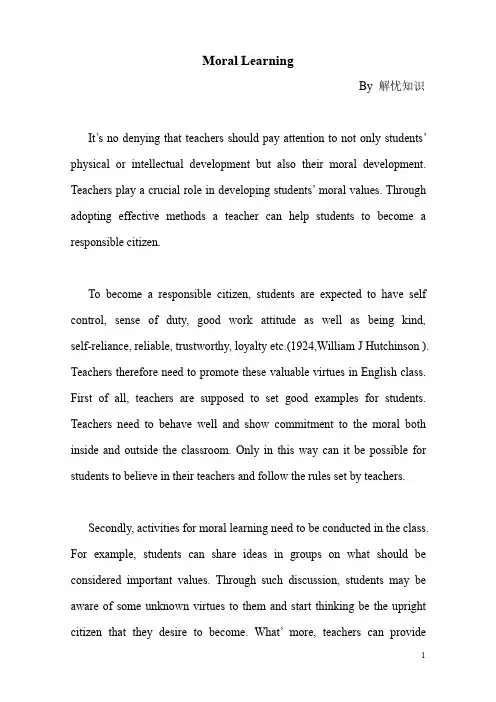
Moral LearningBy解忧知识It’s no denying that teachers should pay attention to not only students’physical or intellectual development but also their moral development. Teachers play a crucial role in developing students’moral values.Through adopting effective methods a teacher can help students to become a responsible citizen.To become a responsible citizen,students are expected to have self control,sense of duty,good work attitude as well as being kind, self-reliance,reliable,trustworthy,loyalty etc.(1924,William J Hutchinson). Teachers therefore need to promote these valuable virtues in English class. First of all,teachers are supposed to set good examples for students. Teachers need to behave well and show commitment to the moral both inside and outside the classroom.Only in this way can it be possible for students to believe in their teachers and follow the rules set by teachers.Secondly,activities for moral learning need to be conducted in the class. For example,students can share ideas in groups on what should be considered important values.Through such discussion,students may be aware of some unknown virtues to them and start thinking be the upright citizen that they desire to become.What’more,teachers can providestudents topics based on social issues which they can write about.In this way,students have great opportunities to express their ideas,values,and feelings on it.It’s always beneficial for students to explore moral issues themselves.Besides,to make the lesson favorable and conductive,teachers can also arrange students in role play.Act out and find the solutions to situations over some problems that they are likely to encounter in daily life. For instance,some students can’t get along well with classmates or always quarrel with parents.The role play can proceed like“Do you have any problems recently?”“Yes.I had a fight with my cousin.”“I think you can deal with it by talking with him.”After the role play,they may figure out many ways towards their problems.Furthermore,it’s a common method that students are introduced to many moral messages that can lead students to have a healthy life and positive attitudes.We can’t count on the students making contribution to our society if they don’t have positive moral values.Teachers thus should give tremendous considerations in building their integral moral values and helping students to become a responsible citizen.。

英语教学论作业习题集Unit 1 Language and Language Learning1.What are the three views on language?1) Structural view on language:The structural view sees language as a linguistic system made up of various subsystems: from phonological, morphological, lexical, etc. to sentences. Each language has a finite number of such structural items. To learn a language means to learn these structural items so as to be able to understand and produce language.This view on language limits knowing a language to knowing its structural rules and vocabulary.2) Functional view on language:The functional view sees language as a linguistic system but also as a means for doing things. Learners learn a language in order to be able to do things with it. To perform functions, learners need to know how to combine the grammatical rules and the vocabulary to express notions that perform the functions. This view on language adds the need to know how to use the rules and vocabulary to do whatever it is one wants to do.3) Interactional view on language:The interactional view considers language as a communicative tool, whose main use is to build up and maintain social relations between people. Therefore, learners not only need to know the grammar and vocabulary of the language but as importantly they need to know the rules for using them in a whole range of communicative contexts. This view on language says that to know how to do what one wants to do involves also knowing whether it is appropriate to do so, and where, when and how it is appropriate to do it. In order to know this, the learner has to study the patterns and rules of language above the sentence level to learn how language is used in different speech contexts.2. What are the views on language learning?1) Behaviourist theory:The behaviorist theory of language learning was initiated by behavioral psychologist Skinner, who applied Watson and Raynor’s theory of conditioning to the way humans acquire language (Harmer, 1983) The key point of the theory of conditioning is that “you ca n train an animal to do anything if you follow a certain procedure which has three major stages, stimulus, response, and reinforcement”(Harmer1983: 30) Based on the theory of conditioning, Skinner suggested language is also a form of behavior. It can be learned the same way as an animal is trained to respond to stimuli. This theory of learning is referred to as behaviorism.2) Cognitive theory:The term cognitivism is often used loosely to describe methods in which students are asked to think rather than s imply repeat. It seems to be largely the result of Noam Chomsky’s reaction to Skinner’s behaviorist theory, which led to the revival of structural linguistics. According to Chomsky, language is not a form of behaviour, it is an intricate rule-based system and a large part of language acquisition is the learning of this system. There are a finite number of grammatical rules in the system and with knowledge of these rules an infinite of sentences can be produced. A language learner acquires language competence, which enables him to produce language.3)Constructivist theoryThe constructivist theory believes that learning is a process in which the learner constructs meaning based on his/her own experiences and what he or she already knows. It is believed that education is used to develop the mind, not just to rote recall what is learned. John Dewey(杜威) believed that teaching should be built based on what learners already knew and engage learners in learning activities. Teachers need to design environments and interact with learners to foster inventive, creative, critical learners. Therefore, teachers must balance an understanding of the habits, characteristics as well as personalities of individual learners with an understanding of the means of arousing learners’ interests and curiosity for learning.4)Socio-constructivist theoryVygotsky(前苏联心理学家维果茨基,1978) emphasizes interaction and engagement with the target language in a social context based on the concept of “Zone of Proximal Development” (ZPD「可能发展区/最近发展区」) and scaffolding「鹰架/支架/脚手架」. That is to say, learning is best achieved through the dynamic interaction between the teacher and the learner and between learners. With the teacher’s scaffolding through questions and explanations, or with a more capable peers’ support, the learner can move to a hig her level of understanding and extend his/her skills and knowledge to the fullest potential.3. What are the qualities of a good language teacher?The main elements of a good English teacher are ethic devotion, professional qualities, and personal styles. (Then try to explain these three elements respectively according to your own understanding)Unit 2 Communicative Principles and Task-based Language Teaching1. What is communicative competence?Hedge (2000: 46-55) discusses five main components of communicative competence: linguistic competence, pragmatic competence, discourse competence, strategic competence, and fluency.Communicative competence entails knowing not only the language code or the form of language, but also what to say to whom and how to say it appropriately in any given situation. Communicative competence includes knowledge of what to say, when, how, where, and to whom.2. What are the three principles of communicative language teaching?a) the communicative principle: Activities that involve real communication promote learning.b) the task principle: Activities in which language is used for carrying out meaningful tasks promote learning (Johnson 1982).c) the meaningfulness principle: Language that is meaningful to the learner supports the learning process.3. What are the six criteria for evaluating communicative classroom activities?1) communicative purpose2) communicative desire3) content, not form4) variety of language5) no teacher intervention6) no material control4. What is Task-based Language Teaching?Task-based Language teaching is, in fact, a further development of Communicative Language Teaching. It shares the same beliefs, as language should be learned as close as possible to how it is used in real life. It has stressed the importance to combine form-focused teaching with communication-focused teaching.Unit 3 The National English Curriculum1. What are the designing principles for the National English Curriculum 2001?1)Aim for educating all students, and emphasise quality-oriented education.2)Promote learner-centredness, and respect individual differences.3)Develop competence-based objectives, and allow flexibility and adaptability.4)Pay close attention to the learning process, and advocate experiential learning and participation.5)Attach particular importance to formative assessment, and give special attention to the development of competence.6)Optimize learning resources, and maximize opportunities for learning and using the language.2.What are the goals and objectives of English language teaching?The new curriculum is designed to promote students’ overall language ability, which is composed of five interrelated components, namely, language skills, language knowledge, affects, learning strategies and cultural understanding. Each component is further divided into a few sub-categories. Language teaching is no longer aimed only for developing language skills and knowledge, but expanded to developing learners’ positive attitude, motivation, confidence as well as strategies for life-long learning along with cross-cultural knowledge, awareness and capabilities.3. What are the challenges facing English language teachers?1)English language teachers are expected to change their views about language which is not a system of linguistic knowledge but a means for communication.2)English language teachers are expected to change their traditional role of a knowledge transmitter to a multi-role educator.3)English language teachers are expected to use more task-based activities and put the students at the center of learning.4)English language teachers are expected to use more formative assessment in addition to using tests.5)English language teachers are expected to use modern technology in teaching, creating more effective resources for learning and for using the language.Unit 4 Lesson Planning1. Why is lesson planning necessary?Lesson planning means making decisions in advance about what techniques, activities and materials will be used in the class. It is obvious that lesson planning is necessary.Benefits:1) To make the teacher aware of the aims and language contents of the lesson.2) To help the teacher distinguish the various stages of a lesson and to see the relationship between themso that the lesson can move smoothly from one stage to another.3) Proper lesson planning gives the teacher opportunity to anticipate potential problems that may arisein class so that they can be prepared with some possible solutions or other options for the lesson.4) Lesson planning gives teachers, especially novice teachers, confidence in class.5) The teacher also becomes aware of the teaching aids that are needed for the lesson.6) Lesson planning helps teachers to think about the relative value of different activities and how muchtime should be spent on them. The teacher soon learns to judge lesson stages and phases withgreater accuracy.7) The plan, with the teacher’s comments and corrections, provides a useful, time-saving referencewhen the teacher next plans the same lesson.8) Lesson planning is a good practice and a sign of professionalism.2. What are the principles for good lesson planning?Aims— means the realistic goals for the lesson. That is, the teacher needs to have a clear idea of what he / she would like to achieve for the lesson or what outcomes are expected from the lesson.Variety—means planning a number of different types of activities and where possible, introducing students to a wide selection of materials so that learning is always interesting ,motivation and never monotonous for the students.Flexibility—means planning to use a number of different methods and techniques rather than being a slave to one methodology. This will make teaching and learning more effective and more efficient.Learnability—means the contents and tasks planned for the lesson should be within the learning capability of the students. Of course, things should not be too easy either. Doing things that are beyond or below the students’ coping ability will diminish the ir motivation.Linkage--means the stages and the steps within each stage are planned in such a way that they are somehow linked with one another. Language3 learning needs recycling and reinforcement.3. What are macro planning and micro planning?Macro planning is planning over a longer period of time, for instance, planning for a whole program or a whole-year course.In a sense, macro planning is not writing lesson plans for specific lessons but rather helping teachers get an overall felling or idea about the course and also get familiarized with the context in which language teachingtakes place. Macro planning involves the following:1) Knowing about the course:The teacher should get to know which language areas and language skills should be taught or practised in the course, what materials and teaching aids are available, and what methods and techniques can be used.2) Knowing about the institution:The teacher should get to know the institution’s arrangements regarding time, length, frequency of lessons, physical conditions of classrooms, and exam requirements.3) Knowing about the learners:The teacher should acquire information about the students’ age range, sex ratio, social background, motivation, attitudes, interests, learning needs and other individual factors.4) Knowing about the syllabus:The teacher should be clear about the purposes, requirements and targets specified in the syllabus.Much of macro planning is done prior to the commencement of a course. However, macro planning is a job that never really ends until the end of the course.Micro planning is planning for a specific unit or a lesson, which usually lasts from one to two weeks or forty to fifty minutes respectively.Micro planning should be based on macro planning, and macro planning is apt to be modified as lessons go on.4. What are the components of a lesson plan?A language lesson plan usually has the following components: background information, teaching aims (what language components to present, what communicative skills to practice, what activities to conduct and what materials and teaching aids to be used), language contents (grammar, vocabulary, functions, topics and so on) and skills (listening; speaking; reading and writing), stages (the major steps that language teachers go through in the classroom) and procedures (detailed steps in each teaching stage), teaching aids, assignments, and teacher’s after-class reflection.5. What are the 3P’s model and 3-stage model?The 3P’s m odel refers to presentation, practice and production.At the presentation stage, the teacher introduces new vocabulary and grammatical structures in whatever ways appropriate.At the practice stage, the lesson moves from controlled practice to guided practice and further to the exploitation of the text when necessary.At the production stage, the students are encouraged to use what they have learned and practised to perform communicative tasks. The focus is on meaning rather than accurate use of language forms.3-stage model is frequently adopted in reading lessons and listening lessons. It refers to pre-reading, while-reading and post-reading stages. The pre-stage i nvolves preparation work, such as setting the scene, warming up, or providing key information (such as key words). The while-stage involves activities or tasks that the students must perform while they are reading or listening. The post-stage provides a chance for students to obtain feedback on their performance at the while-stage. This last stage may also involve some follow-up activities, in which students relate what they have read or heard to their own life and use the language spontaneously.Unit 5 Classroom Management1.What are the main roles teachers can play before, during and after the class?Before the class, the teacher is a planner, who plans what to teach, how to teach, and what result to achieve. After then class, the teacher is an evaluator, who evaluates not only how successfully he/she has conducted the class but also how efficient the learning activities have been. Based on the functions that the teacher performs in different activities during the class, Harmer defines the teacher’s roles as controller, assessor, organizer, prompter, participant and resource-provider (Harmer, 1983).2.How to give effective classroom instructions?Proper instruction is the precondition of accomplishment of activities. To give appropriate instruction, it is necessary to follow the following principles.(1) Economy with words: the teacher should use as few words as possible.(2) Simple and clear language at all points: language should be easy to understand.(3) Demonstration of what is needed.(4) Check of students understanding: the teacher can check individual students to make sure that students understand the instruction and know what to do.(5) Use the native language when necessary.(6) Vary the instruction now and then.3.What are the different ways for student grouping?The most common student groupings are lockstep, pair work, group work, and individual study.Lockstep (Whole class work) is where all the student are under the control of the teacher. They are all doing the same activity at the same rhythm and pace. Lockstep is often adopted when the teacher is making apresentation, checking exercise answers, or doing accuracy reproduction. When the teacher asks questions, the students speak either together or one by one, in turns or indicated by the teacher.Pair work is where the students work in pairs. It could be a competition over a game or co-operation in a task or project between the two students. They could also do certain exercises together or oral practice. When the students are doing pair work, the teacher usually circulates around the classroom, answering question or providing help when necessary.Group work is where the students work in small groups. Each group has 3,4,or 5 students, depending on the activity. What students do in group work is similar to pair work, only there are more members in the group. Group work is most beneficial when the activity requires contributions from more than two students. The teacher can join each group for a while, but only as a participant not as a leader or inspector.Individual study is the stage during the class where the students are left to work on their own and at their own speed. Usually they are doing the same task, but the teacher may give them a choice of tasks. Some activities cannot be done in pairs or groups, for instance, reading and writing. People read at different speed, so they cannot read together, though two people might share one book. It seems writing can be done in pairs or groups, but what they are actually doing when they are working together is brainstorming ideas, discussing, or revising. When it comes to the real writing stage students should work individually.4.How to ask effective questions?1)Questions should be closely linked with the teaching objectives in the lesson;2)Questions should be staged so that the level of challenge increases as the lesson proceeds;3)There should be a balance between closed and open, lower-order and higher-order questions;4)Wait time is important to allow students to think through their answers;5)Students should be provided opportunities to ask their own questions and seek their own answers;6)A secure and relaxed atmosphere of trust is needed and students’ opinions and ideas are valued.5.How to treat students’ errors in the classroom?There are different ways and techniques for correcting errors, such as direct teacher correction, indirect teacher correction, self-correction, peer correction, whole classroom correction, etc. As a general rule, indirect teacher correction is encouraged rather than direct teacher correction to avoid damaging students’ self esteem and confidence. Also, self-correction is encouraged before teacher correction or peer correction.Unit 6 Teach Pronunciation1. What is the goal of teaching pronunciation?The goal of teaching pronunciation is not to teach learners to achieve a perfect imitation of a native accent, but simply to get the learners to pronounce accurately enough to be easily and comfortably comprehensible to other speakers.The realistic goals of teaching pronunciation:Consistency: The pronunciation should be smooth and natural.Intelligibility: The pronunciation should be understandable to the listeners.Communicative efficiency: The Pronunciation should help to convey the meaning that is intended by the speaker.2. What aspects of pronunciation do we need to teach?1)sounds………the vowels and consonants of English2)combination of sounds…….pronunciation of words3)word stress….the stress in a word and shift of stress4)strong & weak forms…the importance of the different syllables in maintaining the rhythm of the speech, especially the model verbs and auxiliary verbs5)linkage of sounds……..the liaison of sound in natural speech6)rhyme & rhythm7)pitch & intonation…the function of pitch and intonation in conveying meaning8)filler words……the sounds which d o not convey meaning but can help to maintain communication, e.g. uh huh, um, er, oh, ah, well.Unit 7 Teaching Grammar1.What are the major types of grammar presentation methods?Deductive method: the teacher presents the rule of the structure on the blackboard and explains it to the students. This would be followed by the teacher giving several examples and then asking the students to apply the rules themselves in some exercises.Inductive method: The teacher does not explain the rule at the beginning, but presents various language forms and the students are left to discover or induce the rules or generalizations on their own.The guided discovery method:is similar to the inductive method in that the students are induced to discover rules by themselves but different in that the process of the discovery is carefully guided and assisted by the teacher and the rules are then elicited and taught explicitly.2.What are the major types of grammar practice activities?Mechanical practice involves activities that are aimed at form accuracy. By doing mechanical practice,the students pay repeated attention to a key element in a structure. Substitution and transformation drills are most frequently used in mechanical practice.Meaningful practice the focus is on the production, comprehension or exchange of meaning though the students “keep an eye on” the way newly learned structures are used in process. Meaningful practice usually comes after mechanical practice.Unit 8 Teaching Vocabulary1.What does knowing a word involve?A simple answer would be (1)knowing its pronunciation & stress; (2) knowing its spelling & grammar; (3) knowing its meaning; (4) knowing how & when to use it to express the intended meaning.According to Hedge (2000), vocabulary learning involves at least two aspects of meaning. The first aspect involves the understanding of its denotative and connotative meaning. The second aspect involves understanding the sense relations among words.2.How can we present new vocabulary items effectively?1) Draw pictures, diagrams and maps to show meanings or connections of meaning2) Use real objects to show meanings;3) Mime or act to show meaning; ask some ss come to the front and teach some words of this kind, such as: catch, shave4) Use lexical sets. Or word series. E.g. cook: fry, boil, bake, and frill;5) Use synonymous and antonymous to explain meanings;6) Translate and exemplify, especially with technical words or words with abstract meaning;7) Use word formation rules and common affixes.8) Teach vocabulary in chunks;9) Provide different contexts in real life for introducing new words.3.What are some effective ways to consolidate vocabulary?1) Labeling;2) Spotting the differences;3) Describing and drawing;4) Playing a game;5) Using word series;6) Word bingo;7) Word association;8) Finding synonyms and antonyms;9) Using word categories;10) Using word net-work;11) Using the internet resources for more ideas.Unit 9 Teaching Listening1.What are the characteristics of the listening process?Generally speaking, listening in real life has the following characteristics:a) spontaneity: we listen to people speaking spontaneously and informally without rehearsing what they are going to say ahead of time.b) context: the context of listening is usually known to both the listener and the speaker in real life.c) visual clues: most of the time we can see the participants’ facial expressions, gestures and other body language as well as the surrounding environment.e) listener’s response: m ost of the listening in daily life allows the listener to respond to the speaker.f) speaker’s adjustment: the speaker can adjust the way of speaking according to the listener’s reactions.2.What are the models of teaching listening?1)Bottom-up model: listening comprehension is believed to start with sound and meaningrecognitions2)Top-down model: listening for the gist and making use of the contextual clues and backgroundknowledge to construct meaning are emphasized.3)Interactive model: listening involves both bottom-up processing (recognizing sounds of words,phrases or structures) and top-down processing (inferring meaning from broad contextual clues and background knowledge).3.What are the common activities in teaching listening?1) Pre-Listening activities: predicting and setting the scene2) While-listening activities:listening for the gist; listening for specific information; no specificresponses; listening and ticking; listening and sequencing; listening and acting; listening and drawing; listening and filling; listening and guessing; listening and taking notes.3) Post-listening stage: multiple-choice questions; answering questions; note-taking and gap-filling; dictoglossUnit 10 Teaching Speaking1.What are the main characteristics of spoken language?a. in fairly simple sentence structuresb. in incomplete sentencesc. in informal, simple or common vocabularyd. with broken grammar, false starts, hesitation, fillers, etc.e. with a high proportion of repetition or redundancyf. largely unplanned organizationg. a low density of informationh. context independent (Background knowledge is necessary to understand exactly what is being expressed.)2. What are the characteristics of successful speaking activities?1) Maximum foreign talk: Problems: students spend too much time to speak Chinese; the teacher talks too much.2) Even participation: encourage speaking from as many different students as possible. The outspoken students do not dominate discussion.3) High motivation: various interesting tasks in line with the students’ ability.4) Right language level: the task should be designed so that students con complete it successfully with the language that they have.3. What are the main types of speaking activities?1)controlled activities;2)semi-controlled activities;3)information-gap activities;4)dialogues and role-plays;5)activities using pictures;6)problem-solving activities…Unit 11 Teaching Reading1. What are the main reading skills?Skimming: the reader moves his eyes over the text very quickly just in order to get the main idea of the text, or sometimes decide whether it is worth reading more deeply or not.Scanning: the reader locates a particular piece of information without necessarily understanding the rest of a text or passage. For example, the reader may read through a chapter of a book as rapidly as possible in order to find out information about a particular date, such as when someone was born.Inferring: reading between the lines. Make use of syntactic, logical and cultural clues to discover the meaning of unknown elements. Such as the writer’s opinions and attitudes which are not directly stated in the text.【Strategic skills needed in reading:Distinguishing the main idea from supporting details; Skimming: reading for the gist or main idea; Scanning: reading to look for specific information; Predicting: guessing what is coming next】2. What are the main reading models for teaching reading?Bottom-up approach: The reader builds up the meaning of a text on the basis of decoding smaller units: first words, and phrases, then sentences and paragraphs, and finally working out the meaning of the whole text.Top-down approach: The reader uses his or her knowledge of the topic or of the type of the text and makes predictions about what the text will contain, then he uses these predictions to check his understanding of the text. In this way, the reader gets a global view of the text before he dives into the details of it.Interactive approach: The reader uses the above two approaches together, and the two ways interact with each other in the understanding of the text. That means the reader might predict the context of the text by using his knowledge of the topic (top-down), then look for key words (bottom-up) to check the prediction, or get the main gist of the text by skimming it quickly (top-down) and examine the writer’s choice of vocabulary for understanding the implied meaning.3. What types of activities can we use in teaching reading?。

乔布斯经典语录:活着就是为了改变世界英文版他的成就和人格魅力影响了一代人和整个世界,他就是拥有梦幻般传奇经历的苹果电脑公司的创始人斯蒂夫·乔布斯。
这个个人电脑领域的梦想家引领并改变了整个计算机硬件和软件产业。
这个精力充沛魅力无限的家伙同时也是一个很会鼓动人心的激励大师,甚至在他的平常对话中,经典的语句也常常脱口而出。
这里摘取了一些经典的乔氏语录,希望对你有所帮助。
Innovation distinguishes between a leader and a follower.领袖和跟风者的区别就在于创新。
Innovation has no limits. The only limit is your imagination. It's time for you to begin thinking out of the box. If you are involved in a growing industry, think of ways to become more efficient; more customer friendly; and easier to do business with. If you are involved in a shrinking industry – get out of it quick and change before you become obsolete; out of work; or out of business. And remember that procrastination is not an option here. Start innovating now!创新无极限!只要敢想,没有什么不可能,立即跳出思维的框框吧。
如果你正处于一个上升的朝阳行业,那么尝试去寻找更有效的解决方案:更招消费者喜爱、更简洁的商业模式。