
老年护理医院下呼吸道感染病原菌及耐药性分析
- 格式:ppt
- 大小:30.50 KB
- 文档页数:15


呼吸科下呼吸道感染患者痰标本中革兰阴性杆菌的病原菌分布及耐药性分析呼吸科下呼吸道感染是呼吸科常见的一种疾病,而痰标本中革兰阴性杆菌的病原菌分布及耐药性一直是呼吸科医生关心的话题。
近年来,革兰阴性杆菌对各类抗生素的耐药情况日益严重,给呼吸道感染的治疗带来了一定的困难。
对于呼吸科下呼吸道感染患者痰标本中革兰阴性杆菌的病原菌分布及耐药性进行深入的分析,对于临床医生来说尤为重要。
病原菌分布分析是对呼吸道感染的基础和起点,通过对患者痰标本中革兰阴性杆菌的病原菌分布进行分析,可以为呼吸科医生选择最合适的抗生素治疗提供依据。
根据前期调查,目前革兰阴性杆菌中以铜绿假单胞菌、不动杆菌、大肠埃希杆菌等为主要病原菌。
而革兰阴性杆菌的病原菌分布在不同地区、不同医院甚至不同科室中可能存在一定的差异,及时对当地的病原菌分布进行调查分析,有助于临床医生根据本地区的情况进行更有效的治疗。
对于呼吸科下呼吸道感染患者痰标本中革兰阴性杆菌的耐药性分析也是医生关注的焦点之一。
革兰阴性杆菌对于广谱抗生素的耐药情况一直备受关注。
研究表明,铜绿假单胞菌对β-内酰胺类、氨基糖苷类、喹诺酮类等多种抗生素具有较高的耐药率,而不动杆菌则对碳青霉烯类抗生素耐药情况较为严重,大肠埃希杆菌对β-内酰胺类抗生素也存在一定的耐药问题。
针对以上情况,医生应当根据当地革兰阴性杆菌的耐药情况对感染进行相应的抗生素治疗。
在治疗过程中,应当根据病人的具体情况进行耐药机制的分析和监测,以实现更加个性化和精准的治疗。
为了更好地了解和掌握革兰阴性杆菌的耐药情况,呼吸科医生应当加强对呼吸道感染患者痰标本中革兰阴性杆菌的病原菌分布及耐药性的研究。
通过采集痰标本并进行细菌培养和药敏试验,可以对患者的病原菌分布及耐药性进行及时、准确的分析。
可以利用分子生物学方法对耐药菌株进行分子鉴定和耐药基因检测,从而更加全面地了解革兰阴性杆菌的耐药机制,为临床治疗提供更为准确的依据。
在临床实践中,医生还应当注重抗生素的合理使用,避免滥用和不当使用抗生素导致耐药菌株的产生。

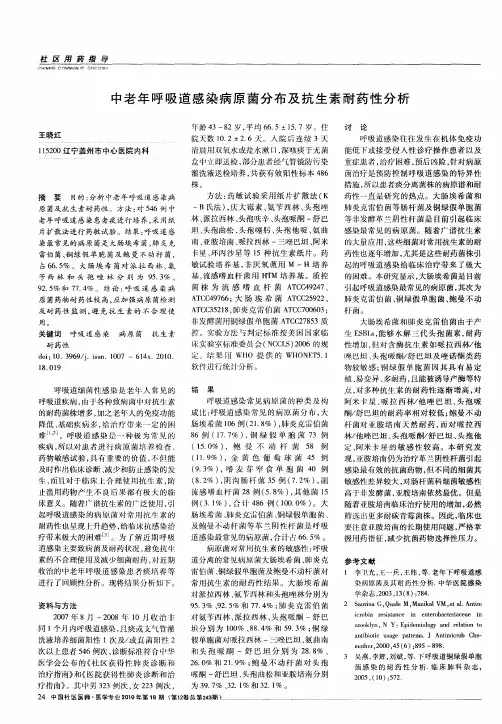
老年患者下呼吸道感染的病原菌分布及其耐药性分析李红丽【摘要】Objective To review the distribution and drug resistance of pathogens in nosocomial lower respiratory tract infections among 241 gerontal patients to provide reference for rational use of antimicrobial agents. Methods Sputum samples were collected from 687 hospitalized gerontal patients with lower respiratory tract infections. Pathogens were isolated from the sputum samples and bacterial rapid test kit and relevant software were applied to identify the types and antibiotic resistance of the pathogens. Results A total of 241 strains of pathogenic bacteria were isolated from the 687 patients ( detection rate : 35.1% ).Of these strains, 165 were Gram - negative bacillus ( 68.5% ), 35 were Gram - positive cocci ( 14.5% ) and 41 were fungi ( 17.0% ). The top three Gram - negative bacilli were Klebsiella pneumonia, Escherichia coli, and Pseudomonas aeruginosa.The top three Gram - positive cocci were Staphylococcus aureus, Staphylococcus haemolyticus and Staphylococcus epidermidis.Analysis of drug resistance showed that imipenem resistance rates of the three Gram - negative bacteria were the lowest, while ampicillin and ofloxacin resistance rates were the highest. The resistance rate of staphylococcus to penicillium was 100% . Staphylococcus was sensitive to vancomycin, imipenem and teicoplanin. Conclusion Gram - negative bacteria are the main pathogens of lower respiratory tract infections among gerontal patients, with Klebsiella pneumonia mostcommonly seen. Pathogen detection and drug resistance monitoring should be enhanced with the hope to promote the rational use of antimicrobial agents and to slow down the emergence of antibiotic - resistant strains.%目的分析我院老年患者下呼吸道感染病原菌的分布及其耐药情况,为临床合理选用抗菌药物提供科学的依据.方法收集687例老年下呼吸道感染患者的痰液标本进行细菌培养,分离病原菌,用珠海迪尔试剂盒及分析软件进行细菌鉴定及药物敏感试验.结果 687例老年下呼吸道感染患者的痰液标本共检出病原菌241株,检出率为35.1%,其中革兰阴性杆菌165株,占68.5%;革兰阳性球菌35株,占14.5%;真菌41株,占17.0%.革兰阴性杆菌前3位分别为肺炎克雷伯菌、大肠埃希菌、铜绿假单胞菌;革兰阳性球菌前3位是金黄色葡萄球菌、溶血葡萄球菌、表皮葡萄球菌.3种革兰阴性杆菌对亚胺培南的耐药率最低,对氨苄西林和左氧氟沙星的耐药率较高;葡萄球菌对青霉素的耐药率为100.0%,而对万古霉素、亚胺培南及替考拉宁均敏感.结论革兰阴性杆菌是老年患者下呼吸道感染的主要病原菌,最多的为肺炎克雷伯菌,应加强实验室对病原菌的耐药性监测,合理指导临床使用抗菌药,以减少耐药菌株的出现.【期刊名称】《中国全科医学》【年(卷),期】2011(014)027【总页数】3页(P3141-3143)【关键词】老年;呼吸道感染;病原菌;耐药性【作者】李红丽【作者单位】071051,河北省保定市第三中心医院检验科【正文语种】中文【中图分类】R56;R969.3下呼吸道感染是最常见的感染性疾患,尤其是老年人,而老年重症患者更是多发。
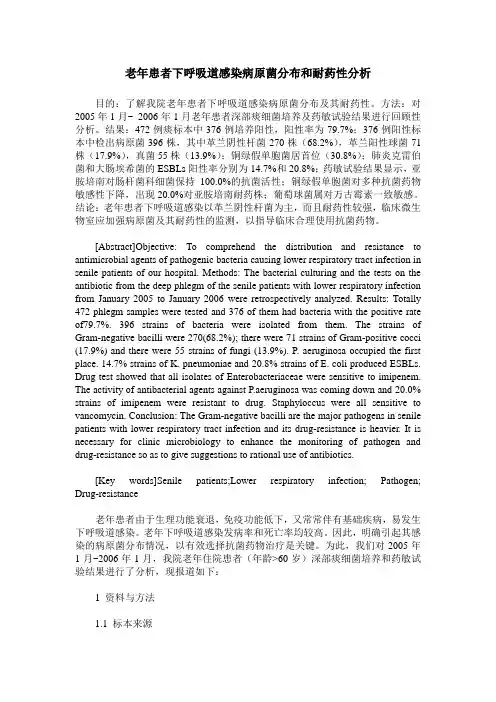
老年患者下呼吸道感染病原菌分布和耐药性分析目的:了解我院老年患者下呼吸道感染病原菌分布及其耐药性。
方法:对2005年1月~ 2006年1月老年患者深部痰细菌培养及药敏试验结果进行回顾性分析。
结果:472例痰标本中376例培养阳性,阳性率为79.7%;376例阳性标本中检出病原菌396株,其中革兰阴性杆菌270株(68.2%),革兰阳性球菌71株(17.9%),真菌55株(13.9%);铜绿假单胞菌居首位(30.8%);肺炎克雷伯菌和大肠埃希菌的ESBLs阳性率分别为14.7%和20.8%;药敏试验结果显示,亚胺培南对肠杆菌科细菌保持100.0%的抗菌活性;铜绿假单胞菌对多种抗菌药物敏感性下降,出现20.0%对亚胺培南耐药株;葡萄球菌属对万古霉素一致敏感。
结论:老年患者下呼吸道感染以革兰阴性杆菌为主,而且耐药性较强,临床微生物室应加强病原菌及其耐药性的监测,以指导临床合理使用抗菌药物。
[Abstract]Objective: To comprehend the distribution and resistance to antimicrobial agents of pathogenic bacteria causing lower respiratory tract infection in senile patients of our hospital. Methods: The bacterial culturing and the tests on the antibiotic from the deep phlegm of the senile patients with lower respiratory infection from January 2005 to January 2006 were retrospectively analyzed. Results: Totally 472 phlegm samples were tested and 376 of them had bacteria with the positive rate of79.7%. 396 strains of bacteria were isolated from them. The strains of Gram-negative bacilli were 270(68.2%); there were 71 strains of Gram-positive cocci (17.9%) and there were 55 strains of fungi (13.9%). P. aeruginosa occupied the first place. 14.7% strains of K. pneumoniae and 20.8% strains of E. coli produced ESBLs. Drug test showed that all isolates of Enterobacteriaceae were sensitive to imipenem. The activity of antibacterial agents against P.aeruginosa was coming down and 20.0% strains of imipenem were resistant to drug. Staphyloccus were all sensitive to vancomycin. Conclusion: The Gram-negative bacilli are the major pathogens in senile patients with lower respiratory tract infection and its drug-resistance is heavier. It is necessary for clinic microbiology to enhance the monitoring of pathogen and drug-resistance so as to give suggestions to rational use of antibiotics.[Key words]Senile patients;Lower respiratory infection; Pathogen; Drug-resistance老年患者由于生理功能衰退,免疫功能低下,又常常伴有基础疾病,易发生下呼吸道感染。