diction修辞学学习
- 格式:ppt
- 大小:510.00 KB
- 文档页数:34

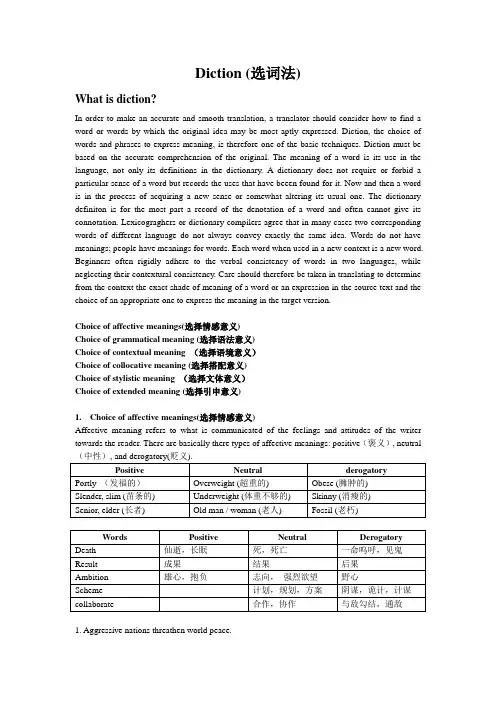
Diction (选词法)What is diction?In order to make an accurate and smooth translation, a translator should consider how to find a word or words by which the original idea may be most aptly expressed. Diction, the choice of words and phrases to express meaning, is therefore one of the basic techniques. Diction must be based on the accurate comprehension of the original. The meaning of a word is its use in the language, not only its definitions in the dictionary. A dictionary does not require or forbid a particular sense of a word but records the uses that have beeen found for it. Now and then a word is in the process of acquiring a new sense or somewhat altering its usual one. The dictionary definiton is for the most part a record of the denotation of a word and often cannot give its connotation. Lexicograghers or dictionary compilers agree that in many cases two corresponding words of different language do not always convey exactly the same idea. Words do not have meanings; people have meanings for words. Each word when used in a new context is a new word. Beginners often rigidly adhere to the verbal consistency of words in two languages, while neglecting their contextural consistency. Care should therefore be taken in translating to determine from the context the exact shade of meaning of a word or an expression in the source text and the choice of an appropriate one to express the meaning in the target version.Choice of affective meanings(选择情感意义)Choice of grammatical meaning (选择语法意义)Choice of contextual meaning (选择语境意义)Choice of collocative meaning (选择搭配意义)Choice of stylistic meaning (选择文体意义)Choice of extended meaning (选择引申意义)1.Choice of affective meanings(选择情感意义)Affective meaning refers to what is communicated of the feelings and attitudes of the writer towards the reader. There are basically there types of affective meanings: positive(褒义), neutral (中性), and derogatory(贬义).1. Aggressive nations threathen world peace.侵略成性的国家威胁世界和平。
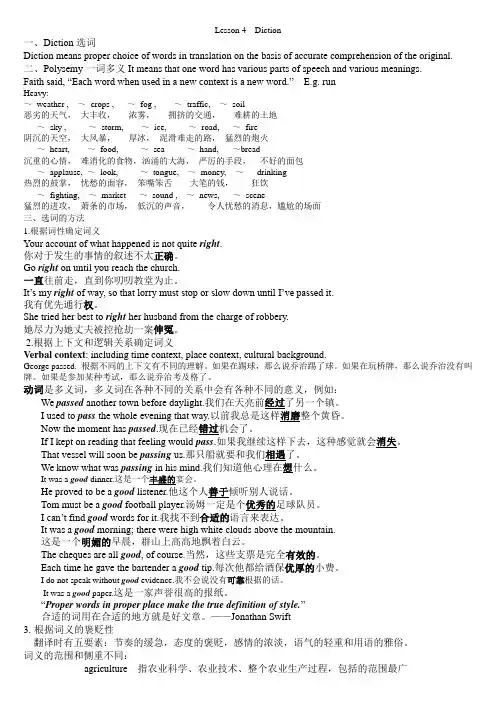
Lesson 4 Diction一、Diction选词Diction means proper choice of words in translation on the basis of accurate comprehension of the original. 二、Polysemy一词多义It means that one word has various parts of speech and various meanings.Faith said, “Each word when used in a new context is a new word.” E.g. runHeavy:~weather , ~crops , ~fog , ~traffic, ~soil恶劣的天气,大丰收,浓雾,拥挤的交通,难耕的土地~sky , ~storm, ~ice, ~road, ~fire阴沉的天空,大风暴,厚冰,泥滑难走的路,猛烈的炮火~heart, ~food, ~sea ~hand, ~bread沉重的心情,难消化的食物,汹涌的大海,严厉的手段,不好的面包~applause, ~look, ~tongue, ~money, ~drinking热烈的鼓掌,忧愁的面容,笨嘴笨舌大笔的钱,狂饮~fighting, ~market ~sound , ~news, ~scene猛烈的进攻,萧条的市场,低沉的声音,令人忧愁的消息,尴尬的场面三、选词的方法1.根据词性确定词义Your account of what happened is not quite right.你对于发生的事情的叙述不太正确。
Go right on until you reach the church.一直往前走,直到你叨叨教堂为止。
It’s my right of way, so that lorry must stop or slow down until I’ve passed it.我有优先通行权。