
新牛津译林苏教版五年级英语上册Unit4 Hobbies 第一课时优质课课件.ppt
- 格式:ppt
- 大小:2.82 MB
- 文档页数:26

Do one thing at a time, and do well.
1 小学英语译林牛津版五年级上册
小学英语译林牛津版五年级上册
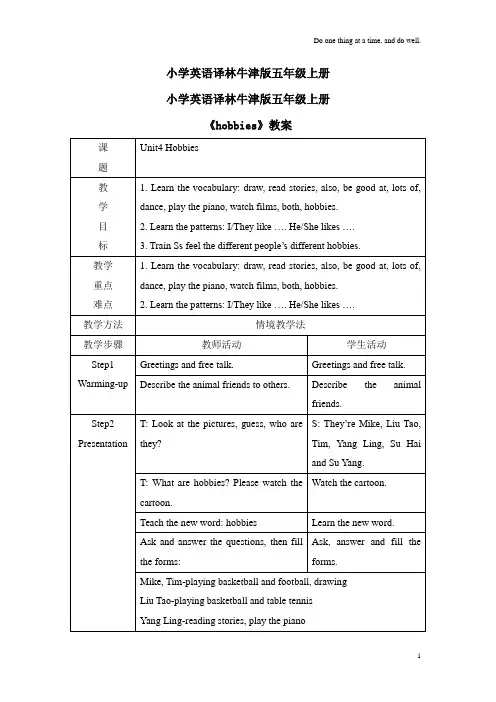
《hobbies》教案
课
题 Unit4 Hobbies
教
学
目
标 1. Learn the vocabulary: draw, read stories, also, be good at, lots of,
dance, play the piano, watch films, both, hobbies.
2. Learn the patterns: I/They like …. He/She likes ….
3. Train Ss feel the different people’s different hobbies.
教学
重点
难点 1. Learn the vocabulary: draw, read stories, also, be good at, lots of,
dance, play the piano, watch films, both, hobbies.
2. Learn the patterns: I/They like …. He/She likes ….
教学方法 情境教学法
教学步骤 教师活动 学生活动
Step1
Warming-up Greetings and free talk. Greetings and free talk.
Describe the animal friends to others. Describe the animal
friends.
Step2
Presentation T: Look at the pictures, guess, who are
they? S: They’re Mike, Liu Tao,
Tim, Yang Ling, Su Hai
and Su Yang.

语法讲解与强化训练
译林版五年级上册 Unit 4 Hobbies
【句型1】1.I like playing basketball and football.我喜欢打篮球和踢足球。
固定句型:主语+like(s)doing sth.
用法:like doing sth的意思是“喜欢做某事”。当其主语是第三人称单数时,like要变为第三人称单数形式。
例:—He likes singing.他喜欢唱歌。
like +ing (动名词形式)
知识拓展:动词原形--动名词形式:
(1)一般情况下,直接加 ing 形式:draw-drawing; read-reading; sing-singing
(2)以不发音 e 结尾的,去 e 加 ing 形式:dance-dancing; write-writing;
ride--riding; take--taking; like--liking, hope -hoping; have-having
(3)重读闭音节(只有一个元音字母+一个轴音字母结尾时)要双写结尾的辅音字母再加ing
sit-sitting;swim-swimming;put-putting;run-running;shop-shopping;jog--jogging;forget -forgetting;get-getting;stop-stopping;
1.—What ______ he ______ doing? ( )
—He ______ reading.
A.do; like; like B.does; likes; likes C.does; like; likes
2.—Peter, would you like _____ some bananas? ( )
—Yes, I like _____ bananas.
A.eating; to eat B.to eat; eating C./; eat

五年级上册译林unit4课文
一、单元主题概述。
本单元的主题是“Hobbies”,主要围绕人们的兴趣爱好展开。通过学习本单元,学生能够学会用英语表达各种不同的兴趣爱好,如阅读、绘画、跳舞、唱歌等,同时还能了解他人的兴趣爱好并进行相关的交流。这不仅有助于学生扩充英语词汇量,提高英语语言表达能力,还能增进学生对不同兴趣爱好的认识和理解,培养他们的文化素养和人际交往能力。
二、课文原文及翻译。
A. Read and try.
Wang Bing and his hobbies.
Wang Bing is my good friend. He has many hobbies. He likes playing
football and reading stories. He often plays football with his friends
after school. He reads stories at weekends. He can also play the piano very
well. He is good at drawing, too. He draws pictures for his classmates.
They all like his pictures.
译文。
王兵和他的爱好。
王兵是我的好朋友。他有很多爱好。他喜欢踢足球和读故事书。放学后,他经常和朋友们一起踢足球。他在周末读故事书。他钢琴也弹得非常好。他画画也很擅长。他为同学们画画。他们都喜欢他画的画。
B. Look and learn.
- hobby:兴趣爱好。例如:My hobby is collecting stamps.(我的爱好是集邮。)。 - play football:踢足球。注意“play”后面接球类运动时,球类名词前一般不加定冠词“the”。
- read stories:读故事书。“story”的复数形式是“stories”。

Unit 4
一般现在时的用法
一、定义
表示通常性、规律性、习惯性的状态或者动作(有时间规律发生的事件)的一种时间状态。
二、时间状语
always总是, often经常, usually通常, sometimes有时, every day, in the morning, on
Sundays。如:We go to school from Monday to Friday.
He often does his homework in the evening.
三、基本用法
1. 表示经常性或习惯性的动作或存在的状态。
2. 表示客观真理、客观存在和科学事实。
3. 表示格言或警句。
4. 表示现在时刻的状态、能力、性格和个性。
5. 在时间和条件状语从句中代表一般将来时。
6. 在某些以here,there开头的句子中,用一般现在时表示正在发生的动作。
四、一般现在时的句式结构
1. 当主语是第三人称单数时,动词变成相应的第三人称单数形式
肯定句:主语+动词三单+其它。
否定句:主语+doesn’t+动词原形+其它。
一般疑问句:Does+主语+动词原形+其它?
肯定回答:Yes,主语+does。否定回答:No,主语+doesn’t。
2. 当主语不是第三人称单数时,动词使用原形
肯定句:主语+动词原形+其它。
否定句:主语+don’t+动词原形+其它。
一般疑问句:Do+主语+动词原形+其它?
肯定回答:Yes,主语+do。否定回答:No,主语+don’t。
3. 特殊疑问句:特殊疑问词+一般疑问句?
五、一般现在时中的行为动词
1. 定义:除be动词、情态动词、助动词以外的动词,也叫实义动词。
在一般现在时中,主语是第一、二人称或第三人称复数时,动词用原形;如果主语是第三人称单数,动词后面加小尾巴s,es等。
2. 动词第三人称单数变化规则
(1)一般在动词词尾直接加“s”;以元音字母(a,e,i,o,u)加“y”结尾的也加“s”。如:play-plays, like-likes, ask-asks, work-works, get-gets, look-looks, wear-wears,