句子的连接并列复合句状语从句
- 格式:doc
- 大小:30.00 KB
- 文档页数:6
句子的连接、并列复合句、状语从句1.句子的连接导言:英语的五个基本句型,都为简单句。
如何将两个或两个以上的简单句连接起来,就是句子的连接问题。
牢牢记住:逗号","不能连接两个句子这是英语书面语中句子连接的核心思想,如:错:He is ill, he cannot come to the party this evening. (他病了,今晚不能来参加派对。
)改:He is ill and he cannot come to the party this evening. 或:Because he is ill, he cannot come to the party this evening. 或:He is ill so he cannot come to the party this evening.当然,还可以有其他几种改法。
但不管怎么改,都必须有"连接词",如上句中的 "and", "because", "so" 都称为"连接词"。
不同的连接词有不同的句法功能,名称五花八门。
为了便于学习,讲座中将尽量避免使用语法术语,大家只要记住"连接词"这个概念就可以了。
上述两个句子的连接,如果不用连接词连接,就必须将其中一个句子(一般为从句)的谓语动词改为"动词非谓语形式",即:Being ill, he cannot come to the party this evening.关于这个问题,将在"第五讲:动词非谓语形式"具体讨论。
举出上述例子,是想告诉考生一个重要的语法现象:当考题中出现两个句子(或类似两个句子的结构)要求连接时,A,B,C,D选项的正确答案要么是"连接词",要么是"动词非谓语形式",其他形式都是错的。
这个概念对于应试是非常重要的。
例如:Some metals are better conductors than others, ______ means that the former has atoms that contain more free electrons than the latter.A.itB.thatC.thisD.which不要考虑这个句子是什么意思,首先看到的是这两个句子中间是个","号,其考点只有一个,即A,B,C,D四个选项中哪个是连接词。
A,C在英语中不是连接词,永远不可能用来连接两个句子。
这是个"非限制性定语从句"(具体概念见"第四讲"),故正确答案为D。
又如:It ______ fine, all the students went to Xishan for a picnic.A.wasB.isC.beD.being这两个句子中间又是个","号。
显然,这道题的A,B,C,D选项不是连接词,而是"动词",只有用"动词非谓语形式"才能把这两个"句子"连起来,故正确答案只能是D。
一再强调的一个思想是:对于某些语法题,解题思路比单纯认识几个英文单词更为重要。
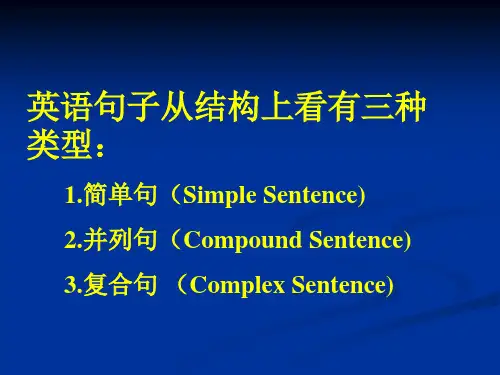
英语中,句子的连接有以下几种形式:1)并列复合句2)状语从句3)定语从句(含同位语从句)4)名词性从句(即主、宾、表语从句)2.并列复合句简单地说,由简单并列连词and, but, or,或复合并列连词both… and…, neither…nor…, either…or…, not only…but also…连接的句子称为并列复合句。
重点:1) and - 不能简单地理解为"和",除了起连接作用外,应根据句子的上下文判别其实际意义,总的表示"递进"。
例如:He is ill and he cannot come to the party this evening.2) But - 表示"转折"所以要确定,应根据上下文,特别是两个句子中的用词是"同方向的"还是"反方向的",前者一般用 "and", 后者一般用 "but",.例如:There was little rain last year______ the farmers still got a bumper crop.这个句中"little rain"(少雨)和"a bumper crop"(丰收)是相反方向的用词,故应填"but"。
请回忆一下"第一讲"中的有关示例。
3) or - 解释为"或者",表示选择,但在"非真实条件句中"解释为"否则",引出"含蓄虚拟式"4)关于复合并列连词,主要注意两个问题,一是"数",二是句子的"均衡"。
在历年军队职称考试中,并列复合句方面的题出得较少。
3.状语从句所谓状语从句,是指用来说明主句行为(或状态)发生的时间、原因、条件、地点、目的、结果及方式等。
1) 时间状语从句:记住以下连接词的意思和重点:(1)when / while / as (当…时侯)注意:while除了做时间状语的连接词外,还解释为"虽然…","而…"。
例如:He is very diligent, while she is very lazy. (他很勤奋,而她却很懒。
)(2)before (after) 在…之前(后)(3)until / not until(直到)注意:not until放在句首时,往往要求倒装(4)as soon as / once (一…就…)(5)immediately / instantly / directly 原本是副词,这里作连接词,表示"一…就…",例如: I knew I had made a mistake directly (或用immediately / as soon as) I had done it. (刚做完这件事,我就知道我做错了。
)(6)the moment / each time / every time / next time / the first time / the instant / the year原本是名词或副词,这里作连接词用。
(7)hardly (scarcely)…when… / no sooner…than…"一…就…"注意:这是时间状语考试的重点句型,一是不要把两个句型中的when和than的搭配搞错了,二是要用倒装语序。
例如:Hardly had I sat down when the telephone rang. (我刚坐下,电话铃就响了。
) 重点:在时间(和条件)状语中,用一般时代替将来时。
例如:We'll start as soon as the leader ______. ( 领导一来就开始。
)esB.is comingC.will comeD.came根据英语"时态一致性"原则,主句与从句的时态应一致,答案似乎应该是B或C,但是正确答案是A,因为在时间状语中,用一般时代替将来时。
将上句改为过去时,道理也一样: He said (that) we would start as soon as the leader _____.A.cameB.was comingC.would comees答案应为A2) 条件状语从句:分真实条件句和非真实条件句(虚拟语气)重点:在条件(时间)状语中,用一般时代替将来时(可参见时间状语从句例子)虚拟语气(见"第六讲")主要连接词:(1)if / unless (除非 = if not 如果不)例如:Children should not be taken into the room of a very sick person ______ there is some special reason for it.A.exceptB. besidesC. unlessD.whereas解题思路:根据上面说过的连接原则,这里必须是一个"连接词",而A,B都是介词,因此正确答案只能在C,D中选。
"whereas"意为"而",故正确答案为C。
(不应把儿童带到重病人房间,除非有某种特殊原因。
)(2)provided / on condition that (跟句子) (如果…)知道这也是连接词就可以了,一般说,当考题中出现这种词时,应倾向选择。
3) 原因状语从句:主要连接词:because/ since / as要点:不要把连接词 because与介词短语because of ( + 名词或-ing形式) 相混淆;不要把表示原因的since与表示时间的since"自从…"相混淆;不要把表示原因的as与表示时间的as"随着…"相混淆;顺便提一下, because表示直接"因果关系",而since, as 是对事实的说明,主句和从句之间并不一定具有"因果关系"。
例如:As you are already 18 years old, you should know what to do and what not to do. (你已经18岁了,应该知道什么该干什么不该干。
)这个句子用because连接就不太合适。
好在军队职称考试中并不要求作这种分辨。
…for 注意:一般只能放在主句后面,即主句 + for从句,例如:He must have gone to bed, for it is too late. (他肯定已经睡了;现在已经很晚了。
)-- 该句不能用becausenow that / seeing that / considering that (由于…)Seeing that this problem was settled, they proceeded to the next one.(鉴于这个问题已经解决,他们开始进行下一个问题。